

Should I donate appreciated stock instead of cash?
Last reviewed: July 2026
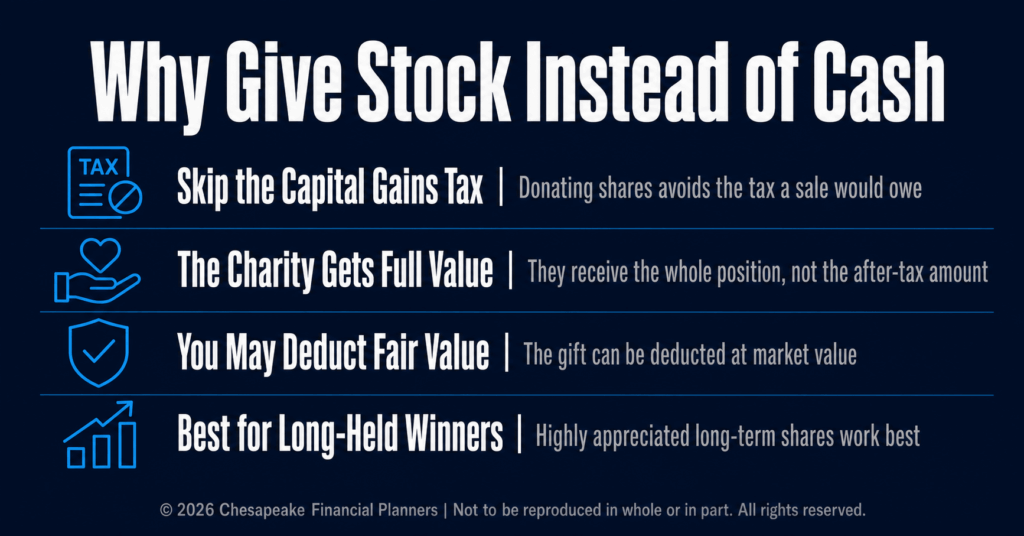
Yes, in most cases. When you donate appreciated stock directly to a qualified charity instead of selling the shares and donating the cash proceeds, you do not owe the capital gains tax that a sale would have triggered, and the charity still receives the full fair market value. The strategy applies only to long-term holdings (over one year) and produces the largest tax benefit when the stock has appreciated significantly above its original cost basis.
Key Takeaways
- Donating appreciated long-term stock means you do not realize the capital gain a sale would have triggered, and the charity still receives full market value.
- The IRS allows a charitable deduction at fair market value up to 30% of AGI when long-term appreciated securities go to a public charity.
- Excess deductions over the AGI ceiling carry forward for five additional tax years, so a single large gift rarely goes unused.
- Short-term holdings (one year or less) limit the deduction to your cost basis, which removes the tax advantage entirely.
About the Author: Jeff Judge, CFP®, AEP®, ChFC®, CLU® is Managing Partner of Chesapeake Financial Planners in Forest Hill, Maryland. He has been helping families and business owners in Harford County and the Baltimore metro area work through charitable giving and tax-aware planning since earning his CFP® certification in 2013, by using Chesapeake Financial Planners’ signature process, the R.U.D.D.E.R. method™. He often reminds clients that the largest tax savings on charitable gifts are usually the ones nobody plans for in advance.
How does donating appreciated stock save you taxes?
Two tax breaks stack into one move. The first is the capital gain you do not have to recognize. When you sell stock that has appreciated, the IRS taxes the gain between your purchase price and the sale price. For shares held more than one year, that is a long-term capital gain, taxed federally at 0%, 15%, or 20% depending on your income, plus an additional 3.8% Net Investment Income Tax for higher earners. Selling appreciated stock to fund a charitable gift therefore gives the IRS a share before the charity sees any of it.
Donating the shares directly removes the sale from the picture. The charity receives the stock, sells it without owing capital gains tax (qualified 501(c)(3) public charities are exempt under IRC §501(a)), and keeps the full proceeds. You then claim a charitable deduction for the fair market value on the date of the gift, not for your original cost basis. Two benefits, one transaction.
The IRS does cap the deduction. For appreciated long-term property donated to a qualified public charity, the deductible amount is limited to 30% of your adjusted gross income (AGI) in the year of the gift. Cash gifts carry a higher 60% AGI ceiling, which sometimes confuses donors who assume cash must therefore be the better path. Most of the time, the capital gains savings on the appreciated stock more than compensate for the lower AGI ceiling.
If you exceed the 30% AGI limit in any given year, the excess deduction does not disappear. It carries forward for up to five additional tax years. A donor making a large gift in a high-income year can keep generating deductions through a lower-earning stretch of retirement.
Jeff Judge often makes the same observation with clients: "The donors who get the most out of this strategy are usually not the wealthiest people in the room. They are the ones holding a concentrated stock position they meant to trim two years ago." A charitable gift lets them rebalance the position without writing a check to the IRS.
What kinds of stock qualify for the charitable deduction?
Three rules decide whether donated stock qualifies for the fair-market-value deduction. The shares must be publicly traded or other "qualified appreciated stock." The holding period must exceed one year. And the recipient must be a 501(c)(3) public charity rather than a non-operating private foundation.
Publicly traded shares (common stock, preferred stock, ETFs, mutual funds) are the simplest case. Restricted stock or shares in a privately held company can also qualify, but they generally require a written appraisal and additional reporting on Form 8283 for any donation valued above $5,000. Publicly traded securities are exempt from the appraisal requirement regardless of dollar amount.
The one-year holding requirement matters more than donors usually realize. Stock held one year or less is treated as ordinary income property for charitable deduction purposes. The deduction then caps at your cost basis, not the current fair market value. The capital gains benefit disappears entirely. If you bought shares ten months ago that have doubled, holding them for another two months before donating can cut your effective tax cost roughly in half. Donors looking to avoid capital gains donation mistakes should also verify that the receiving charity is a 501(c)(3) public charity in good standing with the IRS.
The receiving charity type also matters. Gifts to a public charity (most operating nonprofits, donor-advised fund sponsors, community foundations) receive the 30% AGI ceiling. Gifts of non-publicly-traded stock to a non-operating private foundation are deductible only at cost basis and capped at 20% of AGI. Publicly traded stock donated to a private foundation can still qualify at fair market value, but the lower AGI ceiling applies. Donors weighing a family foundation against a How does a donor-advised fund work and who should consider using one? structure should run those numbers carefully before committing.
When does donating stock beat donating cash?
The choice depends on four variables: the size of the unrealized gain, your marginal capital gains rate, whether you will itemize this year, and whether the AGI ceiling will limit the deduction. For donors who itemize and own long-term appreciated shares, the stock gift almost always produces a better result. The comparison narrows when the stock has minimal embedded gains, when the donor sits well below the AGI ceiling, and when the donor is not in the top capital gains bracket.
A side-by-side example with $50,000 in stock that has a $10,000 cost basis (a $40,000 long-term gain):
| Outcome | Donate Stock Directly | Sell, Then Donate Cash |
|---|---|---|
| Charity receives | $50,000 | $50,000 |
| Capital gain triggered | $0 | $40,000 |
| Federal capital gains tax (23.8% top rate) | $0 | $9,520 |
| Out-of-pocket cost to donor | $50,000 | $59,520 (gift plus tax) |
| Charitable deduction | $50,000 | $50,000 |
The donor in the second column pays nearly $10,000 in capital gains tax that the donor in the first column never owes. Both donors receive the same $50,000 deduction. The difference scales with the unrealized gain. On a $200,000 stock position with a $50,000 basis, the tax cost of selling first crosses $35,000 at the top federal long-term rate of 23.8% (20% long-term plus 3.8% Net Investment Income Tax).
The math reverses if the stock has dropped below your cost basis. A loss position is worth more sold than donated, because the sale generates a deductible capital loss that a donation would forfeit. The cleaner sequence is: sell the losing positions to harvest the loss, donate the cash from those sales, and reserve the long-term winners for in-kind charitable transfers. Capital loss harvesting and stock-gift planning operate as a single coordinated strategy when run together.
How do you actually donate appreciated stock?
Four steps cover almost every situation.
First, identify the specific lots. If you bought the same security over multiple years, your brokerage tracks each purchase separately. The lots with the largest embedded gain and longest holding period are usually the right ones to donate. Lots held less than a year do not qualify for the fair-market-value deduction. Lots with smaller embedded gains waste the strategy's tax advantage.
Second, contact the receiving charity. Larger nonprofits, donor-advised fund sponsors, and community foundations all have established processes for accepting in-kind stock donations. They will provide the account information for their brokerage custodian. The transfer happens broker-to-broker, not through a sale on your end.
Third, instruct your broker in writing. The transfer date for IRS purposes is the date the shares arrive in the charity's account, not the date you submit the request. Year-end donations often run into the deadline because in-kind transfers can take three to seven business days, sometimes longer in late December. If you plan to donate for the current tax year, start the transfer by mid-December at the latest, and earlier is safer.
Fourth, document the donation for your return. The receipt from the charity should list the security name, share count, and transfer date, not a dollar amount. The IRS-deductible value is the average of the high and low trading prices on the transfer date, calculated at filing time by you or your CPA. Donations above $500 require Form 8283 with the tax return. Donations of non-publicly-traded stock above $5,000 require a qualified written appraisal completed within 60 days before the gift.
Each of those four steps fits inside a broader planning framework. The R.U.D.D.E.R. Method™ is Chesapeake Financial Planners' six-step planning process: Review and Recognize, Uncover and Understand, Design and Develop, Discuss and Decide, Execute and Empower, and Reassess and Refine. Charitable strategy decisions live in the Design and Develop step, where the lot selection, the donation vehicle, and the deduction sizing get stress-tested against the rest of the year's tax picture. Jeff has watched many year-end charitable gifts get rushed into cash because the donor started the in-kind transfer process in the third week of December and missed the broker cutoff. Starting in October moves the same dollars into a far better tax outcome.
Most donors think of the fair market value deduction as the biggest savings, but the capital gains avoidance is usually the larger number when the embedded gain is substantial. Both wins land in the same return.
Related Topics Worth Reading
Gifting stock to charity rarely sits in isolation. It interacts with capital gains planning, estate planning, retirement account drawdowns, and the year-by-year tax bracket picture. These related guides walk through the surrounding decisions.
For a direct comparison of the three most flexible charitable vehicles, see Donor-advised fund, private foundation, or QCD: which giving strategy fits me?. It walks through how the AGI ceilings, deductibility timing, and operational rules differ across donor-advised funds, private foundations, and qualified charitable distributions.
Donors over age 70½ holding appreciated assets inside an IRA face a different set of choices. How can a qualified charitable distribution lower my RMD and taxes? covers how to give directly from a traditional IRA, satisfying part of the required minimum distribution while keeping the withdrawal off taxable income.
When the appreciated stock dominates the portfolio, the charitable gift is usually one piece of a broader rebalance. How do I diversify a concentrated company stock position without a huge tax bill? walks through the structured approaches to trimming a single-stock concentration over time.
The estate-planning alternative also deserves a look. What is step-up in basis, and how are inherited assets taxed? examines when the right decision is to hold the appreciated stock for heirs to receive at the stepped-up basis. Older donors with large estates should run this comparison before locking in lifetime gifts.
Frequently Asked Questions
Can you donate stock to a donor-advised fund and get the same tax benefit?
Yes, donating appreciated stock to a donor-advised fund (DAF) receives the same fair-market-value deduction and capital gains treatment as donating directly to an operating charity. The 30% AGI ceiling and the one-year holding rule apply identically. DAFs add flexibility because the donor takes the full deduction in the year of the contribution and then recommends grants to operating charities over many years on a custom timeline.
Is donated stock taxed when the charity sells it?
No, qualified 501(c)(3) public charities do not pay capital gains tax when they sell donated securities. That is why the strategy works at all: the embedded gain that would have cost you up to 23.8% federally instead funds the charity in full. The receiving charity typically liquidates the shares within a few days of receipt to convert them to cash for current operations.
What if I want to keep the stock and still get the deduction?
Donate the appreciated shares, then immediately repurchase them with cash. The repurchase resets your cost basis at the current market price, locks in the deduction at fair market value, and keeps your portfolio position intact. Wash sale rules apply to harvested losses, not to charitable donations of gains, so the repurchase can occur the same day. Consult your tax advisor on the timing.
Can I donate appreciated stock to a private foundation?
You can, but the rules are less generous. Gifts of non-publicly-traded appreciated securities to a non-operating private foundation are deductible only at cost basis, not fair market value. The AGI ceiling also drops from 30% to 20%. Publicly traded stock gifted to a private foundation can still qualify at fair market value, but the lower AGI ceiling continues to apply.
Do I need an appraisal to donate stock?
Publicly traded securities do not require an appraisal regardless of the donation amount. Non-publicly-traded stock (private company shares, restricted stock) donated above $5,000 requires a qualified written appraisal completed within 60 days before the donation date. Form 8283 must be filed with the tax return for any non-cash donation above $500, and the appraiser must sign the form for gifts above $5,000.
What's the deadline for a year-end stock donation?
The donation must complete by December 31, meaning the shares must arrive in the charity's brokerage account by year-end, not merely be requested. In-kind transfers between brokerages can take three to seven business days, longer in the final weeks of December as broker volume spikes. Most charities ask donors to initiate transfers by mid-December at the latest, and earlier is safer.
If you plan to donate appreciated stock as part of a multi-year giving habit, the savings compound across tax years. Our planning resources at chesapeakefp.com walk through how stock gifts, donor-advised funds, and qualified charitable distributions compare side by side. Stop by before tax year-end if you are working out which combination fits your situation this year.
Want to go deeper? Our 10 Signs You're Ready for a Certified Financial Planner walks through this step by step.
Disclosures
The information provided is for educational purposes only and should not be construed as investment advice. Investment strategies should be tailored to individual circumstances, risk tolerance, and goals. Past performance doesn't guarantee future results. Consult with qualified financial professionals regarding your specific situation.
This information is not intended to be a substitute for specific individualized tax, investment or legal advice. We suggest that you discuss your specific situation with a qualified tax, legal or financial advisor.
Advisors associated with Chesapeake Financial Planners may be either (1) LPL Financial Registered Representatives offering securities through LPL Financial, Member FINRA and SIPC, and investment advisor representatives offering investment advice through Great Valley Advisor Group; or (2) solely investment advisor representatives offering investment advice through Great Valley Advisor Group and not affiliated with LPL Financial. Great Valley Advisor Group, and Chesapeake Financial Planners are separate entities from LPL Financial.


