

Do I Need an Advance Directive and a Healthcare Proxy?
Last reviewed: July 2026
Yes, you need an advance directive and a healthcare proxy. An advance directive is a legal document that records your medical treatment wishes if you can't speak for yourself, and a healthcare proxy names a specific person to make medical decisions on your behalf. Without these documents, your family may face court delays and difficult guesswork during a medical crisis. Every adult over 18 should have both in place, no matter your age or health.
Key Takeaways
- An advance directive records your medical wishes; a healthcare proxy names who decides for you when you cannot.
- Roughly 45% of U.S. adults have completed an advance directive, leaving the majority unprotected, per a JAMA study.
- These documents cost little or nothing and can be created without an attorney in most states.
- Without them, families may need court-appointed guardianship, which can take weeks and thousands of dollars.
About the Author: Jeff Judge, CFP®, AEP®, ChFC®, CLU® is Managing Partner of Chesapeake Financial Planners in Forest Hill, Maryland. He has been helping families and business owners in Harford County and the Baltimore metro area navigate estate planning since earning his CFP® certification in 2013, by using Chesapeake Financial Planners’ signature process, the R.U.D.D.E.R. method™. Jeff has watched healthy 40-year-olds skip these documents, then scramble when a parent's stroke leaves nobody legally able to direct care.
Most people think advance directives are only for the elderly or the seriously ill. That assumption costs families dearly. A car accident or sudden stroke can leave anyone unable to communicate, and the time to plan is long before that moment arrives.
What Is an Advance Directive?
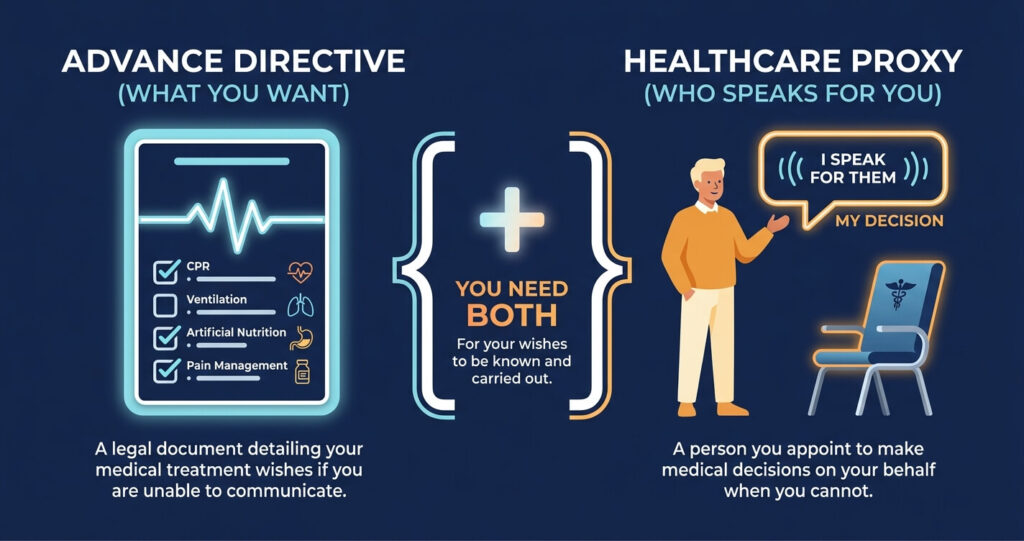
An advance directive is a written legal document that spells out your medical treatment preferences if you become unable to communicate them yourself. It typically covers decisions like whether you want life-sustaining treatment, mechanical ventilation, artificial nutrition, or resuscitation in specific circumstances.
The term "advance directive" is often used as an umbrella that includes two main components: a living will and a healthcare proxy. A living will states your treatment wishes in writing. A medical directive of this kind guides doctors and family when you cannot speak. The National Institute on Aging describes advance directives as the foundation of advance care planning.
Jeff Judge often tells clients that an advance directive isn't about anticipating death. It's about removing the burden of impossible decisions from the people you love. When your wishes are written down, your family isn't forced to guess what you would have wanted during the worst week of their lives.
What Is a Healthcare Proxy?
A healthcare proxy, also called a healthcare power of attorney, is a legal document that names a specific person to make medical decisions for you when you can't. That person, sometimes called your agent or surrogate, has the legal authority to talk with your doctors and direct your care according to your stated wishes.
A living will tells doctors what you want. A healthcare proxy tells them who decides when a situation isn't spelled out in your documents. Medicine is full of gray areas no document can fully anticipate, so naming a trusted decision-maker matters as much as recording your wishes. The American Bar Association recommends choosing someone who can stay calm under pressure and will honor your values, not their own.
Pick your proxy carefully. The right person is someone who knows your wishes, can advocate firmly with medical staff, and won't freeze when a doctor asks a hard question.
Advance Directive vs. Healthcare Proxy: What's the Difference?
These two documents work together but do different jobs. Here's how they compare side by side.
| Feature | Advance Directive (Living Will) | Healthcare Proxy |
|---|---|---|
| What it does | Records your specific treatment wishes in writing | Names a person to make decisions for you |
| When it applies | When you can't communicate and the situation is covered | When you can't communicate, including gray areas |
| Who acts on it | Doctors follow the written instructions | Your named agent directs your care |
| Best for | Stating clear preferences on life support, resuscitation | Handling decisions your document doesn't cover |
Most estate planning attorneys recommend having both. One without the other leaves a gap. A living will with no proxy can't handle situations it didn't anticipate, and a proxy with no living will leaves your agent guessing at your true wishes.
What Is a Financial Power of Attorney and Why Do I Need One?
Why Does Everyone Need These Documents?
Without an advance directive and healthcare proxy, your family may have to petition a court to be appointed your legal guardian before they can make medical decisions. That process can take weeks and cost thousands in legal fees, all while you're in a hospital bed.
Despite the stakes, completion rates remain low. A JAMA study found that only about 37% of U.S. adults have completed any advance directive, and just 33% have a living will. Younger adults are far less likely to have one, even though accidents don't check your age first.
What is a will and do I need one for my estate?
The R.U.D.D.E.R. Method™ is Chesapeake Financial Planners' six-step planning process: Review and Recognize, Uncover and Understand, Design and Develop, Discuss and Decide, Execute and Empower, and Reassess and Refine. Advance directives and healthcare proxies live squarely in the Design and Develop stage, where we make sure the documents that protect you actually exist before you need them. Jeff Judge notes: "An advance directive and healthcare proxy cost almost nothing to put in place and take a few hours to complete, but without them your family could spend weeks and thousands of dollars in court just to be allowed to speak on your behalf in a medical crisis."
Do I need to update my beneficiary designations after a divorce or major life change?
How Do You Create These Documents?
You don't always need an attorney to create a valid advance directive and healthcare proxy. Many states provide free statutory forms, and organizations like the National Hospice and Palliative Care Organization offer state-specific documents at no cost.
That said, the requirements vary by state. Some states require witnesses, others require notarization, and a few require both. Once completed, give copies to your healthcare proxy, your primary doctor, and a trusted family member. A document sitting in a drawer nobody knows about does no good in an emergency.
For families with complex situations, a special needs dependent, a blended family, or significant assets, working with an estate planning professional ensures these documents fit alongside your broader plan.
How Do I Leave Money to a Disabled Child Without Losing Benefits?
Frequently Asked Questions
What is the difference between a living will and an advance directive?
An advance directive is the broad legal category that includes a living will and a healthcare proxy. A living will is one type of advance directive that records your specific medical treatment wishes in writing. The advance directive umbrella also covers naming a healthcare agent, so a living will is a part, not the whole.
At what age should I get an advance directive?
You should create an advance directive as soon as you turn 18. Once you're a legal adult, your parents lose automatic authority to make medical decisions for you. Accidents and sudden illness don't wait for old age, so having these documents in place protects you at any stage of life, not just in retirement.
Do I need a lawyer to create an advance directive?
No, you don't need a lawyer to create a valid advance directive in most states. Many states offer free statutory forms, and nonprofits provide state-specific documents at no cost. A lawyer becomes helpful when your situation is complex, such as a blended family, special needs dependents, or substantial assets that need coordinated planning.
Can I change my advance directive after I create it?
Yes, you can change or revoke your advance directive at any time as long as you're mentally competent. Many people update these documents after major life events like a divorce, a new diagnosis, or a change in their chosen healthcare proxy. Review your documents every few years and replace outdated copies with everyone who holds them.
What happens if I don't have an advance directive or healthcare proxy?
Without these documents, your family may have to ask a court to appoint a legal guardian before anyone can make medical decisions for you. This process can take weeks and cost thousands in legal fees during an already stressful time. State default rules may also hand decisions to a relative who doesn't know your wishes.
Does my healthcare proxy need to live nearby?
No, your healthcare proxy doesn't have to live nearby, though it helps in an emergency. With phone and video access, an out-of-state agent can still direct your care. What matters more is choosing someone who knows your wishes, can advocate firmly with doctors, and stays calm under pressure when hard decisions arise.
If you found this helpful, our estate planning checklist walks through advance directives, healthcare proxies, wills, and beneficiary designations in one place. Download it at chesapeakefp.com to make sure nothing in your plan falls through the cracks.
Disclosures
The information provided is for educational purposes only and should not be construed as investment advice. Investment strategies should be tailored to individual circumstances, risk tolerance, and goals. Past performance doesn't guarantee future results. Consult with qualified financial professionals regarding your specific situation.
Advisors associated with Chesapeake Financial Planners may be either (1) LPL Financial Registered Representatives offering securities through LPL Financial, Member FINRA and SIPC, and investment advisor representatives offering investment advice through Great Valley Advisor Group; or (2) solely investment advisor representatives offering investment advice through Great Valley Advisor Group and not affiliated with LPL Financial. Great Valley Advisor Group, and Chesapeake Financial Planners are separate entities from LPL Financial.


