

Blended Family Estate Planning: How It Really Works
Last reviewed: July 2026
Blended family estate planning is the work of writing one estate plan that protects three groups whose interests rarely line up: your new spouse, your biological children from a prior marriage, and any stepchildren you've raised as your own. The default tools (a basic will, joint accounts, "I love you" beneficiary designations) usually fail blended families because they assume one family unit, not two stitched together. Done well, a blended family estate plan uses a combination of trusts, lifetime gifts, and account-by-account beneficiary alignment to direct the right asset to the right person at the right time, without leaving anyone to fight it out in probate.
On This Page
- Key Takeaways
- Why Does a Standard Will Usually Fail Blended Families?
- What Is a QTIP Trust and When Does a Second Marriage Need One?
- How Do You Provide for Both a New Spouse and Biological Children?
- How Do Beneficiary Designations Override Your Will?
- What Mistakes Quietly Sabotage Blended Family Estate Planning?
- Related Topics Worth Reading
- Frequently Asked Questions
- Disclosures
Key Takeaways
- Blended family estate planning fails most often when families rely on a basic will and joint accounts, which assume one unified family.
- The 2026 federal estate tax exemption is $15 million per person, so most families plan around inheritance flow, not estate tax.
- A QTIP trust gives a surviving spouse income for life while preserving the principal for your biological children.
- Beneficiary designations on retirement accounts override your will, no matter what your will says.
- Stepchildren inherit nothing by default unless you legally adopt them or name them in writing.
About the Author: Jeff Judge, CFP®, AEP®, ChFC®, CLU® is Managing Partner of Chesapeake Financial Planners in Forest Hill, Maryland. He has been helping families and business owners in Harford County and the Baltimore metro area navigate blended family estate planning since earning his CFP® certification in 2013, by using Chesapeake Financial Planners’ signature process, the R.U.D.D.E.R. method™. Jeff often tells clients that the hardest part of a second marriage isn't the legal documents; it's the conversation with adult children about what those documents say and why.
Why Does a Standard Will Usually Fail Blended Families?
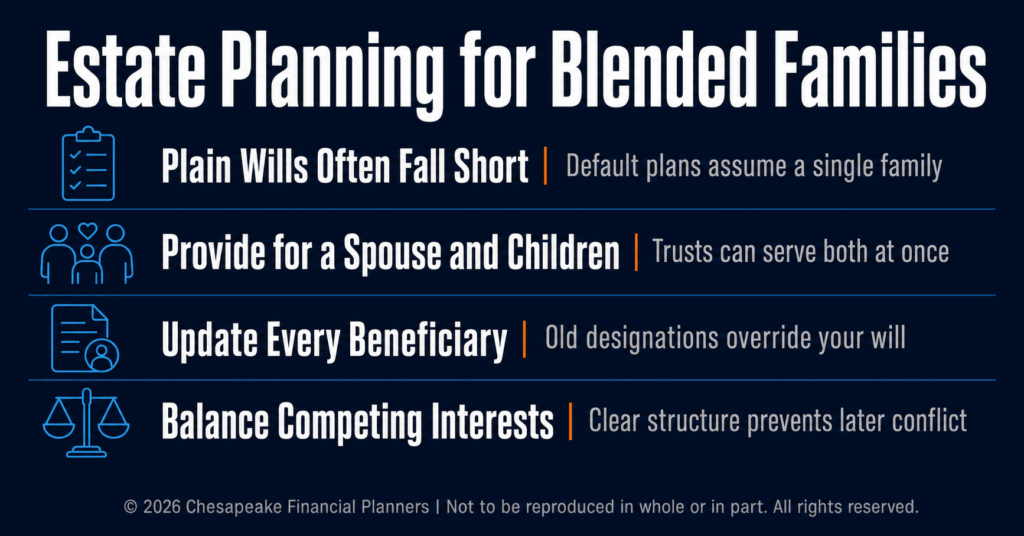
A standard will assumes the family it's written for is shaped like a triangle: two parents, shared children, single inheritance flow. Most blended families don't look like that. Yours might be one spouse with biological kids from a prior marriage, a current spouse, possibly shared children, and stepchildren on one or both sides. A will that says "everything to my spouse, then to our children" pushes money in a direction the will-writer did not actually intend.
Here's the failure mode Jeff sees most often. The first spouse to die leaves everything outright to the surviving spouse. That spouse later writes a new will. Sometimes that new will favors the surviving spouse's own biological children. The deceased spouse's children from a prior marriage get nothing, even though that wasn't the deceased spouse's intent. There is no legal mechanism in a basic will that prevents the surviving spouse from changing the inheritance flow later.
Joint tenancy with right of survivorship has the same problem. A house titled jointly with a new spouse passes 100% to that spouse on the first death, regardless of what either will says. Biological children from a prior marriage have no claim. That holds whether the house was the first spouse's separate property from before the marriage or not.
The fix is structural, not cosmetic. Most blended family plans need either a revocable trust with a marital subtrust, a QTIP trust, or some combination of a lifetime irrevocable trust and beneficiary designations that explicitly route assets to biological children. The right mix depends on the size of the estate, whether the second marriage came after substantial wealth was built, and whether stepchildren are involved.
What Is a QTIP Trust and When Does a Second Marriage Need One?
A QTIP trust (qualified terminable interest property trust) is a marital trust that gives your surviving spouse income for life while preserving the principal for the people you choose, usually your biological children. The IRS defines QTIP property under Section 2056(b)(7)(B) and treats the assets as qualifying for the unlimited marital deduction at the first death. Estate tax on the trust assets is deferred until the surviving spouse dies.
A QTIP solves the structural problem a basic will can't. Your surviving spouse cannot redirect the principal to their own biological children, no matter what their own will says. The principal flows to the remainder beneficiaries you named when you set up the trust. The surviving spouse receives all the income (and sometimes access to principal for health, education, maintenance, and support) but does not control where the trust assets end up.
QTIP trusts are usually the right tool when you have biological children from a prior marriage, you want your current spouse to be able to live comfortably from the trust income, and you don't want your current spouse's later choices to redirect your assets. They aren't always the right tool. If the second marriage is later in life with no significant assets to protect, simpler structures often work. QTIP trusts also carry administrative cost: a trustee, ongoing tax filings, and a separate set of investment decisions. For estates under the 2026 exemption of $15 million per person, the QTIP value is almost entirely about inheritance flow, not federal estate tax savings.
Here's how QTIP stacks up against the two most common alternatives blended families consider:
| Feature | QTIP Trust | Outright Bequest to Spouse | Revocable Trust with Marital Subtrust |
|---|---|---|---|
| Spouse gets income for life | Yes | N/A (gets full ownership) | Yes |
| Spouse can redirect principal | No | Yes | Depends on trust terms |
| Children from prior marriage protected | Yes | No protection | Depends on trust terms |
| Marital deduction available | Yes | Yes | Yes if structured properly |
| Probate avoided | Yes | No | Yes |
How Do You Provide for Both a New Spouse and Biological Children?
You start with a question most couples skip: who do you actually want to be financially protected, and for how long? In blended families, the answer is almost always layered. You want your spouse to keep the lifestyle you built together for the rest of their life. You want your biological children to eventually receive a meaningful inheritance, not because you don't love your stepchildren, but because that's what their other parent would have wanted, or because you've already supported the stepchildren during their childhood.
Most of Jeff's blended family second-marriage clients land on some version of the same structure. A QTIP or marital trust holds the assets that pass at the first death, with the surviving spouse as income beneficiary and biological children as remainder beneficiaries. A separate share, sometimes called a "family bypass" or "credit shelter" share, goes directly to biological children at the first death using the deceased spouse's estate tax exemption, which is generous given the 2026 exemption of $15 million per person under the One Big Beautiful Bill amendment. Retirement accounts get beneficiary designations matching the plan, often with the spouse named primary and biological children as contingent. Jeff Judge notes: "In a blended family, the QTIP structure is usually the only way to genuinely protect a surviving spouse's income for life while ensuring the first spouse's biological children eventually receive what was intended for them, and retirement account beneficiary designations have to be coordinated with the trust or the whole plan unravels."
Lifetime giving starts to matter here too. You can give each child or grandchild up to $19,000 per year in 2026 without using any estate tax exemption. For some blended families, the cleanest approach is to give meaningful gifts to biological children during your lifetime while leaving the bulk of the at-death plan to your spouse. The inheritance arrives before any post-death disputes can start.
For stepchildren you've raised as your own, the plan has to be explicit. There is no automatic legal inheritance right for a stepchild who hasn't been legally adopted. Most state intestate succession laws give a stepchild nothing if you die without a will. Even with a will, you have to name stepchildren by name. "My children" in most state statutes does not include them.
The R.U.D.D.E.R. Method™ is Chesapeake Financial Planners' six-step planning process: Review and Recognize, Uncover and Understand, Design and Develop, Discuss and Decide, Execute and Empower, and Reassess and Refine. In blended family work, the Discuss and Decide step is often the longest. Couples need to align on the inheritance question before any document gets drafted, because the document is the easy part.
How Do Beneficiary Designations Override Your Will?
Retirement accounts, life insurance policies, and most brokerage accounts with transfer-on-death designations bypass your will entirely. The named beneficiary on the form gets the money. Your will has no authority over those assets. This is the single most common way blended family second marriage estate plans go off the rails.
The classic mistake: someone gets divorced, remarries, updates their will to favor the new spouse and biological children, and never updates the 401(k) beneficiary form. Twenty years later, the ex-spouse named on that beneficiary form inherits a six- or seven-figure account. The new spouse has no legal claim. Courts will almost always enforce the beneficiary designation as written, even when the result was clearly not intended.
Federal law adds an extra layer for 401(k) plans and other ERISA-governed accounts. A current spouse is the legally required beneficiary unless they sign a written waiver. If your second spouse hasn't signed a waiver, they're the beneficiary by default, even if your form says otherwise. For IRAs, no automatic spousal protection applies, and the named beneficiary controls. The rules cut differently depending on account type.
For blended families, the beneficiary-form audit takes about an hour and saves more inheritance problems than almost any other single step. Pull every retirement account, every life insurance policy, every brokerage transfer-on-death form. Confirm who is named as primary and contingent. Make sure the names match your current plan, not the plan you had during a prior marriage.

What Mistakes Quietly Sabotage Blended Family Estate Planning?
Five mistakes account for almost every blended family inheritance dispute Jeff has seen. None of them require bad intent. They show up in plans that were built before a remarriage and never updated.
Joint titling between new spouses. A house, a brokerage account, or a bank account titled "JTWROS" passes outright to the surviving spouse at the first death. Biological children have no claim, regardless of what the will says or what the deceased spouse intended. If the goal was to leave the house to biological children at the second death, joint titling defeats it.
Outright bequest with a verbal promise. "She knows what I want her to do." That sentence has caused more litigation than people imagine. A verbal promise to redirect assets to stepchildren or biological children is not enforceable in most states. The surviving spouse can change their will the day after the first death, with no legal obligation to follow through on the prior conversation.
Step-up in basis confusion. When highly appreciated assets pass at death, the new owner gets a stepped-up cost basis under IRC Section 1014. This generally lowers capital gains tax for the heir. In a blended family, that step-up sometimes gets allocated in ways that punish biological children if assets are kept in a marital trust for a long time. Asset allocation between trust types matters more in blended families than in first-marriage families.
Beneficiary form drift. The 401(k) form from a prior job, the term life policy from before the divorce, the IRA opened during the first marriage. Each is a separate document with its own beneficiary, and each will be enforced exactly as written.
Skipping the kids' conversation. The most expensive mistake is the one nobody bills for. Adult children from a prior marriage who don't understand the plan will read suspicion into it. They'll wonder whether the new spouse pressured the document. They'll lawyer up if they're surprised at the reading of the will. A plan explained to adult children in advance, in writing, with the financial advisor present, has dramatically fewer post-death disputes than one that arrives as a surprise.
Related Topics Worth Reading
Blended family estate planning sits at the intersection of several other planning areas. The following posts cover specific tools and strategies that often come up in second-marriage planning.
What is estate tax portability, and how do I claim my spouse's unused exemption?. Portability lets a surviving spouse use the deceased spouse's unused estate tax exemption. In blended families with substantial assets, the choice between portability and a credit shelter trust is significant.
What is a SLAT, and how does spousal gifting work?. Spousal lifetime access trusts can shift wealth out of your estate while keeping access during your spouse's lifetime. The blended family version usually pairs a SLAT with a separate gift to biological children.
What is step-up in basis, and how are inherited assets taxed?. Understanding how cost basis steps up at death changes which assets belong in a marital trust versus an outright bequest. This is the most overlooked tax piece in blended family planning.
What is an ILIT, and how does it keep life insurance out of my estate?. Irrevocable life insurance trusts can provide liquidity for biological children while leaving other assets to a spouse.
What Are the Basics of Estate Planning for High Net Worth?. If you're new to estate planning, the basics post walks through the core documents (will, trust, power of attorney, healthcare directive) before you layer on blended family complexity.
Frequently Asked Questions
Does a prenuptial agreement protect my biological children's inheritance?
A prenuptial agreement protects biological children's inheritance only when paired with consistent estate planning documents, beneficiary designations, and titling decisions. A prenup typically waives spousal rights to specific separate property assets, but it does not direct where those assets go at death. You still need a will, trust, and beneficiary designations matching the prenup's terms; otherwise the prenup and the estate plan work against each other and litigation is likely.
How does a second marriage estate plan handle a home owned before the marriage?
A second marriage estate plan treats a pre-marriage home as separate property in most states, but the way you title and use it after marriage often converts part or all of it to marital property. If you've kept the home in your name only and never commingled funds, you can usually leave it to biological children at death through a will or trust. If your new spouse has been paying part of the mortgage or contributing to improvements, the analysis gets more complicated and a prenup or postnup helps clarify it.
What happens to stepchildren inheritance if I die without a will?
Stepchildren inheritance is zero under almost every state intestacy statute unless you legally adopted them. The default rules give your estate to your surviving spouse and biological children. Stepchildren you raised but did not adopt receive nothing, no matter how long they lived with you or how close the relationship. If you want stepchildren to inherit, name them by name in your will or trust, make a lifetime gift, or beneficiary-designate them on a specific account.
Should both spouses use the same QTIP trust?
Both spouses usually have separate QTIP trusts, not a shared one. Each spouse drafts a QTIP that activates at their own death, with their own surviving spouse as income beneficiary and their own biological children as remainder beneficiaries. The trusts are mirror images in structure but separate documents with separate funding. Coordination matters at the planning stage so the two trusts don't pull against each other, but they're never combined into one trust shared by both spouses.
How often should a blended family update its estate plan?
A blended family should formally review its estate plan every three years, plus immediately after any major life event. Events that trigger an update include a new child or grandchild, a death in the immediate family, a significant change in assets (sale of a business, inheritance received, large investment gain or loss), a move to a different state with different probate or community property rules, or a tax law change like the 2026 exemption increase to $15 million. Annual beneficiary-form audits are simpler and should happen every January.
Can my surviving spouse change a QTIP trust after I die?
Your surviving spouse cannot change the remainder beneficiaries of a QTIP trust after you die. That is the defining feature of the QTIP structure. The surviving spouse receives all the trust income during their lifetime (and possibly limited principal access for health, education, maintenance, and support), but the principal flows to the people you named when the trust was created. If the surviving spouse wants their own biological children to receive more, that has to come from their own separate assets, not from the QTIP trust.
Blended family estate planning is one of the few financial areas where the right document, executed at the wrong time, can do more damage than no document at all. If you found this helpful, our Estate Planning Decision Guide walks through the documents and account-level decisions that matter most for second-marriage couples. Download it at chesapeakefp.com.
Want to go deeper? Our Estate Document Locator walks through this step by step.
This material is for educational purposes only and should not be considered tax or legal advice. Please consult with your tax advisor or attorney regarding your specific situation.
All investing involves risk including loss of principal. No strategy assures success or protects against loss.
The opinions voiced in this material are for general information only and are not intended to provide specific advice or recommendations for any individual.
Insurance products contain exclusions, limitations, and terms for keeping them in force. Please contact a qualified insurance professional for costs and complete details.
CFP Board owns the marks CFP®, CERTIFIED FINANCIAL PLANNER®, and CFP® (with plaque design) in the U.S. The ChFC® and CLU® designations are the property of The American College of Financial Services, which reserves sole rights to their use, and are used by permission.
Disclosures
The information provided is for educational purposes only and should not be construed as investment advice. Investment strategies should be tailored to individual circumstances, risk tolerance, and goals. Past performance doesn't guarantee future results. Consult with qualified financial professionals regarding your specific situation.
Advisors associated with Chesapeake Financial Planners may be either (1) LPL Financial Registered Representatives offering securities through LPL Financial, Member FINRA and SIPC, and investment advisor representatives offering investment advice through Great Valley Advisor Group; or (2) solely investment advisor representatives offering investment advice through Great Valley Advisor Group and not affiliated with LPL Financial. Great Valley Advisor Group, and Chesapeake Financial Planners are separate entities from LPL Financial.


