

LLC or s-corp: which saves me more in taxes?
Last reviewed: July 2026
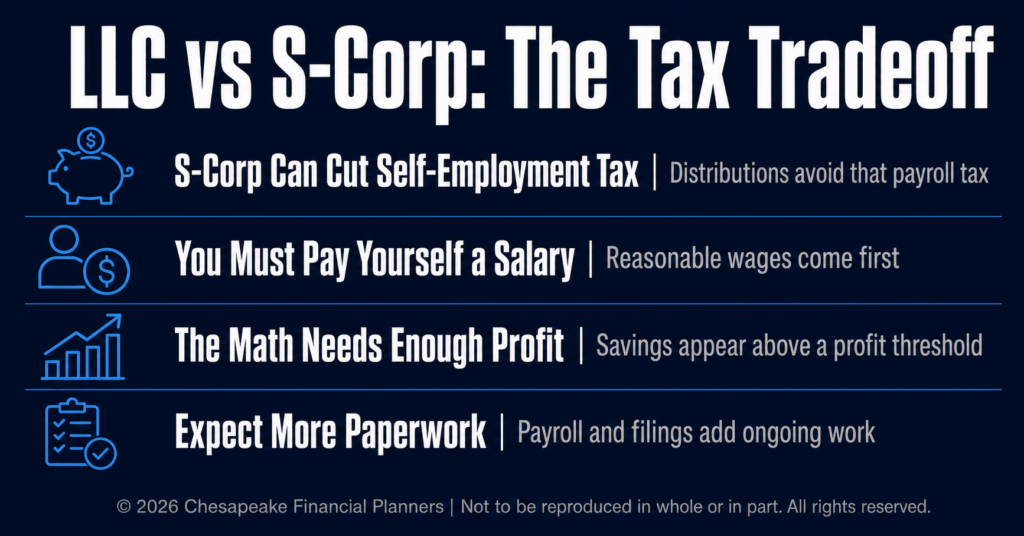
The LLC vs S-Corp decision comes down to one tax: self-employment tax. For most established business owners with profits above roughly $50,000 to $75,000 per year, an S-Corp election saves more than running as a default LLC. The savings come from one place. An S-Corp lets the owner split income between W-2 wages (subject to payroll tax) and distributions (not subject to self-employment tax). A single-member LLC, by default, pays the full 15.3% self-employment tax on every dollar of profit. Below the threshold, the extra payroll and accounting costs of an S-Corp usually erase the savings.
On This Page
- Key Takeaways
- What is the LLC vs S-Corp difference for taxes?
- When does an S-Corp election actually save money?
- What does an S-Corp cost that an LLC doesn't?
- How do the QBI deduction and other tax breaks compare?
- Related Topics Worth Reading
- Frequently Asked Questions
- Disclosures
Key Takeaways
- An S-Corp election lets owners pay self-employment tax only on W-2 wages, not on distributions, which is the main savings over a default LLC.
- The 2026 self-employment tax rate is 15.3% on net SE income up to the Social Security wage base of $184,500, then 2.9% Medicare above that.
- Both LLCs and S-Corps can claim the 20% Qualified Business Income deduction in 2026, subject to income phase-ins starting at $201,750 single or $403,500 MFJ.
- An S-Corp election starts to pay off once annual profits clear roughly $50,000 to $75,000, after accounting for payroll and tax-prep costs.
About the Author: Jeff Judge, CFP®, AEP®, ChFC®, CLU® is Managing Partner of Chesapeake Financial Planners in Forest Hill, Maryland. He has been helping families and business owners in Harford County and the Baltimore metro area work through entity selection and small-business tax strategy since earning his CFP® certification in 2013, by using Chesapeake Financial Planners’ signature process, the R.U.D.D.E.R. method™. Jeff often reminds owners that the LLC vs S-Corp decision is mostly about one number: how much profit the business can reliably produce each year above what the owner reasonably needs to take in payroll.
What is the LLC vs S-Corp difference for taxes?
An LLC and an S-Corp aren't the same kind of thing. An LLC is a state-law entity, registered with the state corporations office (in Maryland, the State Department of Assessments and Taxation). An S-Corp is a federal tax election, made by filing IRS Form 2553. So an LLC can elect to be taxed as an S-Corp without changing its legal form at all. You stay an LLC on paper. You just file your federal tax return as if you were an S-Corp.
That distinction matters because the LLC vs S-Corp question is really a question about pass-through taxation, not about legal structure. Most business owners aren't choosing between forming an LLC or forming a corporation. They're choosing whether the LLC they already have should file Form 2553 to be taxed as an S-Corp.
The default LLC tax treatment is straightforward. A single-member LLC is a disregarded entity for federal income tax. Its profits flow through to the owner's personal Schedule C. The owner pays the full 15.3% self-employment tax on every dollar of net profit, up to the Social Security wage base of $184,500 for 2026, plus 2.9% Medicare on income above that. A multi-member LLC defaults to partnership taxation on Form 1065, but the SE tax math runs the same way on each partner's share.
The S-Corp election rewrites the income flow. Instead of Schedule C, the business files Form 1120-S. The owner now gets two checks. One is a W-2 paycheck, subject to payroll tax. The other is a distribution from S-Corp profits, with no self-employment tax. That distribution income avoids the 15.3% SE tax entirely. For a profitable business, the savings can be substantial. They aren't free. Business entity selection at this layer is a math question wrapped in a structural one, and most owners get the answer wrong by skipping the math.
When does an S-Corp election actually save money?
S-Corp tax savings can add up, but they aren't unlimited and they aren't free. Two conditions need to hold for the election to be worth making.
First, the business has to be profitable enough that splitting income into wages and distributions clears the cost of running payroll. A common rule of thumb: S-Corp election starts to pay off above roughly $50,000 to $75,000 in annual profit. Below that, the costs of running payroll (about $500 to $1,200 a year for a payroll service), preparing a corporate return ($800 to $1,500 from most CPAs), and bumping up your bookkeeping work usually eat the savings.
Second, the owner has to take what the IRS calls "reasonable compensation" as W-2 wages. You can't pay yourself $20,000 in salary and call the remaining $200,000 of profit a distribution. The IRS reasonable compensation guidance has been cited in audits over and over. Getting it wrong means the IRS can reclassify distributions as wages, with penalties and interest layered on top.
A simple illustration. An LLC with $150,000 of net profit pays roughly $150,000 × 92.35% × 15.3%, or about $21,200, in self-employment tax. That same business, taxed as an S-Corp, might pay the owner $80,000 in W-2 wages (a defensible reasonable comp number in many service fields) and distribute the remaining $70,000. The payroll tax on the $80,000 wage works out to about $12,240. The $70,000 distribution carries no SE tax. Gross savings: about $8,960. Subtract maybe $2,000 in extra payroll and tax-prep costs, and the owner nets around $7,000 in S corporation tax savings for the year.
Jeff Judge has watched business owners in Harford County run the numbers backwards on this. They look at the gross tax savings and forget the new costs: payroll service fees, the corporate return, bookkeeping cleanup, and the time spent on quarterly payroll deposits. By the time everything is netted, an owner with $40,000 of profit usually loses money on the election. As Jeff often puts it: "The S-Corp election is a math problem first and a structure problem second. You don't make the election because the entity is better. You make it because the numbers, after all the new costs, leave the owner ahead." For owners pushing into the $200,000-plus profit range, those numbers usually do leave the owner ahead, often by enough to fund another retirement account contribution. What is a cash balance plan, and how can high-income owners save more?
What does an S-Corp cost that an LLC doesn't?
Tax savings only work if the extra costs of S-Corp status are smaller than the SE tax avoided. Here's what an S-Corp adds that a default LLC doesn't have to think about.
Payroll. As soon as you elect S-Corp status, the owner has to be on payroll. That means a payroll service (Gusto, ADP, Paychex, or similar), quarterly Form 941 filings, year-end W-2s, and unemployment tax payments. A bare-bones payroll setup runs about $500 to $1,200 per year. A more full-featured service with HR add-ons can run $2,000 or more.
A corporate tax return. Form 1120-S is more complex than a Schedule C. Most CPAs charge between $800 and $1,500 for an S-Corp return, depending on the volume of distributions, ownership changes, and basis tracking. If the owner had been doing their own taxes on a default LLC, that's a brand-new expense to plan for.
Reasonable compensation analysis. The IRS expects owners to document why their W-2 salary number is reasonable for the work performed. Some CPAs do this informally as part of the tax return. Others charge separately for a compensation study, especially in higher-income or higher-audit-risk fields like medicine, law, and consulting. Cost: anywhere from $0 (informal review) to $1,500 (formal study).
State filings. Many states require S-Corps to file separate state returns and pay annual report fees, and in some cases a franchise tax. Some state-level S-Corp taxes can erase the federal SE tax savings on their own, especially for small-margin businesses. Maryland's tax treatment of S-Corps is more favorable than some other states, but the picture changes by state line.
Time. Quarterly payroll, year-end W-2 prep, and the additional bookkeeping for distributions versus wages takes meaningful time. Owners who don't account for the time-cost often discover that the S-Corp savings came out of their own hours, not out of new dollars.
The pattern Jeff sees most often: an owner making $90,000 in profit elects S-Corp status, saves $3,500 in SE tax, but spends $2,500 on new costs plus 30 to 40 hours of additional admin time. Net win, but small. The same owner at $200,000 of profit saves $9,000 in SE tax against the same $2,500 in costs. That's where the math gets interesting.
This is part of how the firm uses the R.U.D.D.E.R. Method™ to evaluate entity decisions. The R.U.D.D.E.R. Method™ is Chesapeake Financial Planners' six-step planning process: Review and Recognize, Uncover and Understand, Design and Develop, Discuss and Decide, Execute and Empower, and Reassess and Refine. The Review and Recognize step starts with the question that matters most for an S-Corp election: what is the actual net savings after every new cost is counted? Jeff Judge notes: "When we run the actual numbers for a business owner making $90,000 in profit, payroll service fees, a corporate return, and the reasonable compensation analysis often consume more than half the projected SE tax savings before we even get to state-level costs."
How do the QBI deduction and other tax breaks compare?
The Qualified Business Income deduction is the same 20% rate for both LLCs and S-Corps in 2026. Both entities are pass-through businesses. Both owners can potentially claim the deduction on their personal returns. The mechanics differ.
For a default LLC, QBI is calculated on the entire net business profit (Schedule C income), minus the deductible portion of self-employment tax. For an S-Corp, QBI is calculated on the distribution income only, not on the W-2 wages the owner paid themselves. Those W-2 wages count as compensation paid by the business for purposes of the QBI wage limitation that kicks in above certain income levels.
The 2026 QBI phase-in income thresholds, per IRS Revenue Procedure 2025-32: single filers begin to phase in at $201,750 of taxable income, fully phased in at $276,750. Married filing jointly begins at $403,500, fully phased in at $553,500. Above the full phase-in, the deduction starts to be limited by W-2 wages paid and the unadjusted basis of qualified property. Certain "specified service trades" (doctors, lawyers, consultants, financial advisors, and a handful of others) can lose the deduction entirely if income gets too high.
There's also a new feature in 2026. The recently enacted federal tax legislation added a $400 minimum QBI deduction for taxpayers with at least $1,000 of aggregate QBI from active qualified trades or businesses. That's a small floor, but it matters for owners just starting out who would otherwise see no benefit at all.
Here's the side-by-side worth keeping in mind:
| Tax feature | Default LLC (single-member) | S-Corp election (LLC or corp) |
|---|---|---|
| Federal tax form | Schedule C | Form 1120-S |
| Self-employment tax | 15.3% on net SE income up to $184,500 wage base; 2.9% Medicare above | Payroll tax (about 15.3% combined employer/employee) on W-2 wages only |
| Distributions taxed at SE | Yes (all profit is SE income) | No (distributions exempt from SE tax) |
| QBI deduction base | 20% of net business profit | 20% of distribution income (W-2 wages excluded from QBI) |
| Required payroll | No | Yes, owner must be on W-2 |
| Required corporate tax return | No (Schedule C on personal return) | Yes (Form 1120-S) |
| State filings | Annual LLC report only | LLC report plus state S-Corp filings where applicable |
| Reasonable compensation rule | Doesn't apply | Required for owner W-2 |
Where things get tricky is when an owner is near the QBI phase-in threshold. Paying yourself more in W-2 wages reduces your QBI base (less distribution income), but those same W-2 wages can support a larger deduction in the phase-in range. The math runs in both directions, and the right answer depends on the specific income mix.
A second wrinkle worth understanding: solo retirement plans. Under a default LLC, you can contribute to a Solo 401(k) based on net SE earnings, with a 2026 total combined limit of $72,000 and an employee deferral limit of $24,500. Under an S-Corp, the employer profit-sharing portion is calculated on W-2 wages, which means a lower reasonable-comp number caps your maximum employer contribution. This is one place where over-optimizing for SE tax savings can quietly reduce retirement contributions. What is a mega backdoor Roth, and how do I use one?
Related Topics Worth Reading
Once you've sorted out entity selection, the related decisions matter more for business-owner tax planning than most owners realize.
What is the QBI deduction, and how do business owners use it?. The 20% QBI deduction is the largest single tax break for pass-through business owners. Understanding the phase-in thresholds and the W-2 wage limitation can change which entity structure produces the lowest tax bill.
Hiring Your Children Tax Strategy: Can I Legitimately Hire My Kids?. Putting your children on payroll shifts income to a lower bracket and can fund Roth IRAs in their name. The strategy works in both LLC and S-Corp structures, with slightly different payroll mechanics.
What does a buy-sell agreement need to cover for a co-owned business?. Multi-owner LLCs and S-Corps need a written agreement covering what happens at death, disability, or owner exit. The tax treatment is different in each entity type.
How should I invest the proceeds after selling my business?. When the time comes to sell, entity structure shapes whether the sale is treated as a stock sale, asset sale, or some mix. An S-Corp built without an exit in mind can leave money on the table.
What is the 83(b) election, and why does the deadline matter?. For founders issuing restricted equity to themselves or early team members, the 83(b) election has a 30-day window that, once missed, can't be recovered. Worth knowing whichever entity you choose.
Frequently Asked Questions
Can a single-member LLC be taxed as an S-Corp?
Yes, a single-member LLC can elect to be taxed as an S-Corp by filing IRS Form 2553 within 75 days of the start of the tax year, or within 75 days of forming the LLC. The LLC stays an LLC for state-law purposes. Only the federal tax treatment changes. Most single-member LLCs make the election once profits clear the threshold where self-employment tax savings outweigh the new payroll and accounting costs.
What is a "reasonable salary" for an S-Corp owner?
Reasonable salary is the wage you'd pay an outside hire to do the work you're doing as owner. The IRS reasonable compensation guidance lists factors like training and experience, duties and responsibilities, time spent on the business, comparable salaries, and dividend history. A common ballpark for many service businesses is 40% to 60% of total business income, but specific industries (medical, legal, financial) often need higher numbers. Underpaying yourself is a frequent audit trigger.
Do LLCs and S-Corps pay different state taxes?
Often, yes. Many states impose franchise taxes, gross receipts taxes, or separate corporate filings on S-Corps that default LLCs don't face. Some states layer franchise taxes on top of the federal return. Others impose minimum annual S-Corp fees that can run into the hundreds or low thousands of dollars. Before electing S-Corp status, confirm your state's treatment with your CPA. State-level costs can erase federal tax savings, especially for small-margin businesses.
Can I switch from an LLC to an S-Corp mid-year?
You can make an S-Corp election to take effect at the start of any tax year, or, with a late-election filing, retroactively to the start of the current year if you file Form 2553 within roughly 3 years and 75 days and provide reasonable cause. Most owners time the election to the start of a new calendar year for clean bookkeeping. Switching mid-year is technically allowed for the date the entity was formed, not for arbitrary dates.
Does an S-Corp protect my personal assets better than an LLC?
No. Personal asset protection comes from the legal entity (the LLC or the corporation), not from the federal tax election. An LLC taxed as an S-Corp has the same asset protection as an LLC taxed as a sole proprietor. State law on charging orders, member liability, and creditor remedies governs both. If asset protection is the priority, talk to an attorney about the right entity type and any operating agreement language. The tax election is a separate question.
When does an LLC make more sense than an S-Corp?
A default LLC makes more sense when profits are too small to absorb new payroll and accounting costs, when the owner needs to make the largest possible Solo 401(k) or SEP-IRA contributions (which are calculated on net SE income, not W-2 wages), when the business has unpredictable or rapidly fluctuating profits, or when state-level S-Corp taxes would erase the federal savings. Most owners with profits below roughly $50,000 to $75,000 in annual profit land here.
The LLC vs S-Corp decision is one of the few tax moves where a single afternoon of math can save thousands of dollars every year for as long as the business runs. The hard part isn't running the numbers. It's running them on the right facts: your actual profit, your defensible reasonable comp, your state's filing burden, your retirement contribution strategy, and the QBI phase-in you might run into. If you found this helpful, our guide to the QBI deduction covers the next layer of pass-through tax planning in depth. Download it at chesapeakefp.com.
Want to go deeper? Our Tax Strategy Readiness Quiz walks through this step by step.
Disclosures
The information provided is for educational purposes only and should not be construed as investment advice. Investment strategies should be tailored to individual circumstances, risk tolerance, and goals. Past performance doesn't guarantee future results. Consult with qualified financial professionals regarding your specific situation.
This information is not intended to be a substitute for specific individualized tax, investment or legal advice. We suggest that you discuss your specific situation with a qualified tax, legal or financial advisor.
Advisors associated with Chesapeake Financial Planners may be either (1) LPL Financial Registered Representatives offering securities through LPL Financial, Member FINRA and SIPC, and investment advisor representatives offering investment advice through Great Valley Advisor Group; or (2) solely investment advisor representatives offering investment advice through Great Valley Advisor Group and not affiliated with LPL Financial. Great Valley Advisor Group, and Chesapeake Financial Planners are separate entities from LPL Financial.


