

What is the QBI deduction, and how do business owners use it?
Last reviewed: July 2026
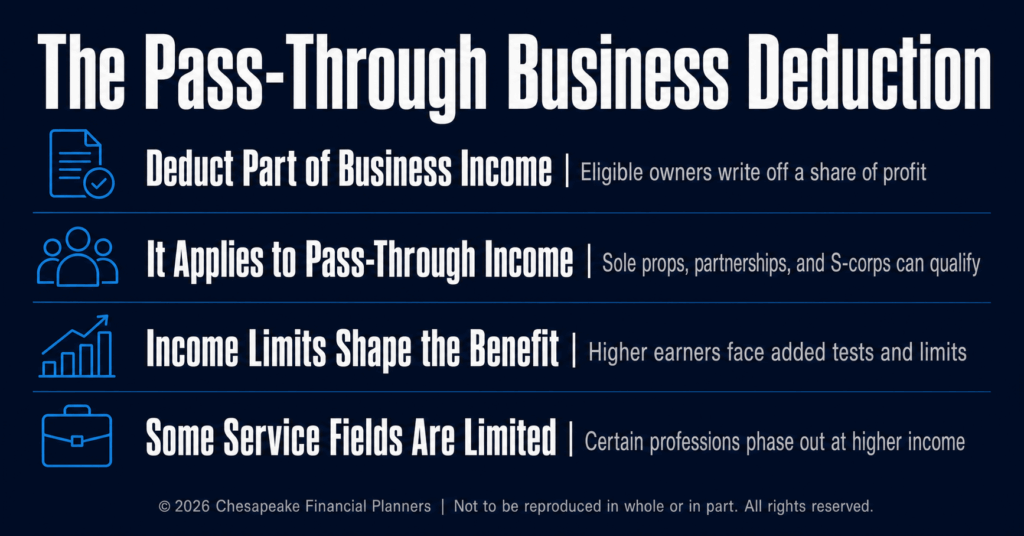
The QBI deduction, also known as the Section 199A or pass-through deduction, lets eligible pass-through business owners deduct up to 20% of qualified business income on their federal return in 2026, reducing the effective top tax rate on that income from 37% to roughly 29.6%. It applies to sole proprietors, S corporation shareholders, partnership members, and certain trusts and estates whose taxable income comes from a qualified U.S. trade or business. The One, Big, Beautiful Bill Act, signed into law on July 4, 2025, removed the original 2025 sunset and made Section 199A permanent.
On This Page
- Key Takeaways
- How does the QBI deduction work in 2026?
- Who qualifies for the QBI deduction?
- How does the W-2 wage limit change the QBI deduction calculation?
- What is a specified service trade or business under Section 199A?
- What did the One, Big, Beautiful Bill Act change about Section 199A in 2026?
- Related Topics Worth Reading
- Frequently Asked Questions
- Disclosures
Key Takeaways
- The 2026 QBI deduction equals up to 20% of qualified business income for eligible pass-through owners.
- Full deduction is available below $403,500 taxable income (MFJ) or $201,750 (all other filers) in 2026.
- The W-2 wage and UBIA limits phase in over the next $150,000 (MFJ) or $75,000 (other) of taxable income.
- The One, Big, Beautiful Bill Act made Section 199A permanent and added a $400 minimum deduction starting in 2026.
- Specified service businesses lose the deduction entirely once taxable income clears the top of the phase-in range.
About the Author: Jeff Judge, CFP®, AEP®, ChFC®, CLU® is Managing Partner of Chesapeake Financial Planners in Forest Hill, Maryland. He has been helping families and business owners in Harford County and the Baltimore metro area navigate pass-through tax planning since earning his CFP® certification in 2013, by using Chesapeake Financial Planners’ signature process, the R.U.D.D.E.R. method™. In Jeff's experience, the QBI deduction gets handled as a filing-season calculation when it should be a multi-year planning conversation about wage choices, retirement contributions, and entity structure.
How does the QBI deduction work in 2026?
The deduction is the lesser of two amounts: the sum of 20% of qualified business income plus 20% of qualified REIT dividends and publicly traded partnership income, or 20% of taxable income minus net capital gain. The arithmetic is straightforward at lower incomes. It gets complicated once taxable income clears the threshold amount, because two separate limitations start to bite: the W-2 wage and capital limit, and the specified service business limit.
Qualified business income is the net amount of income, gain, deduction, and loss from a qualified U.S. trade or business. According to the IRS, QBI does not include capital gains and losses, dividends, interest income unrelated to the business, or reasonable compensation paid to S corporation owners and guaranteed payments to partners. The mechanic matters because the deduction reduces taxable income, not adjusted gross income, and it's available whether the taxpayer itemizes or takes the standard deduction.
For a married couple filing jointly with $300,000 of pass-through QBI and total taxable income under $403,500, the QBI deduction is the full $60,000. They never touch the W-2 wage test and never face the specified service business disqualification. That's the simple case and it covers the majority of small business owners.
The harder case sits above the threshold. The deduction does not disappear, but it stops being automatic. The W-2 wage and UBIA limit forces the owner to demonstrate that the business is paying wages or holding qualified depreciable property, not just generating profit. We come back to the W-2 mechanic below because it is the single most actionable lever for business owners with income above the threshold.
Who qualifies for the QBI deduction?
The deduction is available to non-corporate taxpayers who own a qualified U.S. trade or business operated as a sole proprietorship, partnership (including LLCs taxed as partnerships), S corporation, or certain trusts and estates. C corporation shareholders do not qualify. Neither does income from providing services as a W-2 employee, since employee wages are not pass-through business income.
The qualifying threshold for 2026 is set by IRS Revenue Procedure 2025-32. At or below $403,500 of taxable income for married filing jointly, $201,775 for married filing separately, and $201,750 for all other filers, the owner gets the full 20% deduction with no limitations. Above that, the W-2 wage and UBIA limit phases in over the next $150,000 (MFJ) or $75,000 (other), and the specified service business limit phases in over the same range.
The post-OBBBA $400 minimum deduction is the easiest win for owners with small businesses on the side. As described by Foster Garvey's tax practice, a taxpayer with at least $1,000 of QBI in a qualified business in which they materially participate is entitled to a minimum $400 deduction, indexed for inflation starting after 2026. For a freelancer or part-time consultant who would otherwise calculate to a small deduction or none at all, this is a meaningful floor.
How does the W-2 wage limit change the QBI deduction calculation?
Above the threshold amount, the QBI component for each business is limited to the greater of two amounts. Option one is 50% of the W-2 wages paid by the qualified trade or business. Option two is 25% of W-2 wages plus 2.5% of the unadjusted basis immediately after acquisition (UBIA) of qualified depreciable property held by the business. Whichever number is larger sets the cap.
The 2.5% UBIA bucket matters for asset-heavy businesses, real estate operations, and manufacturing. The 50% wage bucket matters for service-oriented S corporations where the owner is the primary worker. This is where planning shows up. An S corporation owner paying themselves a minimum-justifiable W-2 may have optimized for payroll tax, but they have also capped their QBI deduction at half of that lower wage. Jeff Judge often tells S corporation owners that the wage decision is the single most actionable QBI lever they have, and one of the few they can still adjust before year-end. "The wage you pay yourself isn't just a payroll tax calculation any more," Jeff says. "It's a cap on your deduction." He has watched this exact tradeoff cost owners more in lost QBI deduction than they saved in payroll tax.
Aggregation is the second lever. Multiple trades or businesses under common ownership can be aggregated for QBI purposes if they meet specific tests in the Form 8995-A instructions issued by the IRS. For an owner with one wage-heavy business and one property-heavy business, aggregating can produce a higher combined wage-plus-UBIA limit than treating each separately. The choice is binding for the year it is made and any later year unless the underlying facts change.
The bottom line: above the threshold, the QBI deduction is not a single number to claim. It's the outcome of choices about wages, depreciation, and aggregation made during the year. Owners who wait until April have already given up most of the planning levers.
What is a specified service trade or business under Section 199A?
A specified service trade or business (SSTB) is a separate category that loses the QBI deduction once taxable income clears the top of the phase-in range. The statute names the categories explicitly: health, law, accounting, actuarial science, consulting, athletics, financial services, brokerage services, and businesses involving investing, investment management, or trading in securities, partnerships, or commodities. It also covers any trade or business whose principal asset is the reputation or skill of one or more employees or owners.
Architecture and engineering are not SSTBs by statute, even though those firms look superficially similar to the listed categories. For a 2026 MFJ filer with taxable income above $553,500, an SSTB receives no QBI deduction. For a single filer, the cutoff is $276,750. Between the threshold and the top of the phase-in range, the deduction phases out proportionally.
This is the rule that catches financial advisors, doctors, lawyers, and consulting partners off guard. The deduction looks accessible because the entity structure is a pass-through. It is not accessible once the math runs above the phase-in. Jeff Judge has had this conversation with multiple medical practice partners who assumed they would benefit from Section 199A and learned they had been disqualified by their own income. The planning answer in that situation usually points back to retirement plan contributions, charitable strategies, or income deferral, not to the QBI deduction itself.
This is also the place where the R.U.D.D.E.R. Method™ shows its value for business owners. The R.U.D.D.E.R. Method™ is Chesapeake Financial Planners' six-step planning process: Review and Recognize, Uncover and Understand, Design and Develop, Discuss and Decide, Execute and Empower, and Reassess and Refine. For an SSTB owner whose income is bumping up against the SSTB phase-out, "Reassess and Refine" annually is what keeps the deduction from being a missed opportunity year after year.
What did the One, Big, Beautiful Bill Act change about Section 199A in 2026?
The original Section 199A was scheduled to sunset at the end of 2025. The One, Big, Beautiful Bill Act eliminated the sunset and made the deduction a permanent provision of the Internal Revenue Code. According to the IRS, the bill was signed into law on July 4, 2025, as Public Law 119-21.
Three substantive changes survived from the House bill to the final law. First, the phase-in dollar amounts that govern when the W-2 wage and SSTB limits take full effect increased to $150,000 above the threshold for married filing jointly and $75,000 above the threshold for all other filers. That is a $50,000 and $25,000 expansion compared to prior law. Second, the bill added a $400 minimum deduction for taxpayers with at least $1,000 of QBI in a qualified business in which they materially participate. Third, the 20% rate itself was preserved. The House version had proposed 23%; the final law kept it at 20%.
The changes are effective for tax years beginning after December 31, 2025. That timing matters. The 2025 tax return still uses the prior phase-in ranges. Planning conversations about 2026 should reflect the wider phase-in window, because more owners with taxable income in the $400,000 to $550,000 MFJ band will keep more of their QBI deduction than they would have under the old law.
Related Topics Worth Reading
The QBI deduction sits inside a broader set of decisions facing every pass-through business owner: how to draw compensation, how to structure entity ownership, how to time income recognition, and how to plan for eventual exit. The posts below cover the topics that intersect most often with QBI planning.
- Choosing between S corporation and LLC taxation. The QBI deduction interacts directly with the reasonable compensation rule for S corporations and the self-employment tax exposure of LLCs taxed as partnerships. LLC or s-corp: which saves me more in taxes?
- Owner compensation and reasonable salary. The W-2 wage limit on the QBI deduction creates a counterbalancing incentive against minimizing S corporation owner wages. How much salary do I have to pay myself in an S-corp?
- Retirement plan contributions for business owners. Solo 401(k), SEP IRA, and defined benefit contributions reduce taxable income and can keep an SSTB below the phase-in range. retirement plan options for business owners
- Business succession and buy-sell agreements. The QBI deduction affects how owners think about exit timing and entity structure during a buyout. buy-sell agreements for business owners
- Multi-business aggregation under Section 199A. Owners of more than one pass-through entity can aggregate for QBI purposes under specific tests.
- Year-end tax planning for business owners. Pre-year-end wage adjustments, depreciation elections, and aggregation choices set the QBI deduction outcome. year-end tax planning for business owners
Frequently Asked Questions
Did the One, Big, Beautiful Bill Act make the QBI deduction permanent?
Yes. The One, Big, Beautiful Bill Act, signed into law on July 4, 2025 as Public Law 119-21, eliminated the December 31, 2025 sunset of Section 199A and made the 20% qualified business income deduction permanent. Unless Congress later changes or repeals Section 199A, eligible pass-through business owners can continue to claim the deduction in 2026 and beyond.
Who qualifies for the QBI deduction in 2026?
Owners of sole proprietorships, partnerships, S corporations, and certain trusts and estates qualify if they have income from a qualified U.S. trade or business. C corporations and individuals receiving W-2 wages do not qualify. For 2026, the full deduction is available below $403,500 of taxable income for married filing jointly and $201,750 for all other filers, with the W-2 wage and SSTB limitations phasing in above those thresholds.
How much is the QBI deduction worth?
The QBI deduction equals up to 20% of qualified business income plus 20% of qualified REIT dividends and publicly traded partnership income, capped at 20% of taxable income minus net capital gain. For a business owner in the top 37% federal bracket, the full deduction reduces the effective tax rate on that income to roughly 29.6%, narrowing the gap with the 21% C corporation rate.
What is a specified service business for QBI purposes?
A specified service trade or business (SSTB) is one in the fields of health, law, accounting, actuarial science, consulting, athletics, financial services, brokerage, or investing and investment management. It also includes any business whose principal asset is the reputation or skill of its owners or employees. Architecture and engineering firms are statutorily excluded from the SSTB definition.
How does the W-2 wage limit affect the QBI deduction?
Above the threshold amount, the deduction for each business is capped at the greater of 50% of W-2 wages paid by the business, or 25% of W-2 wages plus 2.5% of the unadjusted basis of qualified depreciable property. The cap means that an S corporation owner paying minimal W-2 wages can lose much of their QBI deduction even when business profits are high.
Do I need to itemize to claim the QBI deduction?
No. The QBI deduction is available regardless of whether you itemize deductions on Schedule A or take the standard deduction. The deduction reduces taxable income directly, separately from above-the-line and itemized deductions, and applies to both filers who itemize and those who do not.
What is the new $400 minimum QBI deduction added by OBBBA?
The One, Big, Beautiful Bill Act added a $400 minimum QBI deduction for taxpayers with at least $1,000 of qualified business income from a trade or business in which they materially participate. The minimum is effective for tax years beginning after December 31, 2025, and is indexed for inflation in $5 increments starting after 2026.
The QBI deduction stayed in place because Congress kept Section 199A permanent. The planning question for 2026 isn't whether business owners can claim it. It's whether you are configuring your wages, depreciation, and entity choices early enough to actually capture the full 20%. For owners in the income band where the W-2 wage limit or SSTB phase-in starts to bite, the decisions are made during the year, not at the filing deadline.
If you found this helpful, Chesapeake's Business Owner Tax Planning Guide covers the wage, retirement, and aggregation decisions that drive the QBI deduction outcome. Download it at chesapeakefp.com.
Want to go deeper? Our 10 Signs You're Ready for a Certified Financial Planner walks through this step by step.
This material is for educational purposes only and should not be considered tax or legal advice. Please consult with your tax advisor or attorney regarding your specific situation.
There is no guarantee that a diversified portfolio will enhance overall returns or outperform a non-diversified portfolio. Diversification does not protect against market risk.
The opinions voiced in this material are for general information only and are not intended to provide specific advice or recommendations for any individual.
All investing involves risk including loss of principal. No strategy assures success or protects against loss.
This information is not intended to be a substitute for specific individualized tax, investment or legal advice. We suggest that you discuss your specific situation with a qualified tax, legal or financial advisor.
CFP Board owns the marks CFP®, CERTIFIED FINANCIAL PLANNER®, and CFP® (with plaque design) in the U.S.
The ChFC® is the property of The American College of Financial Services, which reserves sole rights to its use, and is used by permission.
The CLU® is the property of The American College of Financial Services, which reserves sole rights to its use, and is used by permission.
Disclosures
The information provided is for educational purposes only and should not be construed as investment advice. Investment strategies should be tailored to individual circumstances, risk tolerance, and goals. Past performance doesn't guarantee future results. Consult with qualified financial professionals regarding your specific situation.
This information is not intended to be a substitute for specific individualized tax, investment or legal advice. We suggest that you discuss your specific situation with a qualified tax, legal or financial advisor.
Advisors associated with Chesapeake Financial Planners may be either (1) LPL Financial Registered Representatives offering securities through LPL Financial, Member FINRA and SIPC, and investment advisor representatives offering investment advice through Great Valley Advisor Group; or (2) solely investment advisor representatives offering investment advice through Great Valley Advisor Group and not affiliated with LPL Financial. Great Valley Advisor Group, and Chesapeake Financial Planners are separate entities from LPL Financial.


