

What Are the Rules and Strategies for Required Minimum Distributions?
Last reviewed: July 2026
Required minimum distributions (RMDs) are mandatory annual withdrawals the IRS forces you to take from tax-deferred retirement accounts starting at age 73. You pay ordinary income tax on every dollar, whether you need the money or not. The amount is set by dividing your prior year-end balance by an IRS life expectancy factor, and missing the deadline triggers a penalty of up to 25%. Smart RMD planning starts years before that first distribution, not the year it arrives.
On This Page
- Key Takeaways
- What Are Required Minimum Distributions?
- When Do RMDs Begin and Which Accounts Are Affected?
- How Are RMD Amounts Calculated?
- What Happens If You Miss an RMD Deadline?
- How Do RMDs Affect Your Taxes, Social Security, and Medicare?
- What Strategies Reduce the Impact of RMDs?
- How Do Inherited IRA RMD Rules Work?
- Frequently Asked Questions
- Where to Go From Here
- Disclosures
Key Takeaways
- RMDs begin at age 73 for anyone born between 1951 and 1959, and at age 75 for those born in 1960 or later, per SECURE 2.0.
- The penalty for missing an RMD is 25% of the shortfall, reduced to 10% if you correct it within the IRS correction window.
- For 2026, you can direct up to $111,000 per person to charity through a qualified charitable distribution, satisfying your RMD tax-free.
- Roth IRAs and, as of 2024, Roth 401(k)s carry no lifetime RMD, making Roth conversions a core pre-73 strategy.
- Large RMDs can raise Social Security taxation and trigger Medicare IRMAA surcharges two years later.
About the Author: Jeff Judge, CFP®, AEP®, ChFC®, CLU® is Managing Partner of Chesapeake Financial Planners in Forest Hill, Maryland. He has been helping families and business owners in Harford County and the Baltimore metro area navigate retirement income and tax planning since earning his CFP® certification in 2013, by using Chesapeake Financial Planners’ signature process, the R.U.D.D.E.R. method™. Jeff's view on RMDs is blunt: the people who get hurt aren't the ones who forget to take the distribution, they're the ones who never planned for the tax bill that was building for thirty years.
What Are Required Minimum Distributions?
A required minimum distribution is the smallest amount the IRS requires you to withdraw from a tax-deferred retirement account each year once you reach the starting age. You got a tax deduction when the money went in. Decades of tax-deferred growth followed. The RMD is how the government finally collects.
The rule exists because tax-deferred accounts cannot defer taxes forever. According to the IRS, RMDs apply to traditional IRAs, SEP IRAs, SIMPLE IRAs, and most employer plans including 401(k), 403(b), and 457(b) accounts. Every dollar you withdraw counts as ordinary income in the year you take it.
Why does the IRS require RMDs at all?
The IRS requires RMDs to recapture the taxes it deferred when you funded these accounts. Tax-deferred growth is a loan, not a gift. RMDs force that loan to be repaid on a schedule the government controls, which is why planning the timing matters so much for your bracket.
Here is the part most people miss. The R.U.D.D.E.R. Method™ is Chesapeake Financial Planners' six-step planning process: Review and Recognize, Uncover and Understand, Design and Develop, Discuss and Decide, Execute and Empower, and Reassess and Refine. RMD planning lives almost entirely in the first three steps. By the time the distribution is due, your options have shrunk to almost nothing. The leverage is in the years before age 73, not the year of.
If you want a fuller picture of how withdrawals fit a broader plan, see our guide on What is the best order to withdraw from my 401k, Roth IRA, and taxable accounts in retirement?.
When Do RMDs Begin and Which Accounts Are Affected?
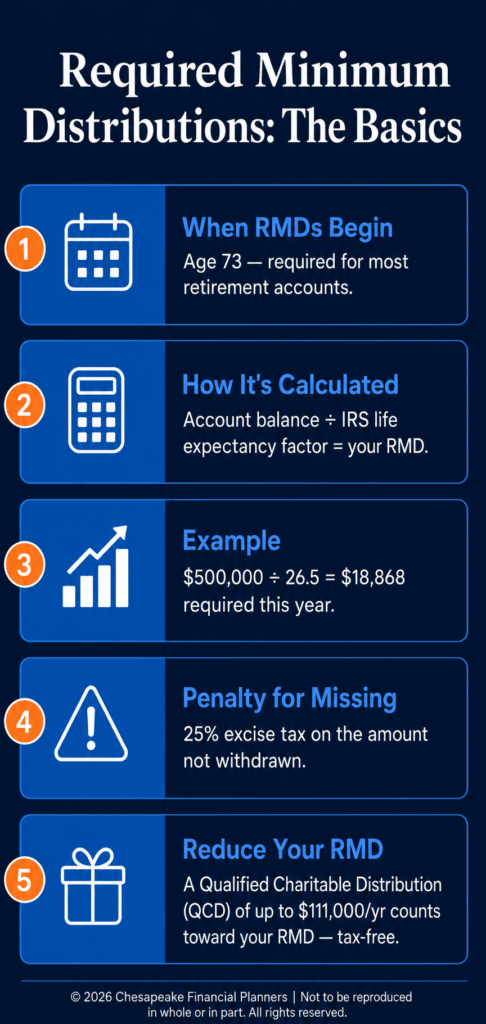
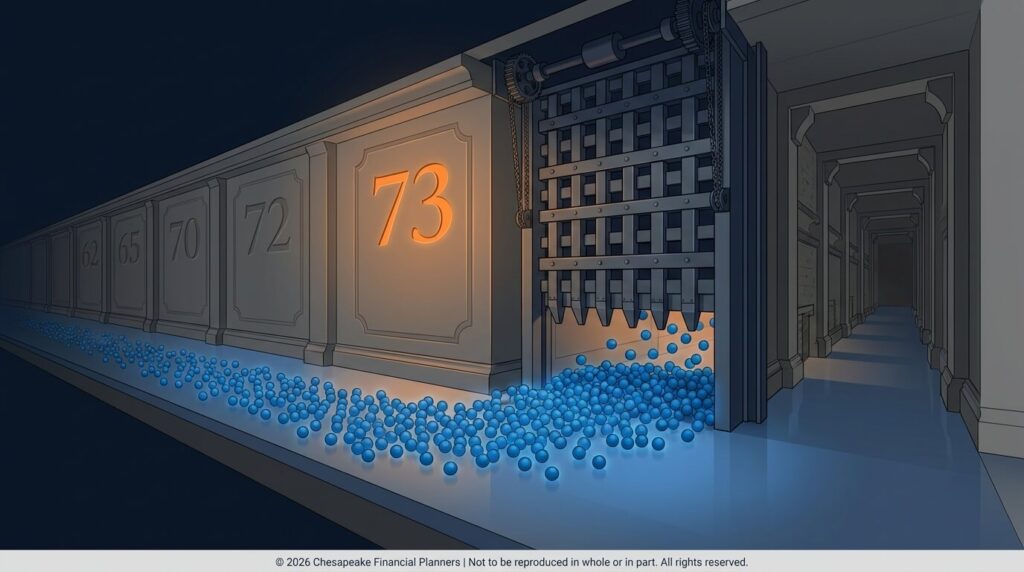
RMDs begin at age 73 for anyone born between 1951 and 1959, and at age 75 for anyone born in 1960 or later. This staggered schedule came from the SECURE 2.0 Act, which raised the age from 72 in two steps. Before SECURE 2.0, the starting age was 72, and before the original SECURE Act, it was 70½.
The account type determines whether RMDs apply. This is where people who own several different accounts get tripped up.
Which accounts require RMDs?
The following accounts require lifetime RMDs once you reach your starting age:
- Traditional IRAs
- SEP IRAs
- SIMPLE IRAs
- 401(k), 403(b), and 457(b) plans
- Inherited retirement accounts, under separate timing rules
Which accounts are exempt from lifetime RMDs?
Roth IRAs never require RMDs during the original owner's lifetime. And as of 2024, the IRS confirmed that designated Roth accounts inside employer plans, including Roth 401(k)s and Roth 403(b)s, no longer require lifetime RMDs either. That change closed a long-standing gap and is one reason Roth conversions have become a more powerful pre-RMD tool. Before this, retirees often rolled Roth 401(k) funds into a Roth IRA purely to dodge the distribution requirement.
There is one working-person exception. If you are still employed past your RMD age and you do not own 5% or more of the company, you can generally delay RMDs from that employer's plan until you actually retire. This does not apply to IRAs, only to the plan at your current job.
Jeff Judge often tells clients that the single most common surprise he sees is a 401(k) someone forgot they had. A plan from a job three employers ago still triggers an RMD, and the custodian will not always chase you down to remind you. For a related decision, read What should I do with my 401(k) when I change jobs? and Can I roll my old 401(k) into an IRA instead?.
How Are RMD Amounts Calculated?
Your RMD is calculated by dividing your account balance as of December 31 of the prior year by a life expectancy factor from the IRS Uniform Lifetime Table. The formula is simple, but the inputs change every year, which is why automating the math is dangerous without a yearly review.
The formula is: prior year-end balance divided by the distribution period equals your RMD.
Take a concrete example. If your traditional IRA was worth $500,000 on December 31 of the prior year and you are age 73, the IRS Uniform Lifetime Table gives you a distribution period of 26.5 years. Your RMD is $500,000 divided by 26.5, or about $18,868. The following year the factor shrinks, so even if your balance stayed flat, your required withdrawal would rise.
How do you calculate RMDs across multiple accounts?
The aggregation rules differ by account type, and getting them backward is a common, expensive mistake. For IRAs, you calculate the RMD for each account separately but you may take the total from any one IRA or any combination of them. For employer plans like 401(k)s, you must calculate and withdraw the RMD from each plan individually. You cannot satisfy a 401(k) RMD by pulling extra from your IRA.
A few details that matter:
- The distribution period shortens each year, which means larger RMDs as you age even in a flat market
- If your spouse is more than ten years younger and is your sole beneficiary, you use the Joint Life and Last Survivor Table, which produces a smaller RMD
- Year-end balance fluctuations affect next year's RMD, so a strong market year raises the following year's required withdrawal
If you are coordinating several income sources at once, our guide on How do I coordinate all my retirement income sources to minimize taxes and maximize income? walks through the sequencing.
What Happens If You Miss an RMD Deadline?
If you miss an RMD or take less than the full amount, the IRS imposes an excise tax of 25% on the shortfall. That penalty drops to 10% if you withdraw the missed amount and file the correction within the timely-correction window. Before SECURE 2.0, this penalty was a brutal 50%, so the current rules are an improvement, but 25% of a missed distribution is still real money.
Here is how the math works. According to the IRS, if your RMD was $20,000 and you withdrew only $10,000, the 25% penalty applies to the $10,000 shortfall. That is a $2,500 penalty, and you still owe ordinary income tax on the distribution itself once you take it.
When is your first RMD actually due?
Your first RMD has a special deadline: you have until April 1 of the year after you turn 73 to take it. Every RMD after that is due by December 31. That extra grace period sounds helpful, but it sets a trap that Jeff has watched cost clients real tax dollars.
The trap is bunching. If you delay your first RMD to April 1, you are then required to take your second RMD by December 31 of that same year. Two distributions in one calendar year can shove you into a higher bracket, increase Social Security taxation, and trigger Medicare surcharges all at once. For most retirees, taking the first RMD by December 31 of the year you turn 73 spreads the income across two tax years and keeps brackets in check.
How to stay penalty-free is straightforward in practice:
- Set calendar reminders well before December 31 each year
- Confirm the calculation with your advisor or custodian annually, since factors change
- Track every account separately if you hold more than one
- Automate the distribution where the custodian allows it, but still review the figure once a year
How Do RMDs Affect Your Taxes, Social Security, and Medicare?
RMDs are fully taxable as ordinary income, and the ripple effects reach well beyond your federal tax bracket. This is the part of RMD planning that surprises people most, because the cost is not just the tax on the distribution. It is everything the higher income knocks loose.
How do RMDs change your tax bracket?
A large RMD can push you into a higher federal and state bracket in a single year. A couple sitting comfortably in the 12% bracket can land in the 22% or 24% bracket once distributions begin, especially if both spouses have sizable traditional accounts. Because the distribution period shrinks every year, this pressure builds rather than eases.
How do RMDs affect Social Security taxation?
RMDs raise your adjusted gross income, and a higher AGI can cause more of your Social Security benefits to become taxable. Per the Social Security Administration, up to 85% of your benefits can be subject to federal income tax once your combined income crosses certain thresholds. A retiree who was paying tax on half their benefit can suddenly be taxed on 85% of it the year RMDs begin.
How do RMDs trigger Medicare IRMAA surcharges?
Higher income from RMDs can trigger Income-Related Monthly Adjustment Amounts, or IRMAA, on your Medicare Part B and Part D premiums. According to Medicare, these surcharges are based on the income reported on your tax return from two years prior. That two-year lookback is the cruel part: an RMD or Roth conversion you take this year can raise your Medicare premiums two years down the road, often catching people completely off guard.
Most states also tax RMDs as ordinary income, though a handful, including Pennsylvania, exempt qualified retirement income from state tax. Maryland taxes RMDs but offers a pension exclusion for eligible retirees, which is worth confirming with your tax advisor.
This cascade is exactly why Jeff treats RMD planning as a multi-year tax project, not an annual chore. The decision that matters is not how to take the distribution. It is how much tax-deferred money you let pile up in the first place. To see how this kind of planning gets built, read How Does a Financial Plan Actually Get Built?.
What Strategies Reduce the Impact of RMDs?
The most effective RMD strategies are executed before age 73, not after. Once distributions are mandatory, your levers are limited. The retirees who pay the least are the ones who started reshaping their accounts in their early sixties. Here are the strategies that move the needle.
Roth conversions before RMDs begin
Converting traditional IRA money to a Roth IRA in your lower-income years shrinks the balance that RMDs will eventually be calculated on. You pay tax on the converted amount now, ideally in a low bracket between retirement and age 73, and that money then grows tax-free with no future RMD. The window between retiring and reaching RMD age is often the single best tax-planning opportunity of a person's life. Read more in Should I Choose a Roth 401k or Traditional 401k? to understand the account mechanics.
Qualified charitable distributions
A qualified charitable distribution (QCD) lets you send money directly from your IRA to a qualified charity, and it counts toward your RMD without adding to your taxable income. For 2026, the IRS sets the QCD limit at $111,000 per person, indexed annually for inflation. This is one of the cleanest tools available: if you are charitably inclined and over 70½, a QCD satisfies your RMD, supports a cause you care about, and keeps your AGI down, which protects your Social Security taxation and Medicare premiums in one move.
Strategic withdrawal sequencing
Drawing down taxable and tax-deferred accounts in the right order during your sixties can flatten your lifetime tax bill and reduce the balance subject to RMDs. The goal is to fill up the lower brackets each year rather than letting tax-deferred money compound untouched until it explodes into mandatory income.
The table below compares the three core levers most retirees should weigh.
| Strategy | Best timing | Primary benefit | Watch out for |
|---|---|---|---|
| Roth conversion | Retirement to age 73 | Shrinks future RMDs, tax-free growth | Tax due now; IRMAA lookback |
| Qualified charitable distribution | Age 70½ and up | Satisfies RMD with no taxable income | Must go directly to charity; per-person limit |
| Withdrawal sequencing | Early 60s onward | Flattens lifetime tax bracket | Requires annual review and discipline |

Continued work past RMD age
If you keep working past your RMD age and do not own 5% or more of the business, you can defer RMDs on your current employer's plan until you retire. This does not help with IRAs or old 401(k)s, but for someone still drawing a paycheck, it can delay a chunk of taxable income.
Jeff has a rule of thumb he shares with pre-retirees: if you have more than half your net worth sitting in traditional retirement accounts, you almost certainly have a Roth conversion conversation to have before 73. The numbers don't always make it obvious, but the IRMAA surcharge and the Social Security tax hit are the costs nobody puts on the spreadsheet until it is too late. If you are weighing whether this kind of planning earns its keep, see Is financial planning worth it if I already have investments?.
How Do Inherited IRA RMD Rules Work?
Inherited IRA RMD rules changed dramatically under the SECURE Act, and they are far less forgiving than the rules for your own accounts. Most non-spouse beneficiaries who inherited an account in 2020 or later must empty the entire inherited IRA within 10 years of the original owner's death, according to the IRS. The old "stretch IRA," which let heirs spread distributions across their own lifetime, is gone for most beneficiaries.
The 10-year rule has a wrinkle. If the original owner had already started their own RMDs before death, the beneficiary generally must also take annual distributions during the 10-year window, not just empty the account by year ten. That detail caught many heirs and advisors off guard, and the IRS finalized its position on it only recently.
Who is exempt from the 10-year rule?
Certain "eligible designated beneficiaries" can still stretch distributions over their life expectancy. These include surviving spouses, minor children of the original owner until they reach majority, disabled or chronically ill individuals, and beneficiaries who are not more than ten years younger than the original owner. Everyone else generally falls under the 10-year rule.
Inheriting a retirement account is one of the life events that should prompt a fresh look at your whole plan. Our guide on Should I update my financial plan after a big life event? covers why. And if your retirement income picture is complex, Why Does a Financial Planning Process Matter More Than Investment Selection? explains the framework we use.
Frequently Asked Questions
At what age do required minimum distributions start?
Required minimum distributions start at age 73 for anyone born between 1951 and 1959, and at age 75 for those born in 1960 or later. SECURE 2.0 set this staggered schedule, raising the age from the previous 72. Your first RMD can be delayed until April 1 of the following year, but every subsequent RMD is due by December 31.
How is my required minimum distribution calculated?
Your RMD equals your prior year-end account balance divided by a life expectancy factor from the IRS Uniform Lifetime Table. At age 73, that factor is 26.5, so a $500,000 balance produces an RMD of about $18,868. The factor shrinks each year, which means your required withdrawal grows as you age, even if your balance stays flat.
What is the penalty for missing an RMD?
The penalty for missing an RMD is a 25% excise tax on the amount you failed to withdraw, per the IRS. That penalty drops to 10% if you correct the shortfall and file within the timely-correction window. Before SECURE 2.0 the penalty was 50%, so today's rules are gentler, but a 25% hit on a missed distribution is still a meaningful and avoidable cost.
Can I avoid RMDs entirely?
You cannot avoid lifetime RMDs on traditional IRAs and most employer plans, but you can reduce or eliminate them on certain accounts. Roth IRAs carry no lifetime RMD, and as of 2024 neither do Roth 401(k)s. Converting traditional balances to Roth before age 73 shrinks the balance subject to RMDs and is the most common avoidance strategy available to retirees.
How does a qualified charitable distribution help with RMDs?
A qualified charitable distribution lets you send up to $111,000 per person directly from your IRA to a qualified charity in 2026, and it counts toward your RMD without increasing your taxable income. Because it stays out of your adjusted gross income, a QCD protects you from higher Social Security taxation and Medicare IRMAA surcharges that a normal taxable distribution would trigger.
Do RMDs affect my Medicare premiums?
Yes, RMDs can raise your Medicare premiums through IRMAA surcharges on Part B and Part D. According to Medicare, these surcharges are based on your tax return from two years prior, so a large RMD or Roth conversion today can increase your premiums two years later. That two-year lookback is why coordinating distributions with Medicare planning matters so much.
How do inherited IRA RMD rules work?
Most non-spouse beneficiaries who inherit an IRA must empty the entire account within 10 years of the original owner's death under the SECURE Act. If the original owner had already begun RMDs, the heir must also take annual distributions during that window. Eligible designated beneficiaries, including surviving spouses and minor children, can still stretch distributions over their life expectancy.
Should I take my first RMD early or wait until April 1?
For most retirees, taking your first RMD by December 31 of the year you turn 73 is the better move. Waiting until the April 1 deadline forces two distributions in one calendar year, since your second RMD is still due that December. That bunching can push you into a higher bracket and increase both Social Security taxation and Medicare surcharges in a single year.
Where to Go From Here
RMDs are not a problem you solve in the year they arrive. They are a tax bill that has been building since the first dollar went into your traditional account, and the most powerful moves to manage required minimum distributions happen in the years before you turn 73. If you want a clear picture of how Roth conversions, charitable distributions, and withdrawal sequencing fit your specific situation, our retirement income planning guide breaks it down step by step. Download it at chesapeakefp.com and start mapping your RMD strategy before the IRS sets the schedule for you.
Want to go deeper? Our Retirement Income Blueprint Workbook walks through this step by step.
Disclosures
The information provided is for educational purposes only and should not be construed as investment advice. Investment strategies should be tailored to individual circumstances, risk tolerance, and goals. Past performance doesn't guarantee future results. Consult with qualified financial professionals regarding your specific situation.
A Roth IRA offers tax deferral on any earnings in the account. Qualified withdrawals of earnings from the account are tax-free. Withdrawals of earnings prior to age 59 ½ or prior to the account being opened for 5 years, whichever is later, may result in a 10% IRS penalty tax. Limitations and restrictions may apply.
Content in this material is for general information only and not intended to provide specific advice or recommendations for any individual. All performance referenced is historical and is no guarantee of future results. All indices are unmanaged and may not be invested into directly.
Investing involves risk including loss of principal.
Advisors associated with Chesapeake Financial Planners may be either (1) LPL Financial Registered Representatives offering securities through LPL Financial, Member FINRA and SIPC, and investment advisor representatives offering investment advice through Great Valley Advisor Group; or (2) solely investment advisor representatives offering investment advice through Great Valley Advisor Group and not affiliated with LPL Financial. Great Valley Advisor Group, and Chesapeake Financial Planners are separate entities from LPL Financial.


