
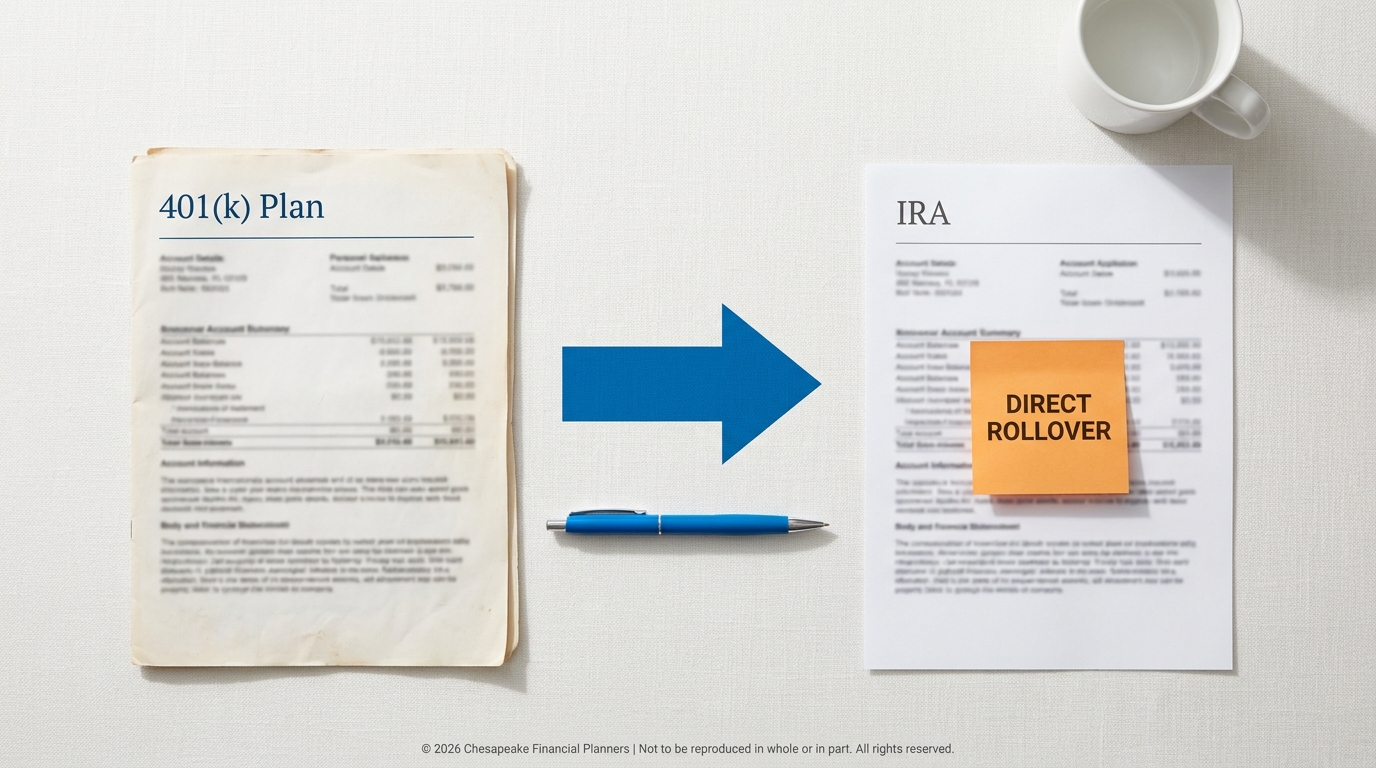
Can I Roll My Old 401(k) Into an IRA Instead?
Last reviewed: July 2026
Yes, you can roll your old 401(k) into an IRA, and for many people it's the cleanest move after leaving a job. A direct rollover transfers the money straight from your old plan into a Traditional or Roth IRA with no taxes and no penalties. Whether it's the right move depends on your fees, your age, and what you plan to do next. A 401(k) rollover to IRA is reversible in the sense that you can roll it back into a future employer plan later, so this decision isn't permanent.
Key Takeaways
- A direct 401(k) rollover to IRA moves your money with zero taxes or penalties when done correctly.
- IRAs usually offer more investment choices and often lower fees than an old workplace plan.
- An indirect rollover triggers a mandatory 20% withholding and must be completed within 60 days.
- The Rule of 55 lets you tap a 401(k) penalty-free at 55, but rolling to an IRA forfeits that flexibility.
About the Author: Jeff Judge, CFP®, AEP®, ChFC®, CLU® is Managing Partner of Chesapeake Financial Planners in Forest Hill, Maryland. He has been helping families and business owners in Harford County and the Baltimore metro area navigate retirement account decisions since earning his CFP® certification in 2013, by using Chesapeake Financial Planners’ signature process, the R.U.D.D.E.R. method™. Jeff has watched plenty of people leave six-figure balances sitting in forgotten old plans for years, paying fees they never see, simply because nobody told them they had a choice.
What Does It Mean to Roll a 401(k) Into an IRA?
A 401(k) rollover to IRA means moving the money from your former employer's plan into an Individual Retirement Account without triggering a taxable event. The account keeps its tax-advantaged status. Your Traditional 401(k) rolls into a Traditional IRA; a Roth 401(k) rolls into a Roth IRA.
There are two ways to do it, and the difference matters more than most people realize:
- Direct rollover (recommended): The money moves custodian-to-custodian. You never touch it, and there's no withholding and no tax reporting headache.
- Indirect rollover (riskier): Your old plan sends you a check. The IRS requires the plan to withhold 20% for taxes, and you have 60 days to deposit the full original amount, including the withheld portion from your own pocket, into the new IRA. Miss the 60-day window and it becomes a taxable distribution, plus a 10% penalty if you're under 59½.
The takeaway is simple: ask for a direct rollover and avoid the indirect path unless you have a specific reason. Jeff tells clients that the 60-day rule has cost people real money over a missed mailbox or a forgotten deadline, and there's almost never a good reason to take that risk.
What should I do with my 401(k) when I change jobs?

What Are Your 401(k) Rollover Options When You Leave a Job?
When you leave an employer, you generally have four choices, and a 401(k) rollover to IRA is only one of them. Knowing all four helps you compare honestly instead of defaulting.
- Leave it where it is. If your balance is large enough, most plans let you keep the money in your old 401(k). Fine as a holding pattern, easy to forget about for a decade.
- Roll it into an IRA. Move it into a Traditional or Roth IRA depending on your account type. This is one of the most popular 401(k) rollover options.
- Roll it into your new employer's 401(k). If your new job offers a plan that accepts transfers, you can consolidate and keep everything under one roof.
- Cash it out. Take the money now and pay ordinary income tax plus a 10% penalty if you're under 59½. Almost always the worst option.
Each path has tradeoffs. The right answer for a 38-year-old switching jobs looks nothing like the right answer for someone retiring at 56.
What Are the Pros and Cons of a 401(k) to IRA Rollover?
Most people ask about the 401(k) to IRA pros and cons before committing, and the honest answer is that it depends on the plan you're leaving and the life you're heading into. Here's a side-by-side comparison of the main factors.
| Factor | 401(k) to IRA Rollover | Keeping the 401(k) |
|---|---|---|
| Investment choices | Thousands of options | Limited menu (often 10-30 funds) |
| Fees | Often lower at low-cost custodians | Sometimes high, occasionally very low |
| Early access at 55-59½ | No penalty exception | Rule of 55 may apply |
| Creditor protection | Varies by state | Strong federal ERISA protection |
| Account consolidation | Combine multiple accounts | Stays separate |
| Roth conversion clarity | Can complicate pro-rata math | Keeps Traditional IRA balance at zero |
The biggest pull toward a Traditional IRA rollover is freedom: more investments and often lower costs. The biggest reason to pause is the Rule of 55 and ERISA creditor protection, which a 401(k) keeps and an IRA generally doesn't match.
When Does Rolling to an IRA Make Sense?
A 401(k) rollover to IRA tends to make sense when your old plan has limited or expensive investment options, when you want to consolidate several scattered accounts into one, or when you value flexibility over the narrow early-access perks a workplace plan offers.
The investment-choice argument is real. A 401(k) hands you a fixed menu your employer picked. An IRA opens up individual equities, bonds, ETFs, and thousands of funds. The fee argument is just as real: many plans carry administrative costs you never see on a statement, and moving to a low-cost custodian can shave those down. Jeff Judge notes: "Most clients are surprised to learn their 401(k) carries administrative fees buried in the plan costs that never appear on a statement, and rolling to a low-cost IRA custodian can quietly recover thousands of dollars over a decade."
There's also a flexibility wrinkle. IRAs let first-time homebuyers withdraw up to $10,000 of earnings penalty-free over a lifetime, and they allow penalty-free withdrawals for qualified higher-education expenses. A 401(k) doesn't offer either exception. If those situations are on your horizon, the IRA's rules favor you.
Should I max out my 401(k) or invest somewhere else?
When Should You Keep the 401(k) Instead?
Keeping your 401(k) or rolling it into a new employer's plan makes more sense when you're between 55 and 59½ and may need early access, when you want strong creditor protection, or when your current plan already offers excellent low-cost institutional funds.
The Rule of 55 is the one that catches people. If you leave your job in the year you turn 55 or later, you can take penalty-free withdrawals from that employer's 401(k). Roll the money to an IRA and you lose that door; you'd wait until 59½ to avoid the 10% penalty. For someone planning an early exit, that's a costly thing to give up by accident.
Creditor protection matters too. 401(k) assets get strong federal protection under ERISA. IRA protection exists but varies by state and is generally weaker. If you're a physician, a business owner, or anyone with real liability exposure, that difference is worth a conversation.
And there's the Roth conversion angle. If you ever plan to do backdoor Roth conversions, a Traditional IRA balance triggers the pro-rata rule, which taxes conversions across all your pre-tax IRA money. Keeping your old 401(k) inside a new employer plan, rather than rolling it to a Traditional IRA, keeps that strategy clean.
Should I Choose a Roth 401k or Traditional 401k?
This is exactly the kind of crossroads where the R.U.D.D.E.R. Method™, Chesapeake Financial Planners' six-step planning process of Review and Recognize, Uncover and Understand, Design and Develop, Discuss and Decide, Execute and Empower, and Reassess and Refine, earns its keep. Jeff has seen people make the rollover call in isolation when it should have been weighed against their retirement timeline, their tax bracket, and their plans for the next decade.
Should I update my financial plan after a big life event?
Frequently Asked Questions
Can I roll a Roth 401(k) into a Roth IRA?
Yes. A Roth 401(k) rolls directly into a Roth IRA, and because both are funded with after-tax dollars, the rollover is tax-free when done as a direct transfer. One bonus: moving into a Roth IRA removes the required minimum distribution that Roth 401(k)s historically carried, giving your money more time to grow.
Will I owe taxes on a 401(k) rollover to IRA?
No, not if you roll a Traditional 401(k) into a Traditional IRA, or a Roth 401(k) into a Roth IRA, using a direct rollover. The money keeps its tax treatment and nothing is owed. You'd only owe taxes if you convert pre-tax 401(k) money into a Roth IRA, which is a taxable conversion, not a standard rollover.
How long does a 401(k) rollover take?
A direct 401(k) rollover typically takes two to four weeks, depending on how quickly your old plan administrator processes the request. Some plans still mail a physical check to your new custodian, which adds time. Start by opening the receiving IRA first, then request the direct rollover from your former employer's plan provider.
What is the 60-day rollover rule?
The 60-day rule applies to indirect rollovers, where the plan sends you a check instead of transferring funds directly. You have 60 days from receipt to deposit the full amount into an IRA, or the IRS treats it as a taxable distribution, plus a 10% penalty if you're under 59½. Direct rollovers avoid this rule entirely.
Can I roll my 401(k) into an IRA while still employed?
Usually no, but some plans allow an in-service rollover once you reach age 59½ or under specific plan rules. Most 401(k) rollover options open up only after you separate from the employer. Check your specific plan's summary plan description, because in-service distribution rules vary widely from one employer to the next.
Is a direct rollover better than an indirect rollover?
Yes, a direct rollover is almost always the better choice. It moves money custodian-to-custodian with no withholding, no 60-day deadline, and no risk of an accidental taxable event. An indirect rollover triggers mandatory 20% withholding and forces you to replace that amount from your own funds to roll over the full balance.
Your Next Step
Rolling your old 401(k) into an IRA can simplify your finances and cut your costs, but it can also quietly cost you the Rule of 55 or muddy a future Roth strategy if you move without a plan. The right answer depends on your age, your tax picture, and where you're headed next. Ready to put a plan around your 401(k) rollover to IRA decision? Jeff Judge and the Chesapeake team serve families and business owners across Harford County and the Baltimore metro. Schedule a free fit call at chesapeakefp.com.
Want to go deeper? Our 401(k) vs. IRA Rollover Guide walks through this step by step.
Disclosures
The information provided is for educational purposes only and should not be construed as investment advice. Investment strategies should be tailored to individual circumstances, risk tolerance, and goals. Past performance doesn't guarantee future results. Consult with qualified financial professionals regarding your specific situation.
Contributions to a traditional IRA may be tax deductible in the contribution year, with current income tax due at withdrawal. Withdrawals prior to age 59 ½ may result in a 10% IRS penalty tax in addition to current income tax.
Advisors associated with Chesapeake Financial Planners may be either (1) LPL Financial Registered Representatives offering securities through LPL Financial, Member FINRA and SIPC, and investment advisor representatives offering investment advice through Great Valley Advisor Group; or (2) solely investment advisor representatives offering investment advice through Great Valley Advisor Group and not affiliated with LPL Financial. Great Valley Advisor Group, and Chesapeake Financial Planners are separate entities from LPL Financial.


