

What Are the Best Charitable Giving Strategies for Wealthy Families?
Last reviewed: July 2026
The best charitable giving strategies for wealthy families route gifts through the most tax-efficient vehicle rather than writing checks, which often produces zero tax benefit. The highest-impact moves are donating appreciated securities to skip capital gains tax, bunching several years of giving into a donor-advised fund to clear the standard deduction, and using qualified charitable distributions from an IRA after age 70½. Each gives more to charity and less to the IRS than cash.
Key Takeaways
- Donating appreciated stock instead of cash skips capital gains tax and still deducts full fair market value, the single most efficient gift for most wealthy families.
- With the 2026 standard deduction at $32,200 for couples, modest annual giving often clears nothing, which is why bunching matters.
- A qualified charitable distribution can move up to $111,000 per person from an IRA to charity in 2026 without counting as income.
- A new 0.5%-of-AGI floor on itemized charitable deductions in 2026 makes timing and bunching more valuable than before.
About the Author: Jeff Judge, CFP®, AEP®, ChFC®, CLU® is Managing Partner of Chesapeake Financial Planners in Forest Hill, Maryland. He has been helping families and business owners in Harford County and the Baltimore metro area give more tax-efficiently since earning his CFP® certification in 2013, by using Chesapeake Financial Planners’ signature process, the R.U.D.D.E.R. method™. Jeff's view: the most generous people he meets are often the least tax-efficient givers, and fixing that lets them give more without spending a dollar more.
Why does charitable giving get less efficient as your wealth grows?
Charitable giving gets less efficient as wealth grows because high earners increasingly take the standard deduction, which means their cash gifts produce no separate tax benefit at all. For 2026, the standard deduction is $32,200 for married couples filing jointly. If your only large itemized deduction is $20,000 of charitable giving, you stay under that threshold and your generosity changes your tax bill by nothing.
The fix is not to give less; it is to give smarter. The same dollars, routed through the right vehicle, can wipe out capital gains tax, shrink a taxable estate, or satisfy a required distribution tax-free. A new wrinkle for 2026 raises the stakes: the One Big Beautiful Bill added a 0.5%-of-AGI floor on itemized charitable deductions, meaning the first half-percent of your AGI in gifts no longer counts. That makes concentrating gifts into fewer, larger years more valuable than spreading them thin.
There is also the estate angle. With the 2026 federal estate and gift exclusion at $15 million per person, families above that line face a 40% estate tax at the margin, and charitable gifts reduce the taxable estate dollar for dollar. For the right family, giving is also estate planning.
Which charitable giving strategies save the most in taxes?
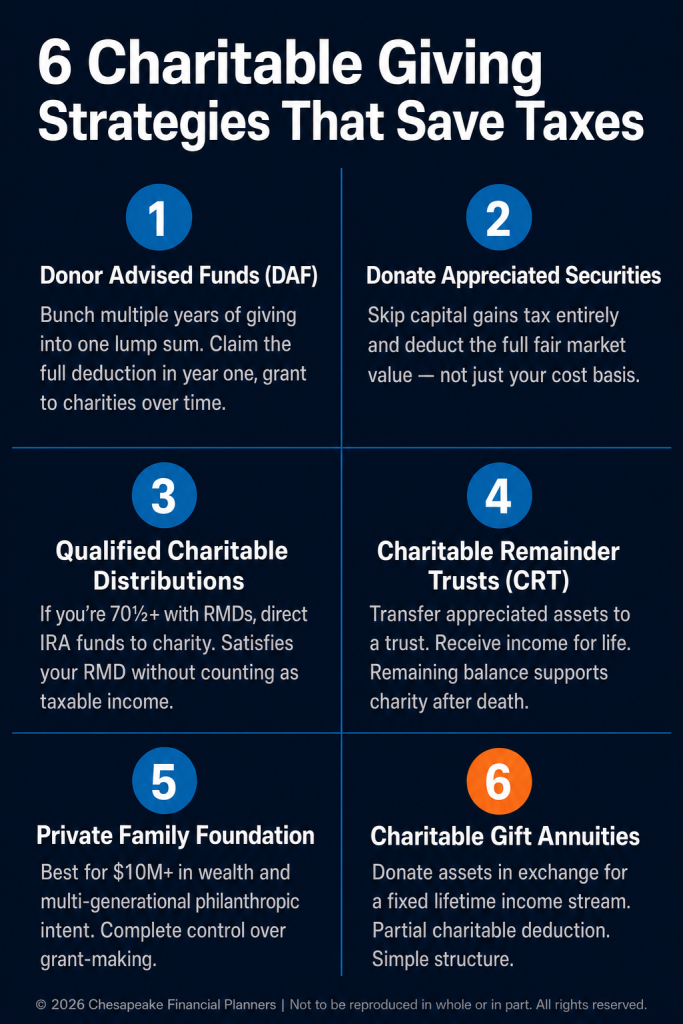
The strategies that save the most pair the right asset with the right vehicle, and six cover almost every situation. Each section below stands on its own, so you can jump to the one that fits.
Donating appreciated securities is usually the highest-value move. If you own stock bought for $50,000 that is now worth $150,000, selling it triggers capital gains tax on the $100,000 gain. Donate the shares directly instead, and you skip that tax entirely while deducting the full $150,000 fair market value. Cash giving cannot match that math.
A donor-advised fund (DAF) solves the standard-deduction problem through bunching. You contribute several years of intended giving in one year, claim the full deduction then, and recommend grants to charities over time as the balance invests and grows. One large year clears the standard deduction; the quiet years take the standard deduction anyway.
Qualified charitable distributions (QCDs) are the retiree's best tool. Starting at age 70½, you can send up to $111,000 directly from an IRA to charity in 2026, and that transfer counts toward your required minimum distribution without adding to your taxable income. As IRS Publication 590-B states plainly, "A qualified charitable distribution will count towards your required minimum distribution." Because it never hits your AGI, a QCD can also hold down Medicare premium surcharges and the taxation of Social Security.
How do trusts, foundations, and gift annuities fit in?
Trusts, foundations, and gift annuities fit the families giving at higher dollar levels who want income, control, or a multi-generational structure alongside the deduction. These are more complex and almost always need an estate attorney, but for the right situation they do what a simple gift cannot.
A charitable remainder trust (CRT) pays you income for life or a set term, then sends the remainder to charity. You transfer appreciated assets in, the trust sells them without immediate capital gains tax, and you take a partial deduction today based on the charity's projected remainder. It suits someone with a large, low-basis position who wants to diversify, generate income, and give.
A private family foundation offers the most control and a vehicle for multi-generational philanthropy, which is why families giving millions over a lifetime use them. The tradeoffs are real: a foundation must pay out at least 5% of its assets each year and owes a 1.39% excise tax on net investment income, plus administrative cost and lower deduction ceilings than public charities. A charitable gift annuity is the simpler cousin: you donate assets to a charity in exchange for fixed lifetime payments, take a partial deduction, and the charity keeps what remains.
Jeff Judge often reminds clients that complexity should follow the gift, not lead it. As Jeff puts it, "A donor-advised fund handles 80% of the families who think they need a private foundation, at a fraction of the cost and hassle." Start with the simplest tool that accomplishes the goal, and add structure only when the dollars and the intent justify it.
How do you choose the right charitable giving strategy?
You choose the right strategy by matching your age, your assets, and your giving level to the vehicle that fits. The table below maps the common situations.
| Your situation | Strategy that usually fits |
|---|---|
| Under 70, give $15,000 to $50,000 a year | Bunch into a donor-advised fund; donate appreciated stock |
| Age 70½+ with required minimum distributions | Use QCDs to satisfy the RMD tax-free |
| Large, low-basis assets and want income | Charitable remainder trust |
| Giving millions, want family involvement | Private family foundation |
| Want simple guaranteed income plus a gift | Charitable gift annuity |
One option deserves a mention even for non-itemizers. Beginning in tax year 2026, taxpayers who take the standard deduction can also deduct up to $1,000, or $2,000 for joint filers, of cash gifts to qualifying charities. It is modest, but it is the first time in years that a non-itemizer gets any charitable benefit, and it stacks on top of the standard deduction.
Run the choice through a real process rather than habit. The R.U.D.D.E.R. Method™ is Chesapeake Financial Planners' six-step planning process: Review and Recognize, Uncover and Understand, Design and Develop, Discuss and Decide, Execute and Empower, and Reassess and Refine. Charitable strategy lands in Design and Develop, where the gift gets matched to the right asset, the right vehicle, and the right year, with your CPA and estate attorney in the room.
Related Topics Worth Reading
Charitable strategy overlaps with tax and estate planning at almost every turn. These related topics round out the picture.
- How donor-advised funds work in depth, including bunching mechanics and grant timing. How Do Donor-Advised Funds Work for Tax Savings?
- The full mechanics of qualified charitable distributions for retirees. How Can I Donate From My IRA and Reduce Taxes?
- How charitable gifts reduce a taxable estate alongside trusts and exemptions. What does a complete estate plan include and where do you start?
- Why donating appreciated stock beats selling it first and giving cash. How Much Will I Pay in Capital Gains Tax?
- How bunching deductions interacts with the standard deduction year to year. How Can Bunching Charitable Deductions Save Me on Taxes?
Frequently Asked Questions
What is the most tax-efficient way to give to charity?
The most tax-efficient way to give for most wealthy families is donating appreciated securities held more than a year. You avoid the capital gains tax you would owe on a sale and still deduct the full fair market value, not just your cost basis. For retirees over 70½, a qualified charitable distribution from an IRA is often even better because it bypasses taxable income entirely.
How does bunching charitable donations work?
Bunching means concentrating several years of charitable giving into a single tax year so your itemized deductions clear the standard deduction, which is $32,200 for couples in 2026. You contribute the lump sum to a donor-advised fund, claim the full deduction that year, then grant to charities over time. In the off years you take the standard deduction, capturing a benefit you would otherwise lose.
What is the QCD limit for 2026?
The qualified charitable distribution limit for 2026 is $111,000 per individual, per IRS Publication 590-B. Each spouse can give up to that amount from their own IRA. You must be at least 70½ on the date of the distribution, and the funds must transfer directly from your IRA custodian to a qualifying charity, never passing through your hands, to avoid being treated as taxable income.
Do I need a private foundation or is a donor-advised fund enough?
Most families are better served by a donor-advised fund than a private foundation because it delivers similar control over grant timing with far less cost and no annual filing burden. A private foundation makes sense when giving reaches into the millions and the family wants direct control, paid roles, or a multi-generational institution. Foundations must distribute at least 5% of assets yearly and pay a 1.39% excise tax on investment income.
Can charitable giving reduce my estate tax?
Yes, charitable giving reduces estate tax because gifts to qualified charities leave your taxable estate dollar for dollar, whether made during life or at death. With the 2026 federal estate exclusion at $15 million per person and a 40% rate above it, charitable bequests and vehicles like charitable remainder trusts can meaningfully cut the estate tax a wealthy family owes while supporting causes they value.
Putting a charitable giving strategy to work
The difference between writing a check and giving strategically can be tens of thousands of dollars in tax savings on the same gift, money that goes to your causes instead of the IRS. The right charitable giving strategies depend on your age, your assets, and how much you give, and they almost always involve a vehicle other than cash. If you found this helpful and want to give more efficiently, our team at Chesapeake Financial Planners works through these strategies with families and their CPAs and attorneys. Visit chesapeakefp.com to learn more.
Please consult your tax professional regarding your specific tax situation.
Want to go deeper? Our Tax-Smart Charitable Giving Playbook walks through this step by step.
Estate planning requires legal assistance. Neither LPL Financial nor its registered representatives offer legal advice.
Disclosures
The information provided is for educational purposes only and should not be construed as investment advice. Investment strategies should be tailored to individual circumstances, risk tolerance, and goals. Past performance doesn't guarantee future results. Consult with qualified financial professionals regarding your specific situation.
Advisors associated with Chesapeake Financial Planners may be either (1) LPL Financial Registered Representatives offering securities through LPL Financial, Member FINRA and SIPC, and investment advisor representatives offering investment advice through Great Valley Advisor Group; or (2) solely investment advisor representatives offering investment advice through Great Valley Advisor Group and not affiliated with LPL Financial. Great Valley Advisor Group, and Chesapeake Financial Planners are separate entities from LPL Financial.


