

How Do Donor-Advised Funds Work for Tax Savings?
Last reviewed: July 2026
A donor-advised fund works for tax savings by giving you an immediate charitable deduction in the year you contribute, while letting you recommend grants to charities later on your own timeline. You fund it with cash or appreciated assets, claim the deduction now, and the money grows tax-free until you give it away. The biggest win comes when you contribute appreciated stock, because you skip capital gains tax and still deduct the full market value. A donor advised fund is the simplest tool most families have for separating the timing of the tax deduction from the timing of the gift.
Key Takeaways
- A donor advised fund gives you an immediate tax deduction now while you recommend grants to charities over time.
- Donating appreciated stock to a DAF avoids capital gains tax and deducts full market value.
- Cash gifts to a DAF are deductible up to 60% of AGI; appreciated securities up to 30% (per IRS rules).
- Bunching several years of giving into one DAF contribution can push you past the 2026 standard deduction of $32,200 for married couples.
About the Author: Jeff Judge, CFP®, AEP®, ChFC®, CLU® is Managing Partner of Chesapeake Financial Planners in Forest Hill, Maryland. He has been helping families and business owners in Harford County and the Baltimore metro area navigate charitable giving and tax strategy since earning his CFP® certification in 2013, by using Chesapeake Financial Planners’ signature process, the R.U.D.D.E.R. method™. Jeff finds that the clients who benefit most from a DAF are the ones sitting on a single low-basis stock position they have been afraid to sell for years.
What Is a Donor-Advised Fund?
A donor-advised fund is a charitable investment account you fund with cash, securities, or other assets in exchange for an immediate tax deduction. The money is invested and grows tax-free, and you recommend grants to qualified charities whenever you choose. Think of it as your own charitable account, minus the legal cost and paperwork of running a private foundation.
You contribute. You deduct. The assets grow. Then you give, on your schedule, to any IRS-qualified 501(c)(3) you want. The charity receives the grant from the fund, not directly from you.
Major sponsors include Fidelity Charitable, Schwab Charitable, Vanguard Charitable, and hundreds of community foundations. According to the National Philanthropic Trust, DAFs now hold well over $200 billion in charitable assets, which tells you how mainstream this tool has become. Jeff Judge often tells clients that the appeal is control without complexity. You get the strategic flexibility of a foundation without the annual tax return, the excise tax, or the legal bills.
How does a donor-advised fund work and who should consider using one?
How Do Donor-Advised Funds Work Step by Step?
A donor-advised fund works in five practical steps, from opening the account to recommending your first grant. The whole setup usually takes less time than opening a brokerage account, and most of the tax benefit lands in year one.
- Open the account. Choose a sponsor and complete the paperwork. Most major sponsors have no minimum to open, though contribution minimums range from roughly $5,000 to $25,000.
- Contribute assets. Fund it with cash, publicly traded securities, private business interests, or real estate. You claim the deduction for the fair market value, subject to IRS AGI limits.
- Invest the balance. Choose an investment pool, from conservative to growth-oriented. All gains inside the fund are tax-free.
- Recommend grants. Suggest grants to any qualified 501(c)(3). Sponsors typically process recommendations within days, and grants can be made anonymously if you prefer.
- Repeat over time. Keep contributing in high-income years and granting in any year, with no requirement to empty the account on a schedule.
That last point matters more than people expect. There is no annual payout requirement on a DAF, which gives you room to build a charitable reserve and give thoughtfully rather than scrambling every December.
What Are the Tax Benefits of a Donor-Advised Fund?
The tax benefits of a donor-advised fund come from three levers that stack together: an immediate deduction, avoided capital gains on appreciated assets, and tax-free growth. Used as a charitable giving strategy, these levers often turn a routine gift into a meaningfully larger one.
The immediate deduction is the headline. Contribute $100,000 to a DAF this year and you claim a $100,000 charitable deduction this year, even if you do not grant a dollar to charity until later. For someone in a high bracket, that single move can cut a tax bill by $30,000 to $40,000.
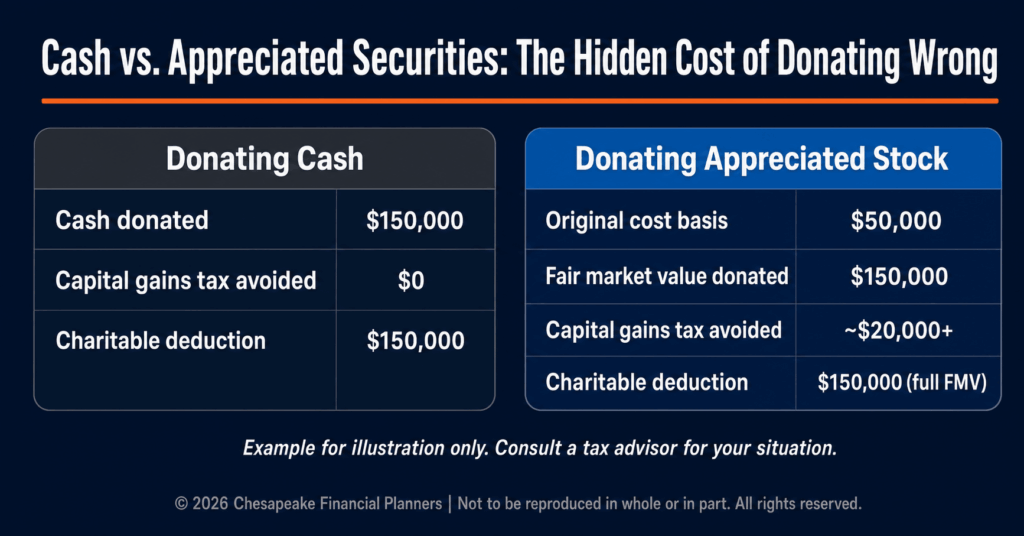
The capital gains avoidance is where the real DAF tax benefits show up. When you donate appreciated stock you held more than a year, you avoid the capital gains tax entirely and still deduct the full market value. Consider a position you bought for $50,000 that is now worth $150,000. Sell it, and you owe federal long-term capital gains tax (15% or 20% depending on income, plus the 3.8% net investment income tax for higher earners). Donate the shares to the DAF instead, and you skip that bill and deduct $150,000. This is exactly why experienced donors rarely give cash. They give appreciated securities. Jeff Judge notes: "When a client donates a highly appreciated stock position directly to their DAF instead of selling it first, they skip the capital gains bill entirely and still deduct the full market value, which on a $100,000 gain can mean $20,000 to $24,000 more actually reaching the causes they care about."
Then growth compounds tax-free inside the fund. Contribute $100,000, let it grow to $150,000 over several years, and the full $150,000 is available for grants with no tax on the gain.
| Tax lever | What it does | Who benefits most |
|---|---|---|
| Immediate deduction | Deduct in the contribution year, give later | Anyone with a high-income year |
| Avoid capital gains | Skip the tax on appreciated assets | Donors holding low-basis stock |
| Tax-free growth | Charitable dollars compound untaxed | Long-horizon givers |
| Bunching | Cross the standard deduction in one year | Steady annual givers |
How does bunching charitable deductions work with a DAF?
Bunching charitable deductions means concentrating several years of giving into one tax year so your itemized deductions clear the standard deduction. With the 2026 standard deduction at $32,200 for married couples filing jointly per the IRS, a household giving $15,000 a year often gets no tax benefit, because their itemized total never beats the standard deduction. Contribute five years of gifts into a DAF at once, itemize that year, then take the standard deduction in the off years while granting from the fund. Jeff Judge has watched this single shift recover tens of thousands in deductions that clients were quietly leaving on the table.
How Can Bunching Charitable Deductions Save Me on Taxes?
Should You Use a DAF or a Private Foundation?
For most families, a donor-advised fund beats a private foundation on cost, deduction limits, and simplicity, while a private foundation wins only when control and family governance are the priority. The choice in the donor advised fund vs private foundation debate usually comes down to how much administrative weight you are willing to carry.
DAFs carry higher deduction ceilings: 60% of AGI for cash and 30% of AGI for appreciated securities, versus 30% and 20% for private foundations under IRC Section 170. They cost less, require no separate tax return, pay no excise tax, and allow anonymous grants. Private foundations give you complete control over investments and grants, a named legacy, and a vehicle for multi-generational family philanthropy, but they come with legal fees, annual filings, a 5% minimum payout, and an excise tax on investment income.
| Feature | Donor-Advised Fund | Private Foundation |
|---|---|---|
| Setup cost | Minimal, no legal fees | Significant legal and setup cost |
| Cash deduction limit | 60% of AGI | 30% of AGI |
| Appreciated securities limit | 30% of AGI | 20% of AGI |
| Annual tax filing | None for the donor | Required (Form 990-PF) |
| Minimum annual payout | None | 5% of assets |
| Excise tax on income | None | Yes |
| Anonymity | Available | Public disclosure |
In Jeff's experience, families drawn to a foundation for the legacy element often get nearly everything they want from a DAF plus a successor advisor arrangement, at a fraction of the ongoing cost. If you are weighing this alongside a broader tax picture, it pays to look at the whole plan.
How can I potentially optimize my taxes as my income grows?
How do you create a family wealth governance structure for long-term success?
How Does a DAF Compare to a Qualified Charitable Distribution?
A DAF and a qualified charitable distribution (QCD) solve different problems, and many retirees use both. A QCD lets you give directly from a traditional IRA to charity after age 70½, satisfying part or all of your required minimum distribution without the gift counting as taxable income. The catch worth knowing: you cannot make a QCD into a donor-advised fund. The two are separate tools. A DAF shines when you want to bunch deductions or give appreciated stock; a QCD shines when you want to reduce taxable IRA income in retirement.
How do qualified charitable distributions work and who benefits most?
Frequently Asked Questions
What is a donor-advised fund in simple terms?
A donor-advised fund is a charitable account you contribute to in exchange for an immediate tax deduction, then use to recommend grants to charities over time. You fund it with cash or assets like appreciated stock, the balance grows tax-free, and you decide later which charities receive the money and when.
Can I deduct a contribution to a donor-advised fund?
Yes, you can deduct a contribution to a donor-advised fund in the year you make it, even if you grant nothing to charity that year. Cash gifts are deductible up to 60% of adjusted gross income and appreciated securities up to 30%, with any excess carried forward for up to five years under IRS rules.
Why donate appreciated stock to a DAF instead of cash?
Donating appreciated stock to a DAF lets you avoid capital gains tax entirely while deducting the full market value of the shares. If you sold the stock first and donated the cash, you would owe tax on the gain. Giving the shares directly captures both the deduction and the avoided capital gains, which is the core DAF tax benefit for high earners.
Is there a minimum amount I have to give from my DAF each year?
No, a donor-advised fund has no required annual payout, unlike a private foundation, which must distribute at least 5% of assets each year. This flexibility lets you build a charitable reserve in a strong income year and give thoughtfully later, though most sponsors encourage active grantmaking over time.
How is a donor advised fund different from a private foundation?
A donor advised fund is simpler and cheaper, with higher deduction limits, no annual tax filing, no excise tax, and no required payout. A private foundation offers complete control over investments and grants plus a named legacy, but carries legal costs, annual filings, a 5% payout rule, and an excise tax on investment income.
Can I name successors to my donor-advised fund?
Yes, most donor-advised fund sponsors let you name successor advisors, such as your children, to continue recommending grants after your death. This makes a DAF a practical tool for multi-generational giving without the cost and administrative burden of forming and maintaining a private foundation across generations.
If you want a clear framework for whether a donor advised fund fits your charitable giving strategy, our guide on tax-smart giving walks through the numbers step by step. Download it at chesapeakefp.com and see how much a single appreciated-stock gift could save you this year.
Want to go deeper? Our Tax-Smart Charitable Giving Playbook walks through this step by step.
Disclosures
The information provided is for educational purposes only and should not be construed as investment advice. Investment strategies should be tailored to individual circumstances, risk tolerance, and goals. Past performance doesn't guarantee future results. Consult with qualified financial professionals regarding your specific situation.
This information is not intended to be a substitute for specific individualized tax, investment or legal advice. We suggest that you discuss your specific situation with a qualified tax, legal or financial advisor.
Advisors associated with Chesapeake Financial Planners may be either (1) LPL Financial Registered Representatives offering securities through LPL Financial, Member FINRA and SIPC, and investment advisor representatives offering investment advice through Great Valley Advisor Group; or (2) solely investment advisor representatives offering investment advice through Great Valley Advisor Group and not affiliated with LPL Financial. Great Valley Advisor Group, and Chesapeake Financial Planners are separate entities from LPL Financial.


