

How Do I Plan for Digital Assets in My Estate?
Last reviewed: July 2026
Digital asset planning is the process of cataloging your online accounts, cryptocurrency, and digital property and giving your executor or trustee the legal authority and practical access to manage them after you die or become incapacitated. The short version: if no one knows an asset exists, and no one can legally access it, that asset is effectively lost. For high-net-worth families, that gap can mean six or seven figures evaporating because a password died with the owner.
Key Takeaways
- Digital asset planning gives your fiduciary the legal authority and the practical access to manage your online accounts and crypto.
- The Revised Uniform Fiduciary Access to Digital Assets Act has been enacted in 46 states plus D.C. and the U.S. Virgin Islands as of 2026.
- Cryptocurrency without recorded access credentials is permanently unrecoverable, unlike a bank account that heirs can claim through legal process.
- A secure inventory plus explicit estate document language is the difference between heirs inheriting your digital wealth and losing it entirely.
About the Author: Jeff Judge, CFP®, AEP®, ChFC®, CLU® is Managing Partner of Chesapeake Financial Planners in Forest Hill, Maryland. He has been helping families and business owners in Harford County and the Baltimore metro area navigate estate planning since earning his CFP® certification in 2013, by using Chesapeake Financial Planners’ signature process, the R.U.D.D.E.R. method™. Jeff has watched more than one family discover, months too late, that the cryptocurrency they knew Dad owned was gone for good because the seed phrase was never written down anywhere.
What Counts as a Digital Asset in Your Estate?
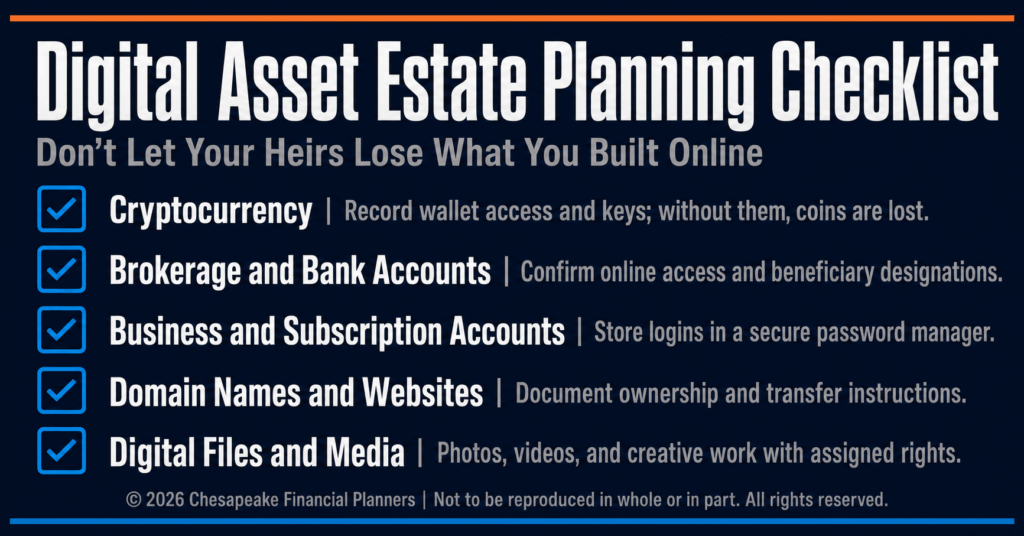
A digital asset is any account, file, or holding that exists in electronic form and requires credentials to access. That definition is broad on purpose, because the planning gap shows up in places people don't expect.
Financial digital assets carry direct monetary value: cryptocurrency wallets, online brokerage and bank logins, PayPal and Venmo balances, and loyalty or rewards points worth real money. Digital property includes domain names, monetized websites, blogs, and online storefronts. Personal digital assets cover email, social media, and cloud-stored photos and documents. Business digital assets include intellectual property, customer databases, and administrative access to the systems your company runs on.
Here's the part people miss. Without planning, your family may not know these assets exist at all, may lack the credentials to reach them, and may run straight into service providers who refuse access even to legitimate heirs. Three separate failure points, and any one of them can lock an asset away permanently. This is exactly the kind of detail that gets missed when wills and trusts focus only on physical and traditional financial property.
Why Is Cryptocurrency the Hardest Digital Asset to Plan For?
Cryptocurrency is the hardest digital asset to plan for because it is designed for self-custody, which means there is no institution to call and no recovery process when the owner dies. If you are the only person who knows your private keys or seed phrase, those coins become permanently inaccessible the moment you are gone.
Compare that to a forgotten bank account. Heirs can claim a dormant bank account through legal channels because a regulated institution holds the asset and has a recovery procedure. Crypto held in a self-custody wallet has neither. Industry analysis from Chainalysis has estimated that roughly 20% of all Bitcoin sits in wallets that appear lost or inaccessible, much of it tied to owners who died or lost their keys without a backup. That is billions of dollars in unrecoverable wealth, and a meaningful share traces back to missing estate planning.
The planning tension is real. Good crypto security means keeping private keys offline, using a hardware wallet, and never sharing credentials. Good estate planning means someone trustworthy can access those same coins after you die. Jeff Judge often tells clients that the goal is not to weaken security, but to build a controlled, documented path that only activates when it should.
What Is the Legal Framework for Fiduciary Access?
The legal backbone for digital asset access is the Revised Uniform Fiduciary Access to Digital Assets Act, known as RUFADAA. According to the Uniform Law Commission, this model law has been enacted in 46 states plus the District of Columbia and the U.S. Virgin Islands as of 2026, giving executors, trustees, and agents under power of attorney a statutory path to access and manage digital assets.
RUFADAA does not override the terms of service you agreed to when you opened each account. Many providers restrict access to the original account holder unless you used the provider's own designation tool to authorize someone else. Some platforms prohibit transfer entirely and simply close the account at death. The law gives your fiduciary standing; the provider's settings often decide what actually happens.
Effective planning means sorting your assets into three buckets: those governed by your state's digital asset law, those controlled by provider terms of service, and those sitting in a gray area between the two. Each bucket needs a different instruction.
How Do You Build and Store a Digital Asset Inventory?
Building a digital asset inventory means creating a complete list of every account, wallet, and digital property, then storing it somewhere both secure and reachable by the right person. Without the inventory, your family is searching blind, and most never find everything.
A workable inventory lists online accounts with login methods, cryptocurrency holdings with wallet types and exchange accounts, digital property with registrar and hosting details, and business access information. For crypto specifically, document wallet locations, hardware device locations, where seed phrases are stored, and any multi-signature requirements, without writing the actual keys into a single exposed document.
Storage is where most plans fail. A password on paper in a desk drawer is neither secure nor durable, and keeping it all in your head means it disappears with you. Better options:
- Use a password manager with an emergency access feature, which grants a designated person access after a waiting period if you do not respond.
- Split highly sensitive crypto credentials across separate secure locations, so no single breach exposes everything.
- Tell your executor where the master instructions live, such as a safe deposit box or your estate attorney's files, without handing over the keys today.
This is one place where Jeff's R.U.D.D.E.R. Method™ earns its keep. The R.U.D.D.E.R. Method™ is Chesapeake Financial Planners' six-step planning process: Review and Recognize, Uncover and Understand, Design and Develop, Discuss and Decide, Execute and Empower, and Reassess and Refine. The Uncover and Understand step is built for exactly this kind of asset that clients forget to mention until someone asks the right question.
What Estate Documents Need Digital Asset Language?
Your core estate documents need explicit digital asset language, because generic wills and powers of attorney often fail to satisfy providers. A power of attorney should specifically authorize your agent to access digital accounts, online financial systems, and electronic communications during any period of incapacity. Without that exact authority, many providers refuse access even to a legally appointed agent.
Your will or trust should name who receives which accounts, files, and digital property, and should grant your executor or trustee authority to search for and access digital assets. Many families pair these documents with a separate digital asset memorandum, a living instruction sheet referenced in the will but updated independently as passwords change, so you are not amending your will every time you reset a login. Powers of attorney and the documents around them are foundational here, which is why digital instructions should sit alongside the rest of your incapacity planning rather than as an afterthought.
Service-specific tools matter too. Google's Inactive Account Manager, Apple's Legacy Contact, and Facebook's legacy contact setting let you designate who handles your accounts. These only work if you configure them in advance, so treat them as backup layers to your legal documents, not replacements.
Frequently Asked Questions
What happens to cryptocurrency if I die without sharing access?
If you die without recording your private keys or seed phrase anywhere your heirs can reach, the cryptocurrency is permanently lost. There is no bank, exchange recovery process, or court order that can recreate a self-custody key. The coins remain on the blockchain forever, but no one can ever move or spend them.
Does a regular will cover my online accounts and digital assets?
A regular will often does not adequately cover digital assets unless it includes explicit language authorizing your executor to access them. Many providers refuse access without specific authorization, and your will alone cannot override their terms of service. Pair your will with a digital asset memorandum and provider-level legacy settings for full coverage.
What is the Revised Uniform Fiduciary Access to Digital Assets Act?
The Revised Uniform Fiduciary Access to Digital Assets Act, or RUFADAA, is a model law giving executors, trustees, and agents legal authority to access a person's digital assets. According to the Uniform Law Commission, it has been enacted in 46 states plus D.C. and the U.S. Virgin Islands as of 2026, though provider terms of service can still limit actual access.
How should I store my digital asset passwords for my heirs?
Store digital asset passwords in a password manager with an emergency access feature, which releases access to a designated person after a waiting period. For highly sensitive crypto credentials, split the information across separate secure locations. Avoid keeping everything in one paper document, which is both insecure and easily lost.
Should I plan for digital assets during incapacity, not just death?
Yes, incapacity planning for digital assets is equally important, because if you cannot manage your own affairs someone must still pay bills, manage investments, and handle time-sensitive accounts. Your durable power of attorney must explicitly authorize digital access, and your agent needs current credentials stored securely to act on your behalf.
What happens to a business that runs entirely online when the owner dies?
An online business can lose substantial value or stop operating entirely if no one has administrative access and documented processes when the owner dies. Your estate plan should state whether the business continues, sells, or shuts down, and should give your fiduciary the access and instructions needed to keep revenue flowing during administration.
If you want a clear, organized way to capture all of this before it becomes a problem, our estate planning resources walk you through building a complete digital asset inventory step by step. Download our estate planning guide at chesapeakefp.com to get started, and bring your questions when you are ready to talk through your specific situation.
What Is a Financial Power of Attorney and Why Do I Need One?
What is a will and do I need one for my estate?
Do I need to update my beneficiary designations after a divorce or major life change?
Want to go deeper? Our Estate Document Locator walks through this step by step.
Disclosures
The information provided is for educational purposes only and should not be construed as investment advice. Investment strategies should be tailored to individual circumstances, risk tolerance, and goals. Past performance doesn't guarantee future results. Consult with qualified financial professionals regarding your specific situation.
Advisors associated with Chesapeake Financial Planners may be either (1) LPL Financial Registered Representatives offering securities through LPL Financial, Member FINRA and SIPC, and investment advisor representatives offering investment advice through Great Valley Advisor Group; or (2) solely investment advisor representatives offering investment advice through Great Valley Advisor Group and not affiliated with LPL Financial. Great Valley Advisor Group, and Chesapeake Financial Planners are separate entities from LPL Financial.


