

How Much Umbrella Insurance Coverage Do I Need?
Last reviewed: July 2026
Most people need umbrella insurance coverage equal to their net worth, typically starting at $1 million and rising to $5 million or more for high-net-worth households. An umbrella policy sits on top of your auto and homeowners liability limits and pays out when those limits are exhausted. If you've built real assets, this is the cheapest serious protection you can buy.
Key Takeaways
- Carry umbrella insurance coverage that matches or exceeds your total net worth to avoid exposing personal assets in a lawsuit.
- A $1 million umbrella policy often costs between $150 and $300 per year, according to the Insurance Information Institute.
- Umbrella coverage extends your existing auto and homeowners liability limits and pays legal defense costs.
- Standard auto and homeowners policies usually cap liability at $300,000 to $500,000, leaving a large gap.
- Umbrella policies cover personal liability only, not business activities or professional malpractice.
About the Author: Jeff Judge, CFP®, AEP®, ChFC®, CLU® is Managing Partner of Chesapeake Financial Planners in Forest Hill, Maryland. He has been helping families and business owners in Harford County and the Baltimore metro area navigate asset protection and risk management since earning his CFP® certification in 2013, by using Chesapeake Financial Planners’ signature process, the R.U.D.D.E.R. method™. Jeff has watched clients with seven-figure portfolios carry the same $300,000 auto liability limit they set up in their thirties, and that gap is the single most common hole he finds in an otherwise solid plan.
When clients walk into a review with a healthy portfolio and a paid-off house, the conversation usually centers on investments and taxes. But the fastest way to lose a chunk of that wealth isn't a market crash. It's a lawsuit you didn't see coming. Umbrella insurance is the quiet line item that protects everything else you've built.
What Is Umbrella Liability Insurance?
Umbrella insurance is a liability policy that pays out above the limits of your underlying auto, homeowners, and watercraft policies. It activates only after you've exhausted those primary limits, which is why it's called "umbrella" coverage. It also broadens protection to certain claims your base policies may exclude, such as libel, slander, and false arrest.
Here's how it works in practice. You cause a serious car accident, and the injured party's medical bills, lost wages, and damages total $2 million. Your auto policy covers $500,000, its limit. A $2 million umbrella policy covers the remaining $1.5 million. Without that umbrella, you'd be personally liable for the difference, which could mean liquidating retirement accounts, selling property, or facing bankruptcy.
The Insurance Information Institute notes that umbrella policies typically provide coverage in million-dollar increments, making it straightforward to layer protection to your exact need. For most households, the policy never pays a claim. But the year it does, it can be the difference between a stressful event and a financial catastrophe.
How Much Umbrella Coverage Do You Need?
The working rule most planners use: carry umbrella coverage equal to your net worth, and round up if you have above-average exposure. A plaintiff's attorney can discover your assets during litigation, and the size of a settlement demand often tracks what you can actually pay.
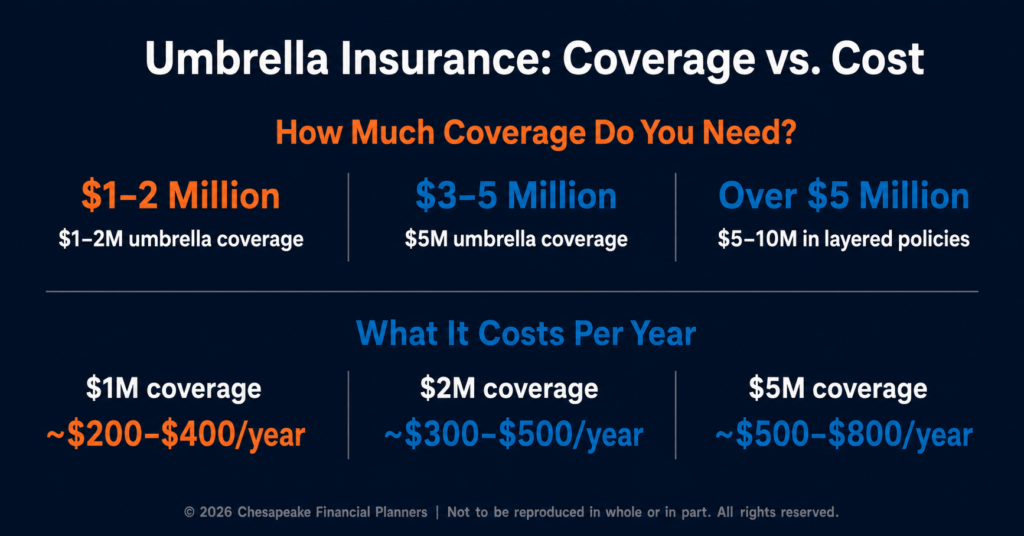
The table below shows a common starting framework based on net worth.
| Net Worth | Suggested Umbrella Coverage | Notes |
|---|---|---|
| $500,000 – $1 million | $1 million | Minimum most carriers offer |
| $1 – $3 million | $2 – $3 million | Match assets you'd hate to lose |
| $3 – $5 million | $5 million | Standard high-net-worth tier |
| Over $5 million | $5 – $10 million | May require layering multiple policies |
If you have $3 million in assets but only $1 million in umbrella coverage, you remain personally exposed for the $2 million gap. That's the scenario Jeff sees most often. People buy "some" umbrella coverage years ago and never revisit it as their net worth climbs. The policy that fit a $1 million household doesn't fit a $4 million one.
Your exposure isn't only about what you own today. It also reflects lifestyle risk: teenage drivers, a pool, a dog, rental property, frequent entertaining, or serving on a nonprofit board. Each of those raises the odds of a claim, and each argues for coverage above the bare net-worth match. This is exactly the kind of trade-off the [R.U.D.D.E.R. Method™ is Chesapeake Financial Planners' six-step planning process: Review and Recognize, Uncover and Understand, Design and Develop, Discuss and Decide, Execute and Empower, and Reassess and Refine.] surfaces during the Uncover and Understand stage, where hidden liability gaps tend to hide.
What Does Umbrella Insurance Cover and Exclude?
Umbrella policies provide broad personal liability protection, but they aren't unlimited. Knowing what's in and what's out prevents an expensive surprise at claim time.
What umbrella insurance typically covers:
- Bodily injury liability: Injuries you cause to others in car accidents, at your home, or through other personal activities.
- Property damage liability: Damage you cause to someone else's property beyond your base policy limits.
- Personal injury claims: Libel, slander, defamation, false arrest, and invasion of privacy, which standard homeowners policies often exclude.
- Legal defense costs: Attorney fees and defense expenses, frequently paid outside your policy limits, even when a suit is frivolous.
What umbrella insurance does not cover:
- Intentional acts: Deliberate harm you cause is never covered.
- Business and professional liability: Personal umbrella policies exclude business activities and professional malpractice. Those require commercial or professional liability insurance.
- Your own injuries or property: Umbrella coverage protects others from you, not you from your own losses.
- Contractual liability: Obligations you assume by contract may fall outside the policy.
According to the National Association of Insurance Commissioners, consumers should always review policy exclusions and the underlying limits a carrier requires before binding coverage. Most insurers mandate minimum underlying liability, often $250,000 to $300,000 on auto and homeowners, before they'll write an umbrella over the top.
How Much Does Umbrella Insurance Cost?
Umbrella insurance is one of the best value-per-dollar protections in personal finance. The Insurance Information Institute reports that a $1 million policy commonly runs about $150 to $300 per year, with each additional million costing far less than the first.
Typical annual premium ranges look like this:
- $1 million in coverage: roughly $150 to $300 per year
- $2 million in coverage: roughly $250 to $500 per year
- $5 million in coverage: roughly $400 to $800 per year
The reason it's so cheap is simple. Umbrella policies pay only after your underlying insurance is exhausted, and large claims are statistically rare, so carriers can offer high limits at low cost. Factors that move your premium include the number of homes and vehicles you own, household drivers, rental properties, and named higher-risk features like pools or trampolines.
Jeff often tells clients that the math here is lopsided in their favor. Spending a few hundred dollars a year to shield several million in assets is one of the clearest risk-management decisions a household can make, and it pairs naturally with broader How can I potentially optimize my taxes as my income grows? and estate work.
How Does Umbrella Insurance Fit Into Your Estate Plan?
Asset protection and estate planning are two sides of the same coin. An umbrella policy protects the assets you intend to pass on, so an uninsured judgment doesn't quietly drain the estate you spent decades building. It works alongside, not instead of, trusts, What Is a Financial Power of Attorney and Why Do I Need One?, and properly titled accounts.
For households layering protection, the order matters: confirm adequate underlying limits, add umbrella coverage to net worth, then coordinate with your estate documents and beneficiary designations so nothing falls through the cracks. Reviewing this every few years, especially after a windfall, a property purchase, or a How Do I Protect My Children's Inheritance in a Blended Family? situation, keeps coverage aligned with reality. Jeff treats it as a standing item in every comprehensive plan review rather than a one-time purchase.
Frequently Asked Questions
How much umbrella insurance coverage do I need?
You generally need umbrella insurance coverage equal to your total net worth, with $1 million as a practical minimum. Households with $3 to $5 million in assets typically carry $5 million in coverage. Higher lifestyle risks, like teen drivers or rental property, justify carrying more than the net-worth match.
How much does a $1 million umbrella policy cost?
A $1 million umbrella policy commonly costs between $150 and $300 per year, according to the Insurance Information Institute. Each additional million in coverage usually costs less than the first because large claims are statistically rare. Your final premium depends on homes, vehicles, drivers, and higher-risk features such as pools.
Does umbrella insurance cover business liability?
No, a personal umbrella policy does not cover business activities or professional malpractice. It covers personal liability only, such as injuries you cause in a car accident or at your home. Business exposure requires commercial general liability coverage, and professional services require separate professional liability or malpractice insurance.
What does umbrella insurance not cover?
Umbrella insurance does not cover intentional acts, business activities, professional malpractice, your own injuries, or your own property damage. It also may exclude liability you assume by contract. The policy protects others from harm you cause, not your personal losses, so always review the specific exclusions before binding coverage.
Do I need umbrella insurance if I have homeowners and auto insurance?
You likely need umbrella insurance even with homeowners and auto coverage, because those policies typically cap liability at $300,000 to $500,000. A serious accident or lawsuit can easily exceed those limits. Umbrella coverage extends your liability protection by millions of dollars for a relatively small annual premium.
How is umbrella coverage different from my auto liability limits?
Umbrella coverage sits above your auto and homeowners liability limits and pays only after those primary limits are exhausted. It also broadens protection to certain claims, like libel and false arrest, that base policies often exclude. Your auto limits are the first layer; the umbrella is the backstop for catastrophic claims.
If you've built meaningful net worth, umbrella insurance coverage is the kind of protection you hope to never use but can't afford to skip. To go deeper on protecting what you've built, download our guide to asset protection and risk planning for high-net-worth families at chesapeakefp.com.
Want to go deeper? Our Busy Professional's Guide to Making Financial Progress walks through this step by step.
Disclosures
The information provided is for educational purposes only and should not be construed as investment advice. Investment strategies should be tailored to individual circumstances, risk tolerance, and goals. Past performance doesn't guarantee future results. Consult with qualified financial professionals regarding your specific situation.
This material is for educational purposes only. Insurance products contain exclusions, limitations, and terms for keeping them in force. Please contact a qualified insurance professional for costs and complete details.
Advisors associated with Chesapeake Financial Planners may be either (1) LPL Financial Registered Representatives offering securities through LPL Financial, Member FINRA and SIPC, and investment advisor representatives offering investment advice through Great Valley Advisor Group; or (2) solely investment advisor representatives offering investment advice through Great Valley Advisor Group and not affiliated with LPL Financial. Great Valley Advisor Group, and Chesapeake Financial Planners are separate entities from LPL Financial.


