

What Is Umbrella Insurance and Do You Need It?
Last reviewed: July 2026
Umbrella insurance is extra liability coverage that kicks in after the limits on your home, auto, or boat policies run out. It protects your savings, your home equity, and your future income when a lawsuit or claim exceeds what your underlying policies will pay. Most people who own a home, earn a steady income, or have assets worth protecting should carry a personal umbrella policy because the cost is low and the downside it covers is enormous.
Key Takeaways
- Umbrella insurance adds liability coverage on top of your auto and home policies, usually in $1 million increments.
- According to the Insurance Information Institute, umbrella policies often cost $150 to $300 per year for the first $1 million in coverage.
- You likely need an umbrella policy if your net worth or future income exceeds your existing liability limits.
- Umbrella coverage pays for legal defense costs, which can run into six figures even when you win.
About the Author: Jeff Judge, CFP®, AEP®, ChFC®, CLU® is Managing Partner of Chesapeake Financial Planners in Forest Hill, Maryland. He has been helping families and business owners in Harford County and the Baltimore metro area navigate risk management and asset protection since earning his CFP® certification in 2013, by using Chesapeake Financial Planners’ signature process, the R.U.D.D.E.R. method™. Jeff has seen more than one family build a careful retirement plan, then watch a single at-fault accident threaten it because they skipped a policy that cost less than their monthly streaming bills.
What Is Umbrella Insurance and How Does It Work?
Umbrella insurance is a form of personal liability insurance that sits above your existing auto, homeowners, and other property policies. When you cause an accident or injury and the damages exceed the liability limit on the underlying policy, the umbrella policy pays the difference up to its own limit.
Here is the mechanics of it. Say your auto policy carries $250,000 in bodily injury liability. You cause a serious accident, and the injured party wins a $900,000 judgment. Your auto policy pays its $250,000 limit. Your $1 million umbrella policy then covers the remaining $650,000. Without the umbrella, that $650,000 comes out of your savings, your home equity, and potentially your future wages through garnishment.
Umbrella policies are sold in increments, typically starting at $1 million and rising to $5 million or more for households with significant assets. The coverage is broad. It applies across your auto, home, and often watercraft policies at the same time, and in many cases it covers liability situations your base policies exclude, such as libel, slander, and false arrest.
One thing worth understanding: an umbrella policy almost always requires you to carry minimum liability limits on the underlying policies first. Insurers commonly require $250,000 to $300,000 of auto liability and $300,000 of homeowners liability before they will sell you an umbrella. This is the "underlying limit" requirement, and it is non-negotiable with most carriers.
What are the fundamentals of personal financial planning?

Who Needs Umbrella Insurance?
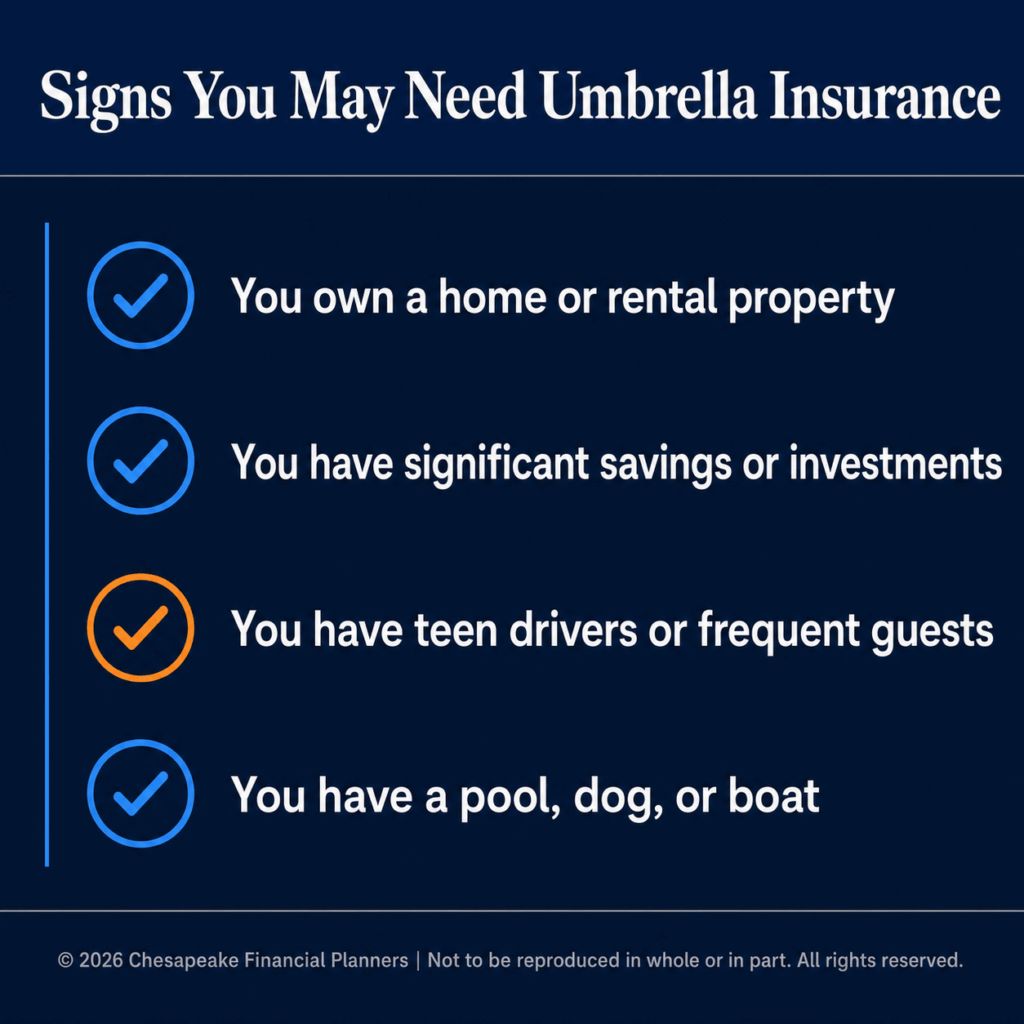
You need umbrella insurance if you have assets or future income worth protecting from a liability judgment. That description fits far more people than it sounds like at first.
The common assumption is that umbrella coverage is only for the wealthy. It is not. A liability judgment can attach to future earnings, not just current assets. A 35-year-old with a modest net worth but a strong income stream is a target for plaintiff attorneys because that income can be garnished for years. According to the Insurance Information Institute, umbrella insurance is recommended for anyone whose assets or income exceed their current liability coverage.
Certain situations raise your liability exposure sharply and make an umbrella policy close to essential:
- You own your home. Home equity is a reachable asset in a judgment, and homeowners face premises liability for injuries on their property.
- You have teenage drivers. Young drivers carry higher accident rates, and you, as the policy owner, carry the liability.
- You own a swimming pool, trampoline, or dog. These are classic "attractive nuisance" and bite-risk exposures that drive liability claims.
- You rent out property. Landlords face tenant and visitor injury claims that can exceed standard policy limits.
- You serve on a nonprofit board or coach youth sports. Volunteer roles can carry personal liability that surprises people.
- You have a public profile or active social media presence. Defamation and personal injury claims fall under many umbrella policies.
Jeff Judge often tells clients to think about umbrella coverage the way they think about the seatbelt in their car. You do not buy it expecting the crash. You buy it because the one time you need it, nothing else will do the job. In his experience, the clients who resist umbrella coverage the hardest are usually the ones whose careful planning would be most damaged by a single uncovered judgment.
How Much Should I Have in My Emergency Fund?
How Much Does Umbrella Insurance Cost and How Much Should You Carry?
Umbrella insurance is one of the least expensive forms of coverage relative to the protection it provides. According to the Insurance Information Institute, a $1 million personal umbrella policy commonly costs between $150 and $300 per year. Each additional $1 million of coverage typically adds roughly $75 to $100 per year, so the marginal cost of more protection is small.
The pricing works this way because umbrella claims are infrequent but severe. The insurer is covering a low-probability, high-cost event, and spreading that risk across many policyholders keeps the premium low for each one.
The harder question is how much to carry. A practical rule used by many planners is to carry umbrella coverage at least equal to your net worth, and ideally enough to cover your net worth plus a reasonable estimate of your future income that could be exposed to garnishment.
Here is a simple way to size it:
| Your situation | Suggested umbrella coverage |
|---|---|
| Net worth under $500,000, steady income | $1 million |
| Net worth $500,000 to $1 million | $1 million to $2 million |
| Net worth $1 million to $3 million | $2 million to $5 million |
| Net worth above $3 million or high public exposure | $5 million or more, plus a coverage review |
This is where umbrella coverage fits into a broader plan. At Chesapeake Financial Planners, risk management is part of the R.U.D.D.E.R. Method™, which is Chesapeake Financial Planners' six-step planning process: Review and Recognize, Uncover and Understand, Design and Develop, Discuss and Decide, Execute and Empower, and Reassess and Refine. Liability gaps tend to surface during the Review and Recognize stage, when we map a household's full asset picture against the coverage actually in place.
How much does it cost to hire a financial planner in 2026?
What Does Umbrella Insurance Not Cover?
Umbrella insurance covers personal liability, not your own losses, and it does not cover everything. Knowing the gaps matters as much as knowing the coverage.
An umbrella policy generally does not cover:
- Your own injuries or property damage. It pays third parties you are liable to, not your own losses.
- Business liability. Personal umbrellas exclude business activities. Business owners need a separate commercial umbrella.
- Intentional or criminal acts. Damage you cause on purpose is excluded.
- Contractual liability. Obligations you take on by contract are usually outside the policy.
- Liability from certain vehicles or activities unless specifically scheduled, such as some recreational vehicles or aircraft.
This is the point where the right structure matters. A personal umbrella protects your household, but a business owner who relies on it for business exposure has a dangerous gap. Jeff has watched business owners assume their personal umbrella covered a client injury at their office. It did not, and the discovery came at the worst possible moment.
Why Do Your Money Values Matter More Than Your Investment Choices?
Frequently Asked Questions
What is umbrella insurance in simple terms?
Umbrella insurance is extra personal liability coverage that pays out after your auto, home, or boat policy limits are exhausted. If you cause an accident and the damages exceed your underlying policy limit, the umbrella policy covers the remaining amount up to its limit, protecting your savings and future income from a large judgment.
Do I really need umbrella insurance if I am not wealthy?
Yes, you likely need umbrella insurance even with modest assets, because a liability judgment can be collected from your future income through wage garnishment, not just your current savings. Anyone with a home, a steady paycheck, teenage drivers, or property that attracts injury claims faces exposure that a low-cost umbrella policy is designed to cover.
How much umbrella insurance should I carry?
You should generally carry umbrella coverage at least equal to your net worth, and ideally enough to cover your net worth plus some of your future income. A household with $700,000 in net worth often carries $1 million to $2 million in umbrella coverage. People with higher net worth or public exposure should consider $5 million or more and a formal coverage review.
How much does umbrella insurance cost per year?
According to the Insurance Information Institute, a $1 million personal umbrella policy typically costs between $150 and $300 per year. Each additional $1 million of coverage usually adds about $75 to $100 annually. The premium is low because umbrella claims are rare but severe, allowing insurers to spread the risk across many policyholders.
What does umbrella insurance not cover?
Umbrella insurance does not cover your own injuries or property damage, business liability, intentional or criminal acts, or most contractual obligations. It pays third parties you are legally liable to, not your own losses. Business owners need a separate commercial umbrella policy, since personal umbrellas exclude business activities entirely.
Does umbrella insurance cover legal defense costs?
Yes, umbrella policies typically cover legal defense costs, often in addition to the policy limit. This matters because defending even a meritless lawsuit can cost six figures. The defense coverage is one of the most valuable and least understood benefits of a personal umbrella policy, since legal fees mount whether or not you ultimately owe damages.
Where Umbrella Insurance Fits in Your Plan
Umbrella insurance is one of the highest-value, lowest-cost moves in personal risk management, and most households that need it do not have it. The right amount of coverage depends on your full financial picture: your assets, your income, your exposures, and the gaps in your existing policies. If you want a clear-eyed look at whether your liability coverage matches your actual risk, our guide to building a complete financial foundation covers where risk management fits alongside saving, investing, and planning. Download it at chesapeakefp.com to see how the pieces connect.
Want to go deeper? Our Why Financial Advice Isn’t Just for Retirees walks through this step by step.
Disclosures
The information provided is for educational purposes only and should not be construed as investment advice. Investment strategies should be tailored to individual circumstances, risk tolerance, and goals. Past performance doesn't guarantee future results. Consult with qualified financial professionals regarding your specific situation.
This material is for educational purposes only. Insurance products contain exclusions, limitations, and terms for keeping them in force. Please contact a qualified insurance professional for costs and complete details.
Advisors associated with Chesapeake Financial Planners may be either (1) LPL Financial Registered Representatives offering securities through LPL Financial, Member FINRA and SIPC, and investment advisor representatives offering investment advice through Great Valley Advisor Group; or (2) solely investment advisor representatives offering investment advice through Great Valley Advisor Group and not affiliated with LPL Financial. Great Valley Advisor Group, and Chesapeake Financial Planners are separate entities from LPL Financial.


