

Should I buy term or whole life insurance?
Last reviewed: July 2026
Term life insurance is the right choice for most people, especially young families needing a lot of affordable coverage for a defined period, while whole life makes sense for specific permanent needs like estate liquidity, a special-needs dependent, or business succession, if you can afford it without shortchanging more important goals. There is no universally better product; the choice depends on whether your need is temporary or lifelong, your budget, and your goals. The key is to cut through the sales pitches on both sides and match the policy to your actual situation.
On This Page
- Key Takeaways
- How does term life insurance work, and what are its trade-offs?
- How does whole life insurance work, and what are its trade-offs?
- Which one should you choose?
- Related Topics Worth Reading
- Frequently Asked Questions
- Protecting the people who depend on you
- Disclosures
Key Takeaways
- Term life covers a set period (often 10 to 30 years) at low cost; whole life covers your whole life and builds cash value, at much higher cost.
- Term is dramatically cheaper for the same death benefit, often many times less, making it ideal for high coverage on a budget.
- Whole life's cash value grows tax-deferred with a guaranteed component plus non-guaranteed dividends, but early cash value is low and returns are modest.
- For most families, term plus disciplined investing fits best; whole life suits specific permanent or estate-planning needs.
- A death benefit is generally income-tax-free to beneficiaries, one of life insurance's most valuable features for protecting a family.
About the Author: Jeff Judge, CFP®, AEP®, ChFC®, CLU® is Managing Partner of Chesapeake Financial Planners in Forest Hill, Maryland. As a Chartered Life Underwriter®, he has helped Harford County and Baltimore-area families choose appropriate coverage since earning his CFP® certification in 2013, by using Chesapeake Financial Planners’ signature process, the R.U.D.D.E.R. method™. As Jeff puts it: "The term-versus-whole-life debate generates more heat than light; the honest answer is that term fits most families' real needs, while whole life is a specialized tool for specific permanent goals, and the right call is about your situation, not anyone's sales pitch."
How does term life insurance work, and what are its trade-offs?
Term life insurance provides coverage for a set period at a low, level premium, paying a death benefit if you die during the term and nothing if you outlive it. Its strengths are affordability and simplicity; its limit is that it is temporary.
As FINRA describes it, "Term life provides coverage for a specified and limited period, known as the term," and you can read the regulator's overview of life insurance types for how each works. With term life, you choose a coverage amount (often a multiple of your income, frequently in the range of 10 to 15 times annual income), a term length matched to your need (commonly until the kids are grown or the mortgage is paid off), and a premium that stays level for that term.
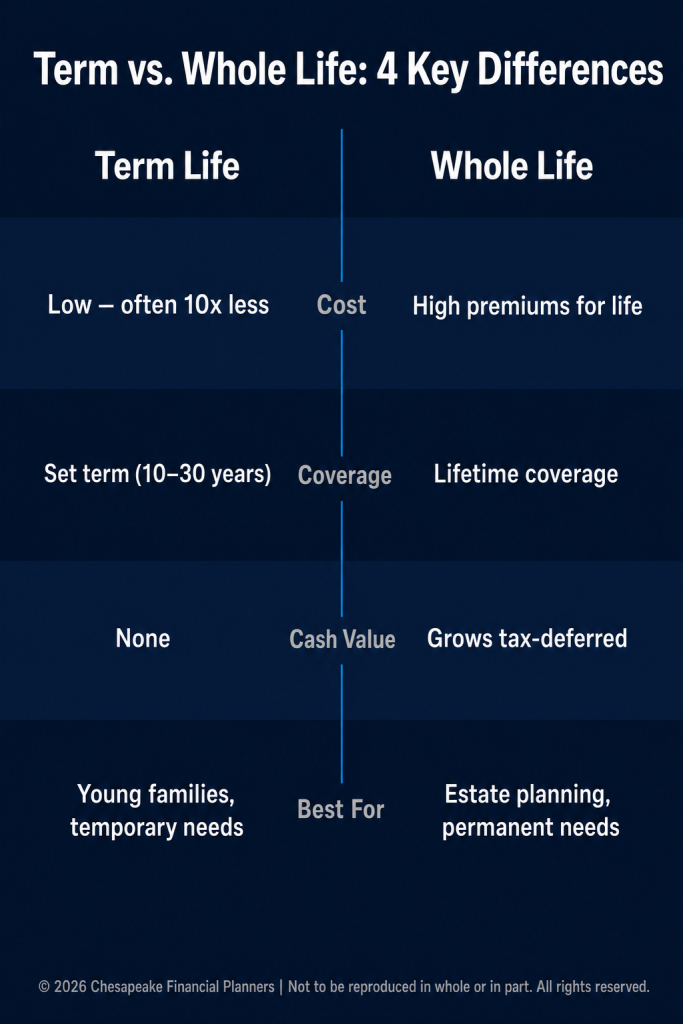
| Feature | Term life | Whole life |
|---|---|---|
| Cost | Low, often many times less | High premiums for life |
| Coverage | Set term (10 to 30 years) | Lifetime coverage |
| Cash value | None | Grows tax-deferred |
| Best for | Young families, temporary needs | Estate planning, permanent needs |
If you die within the term, your beneficiaries receive the death benefit income-tax-free; if you outlive it, coverage simply ends. The advantages are real: term is dramatically cheaper than whole life for the same death benefit, often many times less, which lets a young family afford the high coverage it needs; it is simple, with no investment component to complicate it; and it is flexible, letting you match coverage to a specific window of high need. The "buy term and invest the difference" idea follows directly, because the premium savings can be invested in retirement accounts, such as a Roth IRA (with a 2026 contribution limit of $7,500) or a 401(k), potentially building more wealth than a whole life policy's cash value, though investment outcomes are never guaranteed.
The trade-offs are equally clear. Term builds no cash value, so if you outlive the policy you have paid premiums for years with nothing returned beyond the protection you had. Coverage ends at the term's close, and buying a new policy later will cost much more due to age and any health changes. And it does not fit genuinely permanent needs like estate liquidity or lifelong final-expense coverage. For most people, those limits are perfectly acceptable, because the need for life insurance is itself temporary, ending once the kids are independent and the mortgage and retirement savings are handled.
How does whole life insurance work, and what are its trade-offs?
Whole life insurance provides lifetime coverage plus a cash value that grows tax-deferred, in exchange for much higher premiums. Its strengths are permanence and tax-advantaged cash value; its drawbacks are cost, complexity, and modest returns.
With whole life, you pay a fixed premium (for life or a set period), part of which funds the death benefit and part of which builds a cash value account. That cash value grows at a guaranteed rate, often in a low single-digit range, plus potential dividends from the insurer, which are not guaranteed, and you can borrow against or withdraw from it while living; the IRS treats cash-value growth and policy loans under specific rules worth understanding before relying on them. The benefits are genuine: coverage lasts your whole life as long as premiums are paid, so you never outlive it; the cash value accumulates and can be accessed via loans or withdrawals; the tax treatment is favorable, with tax-deferred cash-value growth, generally income-tax-free death benefits, and tax-free policy loans while the policy stays in force; the fixed premium acts as forced savings for those who struggle to save; and it can serve estate-planning goals like providing liquidity to pay estate taxes or equalizing inheritances, which matters most for estates near the $15 million federal estate tax exclusion for 2026 where an irrevocable life insurance trust can keep the death benefit outside the taxable estate.
The drawbacks are why whole life is not right for everyone. It is far more expensive than term for the same death benefit, often many times the premium. It is complex, with features like dividends, paid-up additions, and surrender charges that are hard to evaluate. Early cash value is low, because in the first years most of the premium goes to insurance costs and commissions, so canceling early can return little or nothing. The returns on cash value are modest, the guaranteed rate is typically below long-term market potential, and after the embedded insurance costs the effective return is often low. And there is opportunity cost: the dollars going to high premiums could potentially earn more invested elsewhere. These trade-offs make whole life a specialized tool rather than a default. Weighing it honestly against your alternatives is exactly the kind of analysis the R.U.D.D.E.R. Method™ supports. The R.U.D.D.E.R. Method™ is Chesapeake Financial Planners' six-step planning process: Review and Recognize, Uncover and Understand, Design and Develop, Discuss and Decide, Execute and Empower, and Reassess and Refine, and an insurance decision lives in Design and Develop, matched to your needs and budget rather than to a product pitch. Jeff Judge notes: "In the early years of a whole life policy, most of your premium is going to insurance costs and commissions, not cash value, so if your circumstances change and you surrender it early, you can walk away with far less than you put in."

Which one should you choose?
Choose term life if your need is temporary and you want affordable, high coverage, and choose whole life if you have a genuine permanent need and can afford it after funding your other priorities. Many families are best served by a combination of both.
Term life fits when you need affordable, high coverage now (a young family, a large mortgage, a single income), when your insurance need is temporary (until the kids are independent, the mortgage is paid off, and retirement savings are built up), when you are disciplined about investing the premium savings, and when you value simplicity and transparency. For example, a parent of young children with a mortgage and one income who needs substantial coverage might buy a long-term term policy and direct the premium savings into a 401(k) and Roth IRA, getting strong protection and building wealth at the same time. Whole life fits when you have a genuinely permanent need (estate-tax liquidity, a special-needs dependent, business succession), when you have already maxed your other tax-advantaged accounts, when you value guaranteed, predictable growth over higher but uncertain returns, when you need forced savings, or when it is part of a sophisticated estate or business plan, and only if you can comfortably afford the premiums without sacrificing more important goals. A business owner with a larger estate, for instance, might use a permanent policy to provide liquidity for estate taxes and equalize inheritances among heirs.
A hybrid approach is common and sensible: term life for the temporary, high-coverage years, plus a smaller whole life policy for a specific permanent need like final expenses, a modest legacy, or estate equalization. That combination gives you maximum protection while your need is greatest and a permanent base where one is genuinely warranted. The guiding principle is that life insurance should protect the people who depend on you, so the best policy is the one that does that within a plan that still funds your retirement and pays down your debt.
Related Topics Worth Reading
Choosing life insurance connects to protection and estate planning. These related topics go deeper.
- How much disability coverage protects your income too. What is the difference between own occupation and any occupation disability insurance?
- Using an ILIT to keep a policy outside your taxable estate. What is an ILIT, and how does it keep life insurance out of my estate?
- Keeping your life insurance beneficiaries up to date. Do I need to update my beneficiary designations after a divorce or major life change?
- Building the emergency fund that complements insurance. How Much Should I Have in My Emergency Fund?
- Why high earners need a coordinated protection plan. What Are the Best Tax Strategies for High Net Worth Individuals?
Frequently Asked Questions
Should I buy term or whole life insurance?
For most people, term life insurance is the better choice because it provides high coverage affordably for the years you need it most, such as while raising children and paying a mortgage. Whole life makes sense for specific permanent needs, like estate-tax liquidity, a special-needs dependent, or business succession, and only if you can afford the much higher premiums without shortchanging retirement and other goals. There is no universally better product; it depends on whether your need is temporary or lifelong.
Why is term life insurance so much cheaper than whole life?
Term life is much cheaper because it is pure insurance for a limited period, with no cash value or lifetime guarantee, so the insurer's expected cost is lower. Whole life costs far more, often many times the premium, because it covers your entire life and builds a cash value account, with part of every premium going toward that cash value, insurance costs, and commissions. The lower term premium is why the "buy term and invest the difference" strategy is popular.
Is whole life insurance a good investment?
Whole life is better thought of as insurance with a savings component than as an investment. Its cash value grows tax-deferred with a guaranteed rate plus non-guaranteed dividends, but early cash value is low, and after the embedded insurance costs the effective return is typically modest, often below long-term market potential. It can make sense for permanent needs, tax-advantaged accumulation after maxing other accounts, or forced savings, but for pure wealth-building, investing the premium difference is usually more efficient.
Can I have both term and whole life insurance?
Yes, and many families do. A common hybrid approach uses term life to cover the temporary years of high need, such as while children are young and a mortgage is large, alongside a smaller whole life policy for a specific permanent need like final expenses, a modest legacy, or estate equalization. This provides maximum affordable protection during your highest-need years while establishing a permanent base of coverage where one is genuinely warranted.
How much life insurance do I need?
A common starting guideline is roughly 10 to 15 times your annual income, but the right amount depends on your specific obligations: outstanding debts like a mortgage, the income your family would need to replace, future costs such as children's education, and any final expenses. The goal is to ensure your dependents could maintain their lifestyle and meet major obligations if you were gone. A financial advisor can help you calculate a precise figure based on your debts, dependents, and goals.
Protecting the people who depend on you
The term-versus-whole-life question is not a battle between products but a match between a policy and your situation. Term life is the right, affordable fit for the temporary, high-coverage needs most families have, while whole life is a specialized tool for genuine permanent needs, worth its cost only when those needs are real and your other priorities are funded. For many, a term policy plus disciplined investing, sometimes with a small permanent policy for a specific goal, is the strongest plan. What matters most is that your coverage actually protects the people you love. Jeff Judge and the Chesapeake Financial Planners team help families across Harford County and the Baltimore metro choose the right type and amount of coverage. Schedule a complimentary consultation at chesapeakefp.com.
Want to go deeper? Our Cost vs. Value walks through this step by step.
Disclosures
The information provided is for educational purposes only and should not be construed as investment advice. Investment strategies should be tailored to individual circumstances, risk tolerance, and goals. Past performance doesn't guarantee future results. Consult with qualified financial professionals regarding your specific situation.
This material is for educational purposes only. Insurance products contain exclusions, limitations, and terms for keeping them in force. Please contact a qualified insurance professional for costs and complete details.
Advisors associated with Chesapeake Financial Planners may be either (1) LPL Financial Registered Representatives offering securities through LPL Financial, Member FINRA and SIPC, and investment advisor representatives offering investment advice through Great Valley Advisor Group; or (2) solely investment advisor representatives offering investment advice through Great Valley Advisor Group and not affiliated with LPL Financial. Great Valley Advisor Group, and Chesapeake Financial Planners are separate entities from LPL Financial.


