

What is the difference between own occupation and any occupation disability insurance?
Last reviewed: July 2026
The difference is what counts as "disabled." Own occupation disability insurance pays benefits if you cannot perform the duties of your specific occupation, even if you could work in another role, while any occupation coverage pays only if you cannot work in any job you are reasonably suited for. For a high-income professional with specialized skills, that distinction can mean the difference between collecting full benefits and being denied, a gap that can run into hundreds of thousands of dollars over a career.
Key Takeaways
- Own occupation coverage protects your specific career; any occupation coverage only pays if you cannot work in essentially any suitable job.
- The definition of "disabled" sits on a spectrum from true own occupation (most protective) to any occupation (least protective).
- Own occupation coverage typically costs more, often cited in the range of 15 to 30 percent above any occupation, but the benefit difference can be far larger.
- Group disability through an employer is usually any occupation; high-income professionals often supplement it with an individual own occupation policy.
- Public coverage is far stricter: Social Security disability pays only if you cannot earn more than $1,690 a month in 2026 in any work, which is why private own occupation coverage matters.
About the Author: Jeff Judge, CFP®, AEP®, ChFC®, CLU® is Managing Partner of Chesapeake Financial Planners in Forest Hill, Maryland. He has helped physicians, dentists, attorneys, and business owners across Harford County and the Baltimore area protect their incomes since earning his CFP® certification in 2013, by using Chesapeake Financial Planners’ signature process, the R.U.D.D.E.R. method™. As Jeff puts it: "People shop disability insurance on price and then discover the definition of disabled only at claim time, which is exactly the wrong order, because that one clause is the whole policy."
What does "own occupation" disability insurance actually mean?
Own occupation disability insurance means you are considered disabled, and benefits are paid, if you cannot perform the material and substantial duties of your regular occupation, even if you are working in another capacity. It protects the income tied to your specific profession, not just your ability to earn money somehow.
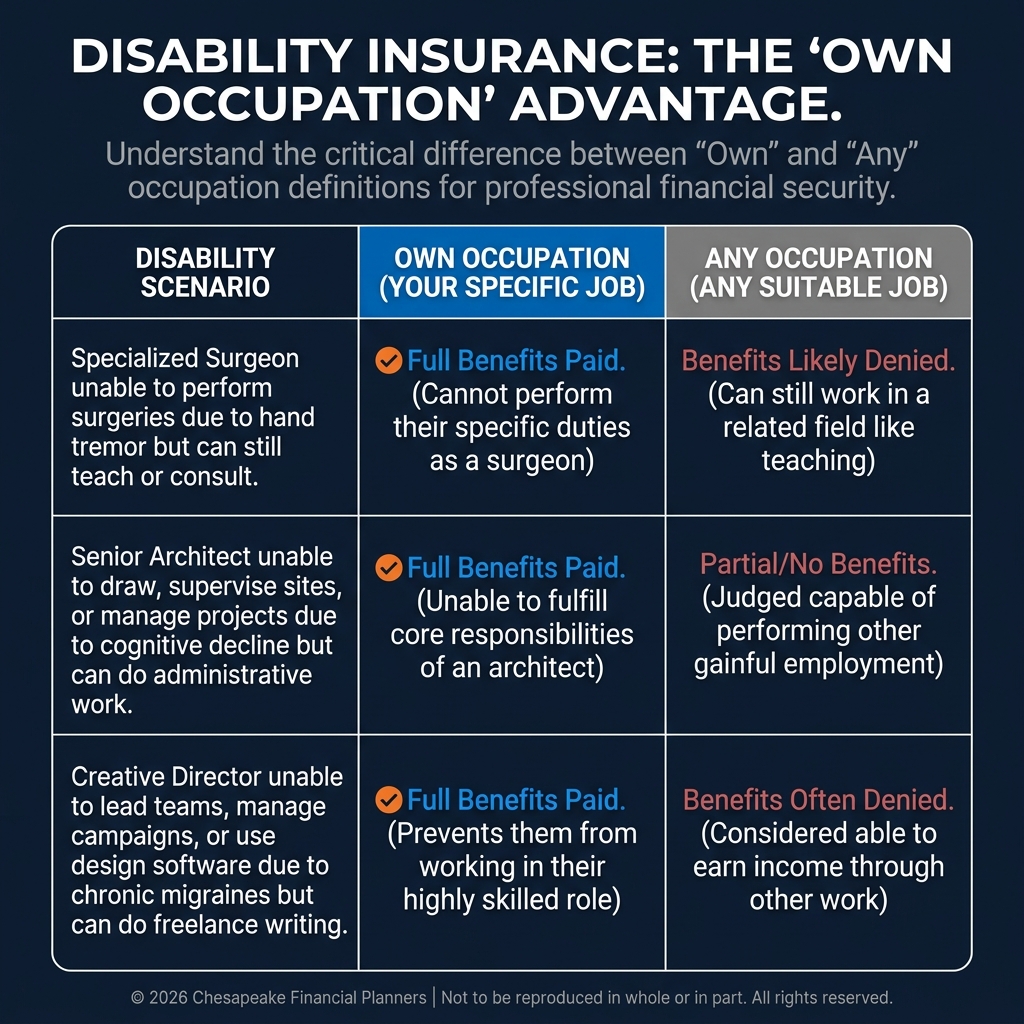
Consider an orthopedic surgeon who develops hand tremors that make operating impossible but who could still teach or consult. A true own occupation policy pays full benefits because the surgeon can no longer perform surgery, the regular occupation, regardless of any consulting income earned afterward. An any occupation policy, by contrast, would pay nothing, reasoning that the surgeon can still earn a living in a related field. The same logic applies to a dentist with a chronic back injury who cannot perform procedures but could do administrative dental work: own occupation pays, any occupation often denies.
The principle is that your coverage should protect the livelihood you actually built. If you spent years developing specialized, highly compensated skills, a policy that stops paying the moment you could earn a fraction of your income elsewhere leaves the most valuable part of your earning power unprotected. That is why the definition, not the benefit amount, is the first thing to examine.

What is the spectrum of disability definitions?
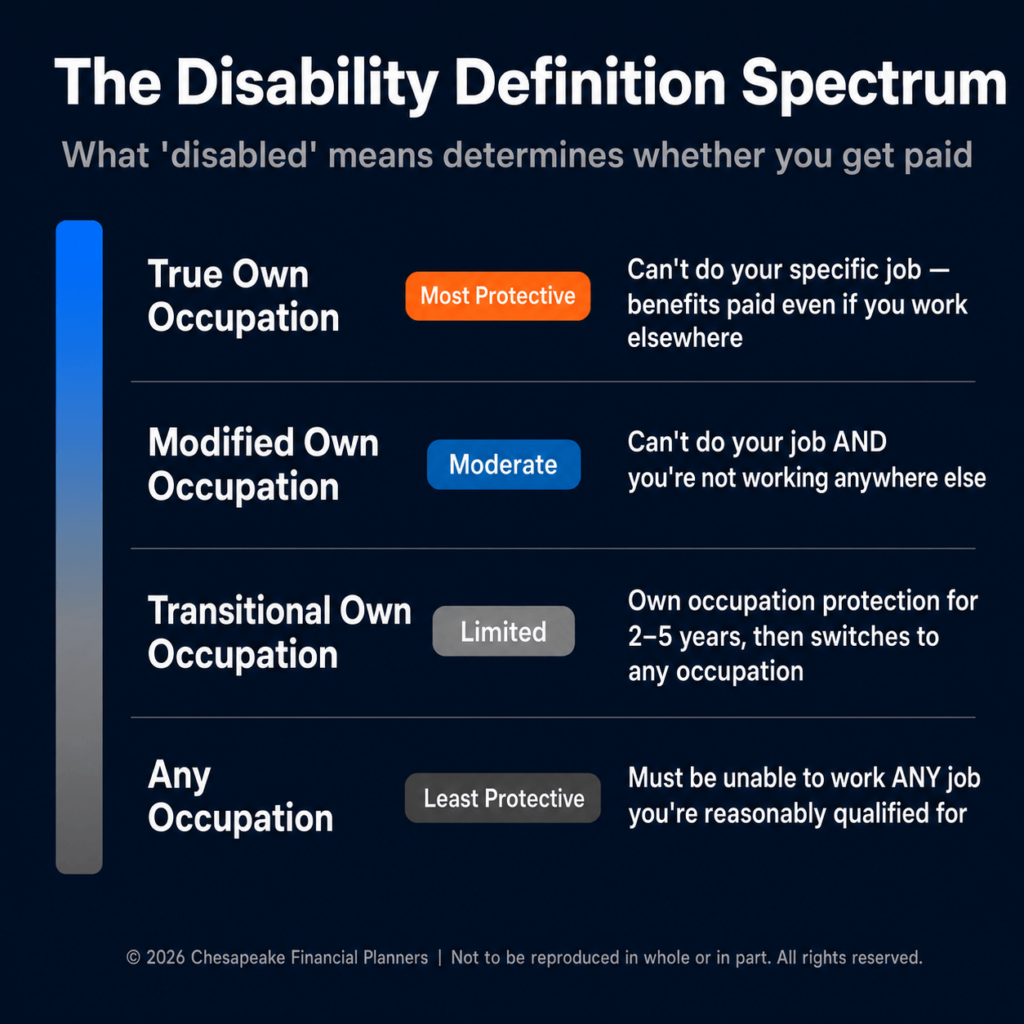
Disability definitions run along a spectrum from most protective to least protective, and where your policy falls determines how likely you are to actually collect. There are four common points on that spectrum, summarized below.
| Definition | What counts as disabled | Protection level |
|---|---|---|
| True own occupation | Cannot perform your specific occupation, even if you work elsewhere | Most protective |
| Modified own occupation | Cannot perform your occupation and are not working in another | Moderate |
| Transitional own occupation | Own occupation for a set period, then converts to any occupation | Limited |
| Any occupation | Cannot perform any job you are reasonably suited for | Least protective |
True own occupation is the most protective: you are disabled if you cannot perform your specific occupation, regardless of whether you work elsewhere or earn income in another field. Modified own occupation is narrower, you are disabled if you cannot perform your occupation and you are not working in another occupation, so taking any other job, even a lower-paying one, can stop benefits. Transitional own occupation provides own occupation protection for a limited period, often two to five years, then converts to an any occupation standard. Any occupation is the least protective: you are disabled only if you cannot perform any job you are reasonably qualified for by education, training, or experience, which is the hardest standard to meet and the one most likely to produce a denied claim for a high earner.
The practical lesson is that two policies can both be called "disability insurance" and offer wildly different real-world protection. Jeff Judge often tells professionals that the word "own occupation" on a brochure is not enough, because modified and transitional versions borrow the name while quietly weakening the promise. Reading the exact definition is the only way to know what you actually own. It also helps to see how strict the alternative can be: the Social Security Administration explains that "Social Security Disability Insurance (SSDI) or 'Disability' provides monthly payments to people who have a disability that stops or limits their ability to work" only if you cannot perform any substantial gainful work, a far harsher test than a true own occupation private policy applies.
Why does own occupation matter so much for professionals?
Own occupation matters most for professionals because specialized skills create specialized income, and an any occupation policy ignores that gap. The more your earnings depend on a specific role, the more you have to lose if coverage only protects your ability to do some other job.
An anesthesiologist earning a high specialty income might technically be able to work in a lower-paying general role, but the difference between those two incomes, compounded over the years remaining in a career, is enormous, and that gap is precisely what own occupation coverage is designed to protect. Mental and physical health risks make this concrete: a surgeon, dentist, pilot, or musician whose work depends on specific physical capabilities, or an attorney whose high-pressure trial practice is derailed by severe anxiety, may be fully unable to perform their actual occupation while an insurer argues they could do something else. Some any occupation policies use broad "gainfully employed in any occupation" language that insurers interpret expansively, denying claims for anyone who can do almost anything related to their background. For perspective on how low that bar can sit, Social Security treats earning more than $2,830 a month in 2026 as substantial gainful activity for a statutorily blind worker, and only slightly different rules govern other claimants, so a high earner can be far from their old income yet still fail an any occupation test.
Business owners face a particular version of this trap. An any occupation policy may deny a claim on the theory that the owner could still manage the business differently, even when a stroke or serious illness has made effective leadership impossible. For all these professionals, the occupation-specific definition is not a luxury feature; it is the part of the policy that makes the coverage match their reality.
What policy features and coverage types should you compare?
Beyond the occupation definition, several features determine how well a disability policy actually performs, and the source of your coverage, group or individual, shapes your choices. These are the details worth comparing before you buy.
Key features to look for include residual or partial disability, which pays a proportional benefit if you can work but earn less because of your disability; non-cancelable and guaranteed renewable provisions, which prevent the insurer from canceling your policy or raising your premium even if your health declines; cost of living adjustments, which increase benefits with inflation over a long claim; a future increase option, which lets you add coverage later without new medical underwriting as your income grows; and presumptive disability, which treats certain losses, such as sight, hearing, speech, or use of limbs, as total disability regardless of the occupation definition.
The group-versus-individual distinction is just as important. Employer group coverage is usually built on an any occupation definition, ends if you leave the employer, may be taxable if the employer pays the premiums, and offers little customization; the Department of Labor notes that an employer offering such a plan generally acts as a plan fiduciary with duties to participants. Whether your benefits are taxed turns on who paid the premium, a point the IRS addresses in its guidance on sick pay and disability income. Individual coverage can be purchased with a true own occupation definition, is portable across jobs, generally pays tax-free benefits when you fund it with after-tax dollars, and can be tailored to your situation. For high-income professionals, a common best practice is to keep the group coverage and supplement it with an individual own occupation policy. This kind of layered, detail-sensitive decision is exactly what the R.U.D.D.E.R. Method™ is built for. The R.U.D.D.E.R. Method™ is Chesapeake Financial Planners' six-step planning process: Review and Recognize, Uncover and Understand, Design and Develop, Discuss and Decide, Execute and Empower, and Reassess and Refine, and disability protection lives in Design and Develop, where the right definition and riders are matched to your career and income.
Related Topics Worth Reading
Disability coverage is one piece of protecting your income and family. These related topics go deeper.
- Protecting a larger net worth from lawsuits and liability. How Much Umbrella Insurance Coverage Do I Need?
- How much life insurance you actually need, and what type. Term vs Whole Life Insurance: Which Do You Need?
- Building the emergency reserve that complements disability coverage. How Much Should I Have in My Emergency Fund?
- Financial planning built around a professional practice or business. What does comprehensive financial planning look like for a business owner?
- Why high earners need a coordinated risk-management plan. What Are the Best Tax Strategies for High Net Worth Individuals?
Frequently Asked Questions
What is the difference between own occupation and any occupation disability insurance?
Own occupation disability insurance pays benefits if you cannot perform the duties of your specific occupation, even if you can work in another role, while any occupation insurance pays only if you cannot work in any job you are reasonably suited for by education, training, or experience. Own occupation is far more protective for specialized professionals, because it protects the income tied to your particular career rather than just your general ability to earn.
Is own occupation disability insurance worth the extra cost?
For most high-income professionals with specialized skills, own occupation coverage is worth the extra cost, which is commonly cited in the range of 15 to 30 percent above an any occupation policy. The reason is that the potential benefit difference, full income protection versus a denied claim, can far exceed the additional premiums paid over a career. Whether it is worth it for you depends on how specialized your work is and how large the income gap would be if you could not do it.
Does group disability insurance from my employer use own occupation?
Usually not. Group disability coverage provided through an employer is typically built on an any occupation definition, which is harder to qualify under, and the coverage generally ends if you leave the employer. Benefits may also be taxable if your employer paid the premiums. Many high-income professionals keep their group coverage but supplement it with an individual own occupation policy that is portable and tailored to their specific occupation.
How do I tell what kind of disability coverage I have?
Read your policy's definition of disability rather than assuming. True own occupation policies use language like "unable to perform the material and substantial duties of your regular occupation," often adding "even if gainfully employed in another occupation." Weaker coverage uses phrases like "unable to perform any occupation for which you are reasonably suited by education, training, or experience," or "and not engaged in any other occupation." If the wording is unclear, have an independent insurance professional review it.
What other disability policy features matter besides the definition?
Several riders significantly affect how well a policy performs: residual or partial disability pays a proportional benefit if you can work but earn less; non-cancelable and guaranteed renewable provisions lock in your coverage and premium; cost of living adjustments keep benefits pace with inflation; a future increase option lets you add coverage later without new underwriting; and presumptive disability treats losses like sight or use of limbs as total disability automatically. These features, alongside the occupation definition, determine the real strength of your coverage.
Protecting the income from the work you actually do
Disability insurance is not about protecting your ability to work in general; it is about protecting the income from the work you actually do. For professionals whose earnings rest on specialized skills, the difference between own occupation and any occupation coverage is the difference between a policy that pays when you need it and one that argues you could do something else. Read the definition, weigh the riders, and consider supplementing group coverage with an individual own occupation policy. If you want a second set of eyes on your current coverage, Jeff Judge and the Chesapeake Financial Planners team help professionals across Harford County and the Baltimore metro make sure their protection matches their reality. Schedule a complimentary consultation at chesapeakefp.com.
Want to go deeper? Our Why Financial Advice Isn’t Just for Retirees walks through this step by step.
Disclosures
The information provided is for educational purposes only and should not be construed as investment advice. Investment strategies should be tailored to individual circumstances, risk tolerance, and goals. Past performance doesn't guarantee future results. Consult with qualified financial professionals regarding your specific situation.
This material is for educational purposes only. Insurance products contain exclusions, limitations, and terms for keeping them in force. Please contact a qualified insurance professional for costs and complete details.
Advisors associated with Chesapeake Financial Planners may be either (1) LPL Financial Registered Representatives offering securities through LPL Financial, Member FINRA and SIPC, and investment advisor representatives offering investment advice through Great Valley Advisor Group; or (2) solely investment advisor representatives offering investment advice through Great Valley Advisor Group and not affiliated with LPL Financial. Great Valley Advisor Group, and Chesapeake Financial Planners are separate entities from LPL Financial.


