

What Will I Pay in Taxes When Selling My Business?
Last reviewed: July 2026
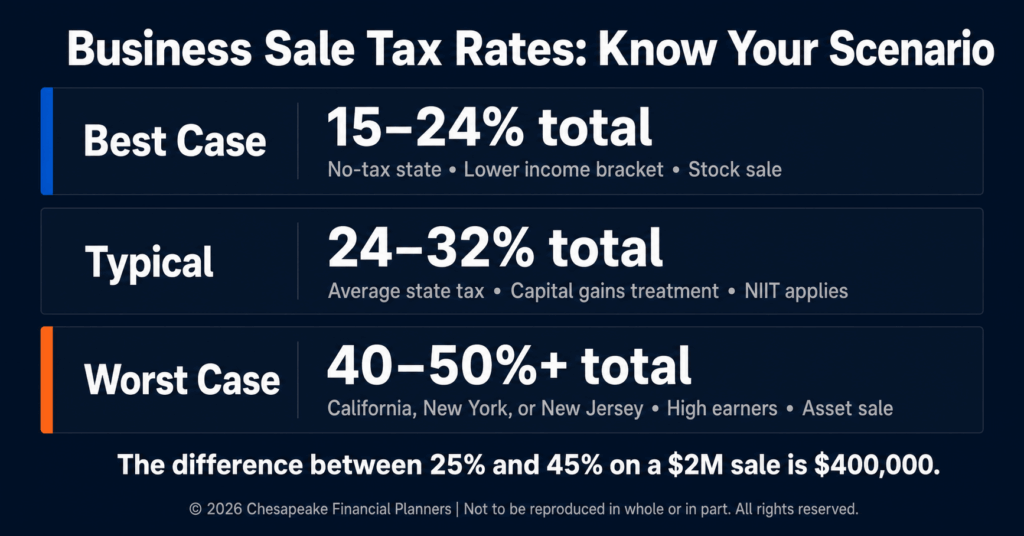
Most business owners pay between 20% and 45% of their sale proceeds in combined federal and state business sale taxes, depending on how the deal is structured and where they live. Sellers who get capital gains treatment land near the low end. Sellers who get hit with ordinary income, depreciation recapture, and a high-tax state can lose nearly half. The structure of the sale, not just the price, decides which side of that range you end up on.
Key Takeaways
- Long-term capital gains on a business sale are taxed federally at 0%, 15%, or 20% based on your taxable income.
- High earners owe an extra 3.8% Net Investment Income Tax on top of capital gains rates.
- Stock sales usually get full capital gains treatment; asset sales mix capital gains and ordinary income.
- Depreciation recapture on real estate is taxed at up to 25% federal, higher than long-term capital gains.
- Qualified Small Business Stock can exclude a large share of gain from federal tax under Section 1202.
About the Author: Jeff Judge, CFP®, AEP®, ChFC®, CLU® is Managing Partner of Chesapeake Financial Planners in Forest Hill, Maryland. He has been helping families and business owners in Harford County and the Baltimore metro area navigate business exits and tax planning since earning his CFP® certification in 2013, by using Chesapeake Financial Planners’ signature process, the R.U.D.D.E.R. method™. Jeff often tells owners that the biggest tax savings on a sale are locked in two or three years before the deal closes, not at the closing table.
How Much Tax Will I Actually Pay on a Business Sale?
For most small and mid-sized business sales, the combined federal and state tax bill falls between 20% and 45% of net proceeds. Where you land depends on whether the gain is taxed as capital gains or ordinary income, whether you owe the Net Investment Income Tax, and your state's rate.
A seller in a no-income-tax state with clean capital gains treatment might pay around 24% all in. A seller in a high-tax state with chunks of ordinary income and depreciation recapture can push past 45%. On a $2 million sale, the gap between 24% and 44% is $400,000. That is real money, and most of it is decided by structure rather than luck.
According to the IRS, long-term capital gains apply to assets held more than one year and are taxed at preferential federal rates of 0%, 15%, or 20%. Ordinary income, by contrast, runs your regular bracket up to 37%. That single distinction drives most of the variance in what owners pay.
What's the Difference Between a Stock Sale and an Asset Sale?
The two ways to sell a business get taxed very differently, and the choice usually creates tension between buyer and seller.
In a stock or membership interest sale, the buyer purchases your ownership stake directly. The gain generally receives full long-term capital gains treatment on the entire sale price, which is why sellers prefer it.
In an asset sale, the buyer purchases individual business assets, and each class is taxed under its own rules:
| Asset class | Tax treatment |
|---|---|
| Goodwill and intangibles | Long-term capital gains |
| Inventory and receivables | Ordinary income |
| Equipment | Depreciation recapture (ordinary), then capital gains |
| Real estate | Capital gains plus Section 1250 recapture up to 25% |
Buyers favor asset sales because they get a stepped-up basis and future depreciation deductions. Sellers favor stock sales because more of the proceeds qualify for the lower capital gains rate. The allocation in the purchase agreement is a negotiation with real tax consequences on both sides.
This is where business exit planning earns its keep. Jeff has watched owners leave six figures on the table simply because they negotiated price hard and ignored how the deal was allocated across asset classes.
How Does My Business Structure Change the Tax?
Your entity type shapes the tax outcome before the deal terms ever come into play.
- C Corporations can face double taxation in an asset sale: once at the corporate level on the gain, then again when proceeds are distributed to you. A stock sale avoids the corporate-level tax. C corp owners should look hard at whether their shares qualify for the QSBS exclusion discussed below.
- S Corporations use pass-through taxation, so there is no second layer of corporate tax. Stock sales typically flow through as capital gains.
- Partnerships and LLCs are flexible enough that most gain can receive capital gains treatment even in an asset sale, when structured carefully.
- Sole proprietorships are always treated as asset sales, producing a mix of capital gains and ordinary income.
What Hidden Taxes Catch Sellers Off Guard?
Three sell business tax strategies fail most often because owners forget about taxes that sit outside the headline capital gains rate.
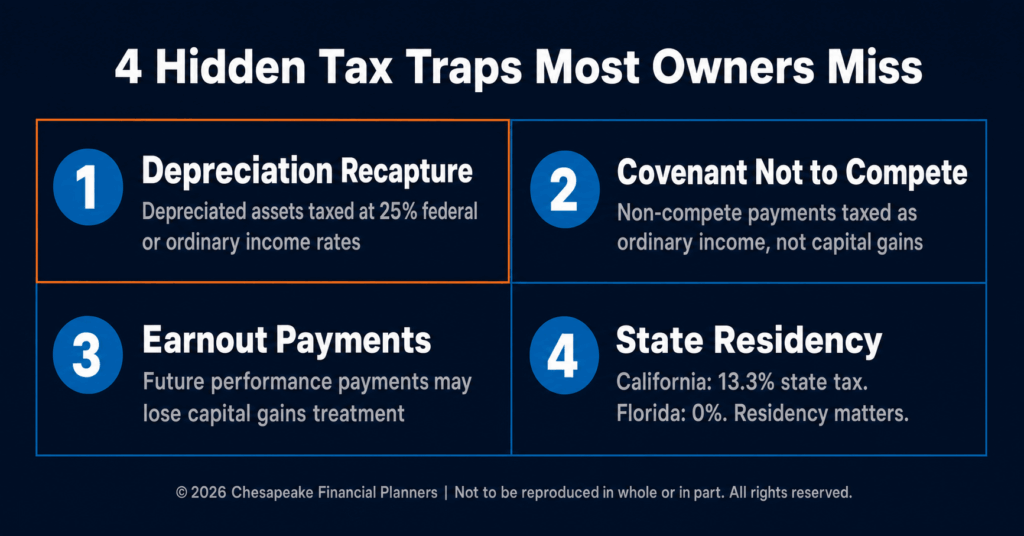
Depreciation recapture. If you wrote off equipment, vehicles, or buildings over the years, the IRS reclaims part of that benefit at sale. Per IRS Publication 544, unrecaptured Section 1250 gain on real estate is taxed at a maximum of 25%, and equipment recapture is taxed as ordinary income. An owner with heavily depreciated assets can face a surprise bill in the tens or hundreds of thousands.
Net Investment Income Tax. The 3.8% NIIT applies once modified adjusted gross income passes $200,000 single or $250,000 married filing jointly. A large sale almost always triggers it, stacking on top of your capital gains rate.
Covenants not to compete. Payments allocated to a non-compete agreement are taxed as ordinary income, not capital gains. Buyers like to load value here because it is deductible for them. Watch this line in the allocation.
Can I Avoid Tax on a Business Sale With QSBS?
The Qualified Small Business Stock exclusion under Section 1202 is one of the most powerful tools available to founders of C corporations. If your stock qualifies, a large share of your gain can be excluded from federal tax. The rules tightened and expanded under the 2025 tax law, with longer holding-period tiers and higher exclusion caps for stock acquired after July 4, 2025.
QSBS does not fit every business, and the qualification rules are strict. But for the right C corp founder, it can be the difference between a 23.8% federal hit and close to zero. This is exactly the kind of planning that has to happen years ahead, not at closing.
Frequently Asked Questions
How much tax will I pay when selling my business?
Most owners pay between 20% and 45% of net proceeds in combined federal and state taxes. Sellers with clean long-term capital gains treatment in a low-tax state pay near the bottom, while sellers facing ordinary income, depreciation recapture, and a high state rate approach the top of that range.
Is selling a business taxed as capital gains or ordinary income?
It depends on the deal structure. Stock sales generally receive long-term capital gains treatment on the full price, taxed federally at 0%, 15%, or 20%. Asset sales split the proceeds: goodwill gets capital gains, while inventory, receivables, and equipment recapture are taxed as ordinary income up to 37%.
What is depreciation recapture on a business sale?
Depreciation recapture is the tax the IRS charges back on deductions you previously claimed for assets like equipment and buildings. Real estate recapture is capped at 25% federally, and equipment recapture is taxed as ordinary income. Both rates exceed long-term capital gains rates, so heavily depreciated businesses face larger bills.
Do I owe the 3.8% Net Investment Income Tax when I sell?
Yes, in most cases. The 3.8% Net Investment Income Tax applies once your modified adjusted gross income exceeds $200,000 single or $250,000 married filing jointly. A significant business sale almost always pushes income above those thresholds, so the 3.8% stacks on top of your capital gains rate.
Can I reduce taxes by selling my business stock instead of its assets?
Often, yes. A stock sale typically qualifies the entire purchase price for long-term capital gains treatment, while an asset sale taxes inventory, receivables, and equipment recapture as ordinary income. Buyers usually prefer asset sales for the basis step-up, so the structure becomes a negotiation with meaningful tax consequences for both parties.
How early should I plan for taxes before selling my business?
Ideally two to three years before closing. The most effective tax moves, such as restructuring the entity, qualifying stock for the QSBS exclusion, or timing income to control your bracket, take time to put in place. Waiting until you have a buyer at the table eliminates most of these options.
Plan the Tax Side Before You Sign
The price you negotiate gets the attention, but the tax structure decides how much you actually keep. If you are weighing an exit in the next few years, our guide to business sale tax planning walks through structure, timing, and the QSBS rules in depth. Download it at chesapeakefp.com.
What's the most tax-efficient way to exit my business?
How Can I Reduce Capital Gains Taxes on My Investments?
What Is the Difference Between Marginal and Effective Tax Rate?
How Can I Reduce Taxes When Earning $200K to $500K?
Want to go deeper? Our Business Sale Tax Planning Guide walks through this step by step.
Disclosures
The information provided is for educational purposes only and should not be construed as investment advice. Investment strategies should be tailored to individual circumstances, risk tolerance, and goals. Past performance doesn't guarantee future results. Consult with qualified financial professionals regarding your specific situation.
Advisors associated with Chesapeake Financial Planners may be either (1) LPL Financial Registered Representatives offering securities through LPL Financial, Member FINRA and SIPC, and investment advisor representatives offering investment advice through Great Valley Advisor Group; or (2) solely investment advisor representatives offering investment advice through Great Valley Advisor Group and not affiliated with LPL Financial. Great Valley Advisor Group, and Chesapeake Financial Planners are separate entities from LPL Financial.


