

Should I invest in index funds or actively managed funds?
Last reviewed: July 2026
For most investors, low-cost index funds are the smarter long-term choice, because they cost less, are more tax-efficient, and historically beat the large majority of actively managed funds over time. Index funds passively track a market index; actively managed funds pay a manager to try to beat it. Active management can add value in narrow situations, but the data is consistently unkind to it as a default. When in doubt, low-cost index funds are the sound starting point for a long-term portfolio.
Key Takeaways
- Index funds track a market index at very low cost; actively managed funds pay a manager to try to beat the market and cost more.
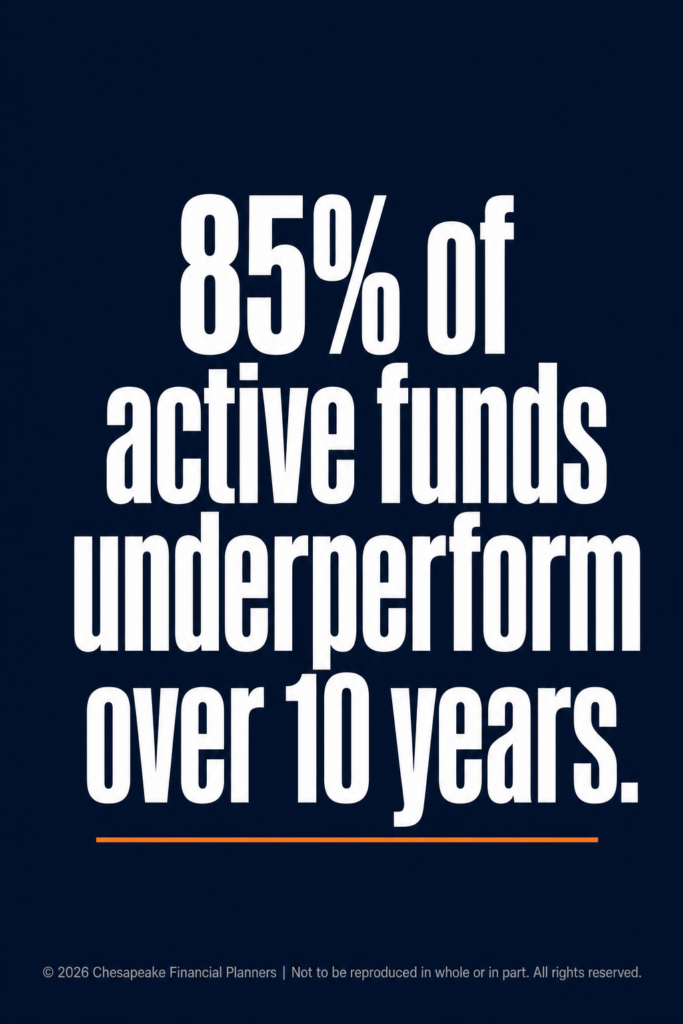
- Over 10 years, the SPIVA research from S&P Dow Jones Indices finds roughly 85-90% of active U.S. equity funds underperform their benchmarks.
- Fees compound: a seemingly small annual fee difference can cost a large amount over decades.
- Index funds are also more tax-efficient and simpler; active management fits only narrow, less-efficient niches.
About the Author: Jeff Judge, CFP®, AEP®, ChFC®, CLU® is Managing Partner of Chesapeake Financial Planners in Forest Hill, Maryland. He has built low-cost, diversified portfolios for Harford County and Baltimore-area investors since earning his CFP® certification in 2013, by using Chesapeake Financial Planners’ signature process, the R.U.D.D.E.R. method™. Jeff's view: the appeal of beating the market is powerful, but the evidence is overwhelming that low costs and discipline beat clever stock-picking for almost everyone, so we start clients with cheap index exposure and add complexity only where it genuinely earns its keep.
What is the difference between index funds and actively managed funds?
The difference is philosophy and cost: an index fund mirrors a market index as cheaply as possible, while an actively managed fund pays professionals to pick investments and try to outperform. That single distinction drives nearly every practical difference between them.
An index fund is a mutual fund or ETF that passively tracks an index, such as a broad U.S. stock benchmark, a total stock market index, or an international index, by holding all or a representative sample of its securities. The SEC notes that passive management usually translates into less trading, more favorable tax consequences, and lower fees than actively managed funds. There is no stock-picking; the fund simply mirrors the index, trades minimally, and keeps costs very low. Its philosophy is that you cannot reliably beat the market, so you should match it at the lowest possible cost. An actively managed fund, by contrast, is run by a manager or team who research companies, analyze markets, and buy and sell in pursuit of beating a benchmark, which means more trading and higher fees. Its philosophy is that skill and research can outperform.
The tension between these two philosophies is the heart of the decision, and it is settled less by argument than by evidence. The question is not whether a talented manager can ever win, some do, but whether you can reliably capture that outperformance after fees, and over long periods, for most investors, the answer has been no.
What does the data say about performance?
The data says most actively managed funds underperform their benchmarks over the long term, and the longer the period, the worse active management looks. This is the uncomfortable but well-documented core of the case for indexing.
According to the SPIVA reports from S&P Dow Jones Indices, which track this rigorously, roughly 85 to 90% of actively managed U.S. equity funds underperform their benchmarks over a 10-year period, and that figure rises above 90% over 15 years. As S&P Dow Jones Indices puts it, "For over 20 years, our renowned SPIVA research has measured actively managed funds against their index benchmarks worldwide," and the most recent scorecard shows roughly 86% of large-cap funds trailing the S&P 500 over the past decade. The few funds that do beat their benchmark rarely repeat the feat consistently, which makes picking tomorrow's winner in advance extremely difficult.
Want to go deeper? Our R.U.D.D.E.R Audit for DIY Investors walks through this step by step.
Three forces explain the gap. First, fees eat returns: active funds commonly charge far more than index funds, and that difference compounds heavily over decades. Second, frequent trading by active managers generates transaction costs and taxable gains that drag on performance. Third, beating the market is simply hard, because markets are broadly efficient and thousands of skilled analysts are all hunting the same mispricings, so consistent outperformance is rare. None of this guarantees any particular outcome, past performance never does, but the pattern across thousands of funds and many years is remarkably consistent.
How do they compare on cost, taxes, and simplicity?
Index funds win clearly on cost, tax efficiency, and simplicity, while active funds add expense, tax drag, and the burden of ongoing oversight. These differences compound into a meaningful long-term edge for indexing.
On cost, broad index funds commonly carry expense ratios near 0.03% to 0.20% while many actively managed funds charge 0.50% to well over 1%, and that gap matters enormously over time: a fee difference that sounds tiny in a single year can compound to a large sum over a multi-decade horizon, since every dollar paid in fees is a dollar that stops compounding for you. On tax efficiency, index funds trade little and so distribute few capital gains, while active funds trade frequently and can hand you taxable distributions even in a flat year, a real drag in taxable accounts. On simplicity, an index fund is close to set-and-forget, while an active fund requires monitoring for manager changes, strategy drift, and underperformance that might force you to switch. And on risk, an index fund carries market risk, while an active fund adds manager risk on top, the chance that poor decisions amplify losses.
The table below sums up how the two approaches compare on the factors that drive long-term results.
| Factor | Index funds | Actively managed funds |
|---|---|---|
| Cost | Very low expense ratios | Substantially higher fees |
| Long-term performance | Match the benchmark, less fees | Most trail the benchmark over 10+ years |
| Tax efficiency | Low turnover, few taxable distributions | Frequent trading can trigger taxable gains |
| Simplicity | Close to set-and-forget | Requires monitoring managers and strategy |
| Risk | Market risk | Market risk plus manager risk |
Put together, these are not small advantages, and they accrue quietly year after year. Choosing a low-cost, diversified approach and sticking with it is exactly the kind of disciplined design the R.U.D.D.E.R. Method™ supports. The R.U.D.D.E.R. Method™ is Chesapeake Financial Planners' six-step planning process: Review and Recognize, Uncover and Understand, Design and Develop, Discuss and Decide, Execute and Empower, and Reassess and Refine, and fund selection lives in Design and Develop, where cost and tax efficiency are weighed alongside your overall allocation.
When might active management make sense, and what about your 401(k)?
Active management makes sense only in narrow cases, less-efficient markets, certain strategies, or genuine downside-protection needs, and most investors do not need them. A blended core-and-satellite approach can be a reasonable middle ground for the disciplined.
The legitimate niches are real but limited: less efficient markets like some emerging-markets or small-cap segments may give skilled managers more room to add value; certain strategies such as value or dividend-growth investing may suit active management; some active managers focus on downside protection that risk-averse retirees may value; and unique tax situations can call for customized, active approaches. But the catch is that most investors do not need any of these, and a diversified portfolio of low-cost index funds works well for the large majority of people. A core-and-satellite strategy, a large core of low-cost index funds plus a small satellite of active bets, is a sensible compromise only if you stay disciplined and do not let the satellite take over. Beware the "hot fund" trap: last year's standout often lags the next year, because past performance does not predict future results, and chasing it is usually a losing game. Jeff Judge notes: "The core-and-satellite approach works fine on paper, but in practice most investors I have seen slowly let the satellite grow until it is driving the portfolio, which defeats the whole purpose of keeping costs low."
For your 401(k), you may be limited to actively managed funds, in which case choose the lowest-cost options available, ideally index funds or anything with a modest expense ratio, and avoid high-fee funds even if their recent performance looks strong, because fees erode returns relentlessly. Rolling an old 401(k) into an IRA can also open access to low-cost index funds you may not have in the plan. If you do go the index route, look for broad market exposure (total stock market, a major U.S. benchmark, total international, and total bond), the lowest expense ratios you can find, and reputable low-cost providers, and remember that ETFs are often slightly more tax-efficient than mutual funds. The SEC's investor bulletin on index funds is a useful primer on how tracking and costs work. Diversification across these broad holdings spreads risk, though it does not ensure a profit or protect against loss in a declining market.
Related Topics Worth Reading
Choosing index versus active connects to vehicle choice, cost, and allocation. These related topics go deeper.
- The ETF-versus-mutual-fund wrapper decision. What is the difference between ETFs and mutual funds?
- Setting the asset allocation that drives most of your results. How Should I Allocate My Investment Portfolio by Age?
- Why diversification still matters and what it can and cannot do. How should my investment mix change as I get closer to retirement?
- Keeping more of your return through tax-aware investing. What Are the Best Tax Strategies for High Net Worth Individuals?
- How fees and behavior, not stock-picking, drive long-term wealth. What behavioral traps hit hardest in the first years of retirement?
Frequently Asked Questions
Are index funds better than actively managed funds?
For most investors over the long term, yes. Index funds cost far less, are more tax-efficient, and, according to SPIVA research from S&P Dow Jones Indices, outperform the large majority of actively managed funds over 10 and 15 years, because high fees and frequent trading drag on active returns. Active management can add value in narrow, less-efficient markets, but those cases are rare, so low-cost index funds are the sound default for most people.
Why do most actively managed funds underperform?
Most actively managed funds underperform for three main reasons: higher fees that compound against you over time, frequent trading that adds transaction costs and taxable gains, and the basic difficulty of consistently beating efficient markets where countless skilled analysts compete for the same opportunities. SPIVA data shows roughly 85 to 90% of active U.S. equity funds trail their benchmarks over a decade, and the funds that do win rarely repeat it consistently.
How much do investment fees actually matter?
Fees matter enormously over long horizons because they compound. A difference that looks small in a single year, between a very low-cost index fund and a higher-cost active fund, can add up to a large sum over several decades, since every dollar paid in fees is a dollar that stops growing for you. This compounding effect is one of the strongest arguments for keeping investment costs as low as possible.
What should I do if my 401(k) only offers actively managed funds?
Choose the lowest-cost options your plan offers, ideally any index funds available or funds with the smallest expense ratios, and avoid high-fee funds even if their recent performance is strong, because fees erode returns over time. You may also consider rolling an old 401(k) from a former employer into an IRA, where you typically have access to a wider menu of low-cost index funds. Within the plan, focus on cost and your overall allocation.
Is a blend of index and active funds a good idea?
A blend can work through a core-and-satellite approach: a large core of low-cost index funds for broad, cheap market exposure, plus a small satellite of active funds or specific strategies. This keeps most of your portfolio low-cost and diversified while allowing targeted bets. It only makes sense if you stay disciplined and do not let the satellite portion grow too large, since the more you tilt toward active, the more fees and manager risk you take on.
Keeping more of what you earn
For the large majority of investors, low-cost index funds are the smarter long-term choice, cheaper, simpler, more tax-efficient, and statistically far more likely to beat active funds over time. Active management has its narrow niches, but they are the exception, not the rule, and chasing last year's hot fund is a reliable way to lose ground. If you are unsure, defaulting to low-cost, broadly diversified index funds will usually leave you wealthier and less stressed. Jeff Judge and the Chesapeake Financial Planners team build diversified, low-cost portfolios for investors across Harford County and the Baltimore metro, without the hype or unnecessary fees. Schedule a free fit call at chesapeakefp.com.
Past performance is no guarantee of future results.
Disclosures
The information provided is for educational purposes only and should not be construed as investment advice. Investment strategies should be tailored to individual circumstances, risk tolerance, and goals. Past performance doesn't guarantee future results. Consult with qualified financial professionals regarding your specific situation.
All performance referenced is historical and is no guarantee of future results. All indices are unmanaged and may not be invested into directly.
R-squared indicates what percentage of a manager's movement in performance is explained by movement in performance in its benchmark. R-squared ranges from 0 to 100 and a score of 100 suggests that all movements of a manager's performance are completely explained by movements in the index.
All indices are unmanaged and may not be invested into directly.
This information is not intended to be a substitute for specific individualized tax, investment or legal advice. We suggest that you discuss your specific situation with a qualified tax, legal or financial advisor.
Advisors associated with Chesapeake Financial Planners may be either (1) LPL Financial Registered Representatives offering securities through LPL Financial, Member FINRA and SIPC, and investment advisor representatives offering investment advice through Great Valley Advisor Group; or (2) solely investment advisor representatives offering investment advice through Great Valley Advisor Group and not affiliated with LPL Financial. Great Valley Advisor Group, and Chesapeake Financial Planners are separate entities from LPL Financial.


