

What behavioral traps hit hardest in the first years of retirement?
Last reviewed: July 2026
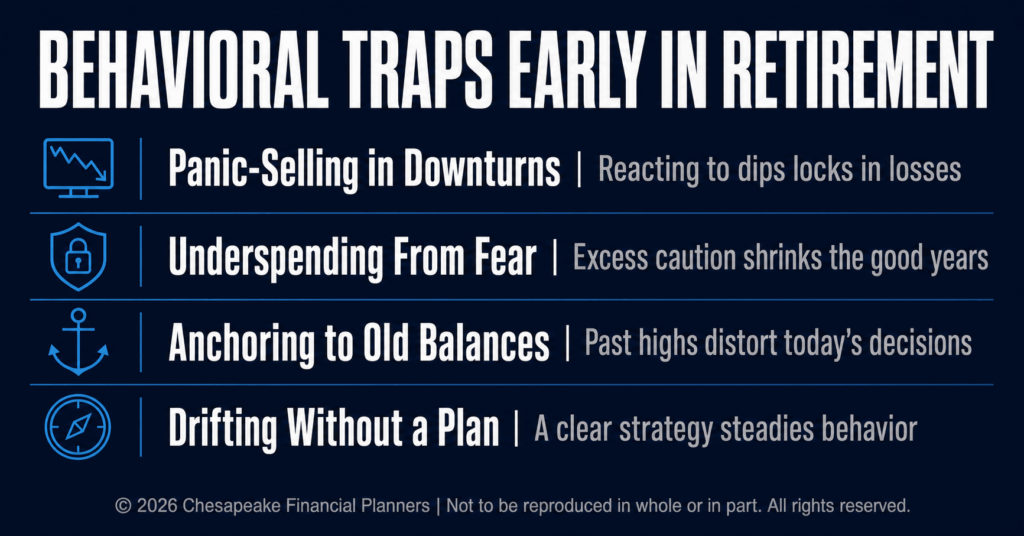
The behavioral traps that hit hardest early in retirement are panic-selling driven by loss aversion, the surprising tendency to underspend out of fear, anchoring to your portfolio's peak value, recency bias that overweights recent markets, and social and lifestyle pressure that distorts spending. The transition from saving to spending is as much a psychological shift as a financial one, and decades of behavioral research show that our instincts, which served us while accumulating, can quietly undermine us once we are drawing down. Recognizing these traps is the first and most powerful defense against them.
On This Page
- Key Takeaways
- Why is retirement as much a psychological shift as a financial one?
- Which fear-driven traps cause the most damage?
- How do anchoring and recency bias distort a retiree's judgment?
- How do social pressure and identity affect early-retirement spending?
- Related Topics Worth Reading
- Frequently Asked Questions
- Outlasting your own instincts
- Disclosures
Key Takeaways
- Loss aversion makes early-retirement market drops feel unbearable, tempting retirees to sell at exactly the wrong time.
- Many retirees fall into the opposite trap, underspending out of fear and sacrificing years they planned and saved for.
- Anchoring to a portfolio's peak value and recency bias both distort how retirees judge their finances.
- Awareness, a written plan, and a steady process are the most reliable antidotes to behavioral mistakes.
About the Author: Jeff Judge, CFP®, AEP®, ChFC®, CLU® is Managing Partner of Chesapeake Financial Planners in Forest Hill, Maryland, and writes on retirement and behavioral finance. He has guided Harford County and Baltimore-area families through the psychological transition into retirement since earning his CFP® certification in 2013, by using Chesapeake Financial Planners’ signature process, the R.U.D.D.E.R. method™. As Jeff puts it: "The math of retirement income is hard enough, but the behavior is harder, and the clients who do best are the ones who anticipate their own predictable instincts and build a plan that protects them from acting on the worst of them."
Why is retirement as much a psychological shift as a financial one?
Retirement is a psychological shift because it reverses a lifetime of conditioning: after decades of saving and watching balances grow, you must now spend down what you built, which triggers instincts that can work against you. The skills that made you a good saver are not the skills that make you a calm, effective spender.
Behavioral finance, the field developed by researchers like Daniel Kahneman and Richard Thaler, shows that human beings do not make money decisions like rational calculators; we are driven by emotion, mental shortcuts, and predictable biases. The cost is measurable: Morningstar's Mind the Gap study found that "the average dollar invested in US mutual funds and exchange-traded funds earned 1.2% less per year than what those funds returned during the same period," a gap driven largely by mistimed buying and selling. During the accumulation years, many of those tendencies are harmless or even helpful, an aversion to losses keeps you cautious, and watching your balance climb feels rewarding. But the day you retire, the same wiring can mislead you, because now a market drop directly threatens money you are living on, and the habit of accumulating makes it psychologically hard to start spending.
This is why the first years of retirement are behaviorally treacherous. You are navigating a brand-new relationship with your money under emotional conditions, often with the added stress of leaving a career and identity behind, at exactly the moment when sequence-of-returns risk makes early decisions especially consequential. Understanding that your instincts are predictable, and sometimes wrong, lets you plan around them rather than be ambushed by them. The traps below are the ones that catch new retirees most often.
Which fear-driven traps cause the most damage?
The most damaging fear-driven traps are panic-selling in a downturn and, paradoxically, chronic underspending, both rooted in an outsized fear of loss. Loss aversion, the finding that losses feel roughly twice as painful as equivalent gains feel good, sits at the heart of each.
Panic-selling is the classic mistake. When markets fall early in retirement, loss aversion makes the decline feel intolerable, and the urge to "stop the bleeding" by moving to cash can be overwhelming, but selling locks in the loss and means missing the recovery that has followed every historical downturn. Because early-retirement losses are already dangerous due to sequence risk, panic-selling can turn a survivable market event into permanent damage. The antidote is not willpower in the moment but structure built in advance: a cash buffer to spend from during downturns, a written plan that anticipates volatility, and a commitment to not interrupt the recovery by selling at the bottom. Guaranteed income helps too. Delaying Social Security past full retirement age raises your benefit by about 8% per year up to age 70, and a larger guaranteed check reduces how much you must sell from a falling portfolio.
The opposite trap is just as real and far less discussed: underspending. Many retirees who saved diligently for decades cannot psychologically flip the switch to spending, so they live far below their means, deny themselves the trips and experiences they planned for, and arrive in their 80s with more money than they ever needed and fewer years to enjoy it. This too is loss aversion, the fear of running out looms larger than the regret of an unlived retirement, and it is reinforced by the discomfort of watching a balance fall even when the plan fully supports the spending. The fix is a clear, tested income plan that gives you permission to spend, so you can enjoy your retirement with confidence that the numbers work. It helps to remember that part of your income is inflation-protected: Social Security benefits received a 2.8% cost-of-living adjustment for 2026, so a baseline of your spending is designed to keep pace with prices.
How do anchoring and recency bias distort a retiree's judgment?
Anchoring and recency bias distort judgment by fixing a retiree's expectations on the wrong reference point, the portfolio's peak value or the most recent market move, rather than on the long-term plan. Both quietly warp how you feel about your finances.
Anchoring is the tendency to latch onto a specific number as a reference point. In retirement, the most damaging anchor is your portfolio's all-time high: once you have seen your balance at its peak, every figure below it feels like a loss, even if your account is still far above where it began and entirely on track. This makes normal market fluctuations feel like failures and can drive both panic and unnecessary belt-tightening. The remedy is to anchor instead to your plan, your sustainable income, your goals, and your long-term trajectory, rather than to a transient high-water mark.
Recency bias is the tendency to assume the recent past will continue. A retiree who experiences a strong market early on may grow overconfident and overspend, while one who hits an early downturn may become so pessimistic that they slash spending or abandon their strategy, in both cases extrapolating a short stretch into a permanent expectation. Markets, however, do not move in straight lines, and a plan built to withstand full cycles should not be rewritten because of the last few months. Morningstar's researchers note that more volatile funds tend to produce wider behavior gaps precisely because investors get rattled and trade at the wrong moments. A related trap is mental accounting, treating different pots of money, such as a pension versus a brokerage account versus "house money" from gains, as if they followed different rules, when sound planning looks at the whole picture. Guarding against all of these is exactly what the R.U.D.D.E.R. Method™ is built to do. The R.U.D.D.E.R. Method™ is Chesapeake Financial Planners' six-step planning process: Review and Recognize, Uncover and Understand, Design and Develop, Discuss and Decide, Execute and Empower, and Reassess and Refine, and its Reassess and Refine step provides the steady, scheduled review that keeps emotions and biases from driving decisions.
How do social pressure and identity affect early-retirement spending?
Social pressure and a shifting sense of identity push early-retirement spending in unhelpful directions, both toward overspending to keep up and toward anxious cutbacks tied to lost professional purpose. The emotional side of leaving work is easy to underestimate.
On the social side, retirement often coincides with watching peers travel, renovate, or spend freely, and the pull to match them, or the urge to finally reward yourself for decades of work, can lead to lifestyle inflation that the plan was not built for. Gifting to adult children and grandchildren is another common pressure, generous and well-intentioned, but capable of quietly eroding a retiree's own security if it is not planned within the budget. The healthy response is not to deny these impulses but to fund them deliberately within a spending plan, so generosity and enjoyment do not come at the expense of your own stability.
On the identity side, leaving a career can remove a major source of purpose and structure, and the resulting unease sometimes shows up as financial behavior, hoarding money as a proxy for security, or impulsive spending to fill a void. Recognizing that some of these urges are about meaning rather than money helps you address the real need directly, through new routines, relationships, and purpose, rather than through your portfolio. A retirement plan that accounts for the human transition, not just the spreadsheet, is far more likely to leave you both financially secure and genuinely fulfilled. The throughline across every trap is the same: awareness plus a written plan plus a steady process beats willpower alone, every time.

Related Topics Worth Reading
Behavioral traps connect to withdrawals, market volatility, and concentrated stock. These related topics go deeper.
- The market-timing risk that makes early-retirement behavior so consequential. What is sequence of returns risk, and why do the first years of retirement matter most?
- How to build a sustainable, confidence-giving income plan. What is the best order to withdraw from my 401k, Roth IRA, and taxable accounts in retirement?
- Keeping perspective through corrections and bear markets. What is the difference between a bear market and a correction?
- The psychology behind holding too much of one company's stock. Why is it so hard to sell my company stock?
- Why staying invested beats trying to time the market. What Is the Difference Between Index Funds and Actively Managed Funds?
Frequently Asked Questions
What are the most common behavioral mistakes in retirement?
The most common behavioral mistakes in early retirement are panic-selling during market downturns, underspending out of fear of running out, anchoring to a portfolio's peak value so normal fluctuations feel like losses, recency bias that extrapolates recent markets into the future, and lifestyle or social pressure that distorts spending. These stem from emotional instincts and mental shortcuts that served well while saving but can undermine a retiree who is now drawing down. Awareness and a written plan are the best defenses.
Why do retirees underspend in retirement?
Many retirees underspend because the psychological habit of saving for decades is hard to reverse, and the fear of running out of money looms larger than the regret of an unlived retirement, a form of loss aversion. Watching a balance decline, even when the plan supports the spending, feels uncomfortable, so they deny themselves planned experiences and arrive late in life with more than they needed. A clear, tested income plan gives retirees the confidence and permission to actually spend.
How can I avoid panic-selling when markets drop in retirement?
You avoid panic-selling by building structure before a downturn rather than relying on willpower during one. Keep a cash buffer of one to two years of expenses to spend from when markets fall, write down a plan that anticipates volatility, and commit in advance not to sell investments at the bottom. Remember that every historical downturn has eventually recovered, and that early-retirement losses are most damaging when you lock them in by selling. A steady process and an advisor's perspective help.
What is anchoring in retirement finances?
Anchoring is the tendency to fix on a specific reference number and judge everything against it. In retirement, the most harmful anchor is a portfolio's all-time high, because once you have seen that peak, every lower balance feels like a loss even if your account is still well above its starting point and on track. This can trigger both panic and unnecessary cutbacks. The remedy is to anchor to your plan, your sustainable income and goals, rather than to a transient high-water mark.
Does behavioral finance really affect retirement outcomes?
Yes, behavioral finance significantly affects retirement outcomes, often more than investment selection does. Research by figures like Daniel Kahneman and Richard Thaler shows that emotional reactions and cognitive biases routinely lead investors to buy high, sell low, and deviate from sound plans, a pattern sometimes called the behavior gap. In retirement, where early decisions carry outsized weight, managing your own behavior, through awareness, structure, and a disciplined process, can be the difference between a plan that lasts and one that does not.
Outlasting your own instincts
The first years of retirement test your psychology as much as your portfolio, because the instincts honed over a lifetime of saving, loss aversion, anchoring, recency bias, the pull of social comparison, can quietly sabotage the very plan you worked so hard to build. The good news is that these traps are predictable, which means they are manageable. Awareness of your own tendencies, a written income plan that gives you permission to spend, and a steady, scheduled process for reviewing decisions will protect you far better than willpower in the moment ever could. Jeff Judge and the Chesapeake Financial Planners team help retirees across Harford County and the Baltimore metro navigate both the numbers and the behavior of a confident retirement. Schedule a complimentary consultation at chesapeakefp.com.
Disclosures
The information provided is for educational purposes only and should not be construed as investment advice. Investment strategies should be tailored to individual circumstances, risk tolerance, and goals. Past performance doesn't guarantee future results. Consult with qualified financial professionals regarding your specific situation.
CFP Board owns the marks CFP®, CERTIFIED FINANCIAL PLANNER®, and CFP® (with plaque design) in the U.S.
Certified Financial Planner Board of Standards Center for Financial Planning, Inc. owns and licenses the certification marks CFP®, CERTIFIED FINANCIAL PLANNER®, and CFP® (with plaque design) in the United States to Certified Financial Planner Board of Standards, Inc., which authorizes individuals who successfully complete the organization’s initial and ongoing certification requirements to use the certification marks.
Advisors associated with Chesapeake Financial Planners may be either (1) LPL Financial Registered Representatives offering securities through LPL Financial, Member FINRA and SIPC, and investment advisor representatives offering investment advice through Great Valley Advisor Group; or (2) solely investment advisor representatives offering investment advice through Great Valley Advisor Group and not affiliated with LPL Financial. Great Valley Advisor Group, and Chesapeake Financial Planners are separate entities from LPL Financial.


