

What is the difference between ETFs and mutual funds?
Last reviewed: July 2026
The main difference is how they trade and how they are taxed: ETFs trade on an exchange throughout the day and tend to be more tax-efficient, while mutual funds trade once daily at the closing price and make automatic dollar-amount investing easier. Both are pooled funds that let you own a diversified mix of investments, and for a long-term investor holding a low-cost index fund, the choice usually matters far less than people think. What matters most is your account type and how you like to invest.
On This Page
- Key Takeaways
- What are ETFs and mutual funds, and how do they differ?
- How do they compare on fees, minimums, and taxes?
- Which should you choose, and can you own both?
- What actually matters most when choosing?
- Related Topics Worth Reading
- Frequently Asked Questions
- Building a portfolio that works for you
- Disclosures
Key Takeaways
- ETFs trade throughout the day at live prices; mutual funds trade once daily at the closing net asset value.
- ETFs are usually more tax-efficient in taxable accounts because they rarely distribute capital gains; this advantage disappears inside an IRA or 401(k).
- Mutual funds make automatic dollar-amount investing and dividend reinvestment simpler.
- Both can be very low cost; what matters most is asset allocation and fees, not the ETF-versus-fund wrapper. All investing involves risk, including loss of principal.
- Tax efficiency only matters in taxable accounts, where long-term gains are taxed at 0%, 15%, or 20% depending on income; inside an IRA or 401(k) the difference disappears.
About the Author: Jeff Judge, CFP®, AEP®, ChFC®, CLU® is Managing Partner of Chesapeake Financial Planners in Forest Hill, Maryland. He has built low-cost portfolios for Harford County and Baltimore-area investors since earning his CFP® certification in 2013, by using Chesapeake Financial Planners’ signature process, the R.U.D.D.E.R. method™. As Jeff puts it: "Clients often agonize over ETF versus mutual fund as if it were the whole decision, when it is close to the last decision; get the allocation and the fees right first, and the wrapper is mostly a matter of convenience."
What are ETFs and mutual funds, and how do they differ?
ETFs and mutual funds are both pooled investments that hold a diversified basket of assets, but an ETF trades on an exchange like a stock while a mutual fund is bought and sold once a day through the fund company. That trading mechanism is the root of most of the practical differences.
An ETF, or exchange-traded fund, can be bought or sold anytime the market is open, at a live price that moves throughout the day, and most ETFs passively track an index such as a broad U.S. stock benchmark (though actively managed ETFs exist). A mutual fund, by contrast, is bought or sold directly with the fund company at the end of each trading day at its net asset value, the value of its holdings at the close. Mutual funds have been around longer, can be actively or passively managed, and are the backbone of most 401(k) plans.
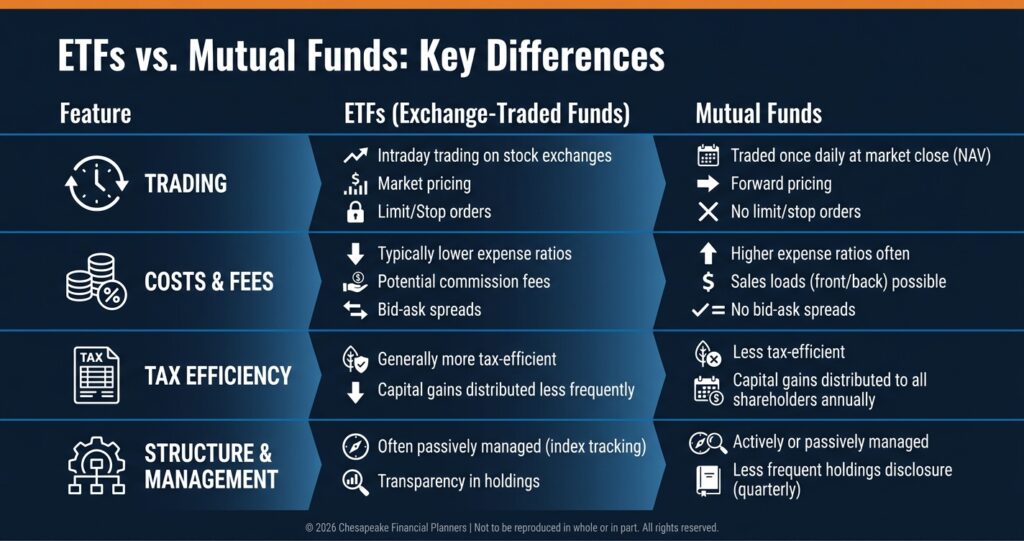
At a glance, the two wrappers compare like this.
| Feature | ETF | Mutual fund |
|---|---|---|
| Trading | Throughout the day at live prices | Once daily at closing NAV |
| Minimum investment | Price of one share (or fractional) | Often in the low thousands |
| Tax efficiency (taxable account) | Rarely distributes capital gains | Can distribute capital gains |
| Automatic investing | Less seamless | Easy dollar-amount automation |
| Fees | Can be very low | Can be very low |
So the core contrast is real-time trading versus once-a-day settlement, and a few features flow from it. For a long-term, buy-and-hold investor, the intraday trading ability of an ETF is an option rather than a meaningful advantage, which is why the deeper differences, taxes, minimums, and automation, usually drive the decision more than trading speed does.
How do they compare on fees, minimums, and taxes?
ETFs and mutual funds compare closely on fees, differ on minimums, and differ most on tax efficiency in taxable accounts. These three areas are where the choice actually has consequences.
On fees, both can be inexpensive: passively managed ETFs and index mutual funds alike can carry very low expense ratios, while actively managed funds of either type cost more, and some mutual funds add sales loads. The takeaway is to compare the specific fund's expense ratio rather than assume ETFs are always cheaper, because they are not always. On minimums, ETFs generally require only enough to buy one share (and many brokerages now offer fractional shares), while mutual funds often set initial minimums in the low thousands, though some have lowered or removed them, making ETFs slightly more accessible for a new investor with limited capital.
Tax efficiency is the biggest real difference, and it only matters in taxable accounts. Because of how ETFs are structured, using in-kind redemptions, they rarely pass capital gains distributions to shareholders. The SEC notes that for index funds in particular, "Passive management usually translates into less trading of the fund's portfolio (fewer transaction costs), more favorable income tax consequences (lower realized capital gains), and lower fees than actively managed funds," a structural edge you can read more about in the SEC's guide to mutual funds and ETFs. Mutual funds can be less tax-efficient: when the manager sells holdings, the fund can distribute capital gains to you even in a year you did not sell anything, leaving you with a tax bill you did not choose. In a taxable brokerage account, that structural edge can favor ETFs meaningfully over time, since avoided distributions are gains you do not pay up to 20% long-term capital gains tax on until you choose to sell. Crucially, inside a tax-advantaged account like an IRA, 401(k), or 403(b), this advantage disappears entirely, because gains are not taxed annually there, so either vehicle works equally well; you can contribute up to $7,500 to an IRA or $24,500 to a 401(k) in 2026 and hold either ETFs or mutual funds without any tax-efficiency difference. For a deeper primer, FINRA's guide to exchange-traded funds and products walks through how ETFs trade and are taxed. Jeff Judge notes: "If you're holding mutual funds in a taxable brokerage account, you can end up writing a check to the IRS for capital gains you never chose to take, simply because the fund manager decided to sell something that year."
Which should you choose, and can you own both?
You should choose based on your account type and habits, and you can absolutely own both. There is no universally better option; the right pick depends on where you are investing and how you like to invest.
Lean toward ETFs if you want the potential tax efficiency of a taxable account, the lowest possible minimum, or live pricing, and you do not need automatic recurring contributions. Lean toward mutual funds if your 401(k) or employer plan only offers them, you want to automate a fixed dollar amount each month, you prefer end-of-day simplicity, or you value effortless automatic dividend reinvestment. And either works well if you are in a retirement account, you are a long-term buy-and-hold investor, or you are simply choosing a low-cost index fund, the most common situations of all.
Many investors hold both, matched to the account: mutual funds in the 401(k) because that is what the plan offers, ETFs in a taxable brokerage for tax efficiency, and either in an IRA by preference. A few myths are worth dispelling: ETFs are not always cheaper, mutual funds are not outdated, ETFs are not only for active traders (most ETF owners are long-term holders), and ETFs are not safer, an S&P 500 ETF and an S&P 500 index fund carry the same market risk because they hold the same thing. This is exactly where a clear process helps, which is what the R.U.D.D.E.R. Method™ provides. The R.U.D.D.E.R. Method™ is Chesapeake Financial Planners' six-step planning process: Review and Recognize, Uncover and Understand, Design and Develop, Discuss and Decide, Execute and Empower, and Reassess and Refine, and vehicle selection lives in Design and Develop, after the allocation and cost decisions that matter more are settled.
What actually matters most when choosing?
What matters most is not ETF versus mutual fund but the bigger decisions that sit above it: your asset allocation, your fees, and your tax location. Keeping that hierarchy straight prevents over-thinking a choice that ranks near the bottom.
In order of importance, your asset allocation comes first, whether you hold the right mix of stocks, bonds, and other assets for your goals and risk tolerance, because that drives the large majority of your long-term results. Fees come next, since lower costs leave more in your pocket over decades, whether the low-cost fund is an ETF or a mutual fund. Tax efficiency follows, mattering in taxable accounts where ETFs usually have the edge, and not at all inside retirement accounts. Convenience, automation, and dividend reinvestment come after that, and only then, last, does the ETF-versus-mutual-fund structure itself.
The practical message is to build a diversified, low-cost portfolio suited to your goals and stay invested, rather than agonizing over the wrapper. Diversification spreads risk across many holdings, though it does not ensure a profit or protect against loss in a declining market. Get the big things right and the ETF-or-fund question takes care of itself.
Related Topics Worth Reading
Choosing investment vehicles connects to allocation, cost, and tax strategy. These related topics go deeper.
- Whether to pay extra for active management at all. What Is the Difference Between Index Funds and Actively Managed Funds?
- Setting the asset allocation that matters more than the wrapper. How Should I Allocate My Investment Portfolio by Age?
- Why spreading across asset classes still matters. How should my investment mix change as I get closer to retirement?
- Harvesting losses in a taxable account. What Are the Best Tax Strategies for High Net Worth Individuals?
- Keeping the right investments in the right accounts. What is the best order to withdraw from my 401k, Roth IRA, and taxable accounts in retirement?
Frequently Asked Questions
What is the main difference between an ETF and a mutual fund?
The main difference is how they trade: an ETF trades on an exchange throughout the day at live prices, while a mutual fund trades once per day at its closing net asset value. ETFs also tend to be more tax-efficient in taxable accounts and have lower minimums, while mutual funds make automatic dollar-amount investing and dividend reinvestment simpler. Both are pooled funds that can hold the same diversified investments.
Are ETFs more tax-efficient than mutual funds?
Generally yes, in taxable accounts. Because of their structure, ETFs rarely distribute capital gains to shareholders, while mutual funds can pass capital gains to you when the manager sells holdings, even in a year you did not sell anything. This tax advantage can be meaningful over time in a taxable brokerage account. Inside a tax-advantaged account like an IRA or 401(k), it does not matter at all, since gains are not taxed annually there.
Are ETFs always cheaper than mutual funds?
No, ETFs are not always cheaper. While many ETFs have very low expense ratios, so do many index mutual funds, and some niche or actively managed ETFs carry high fees. The right comparison is the specific fund's expense ratio and any sales loads, not the category. Both ETFs and mutual funds offer extremely low-cost index options, so cost should be evaluated fund by fund rather than assumed.
Which is better for a 401(k), an ETF or a mutual fund?
For a 401(k), it usually comes down to what the plan offers, which is typically mutual funds, and that is perfectly fine. Inside a 401(k), the tax-efficiency advantage of ETFs disappears because gains are not taxed annually, so either vehicle works equally well. The more important factors in a 401(k) are choosing low-cost, well-diversified funds and getting your overall asset allocation right.
Can I own both ETFs and mutual funds?
Yes, many investors own both, matched to the account. A common setup uses mutual funds in a 401(k) because that is what the plan offers, ETFs in a taxable brokerage account for tax efficiency, and either in an IRA based on preference. There is no rule requiring you to choose only one, and combining them lets you use each where it fits best.
Building a portfolio that works for you
Both ETFs and mutual funds are excellent tools for building wealth, and the differences between them, real as they are, rarely make or break a long-term plan. The hierarchy that matters runs from asset allocation to fees to tax location, with the ETF-versus-fund choice near the bottom. Build a diversified, low-cost portfolio suited to your goals and account types, and stay the course. Jeff Judge and the Chesapeake Financial Planners team help investors across Harford County and the Baltimore metro choose the right vehicles for their situation, without the jargon or pressure. Schedule a free fit call at chesapeakefp.com.
Exchange-traded funds are sold only by prospectus. Please consider the investment objectives, risks, charges, and expenses carefully before investing. The prospectus, which contains this and other information about the investment company, can be obtained from your financial professional. Be sure to read the prospectus carefully before deciding whether to invest.
Want to go deeper? Our R.U.D.D.E.R Audit for DIY Investors walks through this step by step.
Disclosures
The information provided is for educational purposes only and should not be construed as investment advice. Investment strategies should be tailored to individual circumstances, risk tolerance, and goals. Past performance doesn't guarantee future results. Consult with qualified financial professionals regarding your specific situation.
Investing in mutual funds involves risk, including possible loss of principal. Fund value will fluctuate with market conditions and it may not achieve its investment objective.
Advisors associated with Chesapeake Financial Planners may be either (1) LPL Financial Registered Representatives offering securities through LPL Financial, Member FINRA and SIPC, and investment advisor representatives offering investment advice through Great Valley Advisor Group; or (2) solely investment advisor representatives offering investment advice through Great Valley Advisor Group and not affiliated with LPL Financial. Great Valley Advisor Group, and Chesapeake Financial Planners are separate entities from LPL Financial.


