

How Can Business Owners Use Profit-Sharing Plans for Tax Benefits?
Last reviewed: July 2026
Business owners use profit-sharing plans to make large, tax-deductible retirement contributions on a discretionary basis, lowering taxable income in profitable years while keeping cash flow flexible in lean ones. You decide each year whether to contribute and how much, up to $72,000 per participant in 2026. Every dollar you contribute is deductible as a business expense, and the money grows tax-deferred until retirement.
Key Takeaways
- Profit-sharing plans let employers contribute up to $72,000 per participant in 2026, all tax-deductible.
- Contributions are discretionary, so you choose the amount each year based on actual business performance.
- Allocation methods like new comparability can direct most of the contribution to owners while limiting employee cost.
- Pairing profit-sharing with a 401(k) lets an owner reach the full annual limit through layered contributions.
About the Author: Jeff Judge, CFP®, AEP®, ChFC®, CLU® is Managing Partner of Chesapeake Financial Planners in Forest Hill, Maryland. He has been helping families and business owners in Harford County and the Baltimore metro area navigate retirement plan design since earning his CFP® certification in 2013, by using Chesapeake Financial Planners’ signature process, the R.U.D.D.E.R. method™. Jeff often tells owners that the profit-sharing plan is the one retirement vehicle that bends to your business instead of forcing your business to bend to it.
What Is a Profit-Sharing Plan and How Does It Work?
A profit-sharing plan is a defined contribution retirement plan that lets an employer make discretionary contributions to eligible employees' accounts. It can stand alone or sit on top of a 401(k). The defining feature is choice: you are never locked into a fixed contribution.
Here is what makes these plans different from a standard match. The money comes entirely from the employer, not from employee paychecks. You decide each year whether to fund it at all. And the contributions are deductible as a business expense, which is where the tax leverage starts.
For 2026, the IRS sets the per-participant ceiling at $72,000, or 25% of eligible compensation, whichever is less. That cap is one of the highest available to a small business owner who wants to build retirement wealth quickly. These are tax deductible retirement contributions in the truest sense: the deduction lands in the same year you fund the account.
Unlike a fixed 401(k) match, the discretionary structure means a bad revenue year does not trigger a contribution obligation. That flexibility is the entire reason discretionary retirement plans appeal to owners with seasonal or cyclical income.
Should I Choose a Solo 401(k) or SEP IRA for My Business?
Why Are the Tax Benefits So Substantial for Owners?
The tax benefit comes from converting taxable income into a deductible retirement contribution in the same year. For owners in a high combined bracket, that conversion can cut the real cost of saving by a third or more.
Consider an owner with $500,000 in net income and a 40% combined federal and state rate. Without a profit-sharing contribution, that owner pays roughly $200,000 in tax. Contribute $72,000 and taxable income drops to $428,000, trimming the tax bill by about $28,800. The owner has set aside $72,000 for retirement at a net out-of-pocket cost near $43,200.
That is the part owners miss. You are not just deferring tax. In a high-bracket year, you are funding retirement at a steep discount and letting the balance grow tax-deferred until you draw it down. According to IRS guidance, employer contributions to a qualified profit-sharing plan are deductible within the plan's contribution limits, which keeps the strategy clean and well-supported.
Jeff has watched owners overpay tax for years because they assumed these plans were only for large corporations. They are not. A single-owner shop with strong cash flow can capture the same advantage a 50-person firm does.
How Do Allocation Methods Decide Who Gets What?
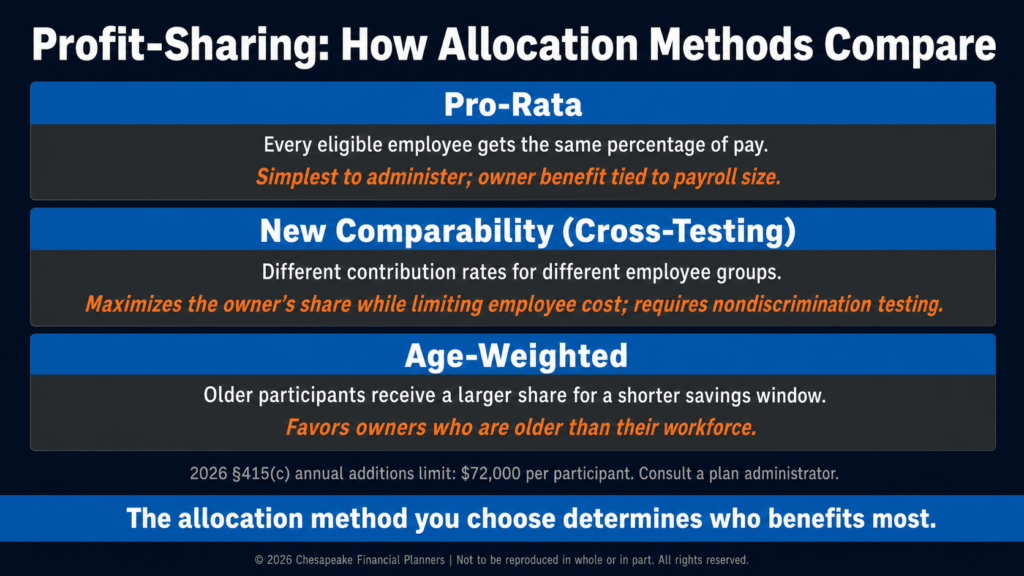
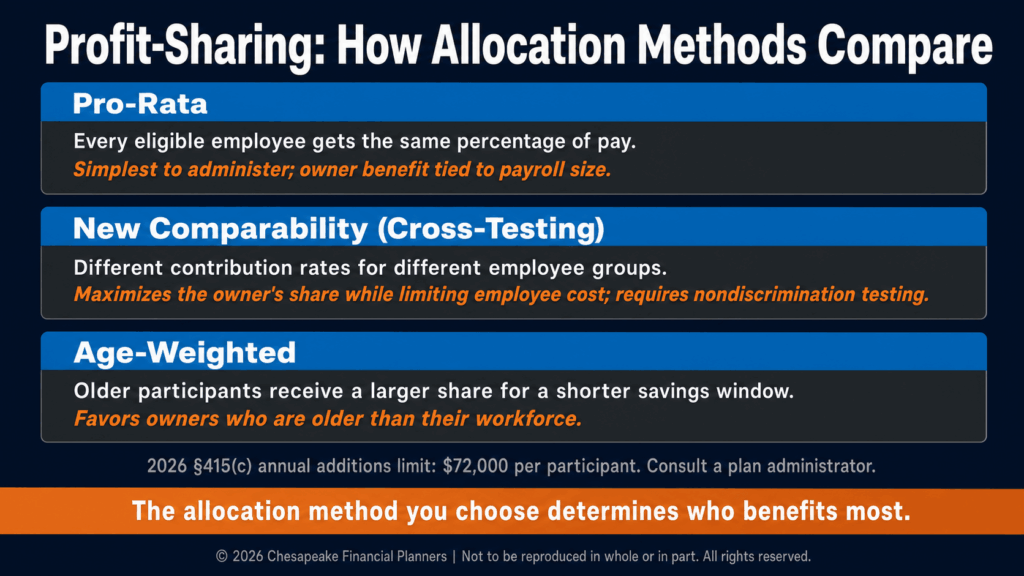
Allocation methods determine how the total contribution is split among employees, and the method you choose directly controls how much lands in the owner's account versus everyone else's. This flexibility is the most underused feature of these plans.
There are three common approaches. Each passes IRS testing differently, so plan design matters.
| Allocation Method | How It Works | Best For |
|---|---|---|
| Pro-Rata | Every eligible employee gets the same percentage of pay | Owners wanting simple, equal treatment |
| Age-Weighted | Older participants receive a larger share to reflect a shorter savings window | Owners significantly older than their staff |
| New Comparability | Employees are split into groups with different rates per group | Maximizing owner contributions while limiting employee cost |
A new comparability, or cross-tested, design might allocate 15% of compensation to owners and 3% to other staff, all while satisfying non-discrimination testing required by the IRS. Age-weighting works similarly when the owner is meaningfully older than the workforce: a 55-year-old owner could receive far more than a 25-year-old earning the same salary, and the math still passes testing.
These plans, when designed correctly, fit naturally into a broader framework like the R.U.D.D.E.R. Method™, Chesapeake Financial Planners' six-step planning process: Review and Recognize, Uncover and Understand, Design and Develop, Discuss and Decide, Execute and Empower, and Reassess and Refine. The allocation choice belongs in the Design and Develop stage, where the owner's retirement goal meets the cost of covering employees.
How do business owners plan for retirement differently?
Why Pair a Profit-Sharing Plan With a 401(k)?
Pairing a profit-sharing plan with a 401(k) lets an owner stack contributions to reach the full annual limit faster than either plan could alone. The 401(k) handles employee deferrals; the profit-sharing piece handles the larger discretionary employer dollars.
The two layers work together. For 2026, an employee can defer up to $24,500 into a 401(k), with a catch-up to $32,500 at age 50 and a higher $35,750 limit for ages 60 through 63 under SECURE 2.0. Add a modest match and a profit-sharing contribution, and an owner can climb toward the $72,000 ceiling using a blend of deferral, match, and discretionary funding.
A common structure looks like this: defer $24,500 as an employee, take a $3,000 employer match, and receive a $44,500 profit-sharing contribution, reaching the $72,000 cap. Employees get a real retirement benefit, and the owner maximizes personal tax-advantaged savings. This hybrid is one of the most effective employer retirement plans available to a closely held business.
How do business owners save for retirement without a 401(k)?
How Do Vesting Schedules Help With Retention?
Vesting schedules let employees earn ownership of employer contributions over time, which turns a profit-sharing plan into a quiet retention tool. An employee who leaves before fully vesting forfeits the unvested portion, and those forfeitures can offset future plan costs.
A graded schedule might vest 20% per year over five years, while a cliff schedule grants full ownership after a set number of years of service. The Department of Labor outlines the vesting rules that qualified plans must follow. For an owner trying to keep good people, vesting rewards longevity without requiring a constant cash commitment, which is exactly the kind of flexibility small business retirement planning should offer.
How Should Business Owners Pay Themselves Salary vs Distributions?
Frequently Asked Questions
How much can a business owner contribute to a profit-sharing plan in 2026?
A business owner can contribute up to $72,000 per participant for 2026, or 25% of eligible compensation, whichever is less. The IRS sets this defined contribution ceiling annually. Because contributions are discretionary, you choose the actual amount each year based on your business performance and cash flow.
Are profit-sharing plan contributions tax deductible?
Yes. Employer contributions to a qualified profit-sharing plan are fully tax deductible as a business expense within the plan's contribution limits. The deduction reduces your taxable income in the year you fund the account, and the balance grows tax-deferred until you withdraw it in retirement, which is where most of the long-term value compounds.
Do I have to contribute to a profit-sharing plan every year?
No. Profit-sharing plans are discretionary, meaning you decide each year whether to contribute and how much. You can contribute generously in a strong year and skip the contribution entirely in a lean one. This flexibility is the main reason owners with cyclical or seasonal income choose profit-sharing over a fixed-match plan.
Can I contribute more to my own account than to my employees' accounts?
Yes, within IRS limits and testing rules. Allocation methods like new comparability and age-weighting can direct a larger share to owners while limiting employee cost, provided the plan passes non-discrimination testing. A cross-tested design might give owners 15% of pay and other staff 3%, all while staying compliant.
Can a profit-sharing plan be combined with a 401(k)?
Yes. Many owners pair a 401(k) with a profit-sharing component to reach the full annual limit. The 401(k) captures employee deferrals and an optional match, while the profit-sharing piece adds larger discretionary employer dollars. Together they let an owner stack contributions up to the $72,000 per-participant cap for 2026.
Who is a profit-sharing plan best suited for?
Profit-sharing plans suit business owners with strong but variable cash flow who want high contribution limits without a fixed commitment. They work for single-owner firms and larger staffs alike. Owners who are older than their workforce often benefit most, since age-weighted and cross-tested allocations can favor them while passing IRS testing.
Profit-sharing plans give business owners one of the rare retirement tools that flexes with the business instead of fighting it. If you want to see how the numbers work for your own situation, our guide to retirement planning for business owners walks through the tradeoffs in depth. Download it at chesapeakefp.com.
Want to go deeper? Our 10 Signs You're Ready for a Certified Financial Planner walks through this step by step.
Disclosures
The information provided is for educational purposes only and should not be construed as investment advice. Investment strategies should be tailored to individual circumstances, risk tolerance, and goals. Past performance doesn't guarantee future results. Consult with qualified financial professionals regarding your specific situation.
This information is not intended to be a substitute for specific individualized tax, investment or legal advice. We suggest that you discuss your specific situation with a qualified tax, legal or financial advisor.
Advisors associated with Chesapeake Financial Planners may be either (1) LPL Financial Registered Representatives offering securities through LPL Financial, Member FINRA and SIPC, and investment advisor representatives offering investment advice through Great Valley Advisor Group; or (2) solely investment advisor representatives offering investment advice through Great Valley Advisor Group and not affiliated with LPL Financial. Great Valley Advisor Group, and Chesapeake Financial Planners are separate entities from LPL Financial.


