

How much money do I need to retire comfortably?
Last reviewed: July 2026
Most people need somewhere between 10 and 12 times their final working salary saved to retire comfortably, but the honest answer is that your number depends on what you spend, not what you earn. A household spending $80,000 a year with $30,000 coming from Social Security needs roughly $1.25 million invested. A household spending $50,000 a year with a pension might retire comfortably on a fraction of that. There is no universal figure to retire comfortably, and anyone who hands you one without asking about your spending is guessing.
The number that actually matters is the gap between what you'll spend each year and what your guaranteed income covers. Multiply that gap by 25, and you have a defensible starting target. Everything else in this guide refines that estimate for your taxes, your timeline, your health, and how long you expect to live.
Key Takeaways
- Your retirement number is built from your spending gap, not a salary multiple. Most households target 10 to 12 times final salary.
- The 4% rule implies you need about 25 times your annual portfolio withdrawal saved to last 30 years.
- The 2026 maximum Social Security benefit at full retirement age is $4,152 per month, which sharply reduces what your portfolio must cover.
- A 65-year-old couple retiring in 2025 may need about $351,000 saved for healthcare, per EBRI.
- Sequence-of-returns risk in the first five retirement years can permanently shrink a portfolio, even if average returns are fine.
About the Author: Jeff Judge, CFP®, AEP®, ChFC®, CLU® is Managing Partner of Chesapeake Financial Planners in Forest Hill, Maryland. He has been helping families and business owners in Harford County and the Baltimore metro area navigate retirement income planning since earning his CFP® certification in 2013, by using Chesapeake Financial Planners’ signature process, the R.U.D.D.E.R. method™. Jeff's blunt take: most people obsess over their investment returns and ignore the two levers that actually move the needle, their spending and their tax bracket in the years just before they stop working.
On This Page
- Why the "magic number" doesn't apply to you
- How to estimate your annual retirement spending
- How to count your guaranteed income sources
- How the 4% rule turns spending into a savings target
- How healthcare and long-term care change the math
- How taxes and where you live affect your number
- Why sequence-of-returns risk can break an otherwise solid plan
- Frequently Asked Questions
Why doesn't the "magic number" apply to you?
The "you need $1 million" rule fails because it answers the wrong question. A million dollars is wildly more than enough for one household and dangerously short for another, and the difference has almost nothing to do with the dollar amount itself.
To retire comfortably, your savings target is a function of five variables that change person to person:
- Your spending. Some retirees live well on $45,000 a year. Others spend $150,000 and feel constrained. The Bureau of Labor Statistics reports that households headed by someone 65 and older spent an average of roughly $60,000 annually in its most recent Consumer Expenditure Survey. Your number could land far above or below that average.
- Your guaranteed income. Social Security, a pension, rental income, and part-time work all reduce what your portfolio has to produce. Two households with identical spending can need radically different savings if one has a pension and the other does not.
- Your retirement age. Retiring at 55 means funding 35-plus years and bridging a decade before Medicare and Social Security. Retiring at 67 means a shorter runway and immediate access to both. The age gap can double the required savings.
- Where you live. State income tax, property tax, and healthcare costs vary enormously. A retiree in a no-income-tax state keeps thousands more per year than an identical retiree in a high-tax state.
- Your legacy goals. Spending your last dollar on your last day requires far less than leaving a seven-figure inheritance. Your endgame changes the target.
What does "comfortable" actually mean in dollars?
Comfortable is the spending level that funds your real life without forcing constant tradeoffs. For most households that means covering essential costs in full, funding the travel and hobbies you actually plan to do, and keeping a reserve for surprises. The practical way to define it: list what you spend now, subtract costs that disappear in retirement like commuting and retirement-account contributions, then add costs that grow like healthcare and leisure. That adjusted number is your comfortable spending level, and it is the foundation everything else is built on.
This is where Chesapeake Financial Planners uses the R.U.D.D.E.R. Method™, our six-step planning process: Review and Recognize, Uncover and Understand, Design and Develop, Discuss and Decide, Execute and Empower, and Reassess and Refine. The first two steps exist precisely to pin down what comfortable means for you before anyone touches a calculator.
How Do I Know If I'm On Track for Retirement?
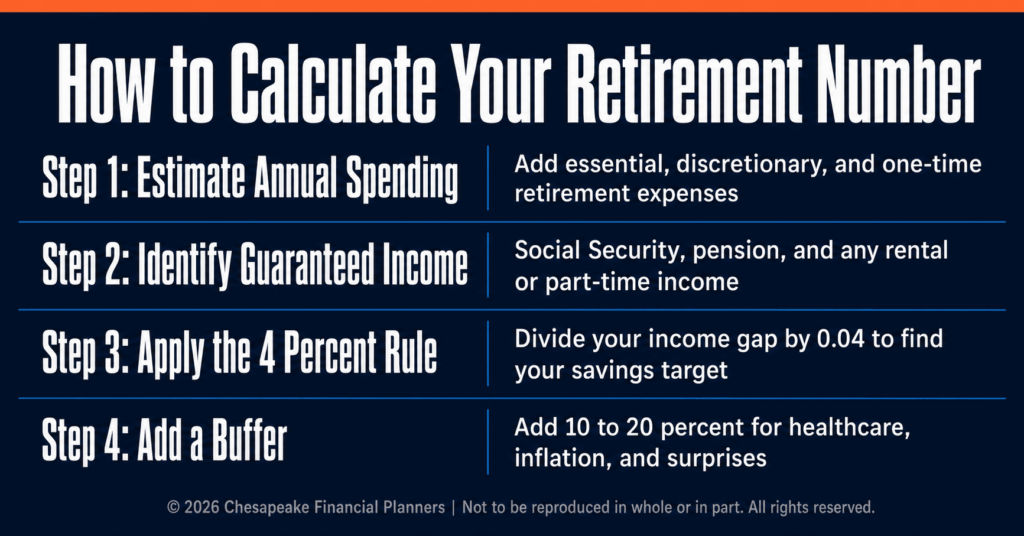
How do you estimate your annual retirement spending?
Estimate your retirement spending by building it from your current expenses, then adjusting for what changes. Start with your actual spending today, because that is the single most reliable predictor of what you'll spend tomorrow. Replacement-rate rules of thumb (plan for 70 to 80 percent of pre-retirement income) are a fine sanity check, but they routinely miss households that travel heavily early in retirement or carry a mortgage into their 70s.
Break your spending into three buckets and the estimate becomes far more accurate than any percentage rule.
What are your essential expenses?
These are the costs that do not stop the day you retire: housing (mortgage or rent, property taxes, insurance, maintenance), healthcare premiums and out-of-pocket costs, food, utilities, transportation, and basic insurance. Essential expenses are the floor your guaranteed income should ideally cover, because these are the bills you cannot defer in a bad market year. A common mistake I see is retirees underestimating home maintenance. A roof, an HVAC system, and a driveway all wear out on roughly the same 15-to-20-year cycle, and they tend to hit within a few years of each other.
For most households, housing remains the single largest line item even after a mortgage is paid off. Property taxes, insurance, and upkeep on a paid-off home can still run $10,000 to $20,000 a year. Healthcare is the line that surprises people most, because it tends to rise faster than general inflation throughout retirement.
What discretionary spending do you actually plan for?
Discretionary spending is where retirement plans live or die on accuracy. This bucket includes travel, dining out, hobbies, gifts, charitable giving, and home improvements. The trap is the "go-go years." Many retirees spend more in their first decade of retirement than they did while working, because they finally have time to travel and pursue the things they deferred. Spending then typically declines through the "slow-go" years and ticks back up late in life as healthcare costs rise.
Plan discretionary spending honestly. If you intend to take two international trips a year for the first ten years, budget for it rather than pretending you'll be frugal. The plan only works if the numbers reflect the life you actually want.
What one-time and irregular costs should you build in?
One-time costs are the expenses that don't appear on a monthly budget but reliably show up over a 30-year retirement: replacing a vehicle every 8 to 12 years, a major home renovation, a wedding gift, a milestone trip, or helping an adult child. These are easy to forget because they're irregular, and forgetting them is how a plan that looked airtight on a spreadsheet runs short in practice. A reasonable approach is to set aside an annual sinking-fund amount for predictable replacements like cars and roofs, so a single large expense doesn't force a portfolio withdrawal at the worst possible time.
Add the three buckets together and you have your estimated annual spending. That number, not your salary, drives everything that follows.
How do I know if I'm saving enough for retirement?
How do you count your guaranteed income sources?
Count every dollar of income that arrives whether or not the market cooperates, because each of those dollars is a dollar your portfolio doesn't have to produce. This is the step that most dramatically lowers your required savings, and it's the one generic "save $1 million" advice ignores entirely.
Your guaranteed and semi-guaranteed income sources typically include:
- Social Security. This is the backbone of most retirement plans. The Social Security Administration reports the estimated average monthly retired-worker benefit is about $2,071 in 2026 after the cost-of-living adjustment. The maximum benefit at full retirement age is $4,152 per month, and claiming later raises it further. Because Social Security is inflation-adjusted and lasts for life, it functions like a bond you can never outlive.
- Pensions. If you have a defined-benefit pension, it provides contractual monthly income. Whether to take it as a monthly annuity or a lump sum is one of the larger irreversible decisions in retirement.
- Annuity income. Some retirees convert a portion of savings into a guaranteed lifetime income stream to cover essential expenses.
- Part-time work. Many retirees work part-time in the early years for income, structure, and social connection. Even modest earnings reduce portfolio withdrawals during the years when sequence risk is highest.
- Rental income. Investment property can produce ongoing cash flow, though it carries its own maintenance and vacancy considerations.
Here's the math that matters. Suppose you need $80,000 a year to live comfortably. You'll receive $36,000 from Social Security and $8,000 from part-time work for the first several years. Your portfolio only has to generate $36,000 a year, not $80,000. That difference is the entire ballgame, because it cuts your required savings by more than half.
As Jeff puts it with clients: the goal isn't to fund your whole lifestyle from your portfolio, it's to fund the gap. People who skip this step routinely talk themselves into thinking they can never retire, when in reality their guaranteed income covers far more than they realize.
How Do I Create Multiple Income Streams for Retirement?
Should I Take Social Security at 62 or Wait Until 70?
How does the 4% rule turn spending into a savings target?
The 4% rule says you can withdraw 4 percent of your portfolio in your first year of retirement, adjust that dollar amount for inflation each year after, and have a high probability your money lasts at least 30 years. Flip it around and it becomes a savings target: divide the income your portfolio needs to produce by 0.04, which is the same as multiplying by 25.
The rule traces back to financial planner William Bengen's 1994 research and was reinforced by the Trinity Study. More recent analysis from Morningstar has put the starting safe withdrawal rate near 3.7 to 4 percent depending on market conditions and asset allocation, so 4 percent remains a reasonable planning anchor rather than a guarantee.
Applied to the gap your portfolio must cover, the math is simple:
| Annual portfolio income needed | Multiply by 25 | Savings target |
|---|---|---|
| $30,000 | × 25 | $750,000 |
| $40,000 | × 25 | $1,000,000 |
| $50,000 | × 25 | $1,250,000 |
| $60,000 | × 25 | $1,500,000 |
| $80,000 | × 25 | $2,000,000 |
Notice that these targets apply to the portfolio gap, not total spending. If you spend $80,000 but Social Security and a small pension cover $44,000 of it, your portfolio only needs to produce $36,000, which puts your target around $900,000 rather than $2 million.
Where does the 4% rule fall short?
The 4% rule is a starting point, not a finish line, and treating it as gospel causes real problems. It assumes a roughly 30-year retirement, a balanced stock-and-bond portfolio, and a willingness to hold withdrawals steady through downturns. Retire at 55 and you may be funding 40 years, which argues for a lower starting rate. Carry a heavily conservative portfolio and the math shifts again. The rule also ignores taxes entirely, and a dollar withdrawn from a traditional IRA is not the same as a dollar withdrawn from a Roth. Use it to get in the right neighborhood, then refine with a real plan that accounts for your timeline and your tax situation.
How do I create reliable income from my retirement savings?

How do healthcare and long-term care change the math?
Healthcare is the line item that breaks more retirement plans than market crashes do, because it's large, it rises faster than general inflation, and most people dramatically underestimate it. A 65-year-old couple retiring in 2025 may need roughly $351,000 saved to cover healthcare costs throughout retirement, according to research from the Employee Benefit Research Institute. That figure does not include long-term care.
Medicare helps, but it is not free and it does not cover everything. The standard Medicare Part B premium is $202.90 per month in 2026, and higher-income retirees pay an income-related surcharge on top of that. Part B does not cover most dental, vision, hearing, or long-term custodial care. Those gaps come out of your pocket or out of supplemental coverage you pay for separately.
Long-term care is the larger and more uncomfortable variable. According to the U.S. Department of Health and Human Services, roughly 70 percent of people turning 65 will need some form of long-term care in their lives. A private room in a nursing home or several years of in-home care can run into hundreds of thousands of dollars, and Medicare does not pay for extended custodial care. This is the risk most people would rather not think about, which is exactly why it sinks plans.
In practice, I tell clients to plan for healthcare as its own dedicated line, not a footnote. Whether you self-fund the risk, buy long-term care or hybrid insurance, or set aside a designated reserve, the decision should be deliberate. Pretending it won't happen is not a plan.
How does my Social Security claiming decision affect my Medicare premiums?
How do taxes and where you live affect your number?
Two retirees with identical portfolios and identical spending can need very different savings depending on how their income is taxed and where they live. Taxes are a controllable variable, and they're one of the biggest levers between a plan that lasts and one that doesn't.
The location piece is the most visible. Some states tax retirement income heavily, some exempt Social Security and pensions, and a handful levy no state income tax at all. Property taxes and the cost of healthcare also swing wide by region. A retiree relocating from a high-tax state to a low-tax one can effectively give themselves a raise of several thousand dollars a year without changing their lifestyle at all.
The tax-bracket piece is less visible and arguably more important. The composition of your savings matters as much as the total. A dollar in a traditional IRA or 401(k) is taxed as ordinary income when you withdraw it. A dollar in a Roth comes out tax-free. A dollar in a taxable brokerage account may qualify for lower long-term capital gains rates. Three retirees with $1 million each can have very different spendable income depending on which accounts that million sits in.
This is why the years just before retirement are so valuable. The window between leaving work and claiming Social Security and starting required minimum distributions is often the lowest-tax stretch of a person's life. The IRS requires most retirees to begin taking RMDs at age 73, and once those distributions start, they can push you into a higher bracket and raise your Medicare premiums. Strategic Roth conversions during the low-tax window can lower lifetime taxes and shrink the savings you actually need.
Jeff's view here is direct: most people optimize the wrong thing. They sweat a half-percent of investment return and ignore the tens of thousands they're handing back in unnecessary taxes over a 30-year retirement. The tax plan often moves your required number more than the portfolio does.
Should I relocate to another state for retirement tax savings?
How Can Maryland Retirees Reduce Their State Tax Burden?
Why can sequence-of-returns risk break an otherwise solid plan?
Sequence-of-returns risk is the danger that poor investment returns in the first few years of retirement permanently damage your portfolio, even if your long-term average return is perfectly fine. It's one of the least understood and most dangerous forces in retirement, and it's the reason two people with identical average returns can end up in completely different places.
Here's why it matters. While you're saving, the order of your returns barely matters, because you're adding money and time smooths it out. Once you're retired and withdrawing, the order matters enormously. If the market drops 25 percent in your first two years while you're pulling out income, you're selling shares at depressed prices to fund living expenses, and those shares aren't there to recover when the market rebounds. The same average return delivered in a different order, with the good years first, can leave you with hundreds of thousands more.
This is the answer to the question every pre-retiree quietly worries about: what happens if the market crashes right when I retire? The defenses are practical. Holding one to three years of spending in cash and short-term bonds lets you avoid selling stocks into a downturn. Keeping flexible discretionary spending lets you trim in bad years. Covering essential expenses with guaranteed income means a market drop never threatens your basic bills. None of these defenses requires predicting the market, which is the point.
In my experience, the clients who sleep best in retirement aren't the ones with the largest portfolios. They're the ones whose essential expenses are covered by Social Security, a pension, or an annuity, so a bad market year is an inconvenience rather than a crisis. That structural protection is worth more than chasing an extra point of return.
Will My Money Last If the Market Crashes During Retirement?
When does buying an annuity make sense for retirement income?

Frequently Asked Questions
How much money do I need to retire comfortably?
Most households need 10 to 12 times their final salary saved to retire comfortably, but the precise figure depends on your spending minus your guaranteed income. Calculate the annual income your portfolio must produce, then multiply by 25. A household needing $40,000 a year from savings targets roughly $1 million.
What is the 4% rule and is it still reliable?
The 4% rule lets you withdraw 4 percent of your portfolio in year one, then adjust that amount for inflation annually, with a high probability your money lasts 30 years. Recent Morningstar analysis places the safe rate near 3.7 to 4 percent, so it remains a solid planning anchor rather than a guarantee.
How much does Social Security cover in retirement?
Social Security covers a meaningful share of most retirees' income. The Social Security Administration reports the average retired-worker benefit is about $2,071 per month in 2026, while the maximum at full retirement age is $4,152. Because it's inflation-adjusted and lasts for life, it sharply reduces the income your portfolio must generate.
How much should I budget for healthcare in retirement?
Budget for healthcare as a major standalone cost, not a footnote. The Employee Benefit Research Institute estimates a 65-year-old couple retiring in 2025 may need around $351,000 saved for healthcare, excluding long-term care. The 2026 standard Medicare Part B premium is $202.90 monthly, with surcharges for higher earners.
Does the 4% rule account for taxes?
No, the 4% rule ignores taxes entirely, which is one of its biggest limitations. A dollar withdrawn from a traditional IRA is taxed as ordinary income, while a Roth withdrawal is tax-free. Your real spendable income depends heavily on which accounts your savings sit in, so a tax plan is essential alongside the rule.
Can I retire comfortably with less than $1 million?
Yes, many households retire comfortably with less than $1 million, especially with strong guaranteed income. If Social Security and a pension cover most of your essential expenses, your portfolio only needs to fund the gap. A retiree spending $55,000 a year with $40,000 in guaranteed income may need closer to $375,000 saved.
How does retiring early change how much I need?
Retiring early sharply increases your required savings because you fund more years and bridge the gap before Medicare and Social Security begin. Retiring at 55 may mean a 40-year retirement, which argues for a lower withdrawal rate and a larger nest egg. You also self-fund healthcare until Medicare eligibility at 65.
Where to go from here
The honest answer to "how much do I need" is that it's knowable, but only after you've pinned down your spending, your guaranteed income, your timeline, and your tax picture. The rules of thumb get you into the right neighborhood. A real plan tells you which house. At Chesapeake Financial Planners, we work through this exact calculation with clients every week, and the number people walk away with is almost always different from the one they guessed. If you're trying to figure out whether you can retire comfortably, a second opinion costs you nothing. Visit chesapeakefp.com to learn more.
Want to go deeper? Our Retirement Income Blueprint Workbook walks through this step by step.
Disclosures
The information provided is for educational purposes only and should not be construed as investment advice. Investment strategies should be tailored to individual circumstances, risk tolerance, and goals. Past performance doesn't guarantee future results. Consult with qualified financial professionals regarding your specific situation.
Advisors associated with Chesapeake Financial Planners may be either (1) LPL Financial Registered Representatives offering securities through LPL Financial, Member FINRA and SIPC, and investment advisor representatives offering investment advice through Great Valley Advisor Group; or (2) solely investment advisor representatives offering investment advice through Great Valley Advisor Group and not affiliated with LPL Financial. Great Valley Advisor Group, and Chesapeake Financial Planners are separate entities from LPL Financial.


