

How Much Life Insurance Do I Actually Need?
Last reviewed: July 2026
The honest answer: enough to replace what you provide financially, cover your debts, fund your family's goals, and bridge the gap until your spouse reaches retirement. For most working parents that lands somewhere between 10 and 15 times annual income, but the right number depends on your specific debts, assets, and goals. A needs-based calculation beats any rule of thumb, and that's what this guide walks you through step by step so you can figure out exactly how much life insurance fits your situation.
On This Page
- Key Takeaways
- Why the Common Rules of Thumb Fail You
- How Do You Calculate Life Insurance Needs Step by Step?
- How Much Income Should Life Insurance Replace?
- What Existing Resources Reduce Your Coverage Need?
- Term vs Whole Life: Which Type Should You Buy?
- How Much Life Insurance Do Business Owners and Stay-at-Home Parents Need?
- What Is the DIME Method for Calculating Life Insurance?
- How Often Should You Recalculate Your Coverage?
- Frequently Asked Questions
- Ready to Run Your Own Number?
- Disclosures
Key Takeaways
- Most families need life insurance equal to 10 to 15 times annual income, but a needs-based calculation gives you a far more accurate number.
- According to LIMRA, roughly 100 million American adults say they need life insurance or need more of it.
- Social Security survivor benefits can pay a family with two children over $3,000 per month, directly reducing how much coverage you need to buy.
- Term life insurance covers most needs at a fraction of whole life cost, often under $40 per month for a healthy 35-year-old.
- Subtract existing assets and employer coverage before buying, or you will overpay for coverage you do not need.
About the Author: Jeff Judge, CFP®, AEP®, ChFC®, CLU® is Managing Partner of Chesapeake Financial Planners in Forest Hill, Maryland. He has been helping families and business owners in Harford County and the Baltimore metro area navigate life insurance decisions since earning his CFP® certification in 2013, by using Chesapeake Financial Planners’ signature process, the R.U.D.D.E.R. method™. Jeff has watched too many families buy a policy based on a slogan instead of a calculation, and the gap between those two approaches is often hundreds of thousands of dollars.
Why the Common Rules of Thumb Fail You
Life insurance rules of thumb fail because they ignore the two things that matter most: your specific obligations and the resources you already have. A single rule cannot fit a 28-year-old renter with no kids and a married 45-year-old business owner with a mortgage and three children headed to college. The math is different because the lives are different.
Here are the shortcuts you have probably heard, and why each one breaks down:
- "Ten times your salary." This is a decent starting estimate, but it ignores your debts, your existing savings, and how many years your family actually needs income. A high earner with a paid-off house and a large 401(k) may need far less than ten times income. A younger parent with young kids and a big mortgage may need more.
- "Enough to pay off the mortgage." Paying off the house is one piece. It does nothing to replace the paycheck that covers groceries, childcare, and retirement savings for the next two decades.
- "As much as you can afford." This leads people to buy expensive permanent policies they later cancel, or to skip coverage entirely because the quoted premium felt high. Affordability is a constraint, not a calculation method.
The real purpose of life insurance is simple to state. It replaces the financial value you provide so your family keeps their lifestyle and reaches their goals if you are not there. Not so much that you waste money on premiums. Not so little that your family is left exposed. Jeff Judge often tells clients that the goal is a number you can defend with a spreadsheet, not a number a salesperson handed you.
This is exactly where the R.U.D.D.E.R. Method™ earns its keep. The R.U.D.D.E.R. Method™ is Chesapeake Financial Planners' six-step planning process: Review and Recognize, Uncover and Understand, Design and Develop, Discuss and Decide, Execute and Empower, and Reassess and Refine. Life insurance sits squarely in the "Uncover and Understand" and "Design and Develop" stages, because you cannot size a policy until you understand the full picture of what your family would actually need.
What are the fundamentals of personal financial planning?

How Do You Calculate Life Insurance Needs Step by Step?
You calculate how much life insurance you need by adding up four things your family would require, then subtracting the resources they already have. The result is your coverage gap, and that gap is the amount of insurance to buy. The method is sometimes called a life insurance needs analysis, and it beats every rule of thumb because it uses your real numbers.
What are the four components of a needs analysis?
The four components are income replacement, immediate expenses and debt, future goals, and existing resources. The first three are what your family needs. The fourth is what you subtract.
Here is the structure, with a realistic example for a household earning $80,000 per year:
- Income replacement. The income your family needs each year, multiplied by the number of years they need it. For our example, $80,000 per year for 20 years.
- Immediate expenses and debt. Funeral costs, mortgage payoff, car loans, credit cards, and student loans. For our example, a $400,000 mortgage plus $30,000 in car loans plus $15,000 in final expenses equals $445,000.
- Future goals. College funding, legacy gifts, or a specific amount your spouse needs to retire. For our example, two children at $150,000 each equals $300,000.
- Existing resources. Savings, investments, retirement accounts you would dedicate to this, and any life insurance you already own. For our example, $300,000 in combined savings and retirement plus $500,000 in employer coverage equals $800,000.
When you run the income replacement piece with a reasonable rate of return, $80,000 per year for 20 years comes to roughly $1.09 million in today's dollars, assuming the proceeds earn about 4% above inflation. Add the immediate expenses of $445,000 and the college goal of $300,000, and the total need is about $1.835 million. Subtract the $800,000 in existing resources, and the coverage gap is roughly $1.035 million. Most families would round that to $1 million or $1.25 million for cushion.
That single calculation tells you more than any rule of thumb ever could. It also explains why two people with the same salary can land on wildly different numbers. The salary is the same, but the debts, the kids, and the existing savings are not.
How Much Should I Have in My Emergency Fund?
How Much Income Should Life Insurance Replace?
Life insurance should replace enough income to cover your family's annual living costs for the number of years until your spouse can stand on their own financially, typically until retirement and Social Security begin. The math hinges on two numbers: the annual income your family needs and the number of years they need it.
How do you turn years of income into a single coverage number?
You convert years of income into a lump sum using present value, because a smaller lump sum invested today can fund a larger stream of payments over time. A simple version multiplies the annual need by the number of years. A more accurate version discounts for the return the money earns while it is being spent down.
Take a household that needs $80,000 per year for 20 years. The crude method gives you $1.6 million. But that assumes the money earns nothing while it sits there, which is too conservative. If the insurance proceeds earn roughly 4% above inflation, the present value drops to about $1.09 million. That half-million-dollar difference is the difference between an estimate and a calculation.
Two adjustments matter here. First, your family's spending usually drops once the mortgage is paid and the kids are launched, so you do not always need to replace 100% of income for the full period. Second, Social Security survivor benefits fill part of the gap, especially while children are young. A surviving spouse caring for children can receive benefits that meaningfully reduce the income the insurance has to cover.
Jeff has seen this play out in plenty of client meetings. A couple walks in convinced they need $3 million because an online calculator told them so. Once you account for the spouse's own earning capacity, the survivor benefits, and the fact that spending falls after the kids leave, the real number is often closer to $1.2 million. The point is not to scare you into a giant policy. The point is to fund what your family actually needs.
Why Do Your Money Values Matter More Than Your Investment Choices?

What Existing Resources Reduce Your Coverage Need?
Existing resources reduce your coverage need dollar for dollar, which is why subtracting them is the single most overlooked step in buying life insurance. Every asset your family could draw on, and every dollar of coverage you already hold, lowers the amount of new insurance you have to purchase.
Which assets count against your insurance need?
The assets that count are savings, taxable investments, retirement accounts you would dedicate to survivors, existing employer or individual life insurance, and projected Social Security survivor benefits. Each one shrinks the gap.
Walk through them in order:
- Savings and taxable investments. Cash and brokerage balances are fully available to your family and reduce the need directly.
- Retirement accounts. Count these carefully. If your spouse needs the 401(k) and IRA for their own retirement, do not double-count that money as a survivor resource. Jeff treats retirement balances as partly available at most, because spending them down early can leave a surviving spouse short later.
- Existing life insurance. Group coverage through your employer often runs one to two times salary. It counts, but remember it usually ends when you leave the job, so do not build your entire plan around it.
- Social Security survivor benefits. This is the big one people forget. According to the Social Security Administration, survivor benefits are payable to a surviving spouse caring for the deceased worker's child under 16 and to the children themselves. For a family with two qualifying children, monthly survivor benefits can exceed $3,000, which over several years adds up to a six-figure resource.
The coverage gap statistic across the country is real. LIMRA research consistently finds that a large share of American households would face financial hardship within months of losing a primary earner, and that the median coverage shortfall is substantial. The fix is not to buy blindly. The fix is to subtract what you have and insure the difference.
One trap worth naming: do not subtract a resource you actually intend to keep. If you want your spouse to retire with the 401(k) intact and still pay off the house, then the 401(k) is not available to plug the income gap. Decide what each asset is for before you net it out.
What is the best way to pay off debt quickly?
Term vs Whole Life: Which Type Should You Buy?
For most families, term life insurance is the right answer because it provides the largest death benefit for the lowest premium during the years your family is most financially vulnerable. Whole life and other permanent policies cost far more for the same coverage and make sense only in specific estate, business, or special-needs planning situations.
How much cheaper is term than whole life?
Term is dramatically cheaper, often five to fifteen times less expensive than whole life for the same death benefit. The difference exists because term has no cash value component and covers a defined period rather than your entire life.
Here is how the two stack up:
| Feature | Term Life | Whole Life (Permanent) |
|---|---|---|
| Coverage period | Set term, often 10 to 30 years | Entire life if premiums are paid |
| Premium cost | Lowest for a given death benefit | Often 5 to 15 times higher |
| Cash value | None | Builds tax-deferred cash value |
| Best use | Income replacement during working and child-rearing years | Estate liquidity, business buy-sell, lifelong dependents |
| Premium stability | Level during the term, then jumps sharply | Level for life |
A healthy 35-year-old in good health can often buy a 20-year, $1 million term policy for somewhere in the range of $30 to $50 per month, depending on health and carrier. The same $1 million in whole life coverage could run several hundred dollars per month. For a young family trying to cover a 20-year income gap, that price difference is the entire ballgame.
Jeff's standard guidance is direct: buy term to cover the temporary gap, invest the difference, and reach for permanent coverage only when you have a permanent need. A family with a special-needs child who will require lifelong support is a legitimate reason for permanent coverage. So is a business owner who needs guaranteed liquidity to fund a buy-sell agreement. Buying whole life simply because an agent framed it as "forced savings" is usually a mistake. You can almost always build more wealth by buying term and investing the premium difference in a low-cost portfolio.
That said, permanent insurance is a real tool, not a scam. The error is using it as the default. Match the type of policy to the type of need, and the decision becomes much clearer.
How much does it cost to hire a financial planner in 2026?
What behavioral biases most commonly hurt investment decisions and how do you fix them?
How Much Life Insurance Do Business Owners and Stay-at-Home Parents Need?
Business owners and stay-at-home parents often need substantial coverage, even though their situations look nothing like a typical salaried earner. Both groups are frequently underinsured because their economic value is not printed on a W-2.
Why do stay-at-home parents need life insurance?
A stay-at-home parent needs life insurance because replacing the work they do, including childcare, household management, and logistics, would cost the family real money. If that parent died, the surviving spouse would have to pay for services the family currently gets for free.
The cost of replacing a stay-at-home parent's labor is not trivial. Full-time childcare, housekeeping, transportation, and meal preparation can run tens of thousands of dollars per year. A policy of $250,000 to $500,000 on a stay-at-home parent is common and reasonable, and the term premium is modest because the insured is often young and healthy.
How is a business owner's life insurance need different?
A business owner's need is different because it layers personal income replacement on top of business obligations like loans, buy-sell agreements, and key-person coverage. The personal calculation works the same way as everyone else's. The business calculation is additional.
Business owners typically need to consider three separate buckets:
- Personal coverage. The same needs-based calculation any family runs, covering income replacement, debts, and goals.
- Buy-sell funding. If you co-own a business, a buy-sell agreement funded with life insurance lets the surviving owners buy out a deceased partner's share without draining the company.
- Key-person coverage. A policy the business owns on an essential person, used to keep operations stable, recruit a replacement, or reassure lenders.
Jeff works with business owners across Harford County and the Baltimore metro who carry a robust personal policy and assume the business is covered, only to discover the buy-sell agreement was never funded. When that happens, a partner's death can force a fire sale or a feud. The fix is to run the personal and business calculations separately, then make sure each one is actually funded. This is the kind of overlooked gap that a thorough planning process is designed to surface before it becomes a crisis.
What Does a Real Financial Review Actually Cover?
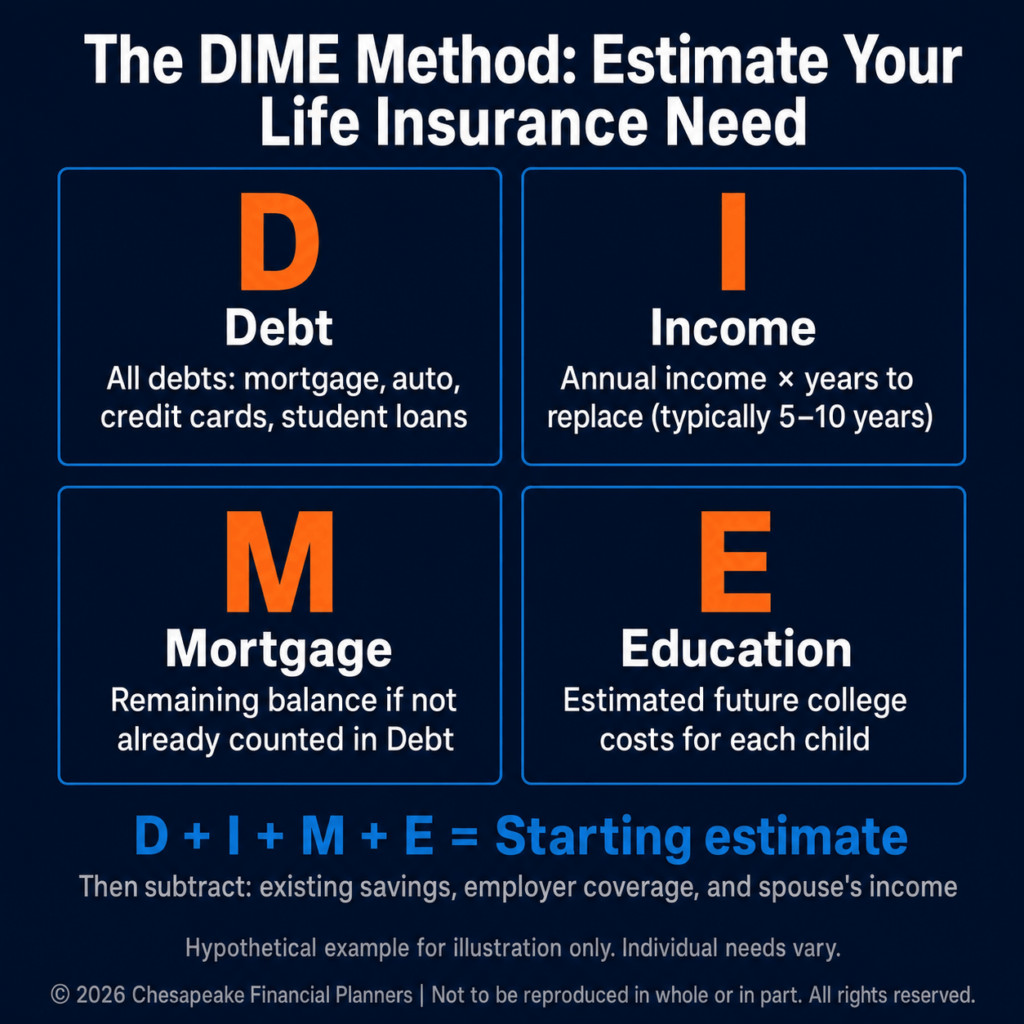
What Is the DIME Method for Calculating Life Insurance?
The DIME method is a four-part formula that adds up Debt, Income replacement, Mortgage, and Education costs to estimate how much life insurance you need. It's the fastest reliable starting point, and you can run it in about five minutes at your kitchen table.
Here's how each piece works:
- D = Debt. Total every non-mortgage debt: car loans, credit cards, student loans, personal loans.
- I = Income. Multiply your annual income by the number of years you want to replace it, usually 5 to 10.
- M = Mortgage. Add your remaining mortgage balance so your family keeps the house.
- E = Education. Estimate future college costs for each child.
A worked example makes it concrete. Take a family with $50,000 in non-mortgage debt, $80,000 in annual income they want replaced for 10 years ($800,000), a $250,000 mortgage, and two kids at $100,000 each for college ($200,000). Added together, that's $1.3 million in coverage. The College Board reports the 2024–25 average published cost of a four-year public in-state education ran over $24,000 per year including living expenses, so $100,000 per child is a defensible planning figure, not a guess.
The DIME method has one blind spot: it ignores what you already own. It doesn't subtract existing savings, your spouse's income, or Social Security survivor benefits. That's why it's a starting point, not a final answer.
How Often Should You Recalculate Your Coverage?
You should recalculate your life insurance coverage every three to five years and after any major life event, because the inputs to the calculation change as your life changes. A number that was perfect at 30 can be badly wrong at 40.
What life events should trigger a coverage review?
The events that should trigger a review are marriage, a new child, a home purchase, a significant income change, a business launch, and paying off major debt. Each one moves your coverage gap up or down.
Think about how the needs analysis shifts over time. Early on, you have a big mortgage, young children, and decades of income to replace, so your need peaks. As the mortgage shrinks, the kids age toward independence, and your retirement accounts grow, your need usually falls. That is the logic behind term insurance laddering, where some families buy a stack of term policies with different end dates so coverage steps down as the need does.
The reverse happens too. A business that takes on debt, a new child, or a move to a much larger mortgage all push the number up. Paying off the house pushes it down. The only way to know is to run the numbers again. Jeff reassesses coverage with clients as part of the Reassess and Refine stage of the R.U.D.D.E.R. Method™, because a plan you set once and never revisit drifts out of alignment with the life it was supposed to protect.
One practical note on timing. If your health is still good and you anticipate needing coverage for longer, locking in a longer level term while you are young and healthy is often cheaper than buying short and re-qualifying later at higher rates. Health changes are not something you can predict, and they are exactly what makes future coverage more expensive or impossible to get.
Why Do So Many Financial Plans Fail at the Execution Stage?
What is the difference between a fee-based and fee-only financial advisor?
Frequently Asked Questions
How much life insurance do I need if I make $80,000 a year?
If you make $80,000 a year, a needs-based calculation typically lands between $800,000 and $1.5 million, depending on your debts, your children, and your existing savings. A rough starting point is 10 to 15 times income, but subtract your assets and any employer coverage to find the actual gap you need to fill.
Is 10 times my salary enough life insurance?
Ten times your salary is a reasonable starting estimate, but it is not a final answer for most families. It ignores your specific debts, your existing savings, your children's college costs, and the Social Security survivor benefits your family would receive. Run a full needs analysis to confirm whether ten times income leaves you over-insured or under-protected.
Do I need life insurance if I have no kids?
You may not need much life insurance if you have no dependents and no shared debt, since the main purpose is replacing income others rely on. However, coverage can still make sense to pay off jointly held debt, cover final expenses, or lock in a low rate while you are young and healthy in case your situation changes later.
Is term or whole life insurance better for most families?
Term life insurance is better for most families because it provides the largest death benefit for the lowest premium during the years your family is most vulnerable. A healthy 35-year-old can often buy $1 million of 20-year term for $30 to $50 per month. Whole life makes sense mainly for estate, business, or lifelong-dependent needs.
How much does life insurance cost per month?
Term life insurance costs surprisingly little for healthy applicants, often $30 to $50 per month for a 35-year-old buying $1 million of 20-year coverage. Price rises with age, health conditions, tobacco use, coverage amount, and term length. Whole life coverage costs several times more for the same death benefit because it builds cash value.
Do stay-at-home parents need life insurance?
Yes, stay-at-home parents need life insurance because replacing their childcare, household management, and logistical work would cost the family real money. A policy of $250,000 to $500,000 is common and inexpensive, since the insured parent is often young and healthy. Without it, a surviving spouse must pay out of pocket for services the family currently receives for free.
How do Social Security survivor benefits affect how much insurance I need?
Social Security survivor benefits reduce how much life insurance you need by providing monthly income to a surviving spouse caring for young children and to the children themselves. For a family with two qualifying children, benefits can exceed $3,000 per month, which over several years becomes a six-figure resource you should subtract from your coverage gap.
How often should I review my life insurance coverage?
You should review your life insurance coverage every three to five years and after major life events like a new child, a home purchase, a business launch, or a significant income change. Your coverage need usually peaks early when debts and dependents are high, then declines as you build assets and pay down debt.
Ready to Run Your Own Number?
The slogans will never fit your situation, but a real calculation will. If you want to figure out exactly how much life insurance you need, our free planning guide walks you through the same needs-based framework Jeff uses with clients, including the income replacement and survivor benefit numbers that trip most people up. Download it at chesapeakefp.com and stop guessing at one of the most important numbers in your financial plan.
Want to go deeper? Our 6 Signs You're Ready for a Certified Financial Planner™ walks through this step by step.
This material is for educational purposes only and should not be considered tax or legal advice. Please consult with your tax advisor or attorney regarding your specific situation.
Guarantees are based on the claims paying ability of the issuing insurance company. Life insurance policies are subject to substantial fees and charges. Surrender charges may apply to policies surrendered during the surrender charge period. Policy loans and withdrawals will reduce the available cash value and death benefit and may cause the policy to lapse or affect any guarantees against lapse.
Disclosures
The information provided is for educational purposes only and should not be construed as investment advice. Investment strategies should be tailored to individual circumstances, risk tolerance, and goals. Past performance doesn't guarantee future results. Consult with qualified financial professionals regarding your specific situation.
This material is for educational purposes only. Insurance products contain exclusions, limitations, and terms for keeping them in force. Please contact a qualified insurance professional for costs and complete details.
Advisors associated with Chesapeake Financial Planners may be either (1) LPL Financial Registered Representatives offering securities through LPL Financial, Member FINRA and SIPC, and investment advisor representatives offering investment advice through Great Valley Advisor Group; or (2) solely investment advisor representatives offering investment advice through Great Valley Advisor Group and not affiliated with LPL Financial. Great Valley Advisor Group, and Chesapeake Financial Planners are separate entities from LPL Financial.


