

What Is the Best Way to Pay Off Debt Quickly?
Last reviewed: July 2026
The fastest way to pay off debt is to stop adding new debt, then throw every spare dollar at one balance at a time while paying minimums on the rest. Two proven methods drive this: the avalanche method, which targets your highest interest rate first to save the most money, and the snowball method, which targets your smallest balance first to build momentum. The right choice depends less on the math and more on whether you need quick wins to stay motivated.
Key Takeaways
- The avalanche method saves the most interest; the snowball method builds momentum by clearing small balances first.
- The average American carries $6,730 in credit card debt as of 2026, often at rates above 20%.
- Stop using credit cards before you start any payoff plan, or you will refill the balances you clear.
- A small starter emergency fund of $500 to $1,000 keeps surprises from pushing you back to credit.
- Consistency beats perfection; the method you actually stick with is the one that works.
About the Author: Jeff Judge, CFP®, AEP®, ChFC®, CLU® is Managing Partner of Chesapeake Financial Planners in Forest Hill, Maryland. He has been helping families and business owners in Harford County and the Baltimore metro area navigate debt and cash flow decisions since earning his CFP® certification in 2013, by using Chesapeake Financial Planners’ signature process, the R.U.D.D.E.R. method™. Jeff has watched clients spend years stuck on credit card minimums, never realizing that a fixed monthly amount and a clear order of attack would have freed them in a fraction of the time.
How Do You Pay Off Debt Quickly?
You pay off debt quickly by combining three moves: stop borrowing, free up as much cash as possible, and direct that cash at one debt at a time until it's gone. Speed comes from focus. Spreading extra money evenly across every balance feels productive, but it barely moves the needle. Concentrating it on a single target is what gets you free.
Start by seeing the whole picture. List every debt you owe: credit cards, student loans, car loans, personal loans, medical debt, anything. For each one, write down the balance, the interest rate, the minimum payment, and the due date. This step is uncomfortable for a reason. Most people underestimate their total by a wide margin until they add it up. You can't attack a number you refuse to look at.
Then decide how much extra you can send each month beyond the minimums. Even $150 makes a difference over time. The Consumer Financial Protection Bureau notes that paying only the minimum on a credit card can stretch repayment across decades while interest quietly doubles what you owe.
Should You Use the Avalanche or Snowball Method?
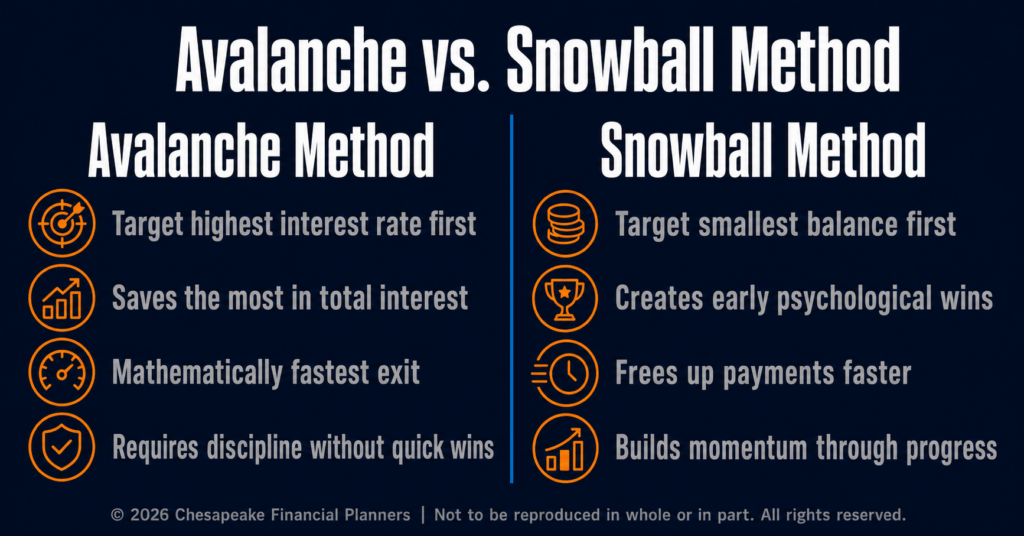
You should use the avalanche method if you want to save the most money, and the snowball method if you need visible progress to stay motivated. Both work. The difference is psychology versus arithmetic, and the better method is the one you'll actually finish.
The avalanche method pays minimums on everything, then sends every extra dollar at the debt with the highest interest rate. Once that's gone, you roll the freed-up payment into the next highest rate. It's mathematically the cheapest path out.
The snowball method pays minimums on everything, then attacks the smallest balance first regardless of rate. When that debt disappears, the momentum and the freed-up payment carry you to the next smallest. You pay slightly more interest overall, but research from Harvard Business School found that people who tackled their smallest balances first were more likely to clear their entire debt, because early wins kept them going.
| Feature | Avalanche Method | Snowball Method |
|---|---|---|
| Target order | Highest interest rate first | Smallest balance first |
| Best for | Math-driven, disciplined savers | People who need quick wins |
| Interest paid | Lowest | Slightly higher |
| First win | Can take longer | Usually fast |
| Motivation | Long-term optimization | Early momentum |
Jeff Judge tells clients to be honest about which type they are. "If you've started and quit a payoff plan before, the snowball is probably your method," he often says. "The few hundred dollars in extra interest is cheap insurance against giving up again."
What Should You Do Before You Start Paying Off Debt?
Before you start, stop adding new debt and build a small cash buffer. You can't bail out a boat that's still taking on water. If credit cards keep funding your lifestyle, no payoff strategy will hold.
Put the cards out of reach without canceling them, since closing accounts can hurt your credit score. Switch discretionary spending to cash or debit so the money leaves your account immediately and you feel each purchase. Then set aside a starter emergency fund of $500 to $1,000 for minor surprises. Without that buffer, a flat tire or an urgent vet bill sends you right back to the card you were trying to pay down.
If you're charging necessities like groceries or utilities, your debt is a symptom of a deeper cash flow gap. Fix that first through budgeting, trimming expenses, or raising income. This is one of the steps in the What are the fundamentals of personal financial planning? that most people skip, then wonder why their debt won't shrink.
How Long Does It Take to Become Debt Free?
It typically takes most households between 18 months and four years to become debt free once they commit to a focused plan and stop borrowing. The timeline depends on your total balance, your interest rates, and how much extra you can send each month.
The lever almost nobody pulls hard enough is the monthly extra payment. Someone sending an additional $300 a month will finish years ahead of someone sending $50, even with identical balances. Increasing income, even temporarily, often shortens the timeline more than any clever optimization. A side income stream applied entirely to debt can compress a four-year plan into two.
Refinancing high-rate debt can also speed things up. A balance transfer or a personal loan at a lower rate, used responsibly, reduces the interest working against you. Just don't treat the freed-up room as permission to spend. That's how people end up with the original debt plus the new loan.
How Does Paying Off Debt Fit Into Your Bigger Plan?
Paying off debt is one piece of a broader financial plan, not the whole thing. Clearing high-interest balances usually beats almost any investment return you could earn, because eliminating 22% interest is a guaranteed 22% gain. But going to zero balances at the expense of retirement contributions or an emergency fund can backfire.
At Chesapeake Financial Planners, we work through this sequencing using the R.U.D.D.E.R. Method™, Chesapeake Financial Planners' six-step planning process: Review and Recognize, Uncover and Understand, Design and Develop, Discuss and Decide, Execute and Empower, and Reassess and Refine. Debt payoff usually lands in the Design and Develop stage, balanced against goals like funding a How much should I save in an emergency fund during a job change? and capturing any employer retirement match, which is free money you rarely want to skip.
Behavior matters more than spreadsheets here. The same patterns described in What behavioral biases most commonly hurt investment decisions and how do you fix them? also drive debt decisions. Recognizing those tendencies helps you choose a method you'll stick with.
Frequently Asked Questions
Is it better to pay off debt or save money first?
Build a small starter emergency fund of $500 to $1,000 first, then prioritize paying off high-interest debt above additional saving. Eliminating a credit card charging 22% interest delivers a guaranteed return no savings account can match. Once high-interest debt is gone, redirect those payments toward fuller savings and investing.
What is the debt avalanche method?
The debt avalanche method means paying minimum payments on every debt while directing all extra money toward the balance with the highest interest rate. Once that debt is gone, you move to the next highest rate. It saves the most money in total interest and is mathematically the fastest path out of debt.
Does paying off debt hurt your credit score?
Paying off debt usually helps your credit score over time by lowering your credit utilization and showing consistent payments. Closing a credit card account after payoff can temporarily ding your score by reducing available credit. Keep paid-off cards open with a zero balance to preserve your credit history and limits.
How much extra should I pay toward debt each month?
Pay as much extra as your budget allows after covering essentials and a small emergency buffer, even if it's only $100 to $300 a month. The extra payment is the single biggest factor in how fast you become debt free. Increasing income temporarily and applying it all to debt accelerates the timeline dramatically.
Should I use a personal loan to pay off credit cards?
A personal loan can help pay off credit cards if it carries a meaningfully lower interest rate and you stop using the cards afterward. Consolidating high-rate balances into one fixed-rate loan simplifies payments and reduces interest. The risk is running the cards back up, leaving you with both the loan and new debt.
Ready to Build a Plan Around Your Debt?
Getting out of debt is rarely about willpower. It's about a clear order of attack and a number you commit to every month. If you found this helpful, our guide to building a complete financial foundation walks through how debt payoff fits alongside saving, investing, and protecting your family. Download it at chesapeakefp.com and start your plan today.
Disclosures
The information provided is for educational purposes only and should not be construed as investment advice. Investment strategies should be tailored to individual circumstances, risk tolerance, and goals. Past performance doesn't guarantee future results. Consult with qualified financial professionals regarding your specific situation.
Advisors associated with Chesapeake Financial Planners may be either (1) LPL Financial Registered Representatives offering securities through LPL Financial, Member FINRA and SIPC, and investment advisor representatives offering investment advice through Great Valley Advisor Group; or (2) solely investment advisor representatives offering investment advice through Great Valley Advisor Group and not affiliated with LPL Financial. Great Valley Advisor Group, and Chesapeake Financial Planners are separate entities from LPL Financial.


