

What Is the Best Retirement Spending Strategy for Me?
Last reviewed: July 2026
The best retirement spending strategy is the one that keeps you from selling investments at a loss during a downturn while still letting your money grow. For most retirees, that means pairing a bucket approach with dynamic spending: hold a cash reserve for near-term expenses, keep growth assets for the long haul, and adjust your withdrawals up or down based on how markets actually perform. There is no single right answer, but these two retirement spending strategies solve the biggest risks better than a rigid fixed-withdrawal plan.
Key Takeaways
- The bucket strategy divides savings into cash, income, and growth segments so you never sell stocks in a down market.
- Dynamic spending adjusts withdrawals each year based on portfolio performance, helping money last longer.
- The 2026 Social Security cost-of-living adjustment is 2.8%, and the average retired-worker benefit is roughly $2,071 per month.
- Sequence of returns risk, not low returns, is what causes most retirees to run short of money early on.
About the Author: Jeff Judge, CFP®, AEP®, ChFC®, CLU® is Managing Partner of Chesapeake Financial Planners in Forest Hill, Maryland. Jeff's view: the strategy matters less than whether you actually have one and stick to it when markets get loud. He has been helping families and business owners in Harford County and the Baltimore metro area develop sustainable retirement income strategies since earning his CFP® certification in 2013, by using Chesapeake Financial Planners’ signature process, the R.U.D.D.E.R. method™.
The move from building wealth to spending it down trips up smart, disciplined savers. You spent thirty years optimizing contributions. Now the question flips. How much can you pull out without running dry? Two retirement spending strategies dominate the conversation because they each solve a real problem. Let me walk through both, then help you figure out which fits.
How Does the Bucket Strategy Work?
The bucket strategy is a retirement income approach that splits your savings into three segments based on when you'll spend the money. Each bucket has its own job and its own level of risk. A reader who only remembers one thing should remember this: the structure exists so you never have to sell stocks at a loss to pay your grocery bill.
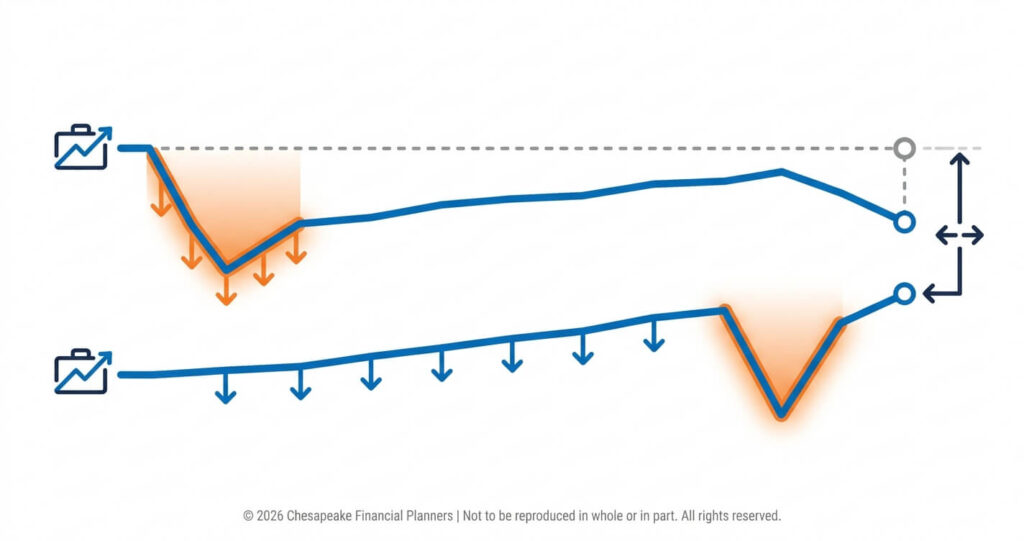
Bucket 1 holds one to two years of living expenses in cash, money market funds, or short-term CDs. This is your spending money. When markets drop, and they will, you draw from here instead of liquidating investments at the bottom. That single feature addresses sequence of returns risk, the danger that a bad market early in retirement permanently damages your portfolio.
Bucket 2 covers years three through ten with bonds, bond funds, and balanced funds. It generates income and modest growth. As Bucket 1 empties, you refill it from Bucket 2, so you're never scrambling to time the market.
Bucket 3 is your growth engine for year eleven and beyond, weighted toward stocks. Because you won't touch it for a decade or more, it can ride out volatility and outpace inflation. According to Morningstar's retirement research, a starting withdrawal rate near 4% has held up across most historical periods, and keeping a long-runway growth bucket is what makes that math work.
Jeff Judge often tells clients that the bucket approach is less about the buckets and more about behavior. When you know two years of expenses sit safely in cash, a 20% market drop stops feeling like an emergency.
What Is Dynamic Spending in Retirement?
Dynamic spending is a retirement withdrawal strategy where you adjust how much you take out each year based on portfolio performance, instead of withdrawing a fixed, inflation-adjusted amount no matter what. In strong years you can spend a little more. In down years you trim. That flexibility is the entire point, and it directly extends how long a portfolio lasts.
The mechanics are simple. Set a target withdrawal, then put guardrails around it. A common version raises spending when the portfolio grows past a ceiling and cuts it when the portfolio falls below a floor. T. Rowe Price research has shown that flexible withdrawal methods can support meaningfully higher initial spending than a fixed-dollar approach, precisely because they pull back during downturns.
Here's the practical step most people skip: separate your non-negotiable expenses from your discretionary ones. Healthcare, housing, and food are fixed. Travel, dining out, and the second vacation are flexible. When markets struggle, you reduce the flexible spending without touching the essentials. Dynamic spending only works if you've drawn that line in advance, before emotions get involved.
Bucket Strategy vs. Dynamic Spending: Which One Fits?
These two retirement spending strategies aren't rivals. Most well-built retirement income plans use both: buckets for structure, dynamic spending for flexibility. Still, the trade-offs differ, and knowing them helps you decide where to lean.
| Feature | Bucket Strategy | Dynamic Spending |
|---|---|---|
| Primary benefit | Avoids selling stocks in a downturn | Extends portfolio longevity |
| Best for | People who lose sleep over volatility | People comfortable adjusting their lifestyle |
| Effort required | Annual refilling and rebalancing | Yearly spending recalculation |
| Emotional cushion | High (visible cash reserve) | Moderate |
| Main weakness | Cash drag in low-yield years | Spending can swing year to year |
If market drops keep you awake, lean into buckets. If you'd rather hold more in growth assets and accept a variable paycheck, lean into dynamic spending. In Jeff's experience with pre-retirees, the people who do best combine the two: they keep a visible cash cushion so they don't panic, and they build guardrails so a long bull market doesn't tempt them into overspending.
This is also where a structured planning process earns its keep. The R.U.D.D.E.R. Method™ is Chesapeake Financial Planners' six-step planning process: Review and Recognize, Uncover and Understand, Design and Develop, Discuss and Decide, Execute and Empower, and Reassess and Refine. Retirement spending lands squarely in the Reassess and Refine step, because no withdrawal plan survives untouched across a 30-year retirement.
How Do You Maintain a Retirement Spending Plan?
A retirement spending plan needs annual maintenance to keep working. Set a yearly review where you refill Bucket 1, rebalance across buckets, and recalculate your dynamic spending number against your actual portfolio value. In strong years, harvest gains from your growth bucket to top off cash. In weak years, let growth assets recover and lean on the cash and income buckets you set aside for exactly this moment.
Coordination matters too. Your portfolio withdrawals are only one income source. The Social Security Administration confirmed a 2026 cost-of-living adjustment of 2.8%, which raises your guaranteed income floor and can reduce how much you pull from investments. Layering Social Security timing, required minimum distributions, and portfolio withdrawals together is where real retirement income planning happens, and where a plan beats a guess.
How do I coordinate all my retirement income sources to minimize taxes and maximize income?
What is the best order to withdraw from my 401k, Roth IRA, and taxable accounts in retirement?
One more honest note. Asset allocation and diversification do not guarantee a profit or protect against loss, and rebalancing can trigger taxes and transaction costs. The goal isn't to eliminate risk. It's to manage it on purpose instead of by accident.
Should I update my financial plan after a big life event?
Frequently Asked Questions
What is the 4% rule in retirement?
The 4% rule is a guideline suggesting you withdraw 4% of your portfolio in the first year of retirement, then adjust that dollar amount for inflation each year after. According to Morningstar, a starting rate near 4% has historically given most retirees a high probability of not outliving their money over a 30-year horizon, though your right number depends on your timeline and flexibility.
How does the bucket strategy reduce sequence of returns risk?
The bucket strategy reduces sequence of returns risk by holding one to two years of cash in a dedicated reserve. When markets fall early in retirement, you spend from that cash instead of selling investments at a loss. This keeps your growth assets invested long enough to recover, which protects the portfolio from the lasting damage a poorly timed early downturn can cause.
Is dynamic spending better than a fixed withdrawal rate?
Dynamic spending often supports a higher starting withdrawal than a fixed inflation-adjusted approach because you cut back during downturns rather than draining the portfolio. T. Rowe Price research shows flexible methods can extend portfolio longevity. The trade-off is a variable paycheck, so it suits retirees who can adjust discretionary spending without stress.
How much cash should I keep in retirement?
Most bucket-strategy plans hold one to two years of living expenses in cash or cash alternatives. If you spend $60,000 a year, that means roughly $60,000 to $120,000 in money market funds or short-term CDs. The exact amount depends on your other guaranteed income, your comfort with market swings, and how quickly you could trim discretionary spending in a downturn.
Can I combine the bucket strategy and dynamic spending?
Yes, and most strong retirement income plans do exactly that. You use buckets to structure where your money sits and to avoid selling stocks in a downturn, then apply dynamic spending to adjust your annual withdrawals based on portfolio performance. The buckets give you behavioral confidence, and the dynamic rules help your money last longer across a long retirement.
Does Social Security change how much I withdraw from my portfolio?
Yes. Social Security provides a guaranteed income floor that reduces how much you need to pull from investments. The Social Security Administration set the 2026 cost-of-living adjustment at 2.8%, and the average retired-worker benefit is about $2,071 a month. Higher guaranteed income lets you take smaller, safer portfolio withdrawals and protect your growth assets longer.
Your retirement should be a stretch of confidence, not a running tally of worry. If you want to pressure-test which spending approach fits your numbers, download our retirement income planning guide at chesapeakefp.com and see how the bucket and dynamic methods compare for your situation.
Asset allocation and diversification do not guarantee a profit or protect against loss. All investments carry some level of risk, including the potential loss of principal invested.
Rebalancing may be a taxable event. There may be transaction costs associated with rebalancing strategies.
Want to go deeper? Our Retirement Income Blueprint Workbook walks through this step by step.
Disclosures
The information provided is for educational purposes only and should not be construed as investment advice. Investment strategies should be tailored to individual circumstances, risk tolerance, and goals. Past performance doesn't guarantee future results. Consult with qualified financial professionals regarding your specific situation.
Advisors associated with Chesapeake Financial Planners may be either (1) LPL Financial Registered Representatives offering securities through LPL Financial, Member FINRA and SIPC, and investment advisor representatives offering investment advice through Great Valley Advisor Group; or (2) solely investment advisor representatives offering investment advice through Great Valley Advisor Group and not affiliated with LPL Financial. Great Valley Advisor Group, and Chesapeake Financial Planners are separate entities from LPL Financial.


