

How can I close the retirement savings gap as a woman?
Last reviewed: July 2026
You can close the retirement savings gap as a woman by raising your contribution rate now, claiming every catch-up contribution you qualify for, negotiating your salary deliberately, and keeping retirement contributions alive through caregiving years. The gap is real, but it is closable. Women retire with less saved on average, live longer, and more often step out of the workforce to care for family. None of those facts mean you are stuck. The levers that close the retirement savings gap women face are practical, and most of them are within your control.
Key Takeaways
- Women age 50 and older can add a $8,000 catch-up contribution to a 401(k) in 2026, on top of the standard limit.
- A non-working spouse can fund a spousal IRA of up to $7,500, or $8,600 at age 50 and older.
- Negotiating a single $5,000 raise early in your career compounds into roughly $250,000 of additional lifetime earnings over 30 years.
- Women live several years longer than men on average, so the same nest egg must stretch across a longer retirement.
About the Author: Jeff Judge, CFP®, AEP®, ChFC®, CLU® is Managing Partner of Chesapeake Financial Planners in Forest Hill, Maryland. He has been helping families and business owners in Harford County and the Baltimore metro area navigate retirement income planning since earning his CFP® certification in 2013, by using Chesapeake Financial Planners’ signature process, the R.U.D.D.E.R. method™. Jeff has watched too many capable women undersave for years not because they earned too little, but because nobody ever told them the gap was fixable.
Why does the retirement savings gap exist for women?
The retirement savings gap for women is driven by four overlapping forces: lower lifetime earnings, career interruptions for caregiving, longer lifespans, and more conservative investing. Understanding each one tells you exactly where to push back.
Women still earn less than men on average. According to the U.S. Bureau of Labor Statistics, women's median weekly earnings run below men's, which means less available to save and smaller percentage-based employer matches. Career breaks compound the problem. Time out of the workforce for children or aging parents reduces both contributions and the wage growth that follows. Then there is longevity. The Social Security Administration reports that women live several years longer than men on average, so a woman's savings need to cover a longer retirement.
Investment behavior matters too. Women sometimes hold more cash and bonds and less stock, which softens volatility but limits long-term growth. The fix is not recklessness. It is making sure your portfolio is built for the timeline you actually have. Name these forces, and each one becomes a strategy.
How much should a woman contribute to close the retirement savings gap?
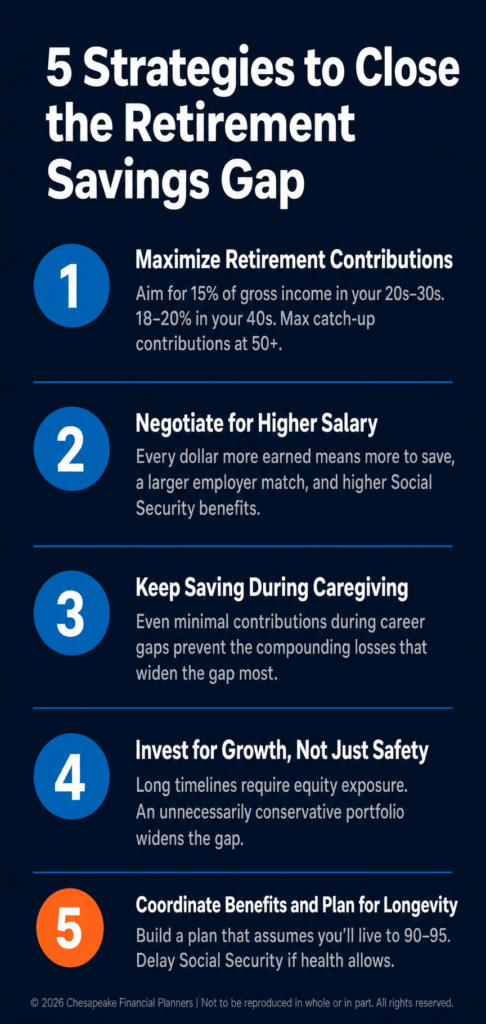
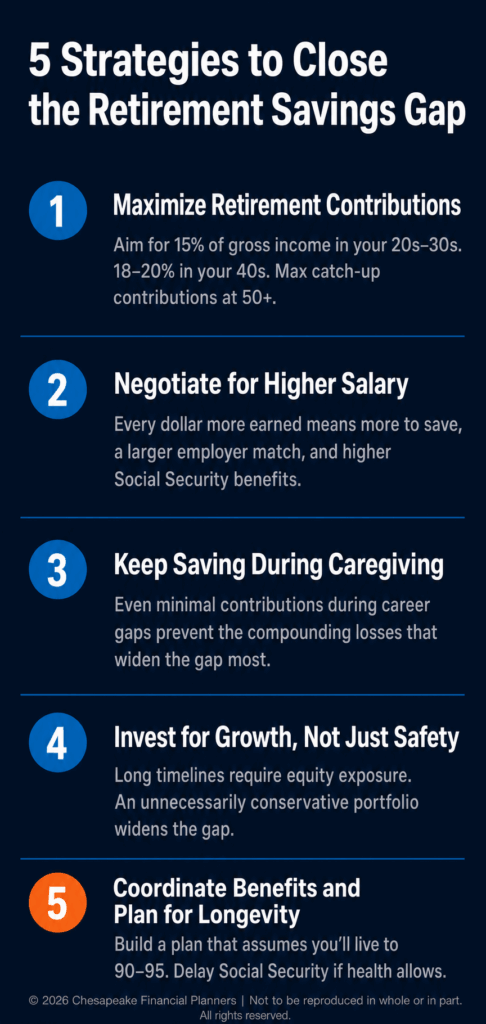
Raise your contribution rate as high as your budget allows, and use a target based on your age. In your 20s and 30s, aim for 15% of gross income including any employer match. In your 40s, push toward 18% to 20% to make up lost ground. At 50 and older, claim every catch-up dollar available.
For 2026, the IRS allows an extra $8,000 catch-up contribution to a 401(k) for savers age 50 and up, plus an additional $1,100 catch-up on IRAs. Those catch-up provisions exist precisely for people who started late or stepped away, which describes a lot of women.
Compound growth is the lever here. A 35-year-old who raises her 401(k) contribution from 6% to 12% can add a meaningful six-figure sum to her balance by 65, depending on market returns. If a jump like that feels tight, start with a 1% increase and add another 1% every six months. Your take-home pay adjusts faster than you expect. Jeff often tells clients that the discomfort of a higher contribution rate fades in about two pay cycles, while the benefit lasts decades.
Should women negotiate salary to fix the retirement gap?
Yes. Negotiating your salary is one of the most underused tools for closing the retirement savings gap because every raise compounds in three directions at once. A higher salary means more you can save, a larger percentage-based employer match, and higher future Social Security benefits up to the wage cap.
Women negotiate less often than men, which leaves real money on the table over a career. Here is how to change that:
- Research market rates for your role using Glassdoor, Payscale, and industry salary reports.
- Document your accomplishments with specific numbers, not vague descriptions.
- Practice your ask out loud with a trusted friend or mentor before the conversation.
- Negotiate for promotions, bonuses, and equity, not just base pay.
The math is striking. A $5,000 raise at 35, with steady 3% annual increases, compounds to more than $250,000 in additional lifetime earnings by 65. That is not a small lever. That is a retirement-altering one.
How do I keep saving during caregiving years?
Keep your retirement contributions alive in some form, even a small one, because pausing entirely for three to five years is where the biggest gaps open. Continuity matters more than perfection.
If you are reducing hours or income, do these three things:
- Maintain at least a minimal contribution. Even $100 to $200 a month preserves the compounding habit.
- If you are married, use a spousal IRA so your working partner can contribute on your behalf, up to $7,500 for 2026 or $8,600 if you are 50 or older.
- Prioritize Roth contributions during lower-income years. You pay tax at a lower rate now and the growth comes out tax-free later.
If you are pausing work entirely, protect what you already saved by avoiding early withdrawals, plan your return to work in advance even if part-time, and route any windfall such as a tax refund or bonus straight into an IRA. The goal is to keep the engine running, not to redline it.

How should women invest to grow retirement savings?
Build a portfolio weighted toward growth for your timeline rather than defaulting to safety, because an overly conservative allocation quietly widens the gap. Holding too much cash and too few stocks feels comfortable, but it sacrifices the long-term growth that closes a savings shortfall.
The balance to strike is an allocation that matches your time horizon and your real risk tolerance, without being unnecessarily cautious. A woman 25 years from retirement can usually carry more equity exposure than she thinks. This is one place a coordinated plan helps. Chesapeake Financial Planners runs decisions like this through the R.U.D.D.E.R. Method™, Chesapeake Financial Planners' six-step planning process: Review and Recognize, Uncover and Understand, Design and Develop, Discuss and Decide, Execute and Empower, and Reassess and Refine. The point is to set an allocation on purpose, then revisit it, rather than letting fear set it for you. Jeff Judge notes: "A woman 25 years from retirement who defaults to a conservative allocation because it feels safer is quietly guaranteeing a shortfall, and we work to replace that default with an intentional equity exposure that reflects her actual time horizon rather than her momentary comfort level."
For more on stretching your savings across a longer retirement, see How do I create sustainable retirement income streams? and How do I know if I'm saving enough for retirement?.
Frequently Asked Questions
What is the retirement savings gap for women?
The retirement savings gap for women is the documented shortfall between what women and men accumulate for retirement. It stems from lower lifetime earnings, career breaks for caregiving, longer lifespans, and more conservative investing. Women typically retire with less saved while needing those savings to last longer, which makes deliberate planning essential.
How much can a woman over 50 contribute to retirement in 2026?
A woman age 50 or older can make a standard 401(k) contribution plus a $8,000 catch-up in 2026. She can also contribute up to $8,600 to an IRA, which includes a $1,100 catch-up. These catch-up provisions exist specifically to help savers make up ground after a late start or a career interruption.
Does negotiating salary really affect retirement savings?
Yes, significantly. A higher salary increases what you can save, raises your percentage-based employer match, and boosts your future Social Security benefits up to the wage cap. A single $5,000 raise at age 35, growing 3% a year, compounds to more than $250,000 in additional lifetime earnings by 65, which directly strengthens retirement security.
Can I still save for retirement if I leave work to be a caregiver?
Yes. If you are married, a working spouse can fund a spousal IRA on your behalf, up to $7,500 in 2026 or $8,600 at age 50 or older. Even a small ongoing contribution preserves your compounding momentum. Avoid withdrawing from existing retirement accounts, and plan your return to work to keep the gap as short as possible.
Why do women need more retirement savings than men?
Women need more savings primarily because they live longer on average. According to the Social Security Administration, women's longer life expectancy means their retirement savings must cover several additional years. Combined with lower lifetime earnings and more career interruptions, this longevity makes a higher savings rate and a growth-oriented portfolio especially important.
At Chesapeake Financial Planners, we work through the retirement savings gap women face with clients every week, building plans around real life rather than a textbook career path. If you are weighing how aggressively to save, when to negotiate, or how to keep saving through a caregiving stretch, a second opinion costs you nothing. Visit chesapeakefp.com to learn more.
Want to go deeper? Our How to Plan for Retirement as a Woman walks through this step by step.
Disclosures
The information provided is for educational purposes only and should not be construed as investment advice. Investment strategies should be tailored to individual circumstances, risk tolerance, and goals. Past performance doesn't guarantee future results. Consult with qualified financial professionals regarding your specific situation.
Growth investments may be more volatile than other investments because they are more sensitive to investor perceptions of the issuing company's growth of earnings potential.
Advisors associated with Chesapeake Financial Planners may be either (1) LPL Financial Registered Representatives offering securities through LPL Financial, Member FINRA and SIPC, and investment advisor representatives offering investment advice through Great Valley Advisor Group; or (2) solely investment advisor representatives offering investment advice through Great Valley Advisor Group and not affiliated with LPL Financial. Great Valley Advisor Group, and Chesapeake Financial Planners are separate entities from LPL Financial.


