
How Credit Score Works: What Affects It Most?
Last reviewed: July 2026
A credit score is a three-digit number, usually from 300 to 850, that lenders use to predict how likely you are to repay borrowed money. Understanding how credit score works comes down to five weighted factors, and the largest by far is simply whether you pay your bills on time. Improving your score means working those five factors in order of how much they count.
Key Takeaways
- A FICO credit score runs from 300 to 850 and is built from five weighted factors.
- Payment history at 35% and amounts owed at 30% together drive about two-thirds of your score.
- The average U.S. FICO score was 713 in 2025, and raising yours is mostly about consistency over time.
- You can check all three credit reports for free and dispute errors that unfairly lower your score.
About the Author: Jeff Judge, CFP®, AEP®, ChFC®, CLU® is Managing Partner of Chesapeake Financial Planners in Forest Hill, Maryland. He has been helping families and business owners in Harford County and the Baltimore metro area understand credit and borrowing since earning his CFP® certification in 2013, by using Chesapeake Financial Planners’ signature process, the R.U.D.D.E.R. method™. Jeff reminds clients that a credit score is not a measure of worth; it is a measure of habits, and habits are something you can change.
What Is a Credit Score, and Why Does It Matter?
A credit score is a snapshot of how you have handled borrowing, compressed into one number. The most widely used model, the FICO score, ranges from 300 to 850, and higher is better. According to Experian, the average U.S. FICO score was 713 in 2025, and nearly one in four consumers now scores 800 or above.
It matters because that number quietly sets the price of your financial life. It influences whether you are approved for a mortgage, car loan, or credit card, and just as importantly, the interest rate you pay. A strong score can mean qualifying easily and paying less; a weak one can mean higher rates or outright denials. The same loan can cost two people very different amounts based on this single figure, whether they borrow from a Should I Use a Bank or a Credit Union? or any other lender.
How Credit Score Works: The Five Factors
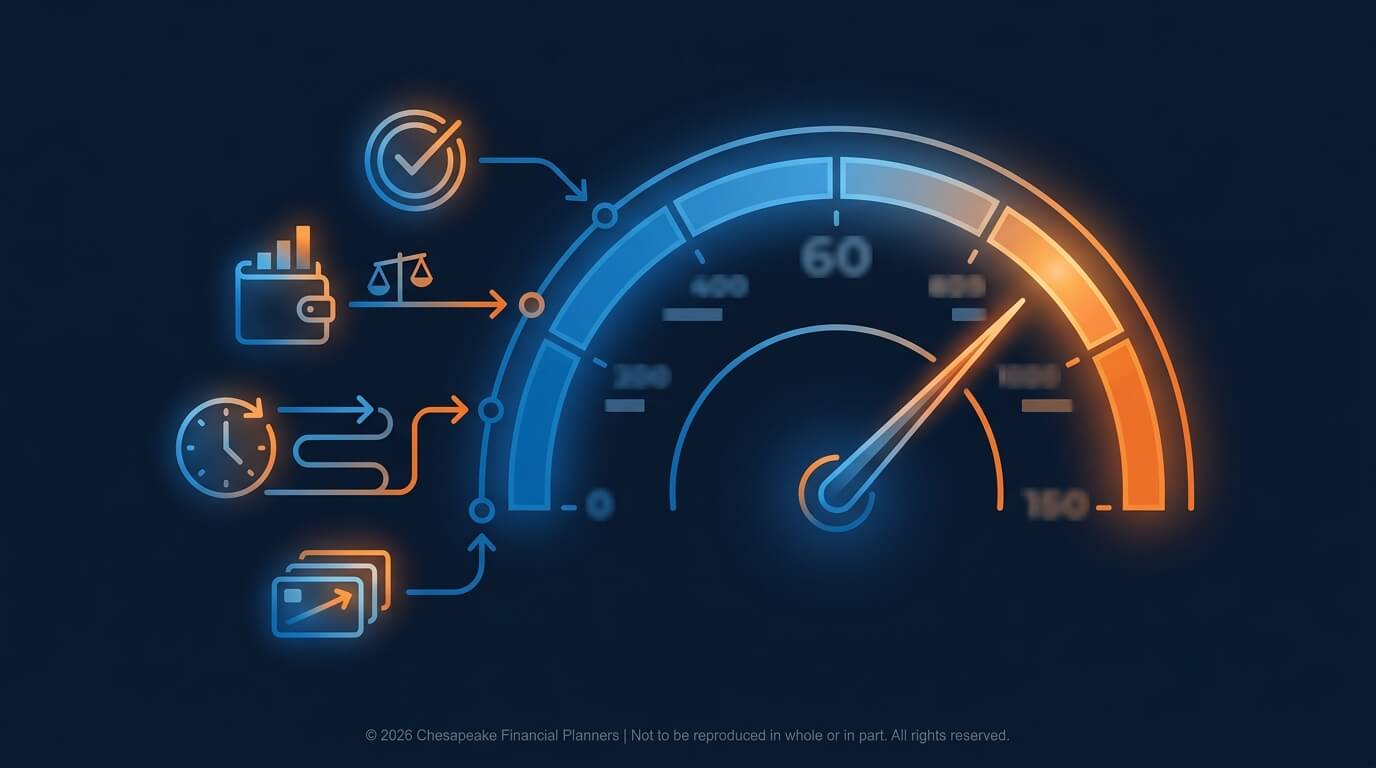
Your FICO score is built from five factors, each carrying a published weight. Knowing the weights tells you exactly where to focus. According to FICO, the breakdown is:
- Payment history, 35%: whether you pay on time, every time. This is the single biggest factor.
- Amounts owed, 30%: how much of your available credit you are using, known as your utilization rate.
- Length of credit history, 15%: how long your accounts have been open.
- New credit, 10%: how many new accounts and inquiries you have opened recently.
- Credit mix, 10%: the variety of credit types you manage, such as cards and installment loans.
The takeaway from these credit score factors is clear. Payment history and amounts owed together make up 65% of your score, so on-time payments and low balances do most of the work. The other three matter, but they are the polish, not the foundation.

How to Improve Your Credit Score
Improving your score is less about tricks and more about steady habits aimed at the heaviest factors. Here is the order that works.
- Pay every bill on time, since payment history is 35% of your score; automate at least the minimums so you never miss.
- Lower your credit utilization by paying balances down, aiming to use less than 30% of each card's limit.
- Keep old accounts open, because closing them shortens your credit history and can raise utilization.
- Apply for new credit sparingly, as each application can ding your score slightly for a while.
- Keep a healthy mix of credit over time, rather than opening accounts just to game the system.
- Check your three credit reports for free at AnnualCreditReport.com and dispute any errors you find.
Do the first two consistently and the rest will mostly take care of itself. One underused move is asking for a credit limit increase on a card you handle well, which lowers your utilization without paying down a cent, as long as you do not spend the new room. Paying balances down attacks two factors at once, and our Debt Avalanche vs Snowball: Which Pays Off Debt Faster? guide lays out the fastest order to do it. There is no overnight fix, but the direction is fully within your control.
How Long Does It Take to Improve a Credit Score?
It depends on what is holding the score down. Lowering a high utilization rate can lift your score within a billing cycle or two, because that factor updates quickly when balances drop. Rebuilding after missed payments, collections, or bankruptcy takes far longer, since negative marks fade gradually and most stay on your report for up to seven years, while a bankruptcy can linger for up to ten.
Jeff Judge tells clients to think in seasons, not days. A consistent year of on-time payments and falling balances changes the picture for almost everyone, and the work to improve credit score standing compounds the same way savings do. The Consumer Financial Protection Bureau offers free, neutral guidance on checking reports and disputing errors if you want a trustworthy starting point.
Frequently Asked Questions
What is a good credit score?
A good FICO credit score is generally considered to be 670 or above, with 740 and up viewed as very good and 800-plus as exceptional. For reference, the average U.S. score was 713 in 2025. Scores above 740 typically unlock the lowest interest rates, while scores below 670 may mean higher rates or tougher approvals.
What hurts your credit score the most?
Missed and late payments hurt the most, because payment history is 35% of your FICO score, the largest single factor. High credit utilization is the next biggest drag, since amounts owed make up 30%. A single 30-day late payment or a maxed-out card can both pull a score down noticeably, so those two areas deserve the most attention.
How is credit utilization calculated?
Credit utilization is the percentage of your available revolving credit that you are currently using. You divide your total card balances by your total card limits, so $2,000 owed against $10,000 of limits is 20% utilization. Lower is better, and most guidance suggests keeping it under 30%, with single digits considered ideal for your score.
Does checking my own credit score hurt it?
No. Checking your own credit score or report is a soft inquiry and never affects your score, so you can review it as often as you like. Only hard inquiries, which happen when a lender checks your credit for a new application, can lower your score, and even then usually by just a few points.
How often does my credit score update?
Your credit score can change whenever lenders report new information, which is typically once a month per account. That means balances, payments, and new accounts can move your score multiple times in a month as different lenders report. Because the data refreshes this often, lowering a balance can show up in your score within a billing cycle or two.
Now that you understand how credit score works, the path to a higher one is refreshingly simple: pay on time, keep balances low, and be patient. Those few habits, repeated, move the number that quietly prices your mortgage, car loan, and cards. If you want a simple framework for managing credit alongside saving and debt, our What are the fundamentals of personal financial planning? walks through it step by step. Download it at chesapeakefp.com. Jeff Judge notes: "Credit scores reward consistency over time, not quick fixes — clients who focus on paying on time and keeping balances well below their limits are almost always surprised by how steadily the number climbs within a few billing cycles."
Want to go deeper? Our Why Financial Advice Isn’t Just for Retirees walks through this step by step.
This material is for educational purposes only and should not be considered tax or legal advice. Please consult with your tax advisor or attorney regarding your specific situation.
The opinions voiced in this material are for general information only and are not intended to provide specific advice or recommendations for any individual.
All investing involves risk including loss of principal. No strategy assures success or protects against loss.
There is no guarantee that a diversified portfolio will enhance overall returns or outperform a non-diversified portfolio. Diversification does not protect against market risk.
Disclosures
The information provided is for educational purposes only and should not be construed as investment advice. Investment strategies should be tailored to individual circumstances, risk tolerance, and goals. Past performance doesn't guarantee future results. Consult with qualified financial professionals regarding your specific situation.
Advisors associated with Chesapeake Financial Planners may be either (1) LPL Financial Registered Representatives offering securities through LPL Financial, Member FINRA and SIPC, and investment advisor representatives offering investment advice through Great Valley Advisor Group; or (2) solely investment advisor representatives offering investment advice through Great Valley Advisor Group and not affiliated with LPL Financial. Great Valley Advisor Group, and Chesapeake Financial Planners are separate entities from LPL Financial.


