

Debt Avalanche vs Snowball: Which Pays Off Debt Faster?
Last reviewed: July 2026
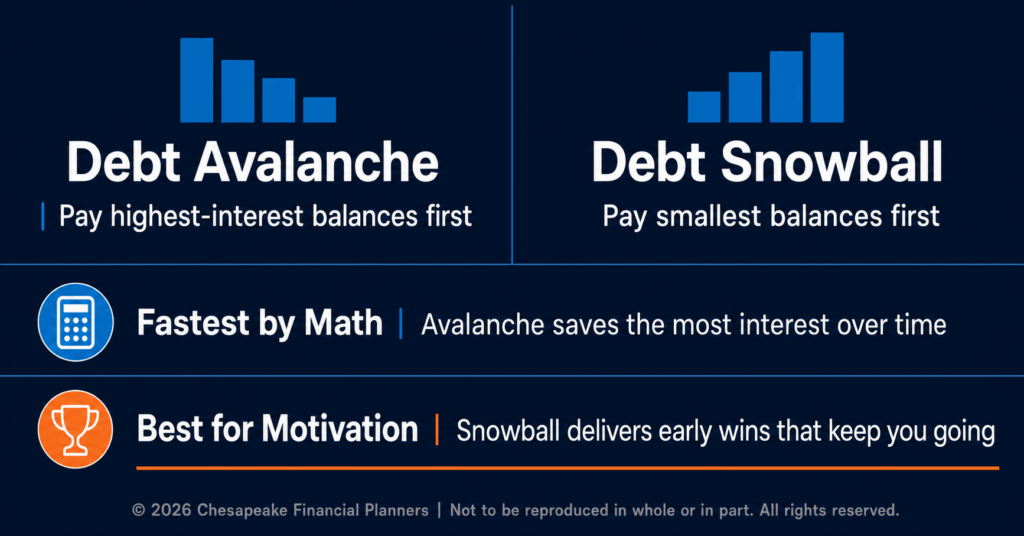
The debt avalanche pays off debt faster and cheaper because it attacks your highest interest rate first. The debt snowball pays off your smallest balance first, which is slower on paper but easier to stick with. So the honest answer to debt avalanche vs snowball is this: the avalanche wins on math, the snowball wins on motivation, and the better method is the one you will actually finish.
Key Takeaways
- The debt avalanche orders balances by interest rate, highest first, and saves the most total interest.
- The debt snowball orders balances by size, smallest first, and delivers fast early wins that build momentum.
- With average credit card rates near 21.5% in 2026, the avalanche's interest savings are real money.
- Neither method works if you quit, so pick the one that fits how you stay motivated.
About the Author: Jeff Judge, CFP®, AEP®, ChFC®, CLU® is Managing Partner of Chesapeake Financial Planners in Forest Hill, Maryland. He has been helping families and business owners in Harford County and the Baltimore metro area get out from under high-rate debt since earning his CFP® certification in 2013, by using Chesapeake Financial Planners’ signature process, the R.U.D.D.E.R. method™. Jeff has watched the spreadsheet-perfect plan lose to the plan someone actually sticks with, more than once.
What's the Difference Between the Debt Avalanche and Debt Snowball?
Both methods tell you to pay minimums on everything and throw every extra dollar at one target debt. They only disagree on which debt to target first. The debt avalanche targets the highest interest rate. The debt snowball targets the smallest balance. That single choice drives every difference between them.
| Factor | Debt Avalanche | Debt Snowball |
|---|---|---|
| Payoff order | Highest interest rate first | Smallest balance first |
| Biggest strength | Saves the most interest | Builds momentum with quick wins |
| Best for | Rate-focused, disciplined payers | People who need visible progress |
| Math result | Usually fastest and cheapest | Slightly slower and costlier |
| First payoff | Can take a while | Often comes fast |
The Consumer Financial Protection Bureau describes these as the two basic ways to reduce debt, which is a useful reminder that you are choosing between two solid options, not a right one and a wrong one.
Debt Avalanche vs Snowball: Which Pays Off Debt Faster?
By the math, the debt avalanche almost always pays off debt faster and for less money. Because it kills your highest interest rate first, it stops the most expensive balance from piling on new charges, so more of every payment goes to principal. As each balance disappears, you roll its old payment into the next target, so both methods accelerate as you go; the avalanche simply front-loads the interest savings. The effect grows when your rates vary widely, which is common right now: as of the most recent Federal Reserve data, the average rate on credit card accounts assessed interest sits near 21.5%, far above most car loans or mortgages.
Here is the shape of it. On roughly $8,000 of debt split across cards at 24%, 18%, and 12%, paying the same fixed amount every month, the avalanche typically saves a few hundred dollars in interest and finishes a month or two sooner than the snowball. The gap is real but usually modest, which is exactly why the tie-breaker is so often behavioral rather than mathematical.

When Does the Debt Snowball Make More Sense?
The debt snowball makes more sense when motivation is the thing most likely to break your plan. Paying off a small balance completely in the first month or two produces a visible win, and that win is not just nice to have. It is what keeps people sending the extra payment in month seven, when the novelty is gone and the big balance has barely moved.
This is the part the math misses. A payoff plan only saves interest if you finish it, and plenty of mathematically perfect avalanche plans get abandoned. If you have tried to pay off debt before and quit, the snowball's early momentum is a feature worth more than the interest it costs. Jeff Judge often tells clients to be honest about which kind of person they are, because the right answer to a debt payoff method is the one their actual behavior supports.
How Do You Choose Between the Avalanche and Snowball?
Start with two honest questions: How far apart are your interest rates, and how have you handled payoff plans in the past? If your rates vary a lot, the avalanche saves enough to be worth the discipline. If your balances are similar in rate, the methods nearly tie, so motivation should decide. And if you have abandoned a plan before, lean snowball.
Americans are carrying more revolving debt than ever, with total revolving consumer credit reaching about $1,290.5 billion in 2026 according to the Federal Reserve, so this is not a niche problem. You can also blend the two: knock out one tiny balance first for the psychological win, then switch to strict avalanche order. Whatever you choose, automate the extra payment so it leaves your account before you can spend it, and recheck your rates once a year, because a card that raises its APR can quietly jump to the front of the avalanche line. Before you accelerate debt payoff, make sure you still have a small cash cushion, which our How Much Should I Have in My Emergency Fund? explains. Paying off high-rate balances also tends to help your How Credit Scores Work: What Affects It Most? over time.
Frequently Asked Questions
Is the debt avalanche or snowball faster?
The debt avalanche is usually faster and cheaper because it targets your highest interest rate first, so less money is lost to interest each month. The debt snowball can feel faster because you clear individual balances sooner, but mathematically it typically takes a little longer and costs a bit more in total interest.
Does the debt snowball cost more in interest?
Usually, yes, but often not by much. Because the snowball ignores interest rate and pays the smallest balance first, a high-rate balance can keep accruing interest while you clear cheaper debts. On typical household balances, the extra cost is often a few hundred dollars, which many people accept in exchange for the motivation the method provides.
Can I combine the avalanche and snowball methods?
Yes, and many people do. A common hybrid pays off one or two of the smallest balances first for the quick psychological win, then switches to strict avalanche order to minimize interest on the rest. The goal is to capture the snowball's early momentum without giving up most of the avalanche's interest savings.
Should I stop investing to pay off debt first?
It depends on the interest rate. Debt charging more than you can reasonably expect to earn investing, such as a credit card near 21.5%, almost always comes first. Lower-rate debt like a mortgage is a closer call, and many people keep contributing enough to capture a full employer retirement match while they pay down balances.
Which method is best for credit card debt?
For credit card debt, the avalanche tends to win because card interest rates are high and often vary widely between cards, so targeting the highest rate first saves the most. That said, if multiple cards carry similar rates, the difference shrinks and the snowball's motivation may matter more than the small interest savings.
So in the debt avalanche vs snowball debate, run the avalanche if you can stay disciplined and your rates vary, and run the snowball if you need the early wins to keep going. Either way, a single focused target beats spreading extra dollars thin. If you want a simple framework for ordering debt payoff alongside saving and budgeting, our What are the fundamentals of personal financial planning? walks through it step by step. Download it at chesapeakefp.com.
Want to go deeper? Our Why Financial Advice Isn’t Just for Retirees walks through this step by step.
This material is for educational purposes only and should not be considered tax or legal advice. Please consult with your tax advisor or attorney regarding your specific situation.
The opinions voiced in this material are for general information only and are not intended to provide specific advice or recommendations for any individual.
All investing involves risk including loss of principal. No strategy assures success or protects against loss.
There is no guarantee that a diversified portfolio will enhance overall returns or outperform a non-diversified portfolio. Diversification does not protect against market risk.
Disclosures
The information provided is for educational purposes only and should not be construed as investment advice. Investment strategies should be tailored to individual circumstances, risk tolerance, and goals. Past performance doesn't guarantee future results. Consult with qualified financial professionals regarding your specific situation.
Advisors associated with Chesapeake Financial Planners may be either (1) LPL Financial Registered Representatives offering securities through LPL Financial, Member FINRA and SIPC, and investment advisor representatives offering investment advice through Great Valley Advisor Group; or (2) solely investment advisor representatives offering investment advice through Great Valley Advisor Group and not affiliated with LPL Financial. Great Valley Advisor Group, and Chesapeake Financial Planners are separate entities from LPL Financial.


