

Should I Use a Bank or a Credit Union?
Last reviewed: July 2026
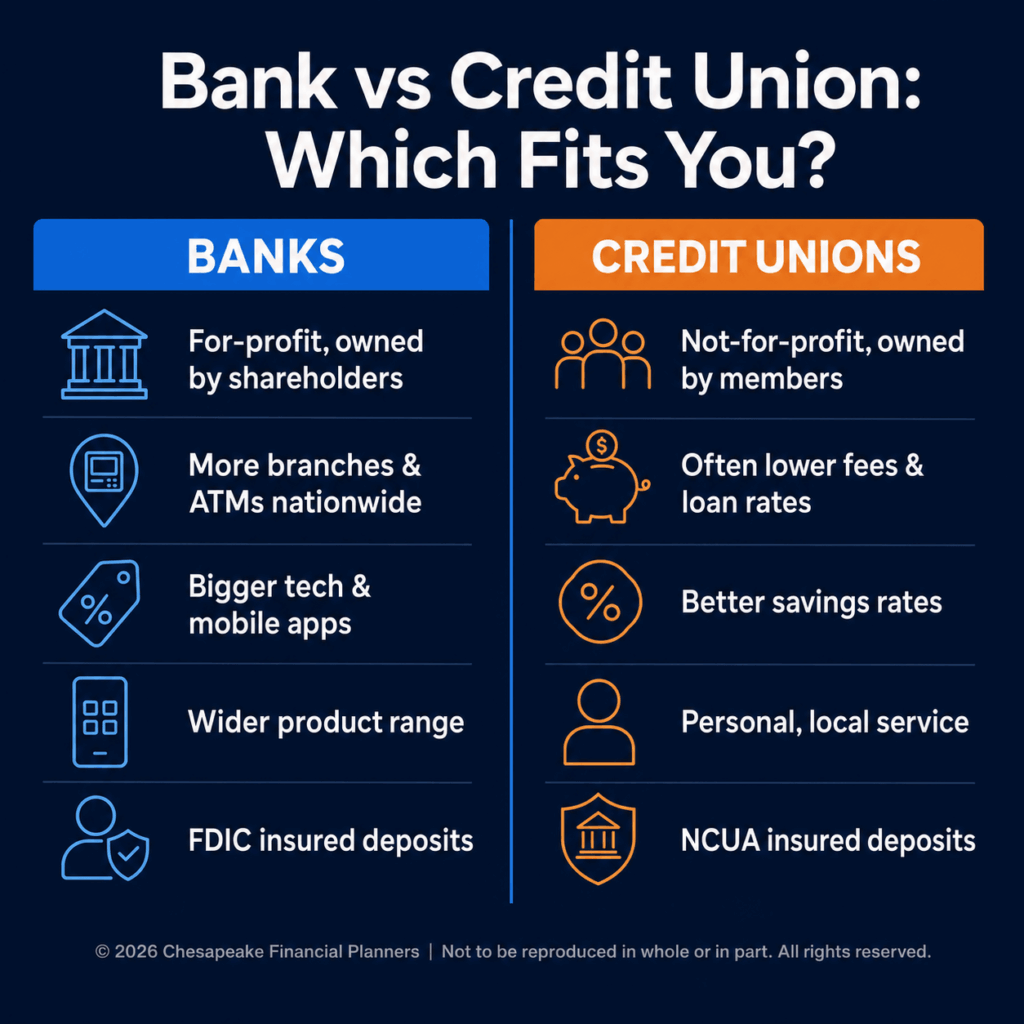
A bank and a credit union do most of the same things. Both hold your checking and savings, issue debit cards, and make loans. The bank vs credit union choice really comes down to ownership, and ownership changes the incentives. Banks are for-profit companies owned by shareholders. Credit unions are not-for-profit cooperatives owned by their members, which usually means lower fees and better rates traded against fewer branches and slower technology.
Key Takeaways
- Banks are for-profit and owned by shareholders; credit unions are not-for-profit and owned by their members.
- Deposits are protected up to $250,000 at both: the FDIC insures banks, the NCUA insures credit unions.
- Credit unions often charge lower fees and loan rates; banks usually win on branches, ATMs, and technology.
- Many households keep both, using each institution for what it does best.
About the Author: Jeff Judge, CFP®, AEP®, ChFC®, CLU® is Managing Partner of Chesapeake Financial Planners in Forest Hill, Maryland. He has been helping families and business owners in Harford County and the Baltimore metro area navigate everyday money decisions like this one since earning his CFP® certification in 2013, by using Chesapeake Financial Planners’ signature process, the R.U.D.D.E.R. method™. Jeff tells clients the name on the building matters far less than matching the account to how they actually bank.
What's the Difference Between a Bank and a Credit Union?
The difference is who owns the institution and where the profits go. A bank is a for-profit business, so its earnings flow to shareholders. A credit union is a not-for-profit financial cooperative, so any surplus flows back to members as lower fees, better rates, or improved service. Both are tightly regulated. Both insure deposits. On the things people worry about most, money and protection, they are far closer than the marketing suggests.
Here is the practical side-by-side.
| Feature | Bank | Credit Union |
|---|---|---|
| Ownership | Shareholders (for-profit) | Members (not-for-profit) |
| Deposit insurance | FDIC, up to $250,000 | NCUA, up to $250,000 |
| Fees | Often higher | Often lower |
| Loan and card rates | Often higher | Often lower |
| Branches and ATMs | More, nationwide | Fewer, often regional |
| Mobile and online tech | Usually more advanced | Often catching up |
| Eligibility | Open to anyone | Membership required |
That last row trips up more people than any other. To open a credit union account you have to be eligible to join, usually through where you live, work, worship, attend school, or a family connection. Credit union membership sounds restrictive, but most credit unions today have broad fields of membership, and many let you qualify by joining an affiliated association. Once you understand the ownership split, the rest of the credit union benefits follow logically from it.
Bank vs Credit Union: Are Your Deposits Equally Protected?
Your money carries the same federal protection at an insured bank or an insured credit union. The FDIC insures bank deposits up to $250,000 per depositor, per insured bank, for each ownership category. The NCUA provides the same $250,000 of coverage at federally insured credit unions through the National Credit Union Share Insurance Fund. Both funds are backed by the full faith and credit of the United States government.
So deposit protection is not the tiebreaker. It is genuinely a tie. The only real task is confirming that the specific institution carries FDIC or NCUA insured coverage before you deposit, which you can verify in seconds on either agency's website. A handful of online "banks" are actually uninsured fintech apps, so the NCUA insured or FDIC member label is the detail worth checking.
When Does a Bank Make More Sense?
A bank usually makes more sense when convenience and breadth are your priorities. Large banks run far more branches and ATMs nationwide, which matters if you travel, move often, or like handling cash in person. They tend to carry bigger technology budgets, so their apps, online tools, and 24-hour support are frequently more polished. And they offer a wider product shelf under one roof: rewards credit cards, business banking, mortgages, and brokerage accounts that link to your checking.
If you want one login for everything and the newest digital features, choosing a bank is often the cleaner path. The trade-off is cost. Big banks more often charge monthly maintenance fees, higher overdraft fees, and lower interest on savings, so the convenience has a price you should weigh honestly. For someone building good habits early, our How Much Should I Have in My Emergency Fund? pairs naturally with picking the right place to keep that cash.
How Do You Choose Between a Bank and a Credit Union?
Start with how you actually use your accounts, not with the logo on the door. Choosing a bank or a credit union comes down to four honest questions: How much do you value branch and ATM access? How fee-sensitive are you? Do you borrow often, where a lower rate compounds into real money? And how much do you lean on top-tier mobile technology?
Jeff Judge often tells clients to run a simple test before switching anything. Pull your last three statements, add up every fee you paid, and write down the rate on any loan or card you carry. Then ask whether a different institution would change those two numbers. Most people discover the credit union wins on cost while the bank wins on convenience, which is exactly why a split setup is so common. Keeping checking at a big bank for the app and the ATMs, while parking savings and loans at a credit union for the rates, captures most of the upside on both sides. There is no rule that says you must pick only one. For the bigger picture, see our What are the fundamentals of personal financial planning? and our Where should I keep my cash: high-yield savings, money market, or CDs? explainer.
Frequently Asked Questions
Is my money safe in a credit union?
Yes, money in a federally insured credit union is protected up to $250,000 per member, per ownership category, by the National Credit Union Administration. That is the same coverage limit the FDIC provides at banks, and both insurance funds are backed by the full faith and credit of the U.S. government. Always confirm the credit union shows NCUA insured signage.
Can anyone join a credit union?
Not automatically, but eligibility is usually easy to meet. Every credit union has a field of membership, so you qualify through where you live, work, worship, or study, or through a family member who already belongs. Many credit unions today have broad eligibility, and some let you join by making a small one-time donation to an affiliated nonprofit group.
Do credit unions have worse technology than banks?
Often, though the gap keeps shrinking. Large banks usually offer more advanced apps and digital tools because their technology budgets are bigger. Many credit unions now belong to shared ATM and branch networks and provide solid online banking, so check the specific institution's app ratings and ATM access before deciding rather than assuming every credit union lags.
Should I use both a bank and a credit union?
Yes, and for many households it is a practical approach. You might keep checking at a large bank for its app and nationwide ATMs while holding savings and loans at a credit union for lower fees and better rates. Using each institution for its strength captures most of the credit union benefits without giving up bank convenience.
Are credit union loan rates really lower?
Frequently, yes. Because credit unions are not-for-profit and return surplus to members, they often price auto loans, credit cards, and mortgages below comparable bank products. The size of the gap varies by institution and by your credit profile, so compare the specific rate and any fees on the exact loan you need rather than assuming the credit union always wins.
The bank vs credit union decision is rarely all-or-nothing. Match the institution to the job: convenience and technology lean bank, cost and personal service lean credit union, and plenty of households quietly use both. If you want a simple framework for organizing accounts, fees, and cash flow in one place, our What are the fundamentals of personal financial planning? walks through it step by step. Download it at chesapeakefp.com. Jeff Judge notes: "Most of our clients end up using both a bank and a credit union without even thinking about it — their direct deposit and bill pay sit at the bank for convenience while their car loan or mortgage is at the credit union because the rate was simply better."
Want to go deeper? Our Why Financial Advice Isn’t Just for Retirees walks through this step by step.
This material is for educational purposes only and should not be considered tax or legal advice. Please consult with your tax advisor or attorney regarding your specific situation.
The opinions voiced in this material are for general information only and are not intended to provide specific advice or recommendations for any individual.
All investing involves risk including loss of principal. No strategy assures success or protects against loss.
There is no guarantee that a diversified portfolio will enhance overall returns or outperform a non-diversified portfolio. Diversification does not protect against market risk.
Disclosures
The information provided is for educational purposes only and should not be construed as investment advice. Investment strategies should be tailored to individual circumstances, risk tolerance, and goals. Past performance doesn't guarantee future results. Consult with qualified financial professionals regarding your specific situation.
Advisors associated with Chesapeake Financial Planners may be either (1) LPL Financial Registered Representatives offering securities through LPL Financial, Member FINRA and SIPC, and investment advisor representatives offering investment advice through Great Valley Advisor Group; or (2) solely investment advisor representatives offering investment advice through Great Valley Advisor Group and not affiliated with LPL Financial. Great Valley Advisor Group, and Chesapeake Financial Planners are separate entities from LPL Financial.


