

What does a financial planner do besides picking stocks?
Last reviewed: July 2026
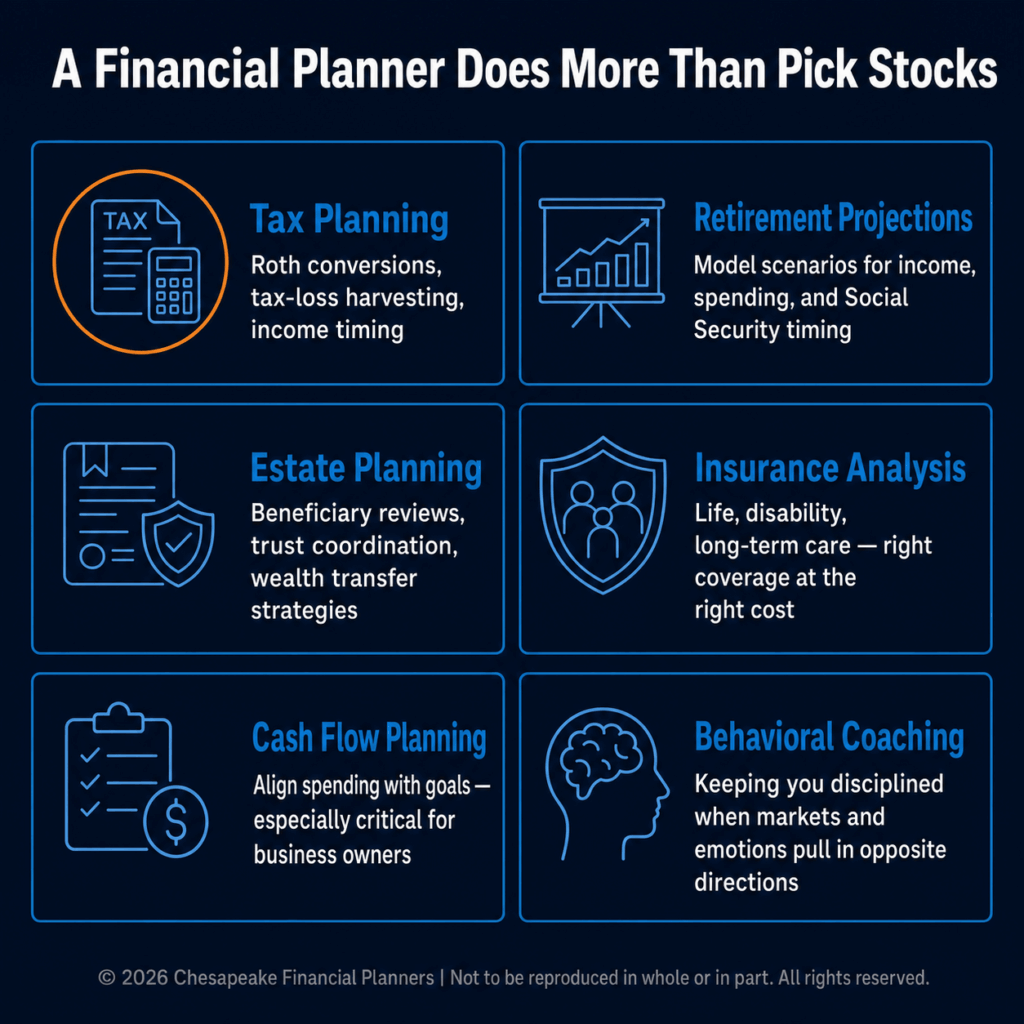
A good financial planner spends most of their time on everything except picking stocks. Comprehensive financial planner services include retirement income projections, multi-year tax planning, estate coordination, insurance analysis, and cash flow strategy. Investment selection is one piece, and honestly, it's rarely the piece that moves the needle most for a family's outcome.
If you're hiring a planner only to manage a portfolio, you're paying for a sliver of what they can deliver. The bigger wins usually come from decisions made around your investments, not inside them.
Key Takeaways
- Financial planner services cover taxes, retirement income, estate planning, insurance, and cash flow, not just investment selection.
- Multi-year tax planning can save tens of thousands over a lifetime, often more than better stock picking.
- The 2026 401(k) employee contribution limit is $24,500, a planning lever most people underuse.
- Coordinating Social Security timing, withdrawals, and Roth conversions is where comprehensive financial planning earns its keep.
About the Author: Jeff Judge, CFP®, AEP®, ChFC®, CLU® is Managing Partner of Chesapeake Financial Planners in Forest Hill, Maryland. He has been helping families and business owners in Harford County and the Baltimore metro area navigate comprehensive financial planning since earning his CFP® certification in 2013, by using Chesapeake Financial Planners’ signature process, the R.U.D.D.E.R. method™. Jeff likes to point out that the clients who fixate on returns are usually the ones leaving the most money on the table in taxes.
What does comprehensive financial planning actually include?
Comprehensive financial planning is the coordination of every part of your financial life so the pieces work together instead of against each other. That means turning vague goals into specific dollar targets, building retirement income projections, planning taxes years in advance, and making sure your estate and insurance are aligned with what you actually want.
Most people walk in with goals like "retire comfortably" or "be secure." A planner forces precision: what does comfortable cost per month, in what year, and what has to happen between now and then to fund it. Once goals are quantified, the trade-offs get clear. Pay down the mortgage or max retirement accounts? Fund a 529 or a taxable account? Retire at 60 or work to 65 for a richer lifestyle? These are math problems, not gut calls.
Jeff Judge often tells clients that the financial plan is the map and the portfolio is just the car. A great car on the wrong road still gets you lost. At Chesapeake Financial Planners, this coordination runs through the R.U.D.D.E.R. Method™, a six-step process built so no decision gets made in isolation.
Why Does a Financial Planning Process Matter More Than Investment Selection?
How does a financial planner help with retirement income?
A financial planner builds retirement income projections that model whether your money lasts, then sequences how you'll actually draw it down. This is far more than an account balance. It's coordinating Social Security timing, retirement account withdrawals, pension elections, and tax brackets year by year so you keep more of what you've saved.
The questions matter. When should you claim Social Security? The Social Security Administration sets full retirement age at 67 for anyone born in 1960 or later, but claiming early or delaying changes your lifetime income by tens of thousands. Lump sum or annuity on a pension? Roth conversions in the gap years between retiring and starting required minimum distributions? Jeff Judge notes: "Claiming Social Security at 62 versus 70 can mean a difference of well over $100,000 in lifetime income for a healthy person, so that single decision often deserves more time in a planning conversation than any investment choice we discuss."
Planners run scenarios for market downturns, longer life expectancy, and rising healthcare costs. These projections either give you confidence or flag a shortfall while there's still time to fix it. The 2026 employee 401(k) contribution limit is $24,500, and using it strategically in your final working years can reshape your entire retirement picture.
What is the best order to withdraw from my 401k, Roth IRA, and taxable accounts in retirement?
How do I coordinate all my retirement income sources to minimize taxes and maximize income?
Why is tax planning a bigger deal than stock picking?
Taxes are usually your largest lifetime expense, which is exactly why proactive tax planning strategies often outperform marginally better investment selection. A planner coordinates moves across years to shrink that bill, while a CPA mostly handles filing what already happened.
The levers a planner pulls include:
- Roth conversions in low-income years
- Tax-loss harvesting to offset realized gains
- Strategic timing of income and deductions
- Asset location, holding tax-inefficient assets inside retirement accounts
- Charitable strategies like donor-advised funds and qualified charitable distributions
These moves can save tens or even hundreds of thousands over a lifetime. Compare that to the marginal edge of picking a slightly better fund, and it isn't close. According to the IRS, the federal estate tax exclusion rises to $15 million per individual in 2026, which reshapes how wealthier families should think about gifting and conversions right now.
For business owners, planners coordinate entity structure, salary versus distribution strategy, retirement plan design like a Solo 401(k) or SEP-IRA, and exit planning to minimize taxes on a sale. This is where wealth management services and tax planning collide, and where a good planner pays for themselves several times over.
How do I plan for retirement when my wealth is tied up in my business?

What other services do financial planners provide?
Beyond investments, taxes, and retirement, a financial planner coordinates estate planning, insurance, and risk management so a single missed detail doesn't unravel the whole plan. These are the unglamorous areas people skip, and they're often where the biggest mistakes hide.
On the estate side, planners make sure you have current documents, a will, powers of attorney, and a healthcare directive, and they work with your attorney on trusts and wealth transfer. They also review beneficiary designations, which are wrong or outdated on a surprising number of retirement accounts and life insurance policies. A stale beneficiary form can override your entire will.
On insurance, a planner pressure-tests whether you have enough life and disability coverage without overpaying for products you don't need. Term versus permanent, how much, and for how long all flow from the plan, not from a sales pitch. As a certified financial planner, Jeff has watched families discover their coverage gaps at the worst possible moment, and that's the situation good planning exists to prevent.
Should I update my financial plan after a big life event?
Is financial planning worth it if I already have investments?
Frequently Asked Questions
What is the difference between a financial planner and an investment manager?
An investment manager focuses on building and managing a portfolio, while a financial planner coordinates your entire financial life, including taxes, retirement income, estate planning, and insurance. Investment management is one component of comprehensive financial planning, not the whole job, and often not the most valuable part for a family's long-term outcome.
Do financial planners only help wealthy people?
No, financial planners help people across a wide range of income and asset levels, not just the wealthy. Younger professionals benefit from cash flow strategy, tax planning, and goal setting, while pre-retirees focus on income projections and Social Security timing. The value comes from coordinated decisions, which matter at every stage, not from a minimum net worth.
Can a financial planner help with taxes if I already have a CPA?
Yes, a financial planner works alongside your CPA rather than replacing them. Your CPA focuses on compliance and filing accurate returns for the year that already happened, while the planner handles proactive, multi-year tax planning strategies like Roth conversions, asset location, and charitable giving designed to lower your lifetime tax bill.
How does a financial planner help business owners specifically?
A financial planner helps business owners with entity structure, salary versus distribution strategy, retirement plan design, and exit planning to minimize taxes on a future sale. Because business owners often have variable income and concentrated wealth, coordinated cash flow and succession planning matter even more than they do for a typical salaried household.
Is it worth paying a financial planner if I only want investment help?
Often no, because if you only want investment management you're paying for a fraction of what a planner delivers. The larger value tends to come from tax planning, retirement income coordination, and estate and insurance decisions. Many people find these planning services move their financial outcome far more than investment selection alone ever could.
When should I hire a financial planner?
You should hire a financial planner when your financial life gets complex enough that decisions start interacting, typically around major life events. Marriage, a new business, a windfall, approaching retirement, or a job change all create coordination needs. The earlier you build a plan, the more flexibility you have to optimize taxes and savings over time.
Ready to see what planning beyond investments looks like?
Picking stocks is the part everyone talks about, but it's rarely where families gain or lose the most. If you want a clearer picture of how comprehensive financial planner services fit together, our free guide walks through the planning decisions that actually move the needle. Download it at chesapeakefp.com.
Want to go deeper? Our 10 Signs You're Ready for a Certified Financial Planner walks through this step by step.
Disclosures
The information provided is for educational purposes only and should not be construed as investment advice. Investment strategies should be tailored to individual circumstances, risk tolerance, and goals. Past performance doesn't guarantee future results. Consult with qualified financial professionals regarding your specific situation.
This material is for educational purposes only. Insurance products contain exclusions, limitations, and terms for keeping them in force. Please contact a qualified insurance professional for costs and complete details.
Stock investing includes risks, including fluctuating prices and loss of principal.
This information is not intended to be a substitute for specific individualized tax, investment or legal advice. We suggest that you discuss your specific situation with a qualified tax, legal or financial advisor.
Advisors associated with Chesapeake Financial Planners may be either (1) LPL Financial Registered Representatives offering securities through LPL Financial, Member FINRA and SIPC, and investment advisor representatives offering investment advice through Great Valley Advisor Group; or (2) solely investment advisor representatives offering investment advice through Great Valley Advisor Group and not affiliated with LPL Financial. Great Valley Advisor Group, and Chesapeake Financial Planners are separate entities from LPL Financial.


