

When should I start working with a financial planner?
Last reviewed: July 2026
The right time to start working with a financial planner is when your financial life gains complexity, when you're earning more than you're saving, or when a major life change is on the horizon. You don't need a million-dollar portfolio. You need a situation that's outgrown your bandwidth, and the earlier you bring in a planner, the more compounding works in your favor.
Key Takeaways
- Hire a financial planner when complexity outpaces your time or expertise, not when you hit an arbitrary asset threshold.
- More than 104,000 CFP® professionals practice across the U.S. as of 2026, and most specialize in a niche or life stage.
- Morningstar’s “Gamma” research estimates that smart financial planning decisions can add the equivalent of about 1.82% per year in value for retirees, primarily through strategies like dynamic withdrawals, tax efficiency, and guaranteed income planning.
- The real cost of waiting isn't the fee, it's years of compounding small mistakes you never realized you were making.
About the Author: Jeff Judge, CFP®, AEP®, ChFC®, CLU® is Managing Partner of Chesapeake Financial Planners in Forest Hill, Maryland. He has helped families and business owners in Harford County and the Baltimore metro area decide when to hire a financial planner since earning his CFP® certification in 2013, by using Chesapeake Financial Planners’ signature process, the R.U.D.D.E.R. method™. Jeff often sees clients delay the call for two or three years, then arrive saying, "I should have done this sooner."
What does a financial planner actually do for you?
A financial planner provides comprehensive financial planning services that coordinate the moving pieces of your financial life: cash flow, investments, taxes, insurance, estate documents, retirement, and any equity compensation tied to your career. The good ones don't just pick funds. They catch the places where decisions you're already making quietly work against each other.
That coordination has become harder to do alone. As of 2026, the CFP Board reports more than 104,000 CFP® professionals practicing in the U.S., and the majority specialize. Some focus on retirees and income strategy. Some focus on equity compensation for tech employees. Some serve business owners through transitions. Choosing the right kind of planner is its own decision.
A planner is also a behavioral coach. Markets drop. Headlines turn loud. A plan reviewed on a calendar, with someone who knows your full picture, is easier to stick with than a portfolio you reread alone on a bad Tuesday. That behavioral discipline is where most of the long-term value comes from.
When does hiring a financial planner make the biggest financial difference?
Financial planning pays off at every life stage, but three moments produce outsized returns on the relationship.
The first is the wealth-building decade, your 30s and early 40s, when income climbs faster than expertise. Decisions about retirement contributions, debt paydown, account types, and asset allocation compound for thirty years. Getting them roughly right matters more than perfectly optimizing any single one.
The second is the decade before retirement. Roth conversion windows, Social Security claiming strategy, healthcare bridge planning, and tax-bracket management between your last paycheck and your first required distribution all collapse into a five-to-ten-year window that closes quickly. A planner who builds the sequencing now saves real money later.
The third is any life change that scrambles the numbers: a business sale, a divorce, an inheritance, a job offer with significant equity. These events get one chance to be handled correctly.
Across all three, Morningstar’s Gamma research (“Alpha, Beta, and Now…Gamma”) estimates that better financial planning decisions can increase certainty-equivalent retirement income by roughly 22.6% on average—often cited as the equivalent of about 1.59%–1.82% per year of additional value. The largest drivers in their framework include withdrawal strategy, total-wealth asset allocation, and tax-efficient decisions. Jeff Judge notes: "The Morningstar Gamma research confirms what we see in practice every day — the biggest gains from working with a planner don't come from picking better investments, they come from sequencing withdrawals correctly and managing taxes across the transition into retirement."
[What financial moves should I make in my 30s, 40s, 50s, and 60s?]

How do you know you're ready to start working with a financial planner?
The clearest signals don't have anything to do with how much you've saved.
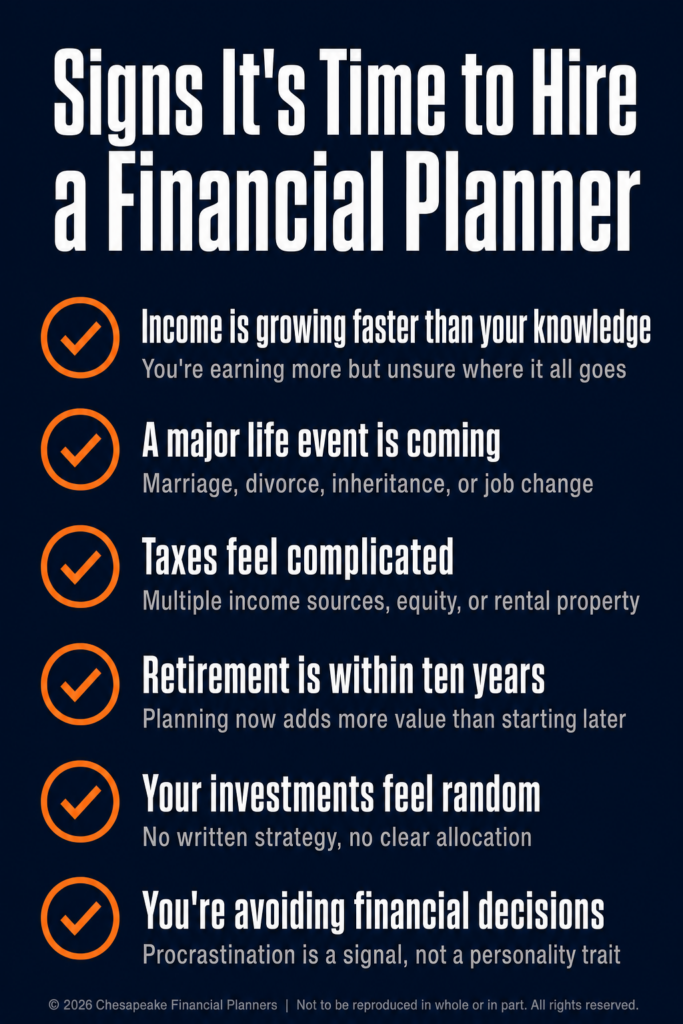
You're ready when you've stopped being able to answer simple questions. How much should I be saving? Am I in the right account types? What happens to my tax bill if I take this bonus as cash versus deferred comp? When the honest answer is "I'm not sure," that's the signal.
You're ready when your income has outpaced your time. Six-figure earners with two kids and a stock plan rarely need more spreadsheets. They need someone to run the spreadsheets and tell them what the math shows.
You're ready when conflicting goals are stalling you. Paying off a 6.5% loan while saving for college while maxing a Roth while wondering about a home upgrade is a planning problem, not a discipline problem. A planner sequences priorities so the math compounds in the right order.
You're ready when you've made a mistake and can name what scared you. Panic-selling in a downturn, cashing out a 401(k) at a job change, missing a Roth conversion window before income jumped. None of those make you a bad client. They make you the right client.
What should you look for in a financial planner?
Four things matter more than the rest when you're vetting a financial planner or wealth management advisor.
Fiduciary duty. Ask, in writing, whether the planner is held to a fiduciary standard at all times. A fiduciary is legally required to put your interests ahead of their compensation. Brokers operating under a "suitability" standard are not.
Compensation model. Fee-only planners are paid by you, not by product commissions. Fee-based planners earn both fees and commissions. Commission-only models often surface in insurance and annuity sales. None are illegal. They produce different incentives. Get the model in writing.
Want to go deeper? Our When and How to Hire a Financial Planner walks through this step by step.
Credentials and verification. The CFP® mark signals a multi-year training and ethics requirement; the CPA, ChFC®, AEP®, and CLU® designations each add depth. Use FINRA BrokerCheck and the SEC's Investment Adviser Public Disclosure database to verify registration and review any disclosures.
Process, not promises. A good planner shows you the framework before they show you a portfolio. They want to see your tax return before they recommend a Roth conversion. As a Maryland CFP®, Jeff often tells prospective clients that anyone recommending a product before they've seen a tax return isn't doing planning.
[How do you choose the right financial advisor and what should you look for?] | [What is the difference between a fee-based and fee-only financial advisor?]
Frequently Asked Questions
How much does a financial planner cost in 2026?
Most ongoing financial planning costs between 0.5% and 1.5% of assets under management annually, or a flat retainer of roughly $3,000 to $10,000 per year for households without a managed portfolio. Hourly engagements typically run $200 to $500 an hour. The right question is not the headline rate, but the total financial advisor cost, including fund expenses, and what coordination work and tax planning is included for it.
What is the difference between a fiduciary and a non-fiduciary advisor?
A fiduciary is legally required to act in your best interest at all times, including disclosing conflicts of interest and recommending the lowest-cost product that fits. A non-fiduciary, often a broker working under a suitability standard, only needs to recommend products that are reasonable for someone in your situation. The same investment can be "suitable" without being the right choice for you specifically.
Is a financial planner worth it if I'm in my 30s?
Often yes, because the decisions you make in your 30s compound for thirty or forty years. A planner in this decade focuses less on portfolio picking and more on contribution rates, account selection, debt strategy, equity compensation, insurance design, and tax positioning. Those four or five right calls, made in your 30s, are usually worth far more than the lifetime planning fee.
Should I use a robo-advisor instead of a financial planner?
A robo-advisor is a reasonable substitute when your situation is simple and you mainly need disciplined portfolio management at low cost. It is not a wealth management advisor substitute when you have equity compensation, a small business, multiple account types, real estate, a complicated tax situation, or a major life transition coming. In those cases, the unmanaged complexity outside the robo's scope is where most of the real cost hides.
What's the right age to start working with a financial planner?
There is no single age that determines when to hire a financial planner. The right time is the first time a financial decision sits unmade because you're not sure of the answer. That can happen at 27, when a first equity grant lands, or at 55, when retirement starts looking real. The trigger is complexity meeting uncertainty, not a birthday.
Bottom line
If you have a financial decision sitting unmade, you have your answer. The fee for a year of working with a financial planner is small next to a single mistimed Roth conversion, a sub-optimal Social Security claim, or a decade of saving in the wrong account types.
At Chesapeake Financial Planners, we work through this exact question with families and business owners every week. If you're weighing whether the timing is right, a second-opinion conversation costs you nothing. Visit chesapeakefp.com to learn more.
Disclosures
The information provided is for educational purposes only and should not be construed as investment advice. Investment strategies should be tailored to individual circumstances, risk tolerance, and goals. Past performance doesn't guarantee future results. Consult with qualified financial professionals regarding your specific situation.
Advisors associated with Chesapeake Financial Planners may be either (1) LPL Financial Registered Representatives offering securities through LPL Financial, Member FINRA and SIPC, and investment advisor representatives offering investment advice through Great Valley Advisor Group; or (2) solely investment advisor representatives offering investment advice through Great Valley Advisor Group and not affiliated with LPL Financial. Great Valley Advisor Group, and Chesapeake Financial Planners are separate entities from LPL Financial.


