

How Do I Take Over My Parent's Finances as Their Caregiver?
Last reviewed: July 2026
To take over your parent's finances as their caregiver, you need a valid durable power of attorney that names you as agent, then you systematically gain access to their bank accounts, bills, and benefits while keeping clean records of every transaction. Financial caregiving for a parent works best when the legal authority is in place before a crisis hits, not during one. If your parent still has capacity, the conversation and paperwork happen now. If they have already lost capacity, you may be looking at a court-supervised guardianship instead.
Key Takeaways
- A durable power of attorney is the single most important document for financial caregiving, and it must be signed while your parent still has capacity.
- Roughly 38 million Americans served as family caregivers in 2023, providing care valued at $600 billion.
- The 2026 annual gift tax exclusion is $19,000 per recipient, which matters when family money moves between accounts.
- Keeping your money separate from your parent's money is not optional; commingling funds is the fastest way to invite a legal challenge.
About the Author: Jeff Judge, CFP®, AEP®, ChFC®, CLU® is Managing Partner of Chesapeake Financial Planners in Forest Hill, Maryland. He has been helping families and business owners in Harford County and the Baltimore metro area navigate estate planning and aging-parent decisions since earning his CFP® certification in 2013, by using Chesapeake Financial Planners’ signature process, the R.U.D.D.E.R. method™. Jeff has watched too many families discover, on the worst possible day, that no power of attorney was ever signed. The fix at that point is slow, expensive, and avoidable.
Becoming the financial caregiver for an aging parent is one of those roles nobody applies for. You inherit it, usually after a fall, a diagnosis, or a slow decline that finally crosses a line. The work itself is not complicated once the legal authority is in place. Getting that authority, and using it correctly, is where families get stuck.
What Legal Authority Do I Need to Manage My Parent's Money?
You need a durable power of attorney (POA), which is a legal document where your parent (the principal) names you (the agent) to make financial decisions on their behalf. The word "durable" is the part that matters. A durable POA stays in effect even after your parent loses mental capacity, which is exactly when you need it most. A non-durable POA terminates at incapacity and is nearly useless for caregiving.
There are two common structures. A springing POA takes effect only when a triggering event occurs, usually a physician certifying incapacity. An immediate POA is effective the moment it is signed. Most planners, Jeff included, lean toward an immediate durable POA for a parent who already trusts the agent, because springing versions create delays and disputes over when, exactly, the trigger happened.
If your parent has already lost capacity and never signed a POA, you cannot create one now. They lack the legal capacity to grant the authority. Your remaining option is guardianship or conservatorship through the court, which is public, slow, and often costs several thousand dollars in legal fees. The Consumer Financial Protection Bureau publishes free guides on the four main fiduciary roles, and it is worth reading before you assume which one applies to you.
What Is a Financial Power of Attorney and Why Do I Need One?

How Do I Get Access to My Parent's Bank Accounts and Bills?
Start by gathering the documents the institution will demand, then walk the POA into each one in person where possible. Banks are cautious with powers of attorney, and for good reason. Financial exploitation of older adults is a real and growing problem; the FINRA Investor Education Foundation and state securities regulators have built entire programs around catching it.
Here is the order that tends to work:
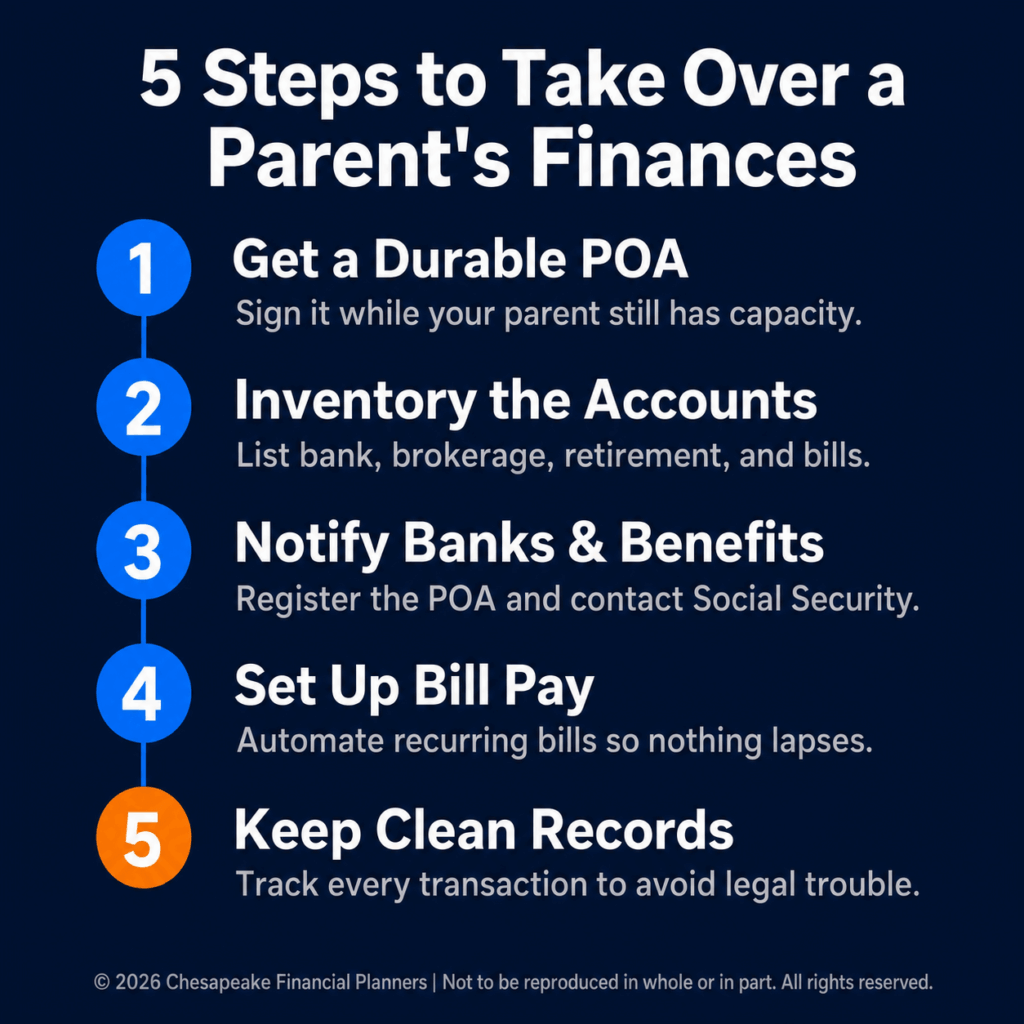
- Locate the master list. Bank accounts, credit cards, utilities, mortgage or rent, insurance premiums, subscriptions, and recurring drafts. Pull twelve months of statements so nothing recurring is missed.
- Present the POA to each bank. Many banks require their own internal POA form on top of the legal document. Ask before you go. Some institutions also flag a POA that is more than a few years old.
- Set up read access first, then transaction access. Online banking with view-only credentials helps you understand the full picture before you start moving money.
- Redirect the mail. A forwarding order through the U.S. Postal Service catches bills and benefit notices your parent may have stopped opening.
- Automate the predictable bills. Recurring payments on autopay reduce the chance a missed utility bill becomes a shutoff notice.
One caution Jeff gives every client in this spot: do not add yourself as a joint owner on your parent's accounts as a shortcut. Joint ownership gives you the access you want, but it also exposes the account to your creditors and scrambles the inheritance among siblings. A POA gives you authority without ownership. That distinction protects everyone.
What is a will and do I need one for my estate?
How Do I Handle Social Security and Government Benefits?
Social Security does not recognize a power of attorney. This surprises almost everyone. To manage a parent's Social Security benefits, you must apply to become their Representative Payee directly through the Social Security Administration. It is a separate process with its own application and oversight.
The same logic applies to Medicare and, for veterans, to VA benefits, each of which runs its own appointed-fiduciary process. The average Social Security retirement benefit was roughly $2,079 per month in 2026, so for many families this is the largest single income stream you are now responsible for protecting. A Representative Payee must use the benefits for the parent's needs and keep records, and the SSA can ask for an accounting at any time.
If your parent receives Medicaid or is approaching long-term care, the rules tighten further. Asset transfers in the wrong window can trigger a penalty period for Medicaid eligibility. This is the point where a financial caregiver should stop improvising and bring in a planner and an elder law attorney.
How Do I Leave Money to a Disabled Child Without Losing Benefits?
How Do I Keep Records and Avoid Legal Trouble?
Treat every dollar as if a judge will review it later, because one might. As your parent's agent, you are a fiduciary, which means you are legally required to act in their best interest, not your own. The cleanest way to honor that duty is rigid separation and documentation.
Three rules carry most of the weight here. First, never commingle funds. Your parent's money stays in your parent's accounts; your money stays in yours. Second, keep a running ledger of every transaction with a note on its purpose. Third, save receipts for anything that could look like a personal benefit to you.
When family money moves, the 2026 annual gift tax exclusion of $19,000 per recipient becomes relevant. Paying a parent's bills from their own money is not a gift. But if siblings start moving money around to equalize caregiving costs, the gift rules can come into play, and a quick conversation with a planner saves a future headache.
This is the kind of decision-sequence the R.U.D.D.E.R. Method™ is built for. The R.U.D.D.E.R. Method™ is Chesapeake Financial Planners' six-step planning process: Review and Recognize, Uncover and Understand, Design and Develop, Discuss and Decide, Execute and Empower, and Reassess and Refine. Financial caregiving is rarely a one-time setup; it gets revisited as a parent's health and needs change. Jeff Judge notes: "Financial caregiving for a parent is not a one-time task you set up and walk away from; as their health changes and expenses shift, what worked at the start of the arrangement usually needs to be revisited at least once a year."
Do I need to update my beneficiary designations after a divorce or major life change?
What is an Accredited Estate Planner (AEP)?
Frequently Asked Questions
Can I manage my parent's finances without a power of attorney?
Not easily and not legally in most cases. Without a durable power of attorney, banks and brokerages will not let you act on your parent's accounts. If your parent still has capacity, sign a POA now. If they do not, your only path is petitioning a court for guardianship or conservatorship, which is slower and more expensive.
What is the difference between a power of attorney and a guardianship?
A power of attorney is signed voluntarily by your parent while they still have capacity, naming you as agent. Guardianship is granted by a court when no POA exists and your parent can no longer make decisions. Guardianship is public, court-supervised, costs more, and removes your parent's legal independence, so a POA is almost always preferable.
Does a power of attorney let me manage Social Security benefits?
No. The Social Security Administration does not recognize powers of attorney for managing benefits. You must apply separately to become your parent's Representative Payee through the SSA. This is true even if you already hold a valid durable power of attorney covering every other part of your parent's finances and accounts.
Should I add myself as a joint owner on my parent's bank account?
Generally no. Joint ownership gives you access but also exposes the account to your own creditors, complicates inheritance among siblings, and can override your parent's will. A durable power of attorney gives you the authority to manage the account without the ownership risks, which is the safer structure for financial caregiving.
How do I avoid being accused of misusing my parent's money?
Keep your money and your parent's money completely separate, never commingle funds, and maintain a written ledger of every transaction with its purpose noted. Save receipts for anything that could appear to benefit you personally. As a fiduciary you must act in your parent's interest, and clean records are your best protection if anyone questions a decision.
When should I bring in a financial planner or elder law attorney?
Bring in professionals when long-term care, Medicaid eligibility, large asset transfers, or sibling disagreements enter the picture. These situations carry penalties and tax consequences that are easy to trigger by accident. A planner coordinates the financial side while an elder law attorney handles eligibility rules, and together they keep a well-meaning caregiver out of trouble.
Taking over a parent's finances is heavy work, and you do not have to map it alone. Our free guide to organizing an aging parent's financial life walks through the documents, accounts, and conversations to handle first. Download it at chesapeakefp.com.
Disclosures
The information provided is for educational purposes only and should not be construed as investment advice. Investment strategies should be tailored to individual circumstances, risk tolerance, and goals. Past performance doesn't guarantee future results. Consult with qualified financial professionals regarding your specific situation.
Advisors associated with Chesapeake Financial Planners may be either (1) LPL Financial Registered Representatives offering securities through LPL Financial, Member FINRA and SIPC, and investment advisor representatives offering investment advice through Great Valley Advisor Group; or (2) solely investment advisor representatives offering investment advice through Great Valley Advisor Group and not affiliated with LPL Financial. Great Valley Advisor Group, and Chesapeake Financial Planners are separate entities from LPL Financial.


