

What Estate Planning Do Lottery Winners Need After Winning?
Last reviewed: July 2026
Lottery winners need a coordinated estate plan built around trusts, lifetime gifting, and estate tax strategy before they ever claim the prize. The reason is simple: a sudden windfall in the tens or hundreds of millions becomes part of your taxable estate immediately, and the wrong moves in the first 90 days can cost your family millions. Smart estate planning for lottery winners protects the money from creditors, lawsuits, family conflict, and a 40% federal estate tax.
Key Takeaways
- Lottery winnings join your taxable estate immediately, exposing amounts above the 2026 federal exemption of $15 million per person to a 40% estate tax.
- Build a professional team and a preliminary plan before claiming, not after.
- Trusts handle three jobs at once: probate avoidance, creditor protection, and controlled distributions to heirs.
- Lifetime gifting up to the annual exclusion shrinks your estate without touching your lifetime exemption.
About the Author: Jeff Judge, CFP®, AEP®, ChFC®, CLU® is Managing Partner of Chesapeake Financial Planners in Forest Hill, Maryland. He has been helping families and business owners in Harford County and the Baltimore metro area navigate sudden wealth and estate planning since earning his CFP® certification in 2013, by using Chesapeake Financial Planners’ signature process, the R.U.D.D.E.R. method™. Jeff has seen the pattern over and over: the people who treat a windfall like a one-time event spend it, and the people who treat it like a structure to build keep it.
Why Do Lottery Winners Face Unique Estate Planning Challenges?
Lottery winners face estate planning challenges that families with generational wealth never deal with, because the money arrives all at once with no infrastructure behind it. You haven't spent decades building the professional relationships, legal structures, or financial habits that established wealthy families take for granted.
Publicity is the first problem. In many states your name and face become public record, which turns you into a target for lawsuits, scams, and an endless line of people asking for money. The privacy that most wealthy individuals guard carefully is gone the moment you claim.
The second problem is behavioral. The National Endowment for Financial Education has long highlighted how sudden wealth recipients struggle with impulsive decisions made under emotional pressure. Jeff Judge often tells clients that the first 90 days after a windfall do more long-term damage than the next 20 years combined, because that's when the rushed, irreversible decisions get made.
What Are the Immediate Steps After Winning the Lottery?
The first move after winning is to slow down and assemble a team before you claim. You need an estate planning attorney who handles high-net-worth clients, a CPA experienced in sudden-wealth taxation, and a credentialed financial advisor. Most state lotteries give winners months to claim, and that window is your most valuable asset.
Here is the sequence Jeff walks clients through:
- Sign the ticket and secure it, then tell almost no one.
- Build the advisory team before claiming the prize.
- Check whether your state allows anonymous claiming through a trust or LLC.
- Draft a preliminary estate and gifting plan with your attorney.
- Claim the prize only after the structure is in place.
Some states permit winners to claim through a trust or LLC, keeping the name private. If your state requires publicity, set boundaries immediately about what you will and won't discuss. According to USA Mega, state anonymity rules vary widely, so verify your specific state's law before claiming. The R.U.D.D.E.R. Method™ is Chesapeake Financial Planners' six-step planning process: Review and Recognize, Uncover and Understand, Design and Develop, Discuss and Decide, Execute and Empower, and Reassess and Refine, and a windfall is exactly the situation it was built for.
How Should Lottery Winners Use Trusts for Asset Protection?
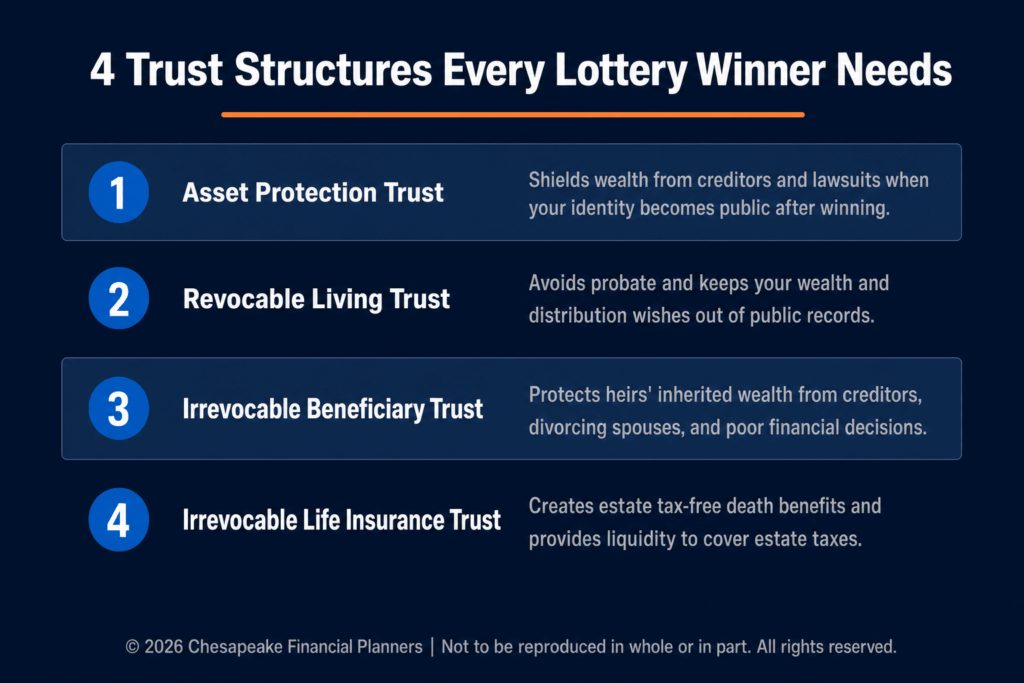
Trusts should sit at the center of estate planning for lottery winners because they handle probate avoidance, creditor protection, and controlled distributions simultaneously. A single outright pile of cash does none of those things.
A revocable living trust keeps your primary assets out of probate and out of public records, so your wealth and your distribution wishes stay private after death. An asset protection trust established in a favorable jurisdiction can shield wealth from future lawsuits, which matters because a publicly known lottery winner is a magnet for litigation.
Irrevocable trusts for your heirs protect inherited money from their creditors, divorcing spouses, and poor decisions. Rather than handing an adult child millions outright, a trust with a professional trustee provides for their needs while preserving the principal. For minor children, trusts are non-negotiable. Jeff has watched families assume an 18-year-old can handle a seven-figure inheritance, and it almost never goes the way they hoped. Staged distributions tied to age or milestones like finishing school protect kids from the money and the money from the kids.
For families wanting to build durable rules around shared wealth, see our guide on How do you create a family wealth governance structure for long-term success?. To shield your assets from the lawsuits that follow public wealth, also review How Much Umbrella Insurance Coverage Do I Need?.
How Does Estate Tax Planning Work for Large Lottery Winnings?
Estate tax planning matters enormously for large winnings because the entire amount becomes part of your taxable estate. In 2026, the federal estate and gift tax exemption is $15 million per person, and amounts above that face a top federal estate tax rate of 40%. On a nine-figure jackpot, that exposure runs into the tens of millions.
| Strategy | What it does | Best for |
|---|---|---|
| Annual exclusion gifting | Moves money out of your estate without using lifetime exemption | Steady, ongoing transfers to many people |
| Lifetime exemption gifting | Removes appreciating assets and their future growth | Large early transfers |
| Irrevocable life insurance trust (ILIT) | Creates tax-free death benefit to pay estate taxes | Providing estate liquidity |
| Charitable trusts / donor-advised funds | Cuts taxable estate while supporting causes | Philanthropic winners |
Lifetime gifting is one of the cleanest levers. You can give up to the 2026 annual exclusion amount per recipient without touching your lifetime exemption, and gifting appreciating assets early removes all future growth from your estate. Strategic charitable giving through a How does a donor-advised fund work and who should consider using one? structure can deliver immediate deductions while shrinking the estate. For broader tax coordination, our overview of How can I potentially optimize my taxes as my income grows? covers how these pieces fit together. Jeff Judge notes: "On a nine-figure jackpot, every year you delay gifting appreciating assets is another year of growth sitting inside a taxable estate, so early and systematic lifetime transfers are usually the first lever we reach for before anything else."
Remember too that federal tax is withheld up front. The IRS withholds 24% on lottery winnings at payout, but the actual top federal income tax bracket means you'll likely owe more at filing, on top of any state tax.
How Can Lottery Winners Prevent Family Conflict?
Lottery winners prevent family conflict through clear structures, documented reasoning, and honest communication, though no plan eliminates every dispute. Sudden wealth turns relatives who never thought about inheritance into people who suddenly feel entitled to a share.
Explain your decisions to the family members affected by them. When beneficiaries understand why money is held in trust rather than handed over outright, they accept the structure more readily. If circumstances justify unequal distributions, document your reasoning carefully, which reduces the odds of a successful will contest. Be ready for relationships to change anyway. Having professional advisors act as a buffer between you and the people asking for money is one of the most underrated protections a winner has. For couples in second marriages, the stakes climb higher, and our guide on How Do I Protect My Children's Inheritance in a Blended Family? addresses those dynamics directly.
Frequently Asked Questions
Do lottery winnings get taxed when I die?
Yes. Lottery winnings become part of your taxable estate, so any amount above the federal exemption is exposed to a 40% federal estate tax at death. In 2026 the federal estate and gift tax exemption is $15 million per person, meaning large jackpots can face significant estate tax without proactive planning through trusts and lifetime gifting.
Should lottery winners take the lump sum or the annuity?
The choice depends on your discipline, age, and estate planning goals. A lump sum gives full control and immediate flexibility to build protective structures, but exposes you to overspending. An annuity provides 20 to 30 years of forced discipline and steady income, yet annuity payments still count toward your taxable estate if you die before receiving them all, creating tax on cash you never touched.
Can lottery winners stay anonymous?
Want to go deeper? Our Busy Professional's Guide to Making Financial Progress walks through this step by step.
It depends entirely on your state. Some states allow winners to claim through a trust or LLC to keep their names off public record, while others require public disclosure. Anonymity matters because a publicly known winner becomes a target for lawsuits and scams. Verify your state's specific rules with your attorney before signing or claiming the ticket, since the option disappears once you claim.
What is the most important first step after winning the lottery?
The most important first step is to slow down and assemble a professional team before claiming the prize. You need an estate planning attorney, a CPA, and a credentialed financial advisor in place first. Most lotteries give winners months to claim, and using that window to build a plan prevents the rushed, irreversible mistakes that destroy windfall wealth within a few years.
How do trusts protect lottery winnings from creditors and lawsuits?
Trusts protect lottery winnings by legally separating ownership of assets from your personal name. An asset protection trust in a favorable jurisdiction can shield wealth from future creditors and lawsuits, which is critical because publicly known winners are frequent litigation targets. Irrevocable trusts for heirs further protect inherited money from their creditors, divorcing spouses, and poor financial decisions over their lifetimes.
How much can a lottery winner give away tax-free each year?
A lottery winner can give up to the 2026 annual gift tax exclusion amount to any number of recipients each year without using any lifetime exemption. Gifting appreciating assets early is especially powerful because it removes both the gift and all future growth from your taxable estate, steadily shrinking estate tax exposure over time.
If you've come into sudden wealth and want a clear-eyed look at protecting it, our guide on managing windfalls and estate structures walks through the decisions step by step. Download it at chesapeakefp.com to start building your plan before the pressure hits.
Disclosures
The information provided is for educational purposes only and should not be construed as investment advice. Investment strategies should be tailored to individual circumstances, risk tolerance, and goals. Past performance doesn't guarantee future results. Consult with qualified financial professionals regarding your specific situation.
This information is not intended to be a substitute for specific individualized tax, investment or legal advice. We suggest that you discuss your specific situation with a qualified tax, legal or financial advisor.
Advisors associated with Chesapeake Financial Planners may be either (1) LPL Financial Registered Representatives offering securities through LPL Financial, Member FINRA and SIPC, and investment advisor representatives offering investment advice through Great Valley Advisor Group; or (2) solely investment advisor representatives offering investment advice through Great Valley Advisor Group and not affiliated with LPL Financial. Great Valley Advisor Group, and Chesapeake Financial Planners are separate entities from LPL Financial.


