

What tax consequences will I face from a business buyout?
Last reviewed: July 2026
A business buyout triggers taxes on your gain, and how much you keep depends almost entirely on deal structure. The biggest factor is whether you sell assets or ownership interest. Stock and membership-interest sales usually get long-term capital gains treatment, while asset sales mix capital gains with ordinary income and depreciation recapture. Understanding business buyout taxes before you sign anything is the difference between keeping most of your proceeds and handing a large slice to the IRS.
Key Takeaways
- Long-term capital gains on a business sale are taxed at 0%, 15%, or 20% federally, per the IRS, based on your income.
- High earners add the 3.8% Net Investment Income Tax once income passes $200,000 single or $250,000 married, per the IRS.
- Stock sales usually beat asset sales for sellers, while buyers prefer asset sales for the step-up in basis.
- Installment sales spread the gain across years and can keep you in lower brackets.
- QSBS may exclude a large share of gain on qualifying C-corporation stock under Section 1202.
About the Author: Jeff Judge, CFP®, AEP®, ChFC®, CLU® is Managing Partner of Chesapeake Financial Planners in Forest Hill, Maryland. He has been helping families and business owners in Harford County and the Baltimore metro area navigate business sale taxes since earning his CFP® certification in 2013, by using Chesapeake Financial Planners’ signature process, the R.U.D.D.E.R. method™. Jeff sees the same pattern every year: owners negotiate hard on the headline price and never run the after-tax math, then they're stunned at closing when the net is 25% lower than the number in the term sheet.
How is your buyout structured: asset sale vs stock sale?
The tax treatment of your buyout comes down to one question. Are you selling assets, or are you selling your ownership stake? The answer drives almost everything else.
In an asset sale, the buyer purchases the business's individual assets: equipment, inventory, customer lists, and goodwill. Sellers usually face higher taxes here because different assets carry different rates. Goodwill gets capital gains treatment, but inventory and depreciation recapture get taxed as ordinary income, which can run up to 37% federally according to the IRS.
In a stock or membership-interest sale, the buyer purchases your ownership stake in the entity itself. This typically delivers long-term capital gains treatment across the board, which is usually far more favorable. That is the core of asset sale vs stock sale tension: buyers prefer asset sales for the basis step-up and liability protection, sellers prefer stock sales for the lower rate. The party with more leverage usually wins, and that gets negotiated.
Your entity type matters too. A C corporation faces potential double taxation on an asset sale, once at the corporate level and again when proceeds reach shareholders. An S corporation buyout generally passes income through to owners and avoids that double layer, though depreciation recapture still applies to certain assets. Partnerships and LLCs offer the most flexibility, often letting you reach capital gains treatment while the buyer still gets some of the step-up they want.
What's the most tax-efficient way to exit my business?
What capital gains tax rate applies to a business sale?
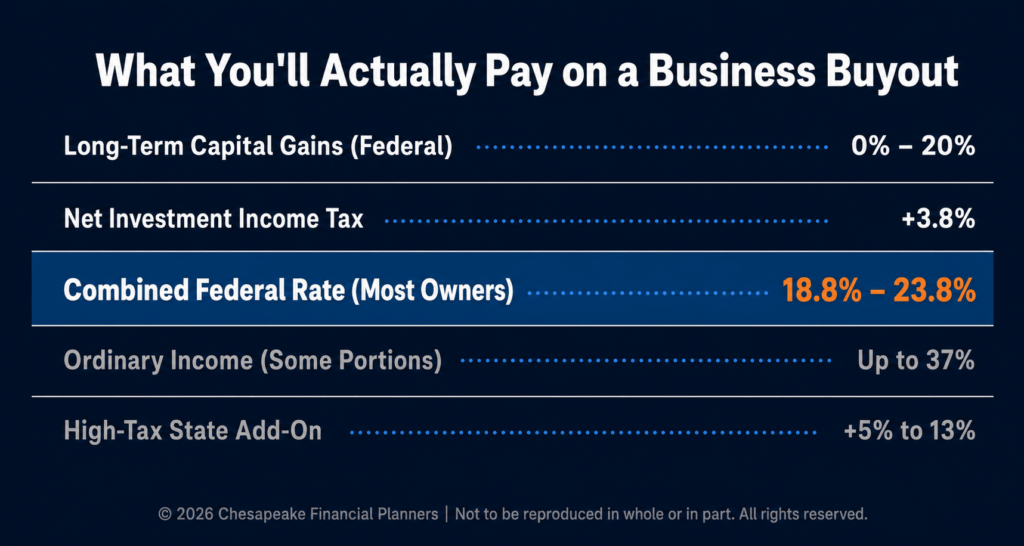
The capital gains tax rate on a business sale depends on your income and how long you held the interest. Profits on ownership held longer than one year qualify for long-term capital gains rates, which the IRS sets at 0%, 15%, or 20% federally depending on your taxable income. Most business owners selling a meaningful stake land in the 20% bracket.
On top of that, the 3.8% Net Investment Income Tax applies once your income crosses $200,000 single or $250,000 married filing jointly, according to the IRS. Combined, most owners face a federal capital gains rate between 18.8% and 23.8%.
Not every dollar of a buyout gets that favorable rate, though. Several pieces can be taxed as ordinary income at rates up to 37%:
- Depreciation recapture on equipment and real property
- Compensation structured as salary or a consulting agreement
- Covenant-not-to-compete payments
- Inventory and receivables in an asset sale
State tax is the part owners forget. Some states tax capital gains the same as ordinary income, some have no income tax at all. A seller in Maryland, where Chesapeake Financial Planners works with business owners across Harford County and the Baltimore metro, faces a different bottom line than a seller in Florida or Texas. Run your specific state rate before you assume the federal number is the whole story.
| Item Sold | Typical Tax Treatment | Federal Rate Range |
|---|---|---|
| Goodwill | Long-term capital gain | 18.8% – 23.8% |
| Ownership/stock interest | Long-term capital gain | 18.8% – 23.8% |
| Equipment (depreciation recapture) | Ordinary income | Up to 37% |
| Inventory & receivables | Ordinary income | Up to 37% |
| Non-compete payments | Ordinary income | Up to 37% |
How Can I Reduce Capital Gains Taxes on My Investments?


What tax strategies reduce the bill on a business buyout?
Smart business sale tax planning happens before you sign, not after. A few moves can preserve a meaningful share of your proceeds, and the best ones require lead time.
Installment sales let you take payment over several years instead of all at once. Spreading the gain can keep you out of the top capital gains bracket and below the NIIT threshold in any single year. The trade-off is buyer default risk and exposure to future tax-law changes, so the interest rate and security matter.
Purchase price allocation is where asset sales get won or lost. The price gets split across asset categories, and each category carries its own rate. Buyers push allocations toward assets they can deduct fast. Your interest is the opposite. This is negotiated, and the allocation directly changes your tax bill.
Qualified Small Business Stock (QSBS) can exclude a large portion of gain on qualifying C-corporation stock held long enough under Section 1202. The 2025 law changes created a tiered exclusion and a higher dollar cap for stock acquired after July 4, 2025, while older qualifying stock keeps prior rules. A QSBS exclusion can be the single most valuable strategy available, but only if your structure and holding period qualify.
Jeff Judge often tells clients the time to plan a sale is two to three years before the offer arrives, not two weeks before closing. Converting an S corporation buyout structure, establishing a QSBS holding period, or setting up a charitable strategy all need runway. The owners who net the most are the ones who treat their exit as a multi-year project.
This is where the R.U.D.D.E.R. Method™ earns its place. The R.U.D.D.E.R. Method™ is Chesapeake Financial Planners' six-step planning process: Review and Recognize, Uncover and Understand, Design and Develop, Discuss and Decide, Execute and Empower, and Reassess and Refine. A buyout touches every one of those steps, because the tax outcome depends on decisions made long before the deal closes.
How Can I Reduce Taxes When Earning $200K to $500K?
How can I potentially optimize my taxes as my income grows?
Frequently Asked Questions
Is a business buyout taxed as capital gains or ordinary income?
It depends on what you sell and how the deal is structured. Selling ownership interest usually gets long-term capital gains treatment at 0%, 15%, or 20% federally. Asset sales mix capital gains on goodwill with ordinary income on inventory, receivables, and depreciation recapture, which can be taxed up to 37%.
How much tax will I pay on selling my business?
Most owners selling ownership interest held over a year face a combined federal capital gains rate of 18.8% to 23.8%, which includes the 3.8% Net Investment Income Tax for higher earners. Add your state rate and any ordinary-income portions like recapture or non-compete payments to estimate your true after-tax proceeds.
Why do buyers prefer asset sales and sellers prefer stock sales?
Buyers prefer asset sales because they get a stepped-up basis to depreciate and can avoid the seller's hidden liabilities. Sellers prefer stock or membership-interest sales because the gain is taxed at lower long-term capital gains rates instead of a mix that includes ordinary income. This conflict gets resolved through negotiation and price adjustments.
Can an installment sale lower my business buyout taxes?
Yes, an installment sale spreads your gain across multiple tax years rather than recognizing it all at once. Spreading income can keep you in lower capital gains brackets and below the Net Investment Income Tax threshold in any given year. The risks are buyer default and future tax-law changes, so structure the security carefully.
Does the QSBS exclusion apply to my business sale?
A QSBS exclusion may apply if you sold qualifying C-corporation stock held long enough under Section 1202. The 2025 law changes added a tiered exclusion and higher cap for stock acquired after July 4, 2025, while older stock keeps prior rules. Most S corporations and LLCs do not qualify, so confirm your structure with a tax advisor before relying on it.
How does my business structure affect the tax on a buyout?
Your entity type changes the tax dramatically. C corporations risk double taxation on asset sales, once at the corporate level and again on distribution. S corporations generally pass income through and avoid that, while partnerships and LLCs offer the most flexibility to reach favorable capital gains treatment while still satisfying the buyer's needs.
If you're weighing a buyout or planning an exit down the road, the after-tax number is the one that matters. Our guide to tax-smart business sale planning walks through the structures and timing decisions in detail. Download it at chesapeakefp.com.
Want to go deeper? Our Business Sale Tax Planning Guide walks through this step by step.
Disclosures
The information provided is for educational purposes only and should not be construed as investment advice. Investment strategies should be tailored to individual circumstances, risk tolerance, and goals. Past performance doesn't guarantee future results. Consult with qualified financial professionals regarding your specific situation.
This information is not intended to be a substitute for specific individualized tax, investment or legal advice. We suggest that you discuss your specific situation with a qualified tax, legal or financial advisor.
Advisors associated with Chesapeake Financial Planners may be either (1) LPL Financial Registered Representatives offering securities through LPL Financial, Member FINRA and SIPC, and investment advisor representatives offering investment advice through Great Valley Advisor Group; or (2) solely investment advisor representatives offering investment advice through Great Valley Advisor Group and not affiliated with LPL Financial. Great Valley Advisor Group, and Chesapeake Financial Planners are separate entities from LPL Financial.


