

How Do I Prepare My Business for a Strong Sale?
Last reviewed: July 2026
To prepare your business for a strong sale, you start three to five years before you list it, not six months. The work that adds the most value is reducing owner dependence, cleaning up your financials, diversifying your customer base, and documenting how the business actually runs. Buyers pay more for a business that keeps performing after you walk away. When you prepare business for sale this far in advance, you give those improvements time to show up in the numbers a buyer will scrutinize.
Key Takeaways
- Begin preparing three to five years before you sell so improvements show up in multi-year financial trends buyers trust.
- Owner dependence is the single biggest value killer; buyers discount heavily when a business cannot run without you.
- Most small businesses sell for a multiple of SDE or EBITDA, so every margin point matters.
- Roughly three of four business owners have no formal transition plan, leaving real money on the table.
- Clean, accrual-based financials with documented add-backs shorten due diligence and protect your asking price.
About the Author: Jeff Judge, CFP®, AEP®, ChFC®, CLU® is Managing Partner of Chesapeake Financial Planners in Forest Hill, Maryland. He has been helping families and business owners in Harford County and the Baltimore metro area navigate business exits since earning his CFP® certification in 2013, by using Chesapeake Financial Planners’ signature process, the R.U.D.D.E.R. method™. Jeff has watched too many owners treat the sale as an event instead of a multi-year project, and that single mistake routinely costs them the difference between a good outcome and a life-changing one.
Why Preparation Decides Your Sale Price
Buyers price risk. Every weakness they spot becomes a reason to pay less, and every strength you can prove becomes a reason to pay more. That is the whole negotiation in one sentence.
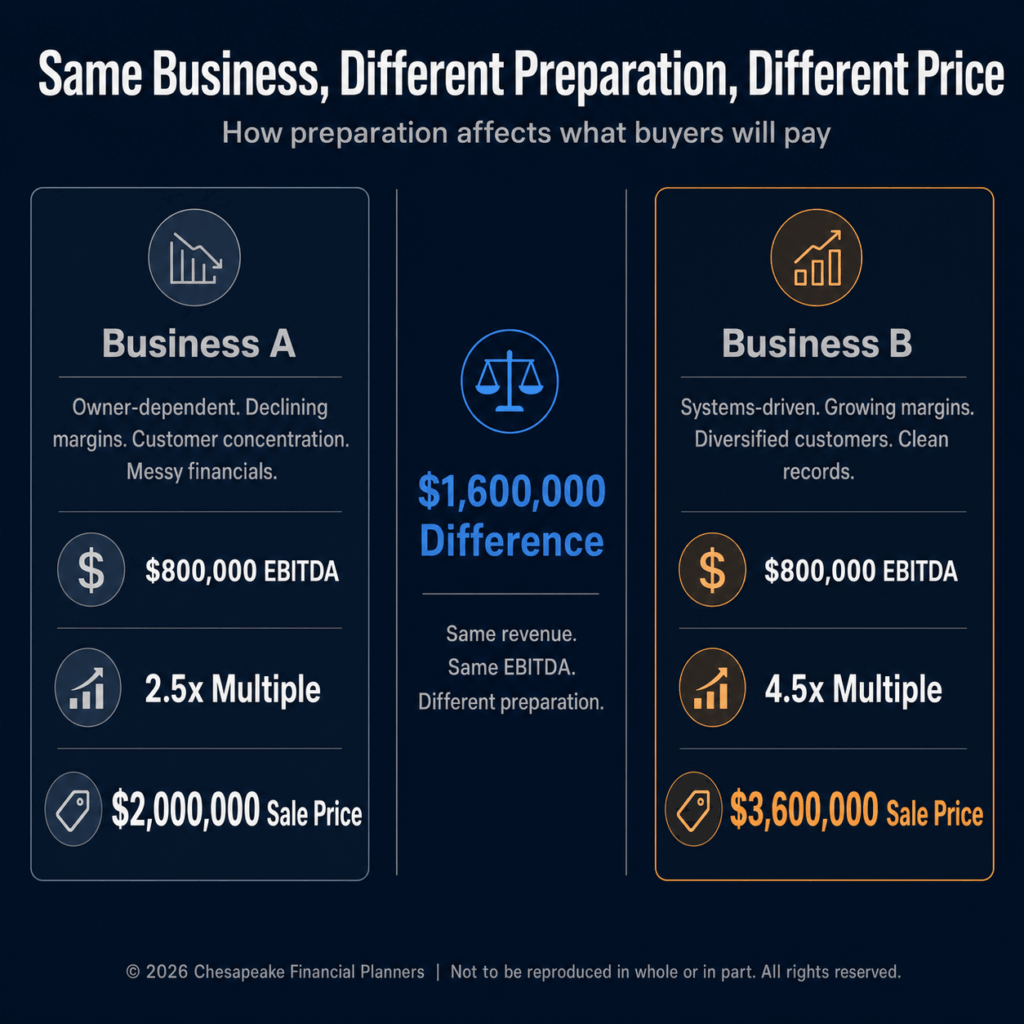
Consider two businesses with identical revenue and the same $800,000 in earnings. The first depends entirely on the owner, has declining margins, leans on two big customers, and keeps messy books. The second runs on a management team, shows growing margins, spreads revenue across many clients, and hands over clean records. The first might fetch a low multiple. The second commands a much higher one. Same earnings, very different check at closing.
According to the BizBuySell Insight Report, most small businesses change hands at a multiple of seller's discretionary earnings or EBITDA, which means the gap between a weak multiple and a strong one is not theoretical. On meaningful earnings, it is hundreds of thousands of dollars, sometimes more. Jeff Judge often tells clients that the years before a sale are the highest-paid years of their career, because the hourly return on fixing these problems dwarfs anything they earn running the business day to day.
How much is my business actually worth if I want to sell?
The High-Impact Areas to Fix First
You cannot fix everything, so spend your energy where buyers actually look. Four areas move the needle more than the rest.
Clean, growing financials. Buyers want three years of accurate, accrual-based statements that show consistent profit and a believable growth story. Clean means business and personal expenses are separated, add-backs for owner compensation are documented, and your accounting methods stay consistent year over year. If you are still on cash basis or running personal expenses through the company, start unwinding that now. The IRS lays out the accounting method rules, and getting this right early prevents painful restatements during due diligence.
Reduced owner dependence. The biggest fear every buyer carries into the room is simple: if the owner leaves, does the business fall apart? A business where you are the top salesperson, the only one who knows the systems, and the keeper of every key relationship is a business that scares buyers. Build a management team, document your procedures, and shift customer relationships from personal to institutional. The goal is a company that runs well during a two-week vacation you do not check in on.
Customer diversification. When one client represents a large share of revenue, buyers see a cliff. Spreading revenue across many customers lowers perceived risk and supports a stronger multiple.
Documented systems. Written processes turn tribal knowledge into a transferable asset. A buyer is purchasing a machine that produces profit, and documentation is the operating manual that proves the machine works without you.
What Do Business Owners Most Often Forget to Plan Before Exiting?
When to Start and How the Timeline Works
The honest answer is earlier than feels comfortable. The Exit Planning Institute has reported that roughly three of four business owners have no formal transition plan, and many of those owners only start thinking about value when a health scare, burnout, or an unsolicited offer forces the issue. That timing almost never produces the best price.
A workable runway is three to five years. Year one, you clean the financials and hire the right CPA. The middle years, you build the team, document systems, and diversify customers so the improvements are visible in the trend, not just promised in a conversation. The final stretch is when you assemble the deal package, line up your advisors, and go to market from a position of strength. This is exactly the kind of multi-year coordination the R.U.D.D.E.R. Method™ is built for, which is Chesapeake Financial Planners' six-step planning process: Review and Recognize, Uncover and Understand, Design and Develop, Discuss and Decide, Execute and Empower, and Reassess and Refine.
In Jeff's experience, the owners who get the strongest outcomes are the ones who treat their exit like a project with a deadline years out, not an emergency they handle in a hurry. The preparation also shapes what you keep after taxes, which is the number that actually matters.
When Should I Start Planning My Business Exit Strategy?
How do I invest the proceeds from selling my business?
Frequently Asked Questions
How long does it take to prepare a business for sale?
A strong preparation runway is three to five years. That timeline gives improvements like cleaner financials, a stronger management team, and customer diversification enough time to show up as multi-year trends, which is what buyers trust. Starting six months before you list rarely moves the needle, because buyers want to see proof over time, not last-minute changes.
What hurts a business sale price the most?
Owner dependence hurts sale price the most. When a business cannot run without the owner handling sales, key relationships, and daily decisions, buyers see a high-risk purchase and discount the price heavily. Customer concentration, messy financials, and declining margins all compound the problem, but the fear of the business collapsing after you leave is the dominant factor.
How do I make my financial statements ready for a buyer?
Make your financials buyer-ready by moving to accrual-based accounting, separating personal and business expenses, and documenting add-backs for owner compensation and one-time costs. Buyers typically want three years of clean, consistent statements showing profitability and a believable growth story. Hiring an experienced CPA early and stopping personal spending through the business are the two fastest wins.
What is the difference between business valuation and asking price?
A business valuation is a professional estimate of what your company is worth based on earnings, risk, and market multiples, while the asking price is the number you list it for, which may reflect negotiating strategy. A credible valuation gives you a defensible starting point and keeps you from leaving money on the table or pricing yourself out of the market.
Should I get an advisor involved before I sell?
Yes, you should involve an advisor years before you sell, not after you have an offer. An advisor helps you reduce owner dependence, structure the deal to minimize taxes, and plan what you do with the proceeds. Coordinating the sale with your broader financial picture is where most of the lasting value is preserved, well beyond the headline sale price.
Ready to Build a Real Exit Plan?
Preparing your business for a strong sale is a multi-year project, and the earlier you start, the more money you keep. Jeff Judge and the Chesapeake Financial Planners team work with business owners across Harford County and the Baltimore metro area to prepare for exits that actually fund the next chapter. Schedule a free fit call at chesapeakefp.com.
Want to go deeper? Our Business Sale Timeline Planner walks through this step by step.
Disclosures
The information provided is for educational purposes only and should not be construed as investment advice. Investment strategies should be tailored to individual circumstances, risk tolerance, and goals. Past performance doesn't guarantee future results. Consult with qualified financial professionals regarding your specific situation.
Advisors associated with Chesapeake Financial Planners may be either (1) LPL Financial Registered Representatives offering securities through LPL Financial, Member FINRA and SIPC, and investment advisor representatives offering investment advice through Great Valley Advisor Group; or (2) solely investment advisor representatives offering investment advice through Great Valley Advisor Group and not affiliated with LPL Financial. Great Valley Advisor Group, and Chesapeake Financial Planners are separate entities from LPL Financial.


