

What Are the Most Tax-Efficient Ways to Donate to Charity?
Last reviewed: July 2026
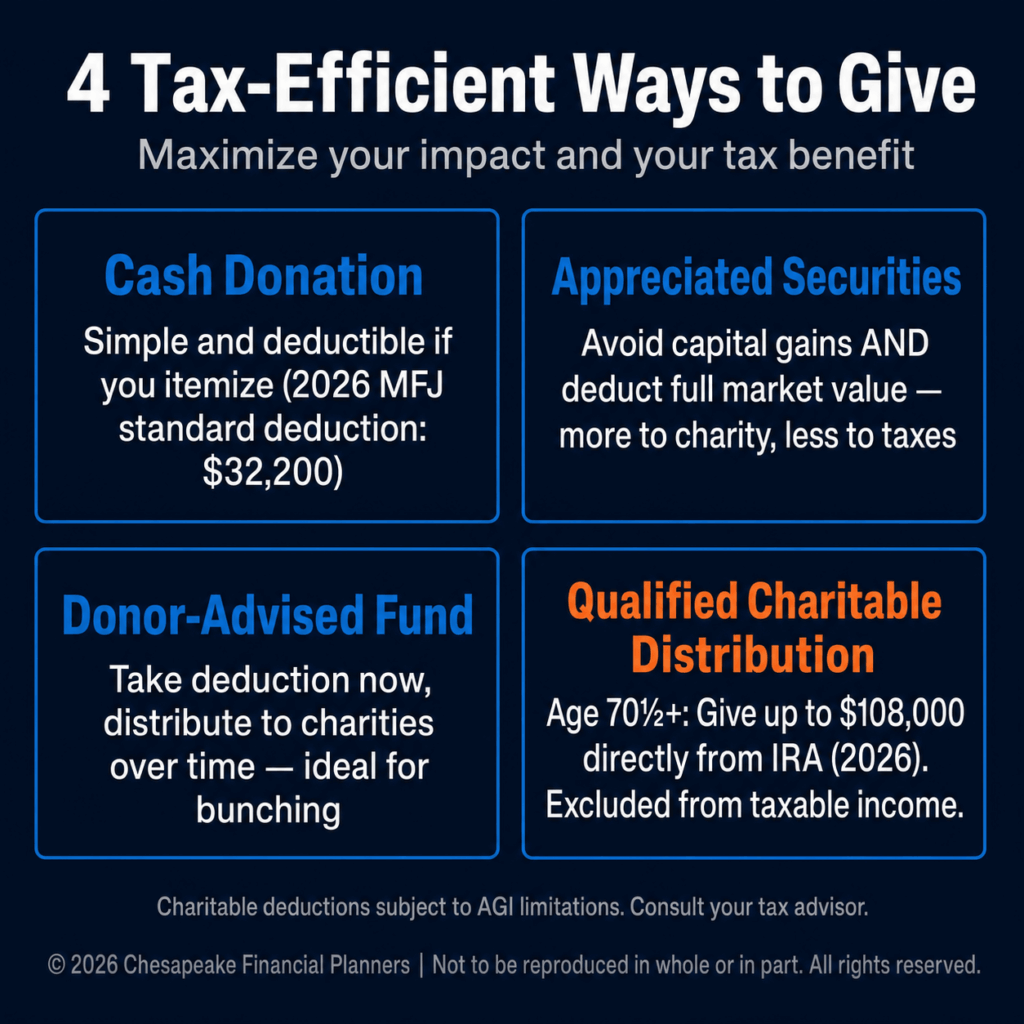
The most tax-efficient charitable donation strategies share one trait: they let you give the same dollars while keeping more in your pocket. The four that move the needle most are donating appreciated securities instead of cash, using a donor-advised fund to bunch several years of giving into one, taking qualified charitable distributions from your IRA after age 70½, and funding a charitable remainder trust with highly appreciated assets. Each works in a different situation, and picking the right one depends on your age, your tax bracket, and what you own.
Key Takeaways
- Donating appreciated securities held over a year lets you skip capital gains tax and deduct full fair market value.
- The 2026 standard deduction of $32,200 for married couples makes bunching contributions critical for many donors.
- Qualified charitable distributions let those 70½ and older give up to $111,000 in 2026 directly from an IRA, tax-free.
- Donor-advised funds combine an immediate deduction with flexible grant timing over many years.
About the Author: Jeff Judge, CFP®, AEP®, ChFC®, CLU® is Managing Partner of Chesapeake Financial Planners in Forest Hill, Maryland. He has been helping families and business owners in Harford County and the Baltimore metro area navigate charitable giving and estate planning since earning his CFP® certification in 2013, by using Chesapeake Financial Planners’ signature process, the R.U.D.D.E.R. method™. Jeff has watched clients write a check to charity in December when the smarter move was sitting right there in their brokerage account: a stock they bought twenty years ago that had quadrupled.
Why Does How You Give Matter as Much as How Much?
The form your gift takes changes your tax outcome more than most people realize. Write a check and you give cash. Donate a stock you bought cheap years ago and you hand the charity the full value while avoiding a tax bill you'd otherwise owe.
Here's the core distinction. When you donate appreciated securities held for more than one year directly to a qualified charity, you deduct the full fair market value and pay zero capital gains tax on the appreciation. Sell the same stock first and you trigger the gain.
Consider stock you bought for $10,000 that's now worth $50,000. Sell it and the federal long-term capital gains tax could run $6,000 to $9,500 depending on your bracket, leaving roughly $40,500 to give. Donate the shares directly and the charity gets the full $50,000, and you deduct $50,000. That gap is real money, and it grows with the size of the gain.
This approach works best with your most appreciated holdings, where the embedded gain is largest. Jeff often tells clients to look at their lowest-basis positions first when they're planning a gift.
How can I potentially optimize my taxes as my income grows?
How Does the Standard Deduction Change Your Giving Strategy?
The 2026 standard deduction of $32,200 for married couples filing jointly, according to the IRS, means many households no longer benefit from itemizing. If your deductible expenses don't clear that bar, your charitable gifts produce no separate tax benefit.
Bunching solves this. Instead of giving $15,000 a year, you concentrate two or three years of gifts into a single tax year, push past the standard deduction, itemize that year, and take the standard deduction in the off years. Same total giving, more total deduction.
The SALT deduction cap limits state and local taxes you can itemize, which makes charitable bunching one of the few remaining levers high earners can pull. A donor-advised fund is the cleanest tool for this because you fund it in the bunch year, deduct it then, and grant to charities at a normal pace afterward.
How Can Bunching Charitable Deductions Save Me on Taxes?
What Is a Donor-Advised Fund and When Should You Use One?
A donor-advised fund is a charitable account where you contribute cash or securities, take an immediate tax deduction, and then recommend grants to charities over time. It separates the timing of your deduction from the timing of your giving.
The advantages stack up. You can contribute appreciated securities and dodge capital gains. The assets grow tax-free inside the fund. And you involve family in grant decisions, which turns giving into a shared conversation. National Philanthropic Trust data shows donor-advised funds now hold hundreds of billions in charitable assets, reflecting how mainstream the tool has become.
Use a DAF when you have a high-income year, want to bunch, or hold appreciated stock you'd rather give than sell. It's the workhorse of modern charitable planning for a reason.
How does a donor-advised fund work and who should consider using one?
How Do Qualified Charitable Distributions Work After 70½?
If you're 70½ or older, a qualified charitable distribution lets you send up to $111,000 in 2026 directly from your IRA to a qualified charity, and that amount is excluded from your taxable income. The IRS adjusts this limit annually for inflation.
This matters because the QCD counts toward your required minimum distribution but never hits your adjusted gross income. Lower AGI can reduce your Medicare Part B premiums, cut the tax on your Social Security benefits, and keep you under thresholds that phase out other deductions.
Even without a charitable deduction, excluding the income from your return often beats taking the distribution, paying tax, and then deducting the gift, especially if you take the standard deduction. Jeff considers the QCD one of the most underused moves among retirees who give regularly.
How do qualified charitable distributions work and who benefits most?

When Does a Charitable Remainder Trust Make Sense?
A charitable remainder trust suits donors with substantial appreciated assets who also want income. You move appreciated property into an irrevocable trust, take an immediate partial deduction, avoid capital gains on the contributed assets, and receive income from the trust for life or a set term. Whatever remains goes to charity.
These trusts are complex and require professional setup and ongoing administration. They fit a narrow situation: you hold highly appreciated assets, want to diversify without a big tax hit, need income, and have genuine charitable intent. The IRS rules on charitable remainder trusts govern payout rates and remainder values closely.
At Chesapeake Financial Planners, we work charitable planning into the broader picture using the R.U.D.D.E.R. Method™, Chesapeake Financial Planners' six-step planning process: Review and Recognize, Uncover and Understand, Design and Develop, Discuss and Decide, Execute and Empower, and Reassess and Refine. Charitable giving touches taxes, estate goals, and income needs all at once, which is exactly why it belongs in a full plan rather than a December scramble.
How do you create a family wealth governance structure for long-term success?
Frequently Asked Questions
What are the most tax-efficient ways to donate to charity?
The most tax-efficient charitable donation strategies are donating appreciated securities to skip capital gains tax, using a donor-advised fund to bunch and deduct several years of giving at once, taking qualified charitable distributions from an IRA after 70½, and funding a charitable remainder trust with highly appreciated assets. The right choice depends on your age, bracket, and holdings.
Is it better to donate stock or cash to charity?
Donating appreciated stock held more than one year usually beats cash. You deduct the full fair market value and avoid the capital gains tax you'd owe if you sold first. With a $50,000 stock and a $40,000 gain, direct donation can save several thousand dollars in tax compared to selling, paying tax, and giving the leftover cash.
Do I have to itemize to deduct charitable contributions?
Yes, you must itemize to claim a charitable deduction, which means clearing the 2026 standard deduction of $32,200 for married couples filing jointly. Many donors no longer itemize, so bunching multiple years of gifts into one tax year through a donor-advised fund is how they recapture the benefit while giving the same total amount.
What is a qualified charitable distribution?
A qualified charitable distribution lets IRA owners age 70½ or older send up to $111,000 in 2026 directly to a qualified charity, excluded from taxable income. It counts toward your required minimum distribution but never raises your adjusted gross income, which can lower Medicare premiums and reduce the tax on your Social Security benefits.
How much can I deduct for charitable contributions?
Charitable deductions are capped as a percentage of your adjusted gross income, with cash gifts to public charities deductible up to 60% of AGI and appreciated securities up to 30%. Amounts over the limit carry forward for up to five years. Cash gifts of $250 or more require written acknowledgment, and property over $5,000 generally needs a qualified appraisal.
What records do I need for charitable donations?
For cash donations of $250 or more, you need written acknowledgment from the charity. For donated property valued over $5,000, you generally need a qualified appraisal. Keep receipts, bank records, and charity letters for every gift. The IRS enforces strict substantiation rules, and missing documentation can cost you the deduction even on legitimate gifts.
If you found this helpful, our guide on integrating philanthropy into a full financial plan covers donor-advised funds, QCDs, and bunching in depth. Download it at chesapeakefp.com to see which charitable donation strategies fit your situation.
Charitable contributions are subject to limitations based on adjusted gross income. Contributions to donor-advised funds and charitable remainder trusts involve irrevocable commitments and may not be suitable for all individuals. Qualified charitable distributions from IRAs are subject to specific IRS requirements and restrictions.
Want to go deeper? Our Tax-Smart Charitable Giving Playbook walks through this step by step.
Disclosures
The information provided is for educational purposes only and should not be construed as investment advice. Investment strategies should be tailored to individual circumstances, risk tolerance, and goals. Past performance doesn't guarantee future results. Consult with qualified financial professionals regarding your specific situation.
This information is not intended to be a substitute for specific individualized tax, investment or legal advice. We suggest that you discuss your specific situation with a qualified tax, legal or financial advisor.
Advisors associated with Chesapeake Financial Planners may be either (1) LPL Financial Registered Representatives offering securities through LPL Financial, Member FINRA and SIPC, and investment advisor representatives offering investment advice through Great Valley Advisor Group; or (2) solely investment advisor representatives offering investment advice through Great Valley Advisor Group and not affiliated with LPL Financial. Great Valley Advisor Group, and Chesapeake Financial Planners are separate entities from LPL Financial.


