
What Are Bonds and How Do They Work in Your Portfolio?
Last reviewed: July 2026
A bond is a loan you make to a government, corporation, or municipality in exchange for regular interest payments and the return of your original investment at a set future date. When you buy a bond, you become the lender, not the owner. The issuer promises to pay you interest (the coupon) on a schedule and repay your principal (the face value) when the bond matures. Understanding what bonds are matters because they shape how steady your portfolio feels when markets get rough.
Key Takeaways
- A bond is a loan to an issuer that pays you interest and returns your principal at maturity.
- U.S. Treasuries are backed by the full faith and credit of the federal government, making them the lowest-risk bonds.
- As of 2026, the 10-year Treasury yield sits near 4.2%, shaping returns across the bond market.
- Bonds and stocks often move differently, which is why fixed income smooths portfolio swings.
- Your bond allocation should track your timeline and how much volatility you can stomach.
About the Author: Jeff Judge, CFP®, AEP®, ChFC®, CLU® is Managing Partner of Chesapeake Financial Planners in Forest Hill, Maryland. He has been helping families and business owners in Harford County and the Baltimore metro area navigate portfolio construction and fixed income investing since earning his CFP® certification in 2013, by using Chesapeake Financial Planners’ signature process, the R.U.D.D.E.R. method™. Jeff often tells clients that bonds are the part of a portfolio you appreciate most on the days the stock market drops 3% before lunch.
If you're building a portfolio, you've probably been told you should own bonds. Most people nod along without fully grasping what a bond actually is or why it earns a spot next to their stocks. That's fair. Bonds don't get the headlines. They rarely double overnight, and nobody brags about their bond returns at a dinner party. But fixed income investments do quiet, important work, and that work gets more valuable the closer you are to needing your money.
What Is a Bond, and How Does It Actually Work?
A bond is a loan with a fixed schedule attached. When you buy one, you hand money to an issuer, and they sign up to pay you back with interest. Say you lend $10,000 to a company for 10 years at a 4% coupon. Every year, they pay you $400. At the end of year 10, they hand back your $10,000. That predictable cycle is the entire appeal.
You are a lender, not a shareholder. That distinction carries legal weight. If a company runs into trouble, bondholders get paid before stockholders. You don't share in the upside if the business booms, but you also don't ride the stock's full plunge if it stumbles. That trade-off is the core of how bonds work.
Bonds carry the label "fixed income" because the payments are scheduled and known in advance. According to FINRA, the price of a bond moves opposite to interest rates: when rates rise, existing bond prices fall, and when rates drop, existing bond prices climb. That inverse relationship trips up a lot of new investors, so it's worth committing to memory.
Why Do Bonds Belong in Your Portfolio?
Bonds earn their place by behaving differently from stocks. They are generally less volatile, which means your account value doesn't swing as hard during a market selloff. Here's the practical payoff, broken down by what bonds do for you:
- Stability during downturns. When equities fall, high-quality bonds often hold value or rise, cushioning your overall portfolio.
- Income you can count on. Retirees and near-retirees can live off bond interest without selling investments at a bad time.
- Diversification. Bonds and stocks tend to move on different timelines, which smooths your combined returns.
- Capital preservation. Money you need within a few years sits safer in bonds than in the stock market.
Jeff Judge has watched clients abandon a sound plan in the middle of a crash, then regret it for years. A meaningful bond allocation reduces the odds of that panic, because the portfolio simply hurts less. That behavioral benefit is hard to measure but easy to feel. For more on how emotion derails investors, see What behavioral biases most commonly hurt investment decisions and how do you fix them?.
How much you hold in bonds depends on your goals, your timeline, and how you react to losses. A 35-year-old saving for a retirement three decades away needs far fewer bonds than a 63-year-old planning to retire next year. Bond portfolio allocation is a personal calculation, not a one-size-fits-all rule.
What Are the Main Types of Bonds?
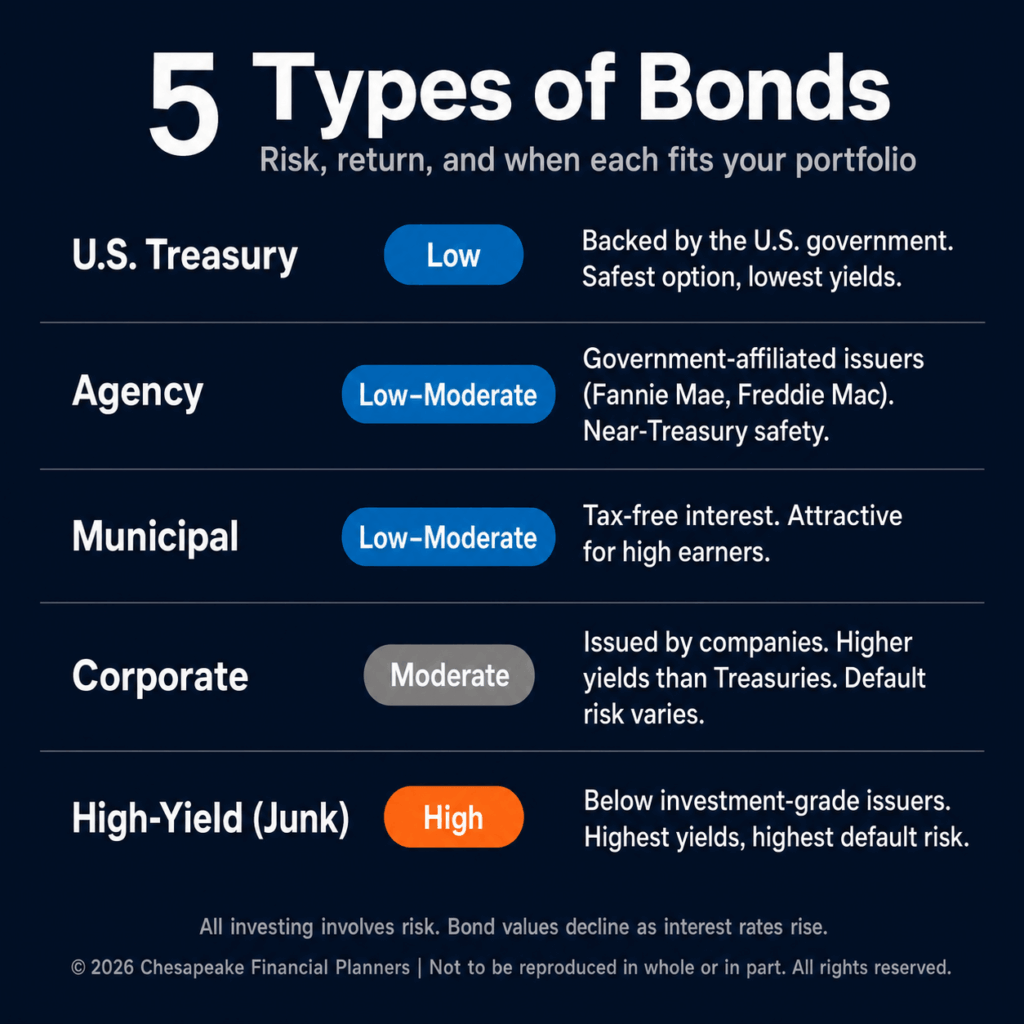
Not all bonds carry the same risk or reward. The most common types you'll meet sit on a spectrum from rock-solid to speculative.
| Bond Type | Issuer | Relative Risk | Notable Feature |
|---|---|---|---|
| U.S. Treasury | Federal government | Lowest | Backed by full faith and credit of the U.S. |
| Municipal | State and local governments | Low to moderate | Interest often federally tax-free |
| Agency | Government-affiliated bodies | Low | Issued by Fannie Mae, Freddie Mac, and similar |
| Corporate | Companies | Moderate | Higher yields than Treasuries |
| High-Yield (Junk) | Lower-rated companies | High | Pays the most to offset default risk |
U.S. Treasury bonds are considered the safest because they're backed by the federal government. The Securities and Exchange Commission notes that Treasuries are widely viewed as having minimal credit risk. Lower risk means lower returns, which is the consistent bargain across the bond market.
Municipal bonds appeal to higher earners because their interest is often exempt from federal tax and sometimes state tax too. Corporate bonds pay more than Treasuries because companies can default. High-yield bonds, sometimes called junk bonds, pay the most precisely because the default risk is real. What you choose comes down to your timeline and your tolerance for surprise.
What Bond Terms Do You Need to Know?
A handful of terms unlock most bond conversations. Learn these five and the jargon stops being intimidating.
- Coupon rate. The interest the bond pays. A 5% coupon on a $10,000 bond pays $500 a year.
- Maturity date. When the bond expires and you get your principal back. Maturities range from months to 30 years.
- Face value (par value). What the bond is worth at maturity, typically $1,000 per bond.
- Yield. Your actual return, which can differ from the coupon depending on what you paid.
- Credit rating. A grade like AAA, BBB, or CCC showing how likely the issuer is to repay. Higher grades mean lower risk and lower yields.
These terms connect to a bigger planning picture. The right mix of bonds isn't an isolated decision. At Chesapeake, we frame it inside a full process. The R.U.D.D.E.R. Method™ is Chesapeake Financial Planners' six-step planning process: Review and Recognize, Uncover and Understand, Design and Develop, Discuss and Decide, Execute and Empower, and Reassess and Refine. Your bond allocation gets revisited every time we reach that final step, because what fit you five years ago rarely fits today. For a wider view, start with What are the fundamentals of personal financial planning?.
If you're shoring up the safer corners of your finances first, pair this with How Much Should I Have in My Emergency Fund? and What is the best way to pay off debt quickly? before stretching for higher yields.
Frequently Asked Questions
What are bonds in simple terms?
Bonds are loans you make to a government, corporation, or municipality. In return, the issuer pays you interest on a set schedule and returns your original investment, called the principal, when the bond reaches its maturity date. You are the lender, which makes bonds a more predictable investment than stocks.
How do bonds make money?
Bonds make money two ways. First, they pay regular interest, known as the coupon, throughout the bond's life. Second, if you buy a bond below its face value and hold it to maturity, you collect the difference as a gain. Some investors also sell bonds for a profit when interest rates fall and prices rise.
Are bonds safer than stocks?
Bonds are generally safer than stocks because they're less volatile and bondholders get paid before shareholders if an issuer fails. According to the SEC, U.S. Treasuries carry minimal credit risk. That said, bonds still face interest rate and inflation risk, so safer does not mean risk-free.
How much of my portfolio should be in bonds?
Your bond allocation depends on your age, timeline, and risk tolerance, not a fixed formula. A younger investor with decades until retirement typically holds fewer bonds, while someone nearing or in retirement holds more for stability and income. A financial planner can match your fixed income allocation to your specific goals and cash flow needs.
What is the difference between a bond's coupon and its yield?
The coupon is the fixed interest rate the bond pays based on its face value. The yield is the actual return you earn, which shifts with the price you paid for the bond. If you buy a bond below face value, your yield exceeds the coupon. If you pay above face value, your yield falls below it.
What happens to bonds when interest rates rise?
When interest rates rise, the prices of existing bonds fall, because newer bonds pay higher rates and become more attractive. According to FINRA, this inverse relationship is fundamental to bond investing. If you hold a bond to maturity, though, you still collect your full face value regardless of price swings along the way.
If you found this helpful, our free guide to building a balanced portfolio walks through how bonds, stocks, and cash work together for your stage of life. Download it at chesapeakefp.com to take the next step in your fixed income strategy and put what are bonds into practical action for your own plan.

Want to go deeper? Our Why Financial Advice Isn’t Just for Retirees walks through this step by step.
Disclosures
The information provided is for educational purposes only and should not be construed as investment advice. Investment strategies should be tailored to individual circumstances, risk tolerance, and goals. Past performance doesn't guarantee future results. Consult with qualified financial professionals regarding your specific situation.
Bonds are subject to credit, market, and interest rate risk if sold prior to maturity. Bond values will decline as interest rates rise and bonds are subject to availability and change in price.
Bonds are subject to market and interest rate risk if sold prior to maturity. Bond values will decline as interest rates rise. Bonds are subject to availability, change in price, call features and credit risk. The opinions expressed in this material do not necessarily reflect the views of LPL Financial.
Advisors associated with Chesapeake Financial Planners may be either (1) LPL Financial Registered Representatives offering securities through LPL Financial, Member FINRA and SIPC, and investment advisor representatives offering investment advice through Great Valley Advisor Group; or (2) solely investment advisor representatives offering investment advice through Great Valley Advisor Group and not affiliated with LPL Financial. Great Valley Advisor Group, and Chesapeake Financial Planners are separate entities from LPL Financial.


