
How Do Bonds Work in My Portfolio?
Last reviewed: July 2026
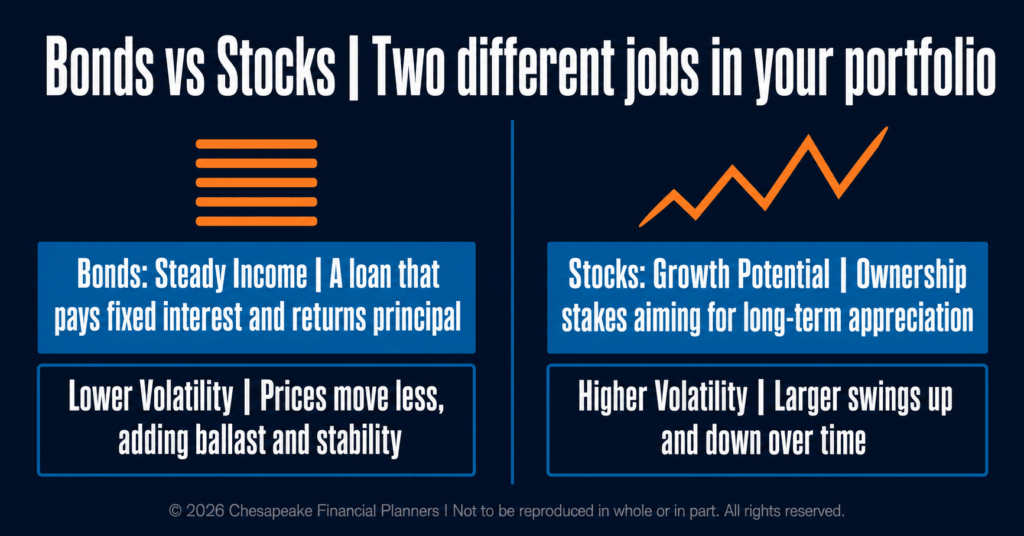
A bond is a loan you make to a government or company in exchange for regular interest payments and the return of your money on a set date. When you buy a bond, you become the lender, and the issuer agrees to pay you a fixed rate of interest until the bond matures. In your portfolio, bonds do a different job than stocks: they generate predictable income and cushion your account when stock prices fall.
Key Takeaways
- A bond is a loan to a government or company that pays you fixed interest until it matures.
- Bonds and stocks usually move differently, which is why owning both smooths out your returns.
- The 10-year Treasury yield was roughly 4.2% in mid-2026, shaping what new bonds pay.
- When interest rates rise, the price of existing bonds falls, and the reverse is also true.
- Bonds belong in most portfolios, but how many you hold depends on your timeline and risk tolerance.
About the Author: Jeff Judge, CFP®, AEP®, ChFC®, CLU® is Managing Partner of Chesapeake Financial Planners in Forest Hill, Maryland. He has been helping families and business owners in Harford County and the Baltimore metro area navigate investment and portfolio decisions since earning his CFP® certification in 2013, by using Chesapeake Financial Planners’ signature process, the R.U.D.D.E.R. method™. Jeff often reminds clients that bonds are not the exciting part of a portfolio, and that is exactly the point: their job is to be boring when the stock market is not.
Most people understand stocks. You buy a share, you own a slice of a company, and you hope it grows. Bonds confuse them. So let's fix that, because understanding how bonds work changes how you think about risk in your entire portfolio.
What Is a Bond, in Plain English?
A bond is a loan with a receipt. You hand money to an issuer, the issuer hands you a promise to pay it back with interest, and that promise is the bond.
Three numbers define every bond. The face value (also called par) is the amount you get back at the end, usually $1,000 per bond. The coupon is the annual interest rate the issuer pays you. The maturity date is when the loan ends and you get your principal back. A $1,000 bond with a 4% coupon and a 10-year maturity pays you $40 a year for ten years, then returns your $1,000.
The issuer matters too. The U.S. Treasury, state and local governments, and corporations all issue bonds. Treasuries are backed by the federal government and are considered among the safest investments in the world. Corporate bonds pay more interest because there's a real chance the company could struggle to repay. According to the SEC's Investor.gov, the trade-off is straightforward: higher potential yield comes with higher risk of not being paid back.
This is the core of bond basics. You are a lender, not an owner. That single distinction explains almost everything about how bonds behave.
How Do Bond Yields and Prices Actually Move?
Bond yields and prices move in opposite directions, and this is the part that trips up most new investors.
Here's why. Say you buy a $1,000 bond paying 4%. A year later, new bonds are paying 5% because interest rates climbed. Nobody wants your 4% bond at full price when they can get 5% from a new one. So the market price of your bond drops until its effective yield matches the 5% available elsewhere. The reverse happens when rates fall: your older, higher-paying bond becomes more valuable, and its price rises.
The 10-year Treasury yield sat around 4.2% in mid-2026, which serves as a benchmark for what new bonds across the market pay. When that benchmark moves, the value of bonds you already own moves with it.
Yield itself comes in a few flavors. The coupon yield is the stated rate on the bond. The current yield factors in what you actually paid for the bond. The yield to maturity is the total return you'll earn if you hold the bond to the end, accounting for price and time. For most everyday investors, yield to maturity is the number that matters most.
If you hold a bond until it matures, the price swings in between don't cost you anything. You get your full face value back regardless. Jeff Judge tells clients this often: paper losses on bonds you intend to hold are just noise, not a reason to sell.
Why Do Bonds Belong in a Portfolio at All?
Bonds belong in a portfolio because they do the opposite of what stocks do at exactly the moments you need it most.
During the steep stock declines of recent decades, high-quality bonds frequently held their value or gained while stocks fell. That negative or low correlation is the whole point. When your stocks drop 30%, a bond allocation gives you something stable to draw from, so you're not forced to sell stocks at the bottom to pay your bills. The SEC describes bonds as a way to preserve capital and generate income, which is precisely the counterweight a stock-heavy portfolio needs.
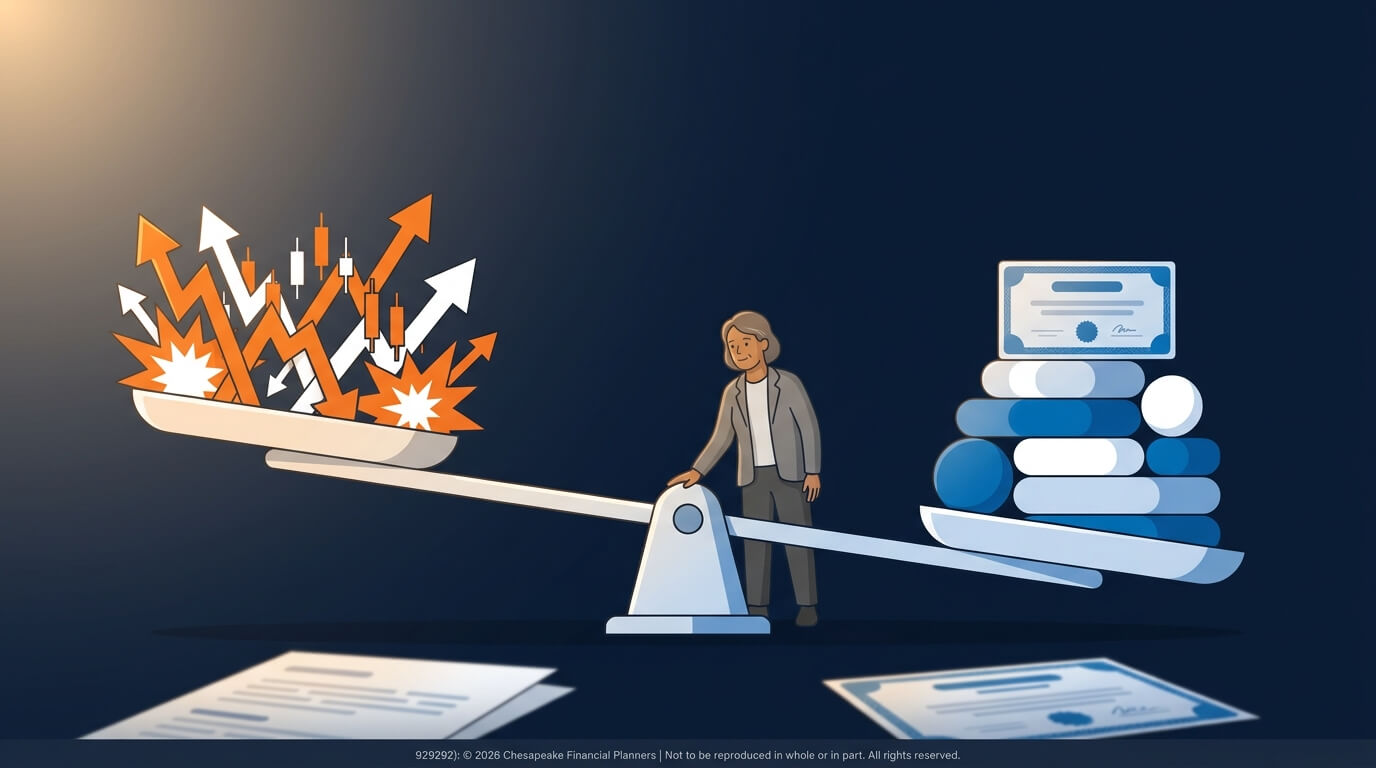
Bonds vs stocks isn't a competition. It's a partnership. Stocks drive long-term growth. Bonds reduce how violently your account swings and provide income along the way. Owning both is what lets most investors stay invested through scary markets instead of panicking and selling.
This is also where the R.U.D.D.E.R. Method™ comes in. The R.U.D.D.E.R. Method™ is Chesapeake Financial Planners' six-step planning process: Review and Recognize, Uncover and Understand, Design and Develop, Discuss and Decide, Execute and Empower, and Reassess and Refine. Deciding how many bonds you should own falls squarely in the Design and Develop step, where your timeline and risk tolerance shape the mix.

In Jeff's experience, the clients who struggle most in down markets are almost always the ones who held too few bonds for their stage of life. They were chasing growth they didn't need and couldn't stomach the ride. A sensible bond allocation isn't about maximizing return. It's about making sure you can actually stick with your plan.
How Many Bonds Should You Own?
How many bonds you should own depends on three things: how long until you need the money, how much volatility you can tolerate, and how much income you need now.
A 30-year-old saving for retirement might hold a small bond allocation, because they have decades to recover from stock declines. A 65-year-old drawing income might hold a much larger one, because a bad market in the first years of retirement can permanently damage a portfolio. There's no universal right answer, which is exactly why rules of thumb like "your age in bonds" should be a starting point, not a final decision.
You can own bonds two ways: individual bonds or bond funds. Individual bonds give you a known maturity date and a fixed payout if you hold them. Bond funds give you instant diversification and easy access but no fixed maturity, so their value floats with interest rates indefinitely. FINRA notes that funds spread your risk across many issuers, which matters more with corporate bonds than with Treasuries.
| Feature | Individual Bonds | Bond Funds |
|---|---|---|
| Maturity date | Fixed and known | None; ongoing |
| Diversification | Limited unless you buy many | Built in |
| Minimum to start | Often $1,000+ per bond | Low, sometimes $1 |
| Price predictability | Get face value at maturity | Floats with rates |
| Best for | Specific future expenses | Broad, hands-off exposure |
The right structure depends on your goal. Saving for a known expense in seven years? An individual bond maturing that year is clean and predictable. Building a long-term diversified portfolio? A low-cost bond fund usually wins.
Frequently Asked Questions
How do bonds work in simple terms?
A bond works like a loan you give to a government or company. You lend them money, they pay you interest at a fixed rate for a set period, and then they return your original investment on the maturity date. You earn income from the interest payments while you hold the bond.
Are bonds safer than stocks?
High-quality bonds, especially U.S. Treasuries, are generally safer than stocks because they pay fixed interest and return your principal at maturity. However, bonds carry their own risks, including interest rate risk and, for corporate bonds, the risk the issuer can't repay. No investment is completely risk-free, including bonds.
What happens to my bonds when interest rates rise?
When interest rates rise, the market price of bonds you already own falls, because newer bonds pay more attractive rates. If you sell before maturity, you may take a loss. But if you hold the bond until it matures, you still receive the full face value, so the price drop in between never costs you anything.
Should I buy individual bonds or bond funds?
Individual bonds suit you when you want a known maturity date and a predictable payout for a specific future expense. Bond funds suit you when you want instant diversification, low minimums, and hands-off exposure. Many investors hold both: funds for broad exposure and individual bonds for targeted goals with set timelines.
How much of my portfolio should be in bonds?
The right bond allocation depends on your time horizon, your tolerance for volatility, and your income needs. Younger investors with decades ahead often hold fewer bonds, while those near or in retirement typically hold more to protect against poorly timed market declines. A financial planner can match the allocation to your specific situation.
Do bonds pay better than a savings account?
Bonds can pay more than a savings account, especially longer-term or corporate bonds, but they carry more risk and less liquidity. With the 10-year Treasury near 4.2% in 2026, yields are competitive, but unlike a savings account, a bond's market value can drop before maturity if you need to sell early.
Putting Bonds to Work in Your Plan
Bonds aren't the part of your portfolio that makes you rich. They're the part that lets you stay invested long enough for the rest of your portfolio to do its job. Understanding how bonds work, how yields move, and how much to own turns them from a confusing line item into a deliberate tool.
If you want to go deeper on building a portfolio that fits your stage of life, our guide on matching your investment mix to your goals walks through the whole process. Download it at chesapeakefp.com, and you'll have a clearer picture of where bonds fit in your plan.
How should my investment mix change as I get closer to retirement?
How Do Interest Rates Affect My Investment Portfolio?
Is my portfolio diversified enough to handle market volatility?
How Do Investment Fees Impact My Long-Term Returns?
Want to go deeper? Our R.U.D.D.E.R Audit for DIY Investors walks through this step by step.
Disclosures
The information provided is for educational purposes only and should not be construed as investment advice. Investment strategies should be tailored to individual circumstances, risk tolerance, and goals. Past performance doesn't guarantee future results. Consult with qualified financial professionals regarding your specific situation.
Stock investing includes risks, including fluctuating prices and loss of principal.
Bonds are subject to credit, market, and interest rate risk if sold prior to maturity. Bond values will decline as interest rates rise and bonds are subject to availability and change in price.
Bonds are subject to market and interest rate risk if sold prior to maturity. Bond values will decline as interest rates rise. Bonds are subject to availability, change in price, call features and credit risk. The opinions expressed in this material do not necessarily reflect the views of LPL Financial.
Advisors associated with Chesapeake Financial Planners may be either (1) LPL Financial Registered Representatives offering securities through LPL Financial, Member FINRA and SIPC, and investment advisor representatives offering investment advice through Great Valley Advisor Group; or (2) solely investment advisor representatives offering investment advice through Great Valley Advisor Group and not affiliated with LPL Financial. Great Valley Advisor Group, and Chesapeake Financial Planners are separate entities from LPL Financial.


