

What is a 1031 exchange, and how does it defer tax on investment property?
Last reviewed: July 2026
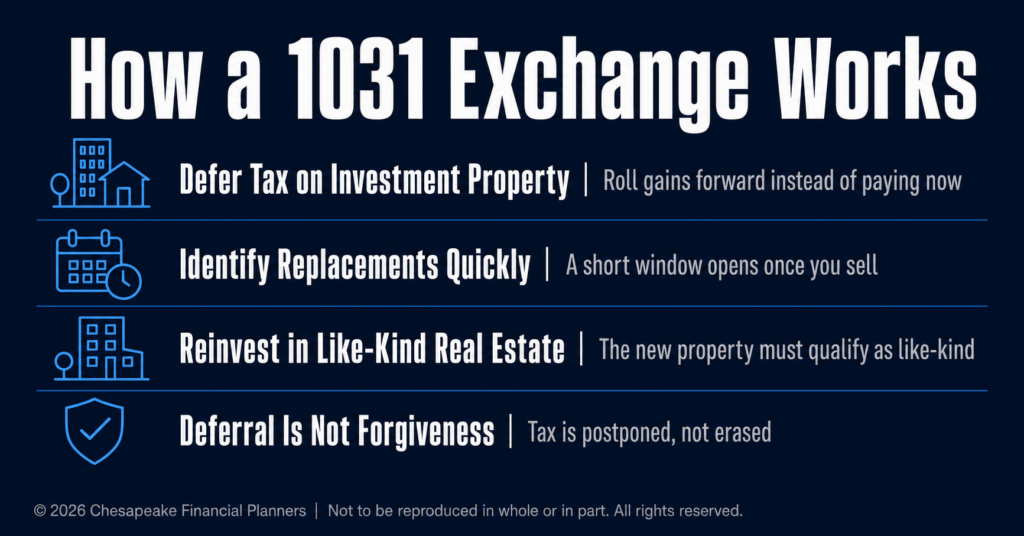
A 1031 exchange lets you sell an investment property and reinvest the proceeds into another qualifying property without paying capital gains tax in the year of the sale. The tax is deferred, not erased. You carry your original cost basis and your deferred gain into the replacement property, which keeps more of your capital invested instead of going to the IRS now. Named after Section 1031 of the tax code, it is one of the few tools that lets real estate investors defer capital gains on real estate for decades, as long as they keep following the rules.
On This Page
- Key Takeaways
- How does a 1031 exchange actually work?
- What are the 1031 exchange rules and deadlines?
- Which types of 1031 exchanges can you use?
- When does a 1031 exchange make sense, and when does it backfire?
- Related Topics Worth Reading
- Frequently Asked Questions
- Putting a 1031 exchange to work
- Disclosures
Key Takeaways
- A 1031 exchange defers capital gains tax when you swap one investment or business property for another like-kind property.
- You have 45 days to identify and 180 days to close on the replacement property, with no extension for a missed deadline.
- Long-term capital gains run 0%, 15%, or 20%, plus a possible 3.8% surtax, all of which a 1031 exchange postpones.
- The deferred gain follows you into the new property; selling later without planning triggers the full bill.
- Since 2018, only real property held for business or investment qualifies. Equipment and personal property no longer count.
About the Author: Jeff Judge, CFP®, AEP®, ChFC®, CLU® is Managing Partner of Chesapeake Financial Planners in Forest Hill, Maryland. He has been helping families and business owners in Harford County and the Baltimore metro area navigate real estate and tax strategy since earning his CFP® certification in 2013, by using Chesapeake Financial Planners’ signature process, the R.U.D.D.E.R. method™. Jeff's view: the 1031 exchange is one of the strongest deferral tools in the code, and also one of the easiest to lose on a calendar technicality.
How does a 1031 exchange actually work?
A 1031 exchange, also called a like-kind exchange, swaps one investment property for another so the gain rolls forward instead of being taxed today. The mechanics are strict. You cannot touch the sale proceeds. A qualified intermediary holds the money between the sale of your old property (the relinquished property) and the purchase of the new one (the replacement property), and the basis and deferred gain transfer to the new property. The IRS states the core rule directly: "Generally, if you make a like-kind exchange, you are not required to recognize a gain or loss under Internal Revenue Code Section 1031."
Like-kind is broader than most people expect. Almost any real property held for investment or business use is like-kind to almost any other. You can exchange a rental duplex for raw land, an office building for an apartment complex, or a retail strip for a warehouse. What matters is how you hold the property, not what type it is.
Here is what that looks like with numbers. Say you bought a rental in Bel Air years ago for $300,000, and it is now worth $600,000. Sell it outright and roughly $300,000 of gain is exposed to capital gains tax and depreciation recapture, which can mean a tax bill well into the five figures. Run it through a 1031 exchange instead and you move the full $600,000 into the next property, with the gain riding along inside your new basis. You have not erased the tax. You have kept the money that would have gone to the IRS working in a larger asset. Multiply that decision across two or three exchanges over a couple of decades, and the gap between deferring and paying as you go can rival the down payment on your next building. Jeff Judge notes: "When you run a 1031 exchange on a property like that Bel Air rental, you are not just deferring a tax bill, you are keeping that capital compounding in a larger asset, and over two or three exchanges the difference in wealth accumulation can be staggering."
Does a 1031 exchange eliminate the tax or just delay it?
A 1031 exchange delays the tax; it does not eliminate it. You defer the capital gains and depreciation recapture until you sell the replacement property in a taxable sale. Many investors defer repeatedly across decades, and the deferred gain can disappear entirely if the property passes to heirs at a stepped-up basis.
What property qualifies for a like-kind exchange?
Only real property held for productive use in a trade, business, or investment qualifies. Your primary residence does not count. Since the 2017 tax law, personal property such as equipment, vehicles, and collectibles no longer qualifies for 1031 treatment. The replacement must also be held for investment, not quick resale.
Do you ever pay tax inside a 1031 exchange?
Yes, you pay tax on any boot, which is cash or non-like-kind value you receive in the deal. If you trade down in price, pull cash out, or reduce your mortgage debt, that difference is taxable. To defer the full gain, you generally must buy equal or greater value and reinvest all the proceeds.
What are the 1031 exchange rules and deadlines?
Two deadlines control every delayed exchange, and the IRS does not forgive a miss. According to the IRS, you have 45 days from the sale of your relinquished property to identify replacement properties in writing, and 180 days from that same sale date to close on the purchase. Both clocks run at the same time, not back to back. Weekends and holidays do not extend them.
Identification follows its own rules. You can name up to three properties of any value (the three-property rule), or more than three as long as their combined value stays under 200% of what you sold (the 200% rule). The same taxpayer who sold the relinquished property must take title to the replacement, which trips up investors who try to shift property into a new LLC mid-exchange.
You also need a qualified intermediary in place before the sale closes. If the proceeds ever land in your own bank account, even briefly, the exchange is dead and the gain becomes taxable.
Which types of 1031 exchanges can you use?
Not every exchange looks the same. The right structure depends on your timing and whether you have already found the replacement property.
| Exchange type | How it works | Typical use |
|---|---|---|
| Delayed (forward) | Sell first, then buy within 45/180 days through a qualified intermediary | The most common situation |
| Simultaneous | Relinquished and replacement properties close the same day | Rare; high coordination risk |
| Reverse | Buy the replacement first, sell the old property later | Competitive markets where you must move fast |
| Improvement (build-to-suit) | Exchange funds pay for construction on the replacement | When the new property needs work to match value |
The delayed exchange covers most investors. Reverse and improvement exchanges add cost and complexity, because an exchange accommodation titleholder has to park the property, but they solve real timing problems. The structure should follow the deal, not the other way around.
One detail trips people up: you do not have to swap one property for one property. You can sell a single building and buy several, or sell several and consolidate into one. The rules care about the total value and equity you reinvest, not the number of properties. That flexibility is what makes the 1031 exchange useful for investors reshaping a portfolio, not just trading one door for another.
When does a 1031 exchange make sense, and when does it backfire?
A 1031 exchange makes the most sense when you want to stay invested in real estate, you have meaningful appreciation or depreciation recapture to defer, and you have a clear replacement target. The deferred tax is real money kept working. On a long-held rental, depreciation recapture alone is taxed up to 25%, and the remaining gain can face the 20% top capital gains rate plus the 3.8% net investment income tax. Deferring all of that lets the money keep compounding for you.
It backfires when the tax tail wags the investment dog. Jeff Judge tells clients that the worst 1031 exchanges he sees are the ones where someone buys a mediocre replacement property just to beat the 45-day clock. You defer a tax bill and inherit a weak asset. As Jeff Judge puts it, "A 1031 exchange should start with the next property, not the tax bill." In his work with Harford County investors, the most common failure is not lining up the replacement property before listing the original, which turns a 45-day window into a scramble.
The cost of rushing is easy to underestimate. Overpay by 10% on a $600,000 replacement just to use up the proceeds, and you have handed away $60,000 to defer a tax bill that might have been smaller than that. The deferral only helps if the replacement is a property you would have wanted to own anyway. That is the test Jeff brings back to every exchange conversation: would you buy this property if there were no tax to defer?
This is where a real process matters. The R.U.D.D.E.R. Method™ is Chesapeake Financial Planners' six-step planning process: Review and Recognize, Uncover and Understand, Design and Develop, Discuss and Decide, Execute and Empower, and Reassess and Refine. Running an exchange through that kind of framework forces the questions most investors skip: how depreciation recapture gets taxed at ordinary rates up to 37%, how the new property fits your income plan, and what your eventual exit looks like.

Related Topics Worth Reading
A 1031 exchange rarely stands alone. These related articles shape whether it is the right move and what comes next.
- How the step-up in basis at death can erase deferred gains for your heirs. What is step-up in basis, and how are inherited assets taxed?
- Where a 1031 exchange fits in the broader capital gains picture. How Much Will I Pay in Capital Gains Tax?
- Other ways to manage a capital gains bill when you sell an appreciated asset. How Can I Reduce Capital Gains Taxes on My Investments?
- Deciding whether to keep or sell real estate you inherited. Should I keep or sell real estate and investments I inherited?
- How Maryland's capital gains surtax affects high earners selling property. How do Maryland's new income tax brackets and 2% capital gains surtax affect high earners?
Frequently Asked Questions
Can you do a 1031 exchange on your primary residence?
No, a 1031 exchange applies only to property held for investment or business use, so your primary residence does not qualify. A separate rule, the Section 121 exclusion, can shelter gain on a home you have lived in. Some investors convert a former rental into investment use, but strict holding-period rules apply.
What is a qualified intermediary, and why do you need one?
A qualified intermediary is an independent party who holds your sale proceeds and handles the exchange paperwork so you do not take possession of the money. The IRS requires this for a delayed exchange. If you receive the funds directly, even for a day, the exchange fails and the entire gain becomes taxable that year.
What happens to the deferred gain when you die?
When you die still holding the property, your heirs generally receive a stepped-up basis to fair market value, which can erase the deferred capital gains and depreciation recapture. This swap-till-you-drop outcome is why many investors keep exchanging rather than ever selling outright. Estate planning should confirm how it applies to you.
Can you 1031 exchange into a property in another state?
Yes, you can exchange into a replacement property in a different state, since like-kind real estate includes property anywhere in the United States. Many investors trade local rentals for property in lower-tax or faster-appreciating markets. Watch for state clawback rules, where some states tax the deferred gain when you eventually sell.
How much does a 1031 exchange cost?
A standard delayed exchange typically runs a few hundred to a couple thousand dollars in qualified intermediary fees, plus normal closing costs. Reverse and improvement exchanges cost more because of the added titleholder structure. Weigh the fee against the tax deferred, which is often far larger than the cost of the exchange.
Can you do a partial 1031 exchange?
Yes, you can exchange part of the value and cash out the rest, but the portion you take as cash or debt relief, known as boot, is taxable in the year of the sale. Partial exchanges make sense when you want to pull some equity out and still defer the bulk of the gain. The deferred and taxable pieces are figured separately.
How is a 1031 exchange different from an Opportunity Zone investment?
A 1031 exchange defers gain by reinvesting in like-kind real estate, while an Opportunity Zone lets you defer gain from almost any asset by investing in a designated zone fund. Opportunity Zones can also reduce tax on the new investment's appreciation if you hold long enough. They solve different problems and follow different timelines.
Putting a 1031 exchange to work
A 1031 exchange can defer a large tax bill, but the deadlines are unforgiving and the wrong replacement property can cost you more than the tax would have. The investors who do well with this tool decide on strategy before they list, not after. You can read more on capital gains tax strategies at chesapeakefp.com, or schedule a complimentary consultation with the Chesapeake Financial Planners team to talk through your specific situation before you sell.
Investments in real estate may be subject to a higher degree of market risk because of concentration in a specific industry, sector or geographical sector. Other risks can include, but are not limited to, declines in the value of real estate, potential illiquidity, risks related to general and economic conditions, stage of development, and defaults by borrower.
Want to go deeper? Our Tax-Smart Financial Plan walks through this step by step.
Disclosures
The information provided is for educational purposes only and should not be construed as investment advice. Investment strategies should be tailored to individual circumstances, risk tolerance, and goals. Past performance doesn't guarantee future results. Consult with qualified financial professionals regarding your specific situation.
Investments in real estate may be subject to a higher degree of market risk because of concentration in a specific industry, sector or geographical sector. Other risks can include, but are not limited to, declines in the value of real estate, potential illiquidity, risks related to general and economic conditions, stage of development, and defaults by borrower.
This information is not intended to be a substitute for specific individualized tax, investment or legal advice. We suggest that you discuss your specific situation with a qualified tax, legal or financial advisor.
Advisors associated with Chesapeake Financial Planners may be either (1) LPL Financial Registered Representatives offering securities through LPL Financial, Member FINRA and SIPC, and investment advisor representatives offering investment advice through Great Valley Advisor Group; or (2) solely investment advisor representatives offering investment advice through Great Valley Advisor Group and not affiliated with LPL Financial. Great Valley Advisor Group, and Chesapeake Financial Planners are separate entities from LPL Financial.


