

Published: | Last reviewed: November 2026 by Jeff Judge, CFP®
Part of our guide: How Does Chesapeake Financial Planners Evaluate a Book of Business?
What red flags do buyers find in an advisory practice's due diligence? In advisory practice due diligence, four show up repeatedly: a messy compliance history, revenue concentrated in a few households or in the advisor personally, disorganized agreements and client records, and pricing or service promises a buyer cannot honor. Each one has a fix you can make before going to market.
Key Takeaways
- Schwab Advisor Services, citing DeVoe & Company, reports more than 300 RIA deals closed in 2025, so buyers have many practices to compare.
- Advisor Legacy says buyers discount value or tie earn-outs to retention when 30% or more of revenue comes from 10 clients.
- SEC rules require advisers to keep true, accurate and current books and records for at least five years in the usual case.
- Open complaints, pending litigation, and unresolved exam findings can make buyers refuse the risk or demand indemnification, according to Advisor Legacy.
About the Author: Jeff Judge, CFP®, AEP®, ChFC®, CLU® is Managing Partner of Chesapeake Financial Planners in Forest Hill, Maryland. He has been helping families and business owners in Harford County and the Baltimore metro area navigate business transitions and exit planning since earning his CFP® certification in 2013, by using Chesapeake's signature process, the R.U.D.D.E.R. Method™. "Buyers rarely walk away over one problem. They walk away over a problem you did not know about."
This post is buyer-neutral. Chesapeake Financial Planners acquires advisory practices, but the red flags below are general market themes, not the firm's own checklist.
What Compliance and Regulatory Red Flags Do Buyers Find in Advisory Practice Due Diligence?
In financial advisor due diligence, compliance problems can end a conversation fastest. Buyers often check an adviser's public record first. The SEC says Form ADV contains disclosure about certain disciplinary events involving the adviser and its key personnel, and its Investment Adviser Public Disclosure site lets anyone view a firm or an individual representative. Individual records trace back to Form U4, which, according to FINRA, requires a disclosure reporting page for each affirmative answer to its disclosure questions. Advisor Legacy adds that open complaints, pending litigation, or unresolved exam findings create risks buyers either refuse to assume or demand indemnification for.
Poor records are the quieter version of the same flag. The SEC's books and records rule says an adviser "shall make and keep true, accurate and current the following books and records relating to its investment advisory business." Those records must be kept for at least five years in the usual case, so gaps show up fast in advisory practice due diligence.
Do buyers see my Form U4 and Form ADV disclosures?
Yes. Investor.gov explains that IAPD shows an adviser's current Form ADV and a representative's background, including disciplinary events, which IAPD calls disclosures. A buyer can pull your Form ADV disclosures before the first call, so review your advisory practice compliance history yourself and be ready to explain every entry.
How Do Concentration and Owner Dependency Raise Red Flags?
Client concentration risk means a few households produce a large share of revenue. Commonwealth lists high concentration in assets or revenue streams among its deal breakers, and Advisor Legacy says that when 30% or more of revenue comes from 10 clients, buyers discount valuation or structure earn-outs tied to retention. Our post on how practice sales are structured explains how those terms work.
Owner dependency is the personal version: revenue that exists because of you. Advisor Legacy says that if the founder is the only rainmaker or the only planner, buyers question whether the firm survives the transition. The FPA Journal lists key person dependency among the value drivers specialists adjust for. Jeff Judge often says a buyer prices what survives the handoff, not what the founder can personally produce.
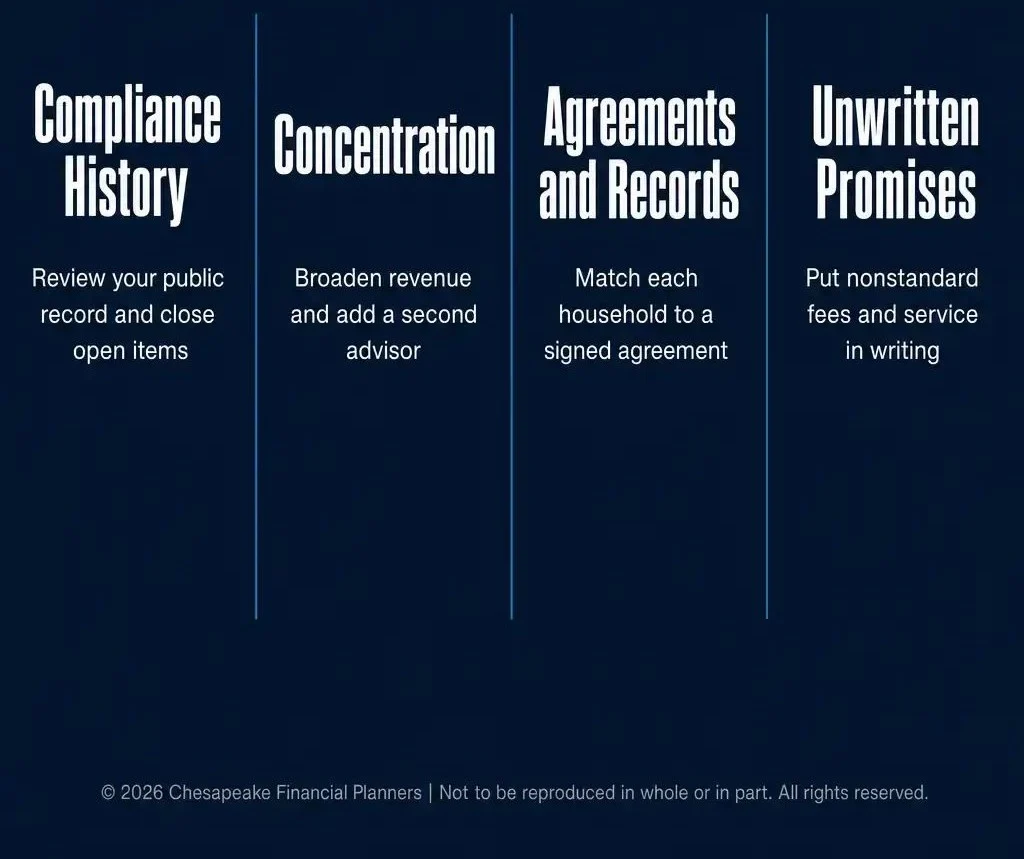
The fix is to broaden revenue where you can, introduce a second advisor to your largest households early, and document service so clients know a team stands behind them.
Why Do Messy Agreements and Client Records Worry Buyers?
Buyers purchase contracts as much as relationships. SEC rules require advisers to keep written agreements entered into with any client, and SEC staff explain that Section 205(a)(2) of the Advisers Act requires advisory contracts to bar assignment without client consent. A missing, unsigned, or outdated agreement leaves a buyer unsure what a client agreed to, what fee applies, and whether the contract can move to a new owner. Buyers also compare each household's fee with the agreement on file, and a mismatch suggests a billing or documentation error.
Client records tell the same story. Inconsistent household data, scattered notes, and files in personal email slow a buyer's review and invite price cuts. An organized advisory practice data room, meaning one folder of agreements, fee schedules, account lists, and compliance documents, signals control.
Which advisory agreements do buyers check first?
The signed agreement for each household, any amendments to fees or services, and proof of which Form ADV brochure each client received. SEC rules require advisers to keep written client agreements and brochure delivery dates, so gaps are visible. Match each client to a current signed agreement before a buyer asks.
What Pricing and Service Promises Can a Buyer Not Honor?
Some promises fade when the owner leaves. A legacy fee break for a longtime household, an unwritten commitment to answer calls the same day, or a pledge that only you will attend each meeting can become a liability in the buyer's model. A buyer cannot honor a promise nobody wrote down, and cannot afford one priced below the cost of service.
In Jeff's experience, informal side commitments are the ones advisors forget to mention until a buyer's questionnaire asks. The fix is to list every nonstandard fee and service commitment, put each in writing, and decide which will continue. Compare what you actually charge with the brochure you give clients, because differences stand out in diligence. Raising a commitment yourself is easier than having a buyer find it, because a disclosed commitment can be priced, while a surprise erodes confidence in everything else.

What Should You Fix Before You Sell an Advisory Practice?
If you plan to sell an advisory practice, work down this list well before you go to market. These advisory practice red flags are fixable, and fixing them early shortens negotiations.
| Red flag | Fix before going to market | What to bring to a buyer |
|---|---|---|
| Compliance history | Review your IAPD record, close open items, document remediation | Form ADV, exam responses, remediation notes |
| Concentration and owner dependency | Broaden revenue, add a second advisor to largest households | Revenue by household, service team roles |
| Messy agreements and records | Match each household to a current signed agreement, build a data room | Signed agreements, fee schedules, account list |
| Unwritten pricing and service promises | Write down nonstandard fees and commitments, decide which continue | Fee exceptions list, service standards |
Documenting your process helps with every row. Chesapeake Financial Planners does this for clients with the R.U.D.D.E.R. Method™. The R.U.D.D.E.R. Method™ is Chesapeake Financial Planners' six-step planning process: Review and Recognize, Uncover and Understand, Design and Develop, Discuss and Decide, Execute and Empower, and Reassess and Refine.
If you are weighing a sale, read How Does Chesapeake Financial Planners Evaluate a Book of Business? for one buyer's published approach. Preparing early makes advisory practice due diligence smoother. Then see what makes a practice more valuable to a buyer. Visit chesapeakefp.com to learn more.
Frequently Asked Questions
What red flags do buyers find in an advisory practice's due diligence?
Four recur: regulatory or compliance history, client and revenue concentration including owner dependency, missing or outdated agreements and records, and pricing or service promises a buyer cannot honor. Fixing each before you go to market gives a buyer less to discount or question.
How can I prepare my advisory practice for due diligence?
Build a data room with signed client agreements, fee schedules, account lists, Form ADV, and exam responses. Review your public IAPD record, document remediation for any open item, and map revenue by household. Preparing these items early lets you answer a buyer's questions quickly and consistently.
Will a regulatory disclosure stop a sale?
Not automatically. Advisor Legacy says unresolved complaints, litigation, or exam findings are the problem, because buyers refuse the risk or demand indemnification. A closed matter with documented remediation is easier to explain, so resolve open items first and be ready to describe each entry.
How much client concentration is too much?
There is no universal cutoff, and each buyer sets its own tolerance. Advisor Legacy says buyers discount or tie earn-outs to retention when 30% or more of revenue comes from 10 clients. Calculate your own numbers by household and plan to broaden revenue.
Which agreements should be in order before a buyer reviews my practice?
A current signed advisory agreement for each household, any amendments to fees or services, and records showing which Form ADV brochure each client received. SEC rules require advisers to keep these records, and a sale involves client consent, so clean documents shorten the process.
Disclosures
The information provided is for educational purposes only and should not be construed as investment advice. Investment strategies should be tailored to individual circumstances, risk tolerance, and goals. Past performance doesn't guarantee future results. Consult with qualified financial professionals regarding your specific situation.
Advisors associated with Chesapeake Financial Planners may be either (1) LPL Financial Registered Representatives offering securities through LPL Financial, Member FINRA and SIPC, and investment advisor representatives offering investment advice through Great Valley Advisor Group; or (2) solely investment advisor representatives offering investment advice through Great Valley Advisor Group and not affiliated with LPL Financial. Great Valley Advisor Group, and Chesapeake Financial Planners are separate entities from LPL Financial.
Chesapeake Financial Planners | 2402 Scotlon Ct, Forest Hill, MD 21050 | (410) 652-7868 | www.chesapeakefp.com
© 2026 Chesapeake Financial Planners | Not to be reproduced in whole or in part. All rights reserved.


