

Last reviewed: October 2026
Probably not. The 83(i) election lets certain private company employees defer income tax on option or RSU shares for up to five years, but only when the employer has adopted it under a written plan that grants options or RSUs to at least 80% of its U.S. employees. I have had exactly one client whose employer ever offered it. Here is how the rule works, why it stays rare, and what to do instead.
Key Takeaways
- Section 83(i) lets qualified employees defer tax on option or RSU shares for up to five years, but only if the employer offers it.
- The employer needs a written plan granting options or RSUs to at least 80% of U.S. employees on the same terms.
- Without 83(i), RSU vests are usually withheld at a flat 22% in 2026, below the 32% to 37% brackets many high earners face.
- Ask your equity administrator in writing whether your plan includes 83(i), and fund a cash reserve sized to your real bracket if it does not.
About the Author: Jeff Judge, CFP®, AEP®, ChFC®, CLU® is Managing Partner of Chesapeake Financial Planners in Forest Hill, Maryland. He has been helping families and business owners in Harford County and the Baltimore metro area navigate equity compensation and tax planning since earning his CFP® certification in 2013, by using Chesapeake's signature process, the R.U.D.D.E.R. Method™. "A deferral rule only helps if your employer actually adopted it, so ask your equity administrator before you build a tax plan around it."
What Does the 83(i) Election Actually Let You Do?
The 83(i) election lets an eligible private company employee push income tax on option or RSU shares past the normal vesting or exercise date. Congress added it in the 2017 tax law, which IRS Notice 2018-97 identifies as section 13603 of Pub. L. 115-97. The target was a real problem: shares vest, a tax bill arrives, and there is no market to sell into.
A qualified equity grant under 83(i) changes the timing. If you elect, the statute moves the income into the tax year that includes the earliest of five events:
- The stock first becomes transferable.
- You become an excluded employee, such as by taking a CEO or CFO role.
- Any company stock becomes readily tradable on an established securities market, typically an IPO.
- Five years pass after your rights first become transferable or free of forfeiture risk.
- You revoke the election.
Some descriptions add "leaving the company" to that list. The statute's list does not. The deferral also covers income tax only, since FICA and FUTA treatment is unchanged under IRS Notice 2018-97. If your RSUs are tied to a liquidity event, see our post on double-trigger RSUs at a private company for when the tax clock starts without any election.
Why Do So Few Private Companies Offer the 83(i) Election?
Because the company has to clear a stack of conditions, and breadth breaks most plans. An eligible corporation must be private, with no stock readily tradable on an established market, and needs a written plan under which at least 80% of all U.S. employees are granted options or RSUs with the same rights and privileges. Share counts can differ above a de minimis amount, and the IRS notice sets part-time and excluded employees aside when counting.
| Requirement | What Section 83(i) says | Why it screens out most companies |
|---|---|---|
| Broad grants | Written plan, 80% of U.S. employees, same rights and privileges | Most plans are tiered by level and hire date |
| Cash-out right | No qualified stock if you can sell it to the company, or take cash, when your rights first become transferable | Company liquidity at vesting can disqualify shares |
| Election timing | Within 30 days of the first date the rights are transferable or vested | Miss the window and the option is gone |
The statute sets the deadline plainly: an election must be made "no later than 30 days after the first date the rights of the employee in such stock are transferable or are not subject to a substantial risk of forfeiture". Our 83(b) election guide covers a cousin rule with a similar clock.
Who counts as an excluded employee under 83(i)? Anyone who is, or in the past 10 years was, a 1% owner; anyone who is or was the CEO or CFO; their family members; and anyone among the four highest compensated officers now or in the past 10 years.
For the company, the deferral ends with withholding owed on a share price it does not control.
"I've talked with founders who looked into offering 83(i) and walked away within a week. They wanted to help their people. The compliance work just didn't make sense for how few employees would benefit." (Jeff Judge, CFP®)
What Are the Catches If Your Company Does Offer 83(i)?
The election postpones tax, it does not shrink it:
- The value is locked at vesting. Income is measured on the first date your rights are transferable or vested, even if the stock declines during the deferral.
- The withholding rate is high. When the deferral ends, withholding is not less than the maximum rate under section 1, which is 37% for 2026 according to the IRS.
- You take on obligations. A qualified employee agrees to meet withholding requirements, which the IRS notice describes as an escrow arrangement.
What happens if the deferral ends and you still cannot sell the shares? You owe the tax anyway. If a trigger such as becoming an excluded employee arrives first, you face income at the vest-date value and top-rate withholding on shares you still cannot sell. The election buys time. It does not create a market.
What Goes Wrong When You Plan Around a Deferral You Do Not Have?
You delay planning for the tax bill you actually have. A client of mine heard about 83(i) secondhand and assumed something like it applied to him. He put off setting aside cash for a large RSU vest, and his company withheld at the flat supplemental rate, well below what his income owed. His only cash source was shares in a company that does not trade on an exchange, sold at a valuation set months earlier.
The arithmetic explains why. The IRS says the flat supplemental rate is 22%, and the federal regulation moves it to the top rate above $1,000,000 in supplemental wages. On a hypothetical $100,000 vest in the 32%, 35%, or 37% bracket, the shortfall is $10,000, $13,000, or $15,000, before FICA and state tax.
"The gap between the flat rate and your real rate is where most surprise tax bills come from. I've seen it run into the tens of thousands of dollars on a single large vest." (Jeff Judge, CFP®)
That is the cost of a headline-friendly tax rule with a narrow use case. It gave my client a reason to wait instead of a reason to plan.

What Should You Do Instead If Your Company Has Not Adopted the 83(i) Election?
Treat the tax as a known, current-year obligation until your employer shows you otherwise in writing. Here is where I would start:
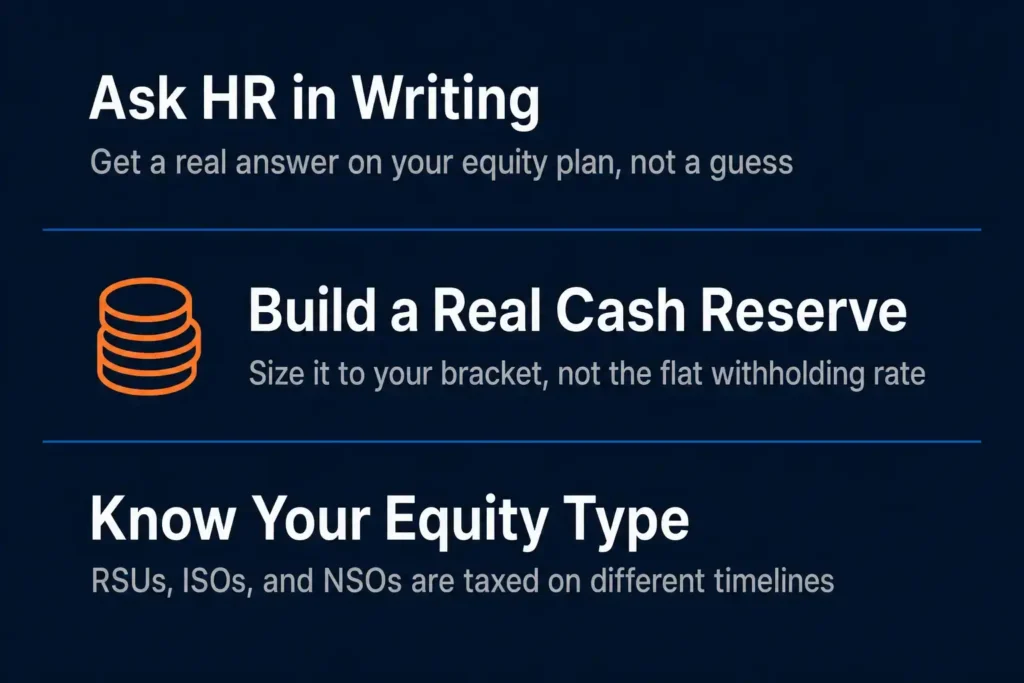
- Ask HR in writing. A plain no on whether your equity plan includes a deferral election lets you stop planning around a maybe.
- Build a cash reserve before every vest. Size it to your marginal rate, not the flat 22%, and include state and county tax.
- Look for a liquidity window. Some private companies run secondary sales or tender offers. Where one exists, it is a real mechanism.
- Know your equity type. RSUs are taxed at vesting, incentive stock options can trigger alternative minimum tax at exercise, and nonqualified options are ordinary income at exercise. Our RSU, ISO, NSO, and ESPP comparison shows each timeline, and why 22% withholding is not enough covers the gap. Before you accept an offer, ask what the exercise and tax timeline looks like and talk with a tax professional.
Federal tax is one layer. Maryland also withholds state and county income tax, per the Comptroller's state and local withholding information. For families around Forest Hill, Bel Air, and the wider Harford County and Baltimore corridor, the vest reserve should cover federal, Maryland, and county tax. How Maryland treats a federal 83(i) deferral is a question for your tax preparer.
The R.U.D.D.E.R. Method™ is Chesapeake Financial Planners' six-step planning process: Review and Recognize, Uncover and Understand, Design and Develop, Discuss and Decide, Execute and Empower, and Reassess and Refine. With equity, the first two steps matter most: review the plan documents, then uncover what your employer offers. A reserve sized to the real tax bill is a less exciting fix than a five-year deferral, but you can actually use it.
Frequently Asked Questions
What is the 83(i) election in simple terms?
The 83(i) election is a tax rule that lets a qualified private company employee defer income tax on stock from vested RSUs or exercised options for up to five years. It only works if the employer adopted it through a written plan covering at least 80% of U.S. employees.
Can I make the 83(i) election if my company has not adopted it?
No, you cannot make the 83(i) election on your own. The stock must come from options or RSUs granted by an eligible corporation in the grant year, which requires a written plan and broad grants. Ask your equity administrator in writing whether your plan includes it.
How much tax is withheld when an 83(i) deferral ends?
When an 83(i) deferral ends, withholding is set at no less than the maximum federal income tax rate, which is 37% for 2026. The amount is based on the stock's value when your rights first became transferable or free of forfeiture, even if the shares have since lost value.
Does the 83(i) election defer Social Security and Medicare taxes?
No, the 83(i) election defers income tax only. According to IRS Notice 2018-97, the FICA and FUTA taxation of the stock is unaffected, so Social Security and Medicare taxes still apply on the normal schedule when the RSUs vest or the options are exercised.
How do I find out whether my company offers the 83(i) election?
Ask your equity administrator or HR team for a written answer about whether your plan document includes an 83(i) deferral. A company that transfers qualified stock must also certify it as qualified and notify you about the election, so a company that offers it has a record.
Should You Count on the 83(i) Election in Your Tax Plan?
Do not ask whether the 83(i) election sounds like it could help you. Ask your equity administrator whether your plan includes it. The rule is real. It just helps a small group at companies built a specific way. My client finally got a straight answer from HR: the company had not adopted it. That thirty-minute conversation did more for his planning than the article that sent him looking.
Ready to put a plan around your equity compensation? Jeff Judge and the Chesapeake team serve families and business owners across Harford County and the Baltimore metro. Schedule a free fit call at chesapeakefp.com.
A version of this article was originally published on Jeff Judge's LinkedIn.
Disclosures
The information provided is for educational purposes only and should not be construed as investment advice. Investment strategies should be tailored to individual circumstances, risk tolerance, and goals. Past performance doesn't guarantee future results. Consult with qualified financial professionals regarding your specific situation.
This information is not intended to be a substitute for specific individualized tax, investment or legal advice. We suggest that you discuss your specific situation with a qualified tax, legal or financial advisor.
CFP Board owns the marks CFP®, CERTIFIED FINANCIAL PLANNER®, and CFP® (with plaque design) in the U.S.
The ChFC® is the property of The American College of Financial Services, which reserves sole rights to its use, and is used by permission.
The CLU® is the property of The American College of Financial Services, which reserves sole rights to its use, and is used by permission.
Advisors associated with Chesapeake Financial Planners may be either (1) LPL Financial Registered Representatives offering securities through LPL Financial, Member FINRA and SIPC, and investment advisor representatives offering investment advice through Great Valley Advisor Group; or (2) solely investment advisor representatives offering investment advice through Great Valley Advisor Group and not affiliated with LPL Financial. Great Valley Advisor Group, and Chesapeake Financial Planners are separate entities from LPL Financial.
Chesapeake Financial Planners | 2402 Scotlon Ct, Forest Hill, MD 21050 | (410) 652-7868 | www.chesapeakefp.com
© 2026 Chesapeake Financial Planners | Not to be reproduced in whole or in part. All rights reserved.


