

Last reviewed: September 2026
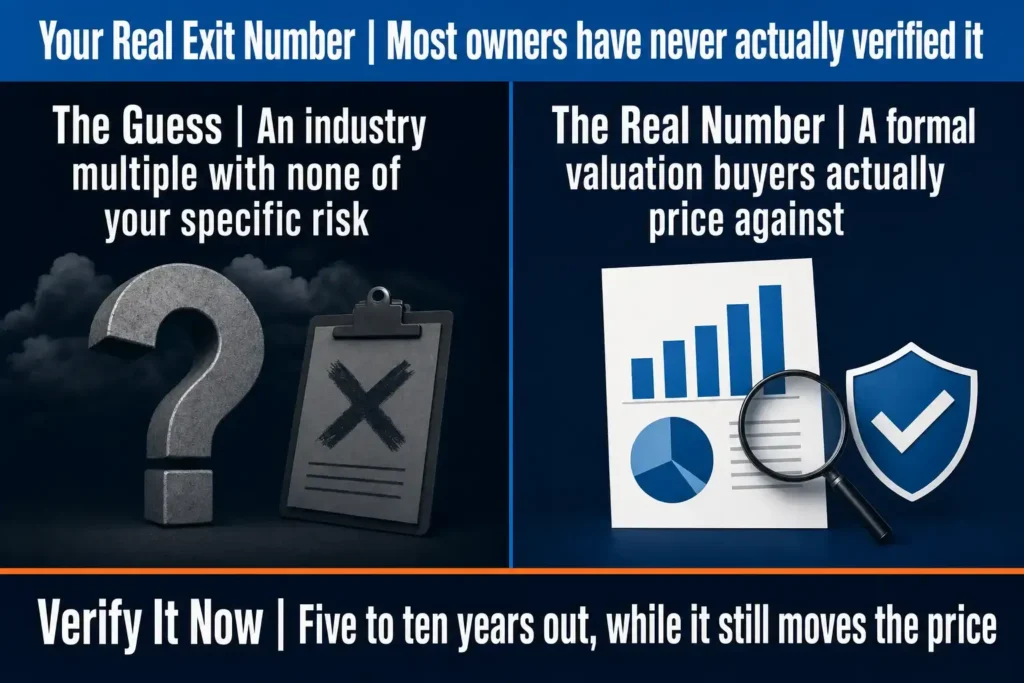
If your retirement plan assumes your business is worth what a rule of thumb business valuation says, the number is probably off by 30 to 50 percent. Most owners estimate value with a multiple of revenue or EBITDA picked up at a conference or from a competitor's sale price, and that shortcut skips the customer concentration, key-person dependency, and addback issues a real buyer prices in. The fix is a formal valuation, done five to ten years before your target exit, while there is still time to close whatever gap it reveals.
Key Takeaways
- A rule of thumb business valuation multiple can overstate or understate real value by 30 to 50 percent once a buyer prices in actual risk.
- Customer concentration and key-person dependency can each cut a formal valuation by 20 percent or more below an owner's mental number.
- Maryland retirees can exclude up to $40,600 of eligible retirement income in 2026, which shapes how sale proceeds should be drawn.
- Federal long-term capital gains on a business sale can reach 20 percent, plus the 3.8 percent Net Investment Income Tax for higher earners.
About the Author: Jeff Judge, CFP®, AEP®, ChFC®, CLU® is Managing Partner of Chesapeake Financial Planners in Forest Hill, Maryland. He has spent years helping business owners and pre-retirees across Harford County and the Baltimore metro area verify what their business is actually worth before it becomes the centerpiece of a retirement plan, using Chesapeake's signature process, the R.U.D.D.E.R. Method™. "I ask business owners a simple question in our first meeting: what's your business worth? Most give me a number without blinking, and it's almost always a guess dressed up as a fact."
Why Does a Rule of Thumb Business Valuation Get the Number Wrong?
Most owners take annual revenue or EBITDA and multiply it by whatever number is standard for their industry: two times revenue for a services firm, four times EBITDA for a manufacturer, whatever came up on a conference panel last year. That multiple gets treated like a law of physics instead of a rough industry average that ignores nearly everything specific to the business sitting in front of it. Any business valuation for sale has to survive this same scrutiny once a real buyer's team gets involved.
A specialty contracting firm owner I worked with had told his wife for a decade the business was worth $3.5 million, based on a 4x EBITDA figure from an industry newsletter. When we ran a formal valuation as part of his broader planning, the number came back closer to $2.1 million. Same revenue. Roughly the same margin. The difference was everything the newsletter multiple never accounted for: he personally held every key client relationship, his systems lived in his head instead of in a documented process, and 60 percent of his revenue came from three customers. If you want the mechanics of each valuation method side by side, we cover that in How to Value Your Business for Exit Planning.
Owners also mix up methodologies without realizing it. Seller's discretionary earnings, which adds back the owner's salary and personal perks, is the right lens for a business the owner runs day to day and plans to sell to an individual buyer. EBITDA multiples fit larger, more institutionalized businesses evaluated by private equity or a strategic acquirer. Applying an EBITDA multiple you read about a private equity deal to a business that is really an owner-operated job with good margins overstates the number every time.
What's the difference between an EBITDA multiple and seller's discretionary earnings?
Seller's discretionary earnings, or SDE, adds back the owner's salary, benefits, and personal perks to show what one owner-operator could take home, and it fits a business being sold to an individual buyer who will run it themselves. An EBITDA multiple values the business as a standalone entity without an owner in the seat, which is the right lens for a company being evaluated by private equity or a larger institutional acquirer, and applying it to an owner-operated business almost always inflates the number.
| Valuation Lens | Best Fit For | What It Tends to Miss |
|---|---|---|
| Seller's Discretionary Earnings (SDE) | Owner-operated sale to an individual buyer | Overstates value if a buyer needs to hire a replacement manager |
| EBITDA Multiple | Institutional or private equity buyer | Understates the addback an owner-run shop's numbers actually need |
| Revenue Multiple | Quick industry rule of thumb | Ignores margin, customer concentration, and owner dependency entirely |
What Makes a Formal Valuation Come In Lower Than an Owner Expects?
Buyers discount for risk, and most owner-run businesses carry more of it than the owner has had to confront. A marketing agency owner I worked with was certain her business was worth $2 million on an 8x EBITDA multiple she had seen cited in an industry report about agency mergers. What that report did not mention: those multiples applied to agencies with diversified rosters and recurring retainer revenue. Her top client made up 45 percent of billings, and half her contracts were project-based rather than retainer. A buyer looking at that risk profile was not paying 8x. The formal number came back at just under 4x, close to $950,000. A small business valuation for an owner-operated shop lives or dies on exactly these adjustments.
Three specific risk factors do most of the damage to an owner's mental number.
- Customer concentration. If losing your top two clients would gut the business, a buyer discounts the multiple regardless of how strong last year's revenue looked.
- Key-person dependency. If the business stops functioning the week you take a vacation, a buyer is pricing a job that pays well, not a transferable company, and that can cut value by 20 percent or more.
- The addback problem. Owners run personal expenses through the business, a truck, country club dues, a family member on payroll who does little. A defensible valuation strips out the addbacks a buyer's accountant will not accept, and I have watched owners lose $400,000 to $600,000 of perceived value in a single afternoon once an analyst went line by line through the schedule.
How much can customer concentration lower my business's value?
When a single client or a small handful of clients make up a large share of revenue, a buyer treats that as risk the business cannot control and prices the multiple down accordingly, sometimes by 20 percent or more on top of any other discounts. Jeff Judge has seen this single factor do more damage to a seller's expected number than any other item on the risk list, because it is also one of the few factors an owner can fix years before a sale if caught early enough.
How Does an Unverified Valuation Wreck a Retirement Plan?
If your retirement plan assumes the business funds a $4 million nest egg and the real fair market value comes in at $2.6 million, you have not lost $1.4 million on paper. You have lost the version of retirement you were planning for. That is a different zip code, a different retirement age, a different answer to whether your spouse can stop working when they wanted to. That is the exact question we work through in Can I Retire After Selling My Business?
I sat across from a couple two years ago who had built their entire retirement income projection around selling their distribution business for what they believed was $5 million. They were 58 and planning to sell at 62. When we ran the actual valuation, the number was closer to $3.2 million, mostly because gross margins had compressed over the prior three years and nobody had caught it, because revenue kept climbing while margin quietly eroded underneath it. That is a four-year runway to close a $1.8 million gap, and every year they waited to find out shrank the number of tools available to fix it.
The same math applies even without an outside sale. Owners transferring the business to a child or a management team still need a real number, because that figure drives the buy-sell agreement, the note terms, and the life insurance funding a buyout. Families stall for years on a transition because nobody can agree on a price, and the underlying reason is almost always the same: there was never an actual valuation, just competing guesses from people with different interests in the outcome.
On top of the business-value question, a sale can trigger federal long-term capital gains up to 20 percent, plus the 3.8 percent Net Investment Income Tax on top of that for higher earners, according to the IRS, which is one more reason the real number matters more than the round figure you have been carrying in your head.
This matters even more for owners in Harford County and the Baltimore metro, where I see a lot of businesses that make up the majority of a family's net worth. If you retire in Maryland, up to $40,600 of eligible pension and retirement income can be excluded from state tax in 2026, but that exclusion phases down against Social Security income, and how you time and structure the proceeds from a business sale changes how much of it you actually keep. I work with owners from Forest Hill to Bel Air to Aberdeen who assume their exit number and their Maryland tax picture are separate conversations. They are not, and getting them wrong at the same time compounds the damage. A Fit Call with our office exists specifically to put the business valuation conversation and the Maryland retirement income conversation on the same table before either one gets locked in.

What Should You Do With a Formal Valuation Once You Have It?
A valuation is not just a number for a buyer someday. It is a diagnostic. It shows exactly which levers move the price: reducing customer concentration below a threshold, documenting processes that currently live only in your head, building a management layer that can run the place without you in the building for a month. Most of those fixes take three to five years to actually move the needle, which is why business exit planning starts with the number, not the timeline.
Take the contracting firm owner from earlier. Once he saw the $2.1 million figure and understood exactly why it landed there, he had a punch list instead of a vague sense of unease. He cross-trained two project managers so the business did not stop when he was out. He diversified his customer base over three years so no single client crossed 20 percent of revenue. He documented the estimating process that used to live entirely in his head. When he sold four years later, the business went for $3.4 million, not because the market got kinder, but because the specific risks a buyer had priced against were largely gone.
This is also where coordination matters more than people expect. Your CPA sees the tax return. Your estate attorney sees the will. Your financial planner sees the investment accounts. None of them, working alone, sees the business as an asset that has to convert into retirement income on a specific calendar. Chesapeake Financial Planners runs every plan through the R.U.D.D.E.R. Method™, Chesapeake's six-step planning process: Review and Recognize, Uncover and Understand, Design and Develop, Discuss and Decide, Execute and Empower, and Reassess and Refine, and a verified valuation is one of the first hard numbers we plug into the Uncover and Understand step for a business owner.
The most common excuse I hear is cost, followed by fear of a bad number. A formal valuation for a business this size typically runs a few thousand dollars. Compare that to a $1.4 million or $1.8 million gap discovered at the closing table, and the math is not close.
When should a business owner actually get a valuation done?
The window that changes outcomes is five to ten years before your target exit, not the year you decide to sell, because by then most of the value-building work is off the table. Jeff Judge tells clients to redo the number every two to three years after that first formal valuation, since the figure moves as the business, the industry, and the broader M&A market move, and a valuation from several years ago tells you almost nothing useful about what the business is worth today.
Frequently Asked Questions
What is a rule of thumb business valuation?
A rule of thumb business valuation is an estimate built from a generic industry multiple, such as two times revenue or four times EBITDA, applied to a business without adjusting for its specific risk factors. It ignores customer concentration, key-person dependency, and the addbacks a real buyer's accountant will scrutinize, which is why the number it produces is often 30 to 50 percent away from what a formal valuation shows.
How often should I get my business revalued before I sell?
Get a formal valuation five to ten years before your target exit, then redo it every two to three years after that. The number moves as your revenue, margins, industry multiples, and the broader M&A market shift, so a valuation from several years ago tells you very little about what your business is worth today.
Is a business valuation different when I'm selling to a family member instead of an outside buyer?
Yes, but you still need a real number either way. A sale to a child or a management team still uses the valuation to set the buy-sell agreement terms, the note structure, and the life insurance that funds the buyout, and family transitions often stall for years when everyone is working from a different guess instead of one verified figure.
What's the difference between seller's discretionary earnings and an EBITDA multiple?
Seller's discretionary earnings adds back the owner's salary and perks to show what one owner-operator could take home, which fits a sale to an individual buyer who plans to run the business personally. An EBITDA multiple values the business as a standalone entity and fits a sale to private equity or a larger institutional acquirer, so applying the wrong one to your business type usually inflates the number you have in your head.
How much does a formal business valuation cost?
A formal valuation for a business this size typically runs a few thousand dollars, paid once every two to three years. Compare that against the $400,000 to $1.8 million gaps we regularly see owners discover at the closing table when they have never had a real number, and the cost of finding out early is not a close call.
Does a business valuation matter if I'm not planning to sell anytime soon?
Yes, because the business is likely the largest asset on your personal balance sheet, and your retirement income plan needs an accurate number for it the same way it needs an accurate portfolio balance. Owners five to ten years from a target exit still have time to act on what the valuation reveals, which is exactly the group for whom the number matters most.
Ready to Find Out What Your Business Is Actually Worth?
Ready to put a plan around what your business exit actually pays you in retirement? Jeff Judge and the Chesapeake Financial Planners team serve business owners and families across Harford County and the Baltimore metro, including Forest Hill, Bel Air, and Aberdeen. Schedule a free fit call at chesapeakefp.com to get a verified starting number before you build a retirement plan around a rule of thumb business valuation guess.
A version of this article was originally published on Jeff Judge's LinkedIn.
Disclosures
The information provided is for educational purposes only and should not be construed as investment advice. Investment strategies should be tailored to individual circumstances, risk tolerance, and goals. Past performance doesn't guarantee future results. Consult with qualified financial professionals regarding your specific situation.
Advisors associated with Chesapeake Financial Planners may be either (1) LPL Financial Registered Representatives offering securities through LPL Financial, Member FINRA and SIPC, and investment advisor representatives offering investment advice through Great Valley Advisor Group; or (2) solely investment advisor representatives offering investment advice through Great Valley Advisor Group and not affiliated with LPL Financial. Great Valley Advisor Group, and Chesapeake Financial Planners are separate entities from LPL Financial.
Chesapeake Financial Planners | 2402 Scotlon Ct, Forest Hill, MD 21050 | (410) 652-7868 | www.chesapeakefp.com
© 2026 Chesapeake Financial Planners | Not to be reproduced in whole or in part. All rights reserved.


