

How Do I Know What My Business Is Worth Before Selling?
Last reviewed: July 2026
To know what your business is worth before selling, get a defensible valuation built on your normalized earnings (usually EBITDA), then apply a market-supported multiple adjusted for your size, growth, risk, and how dependent the business is on you. The number a buyer pays reflects future cash flow they can count on, not the hours you put in or what you need for retirement. Most owners are off by a wide margin until they run the math the way a buyer will.
Key Takeaways
- Your business is worth what a rational buyer will pay for transferable future cash flow, not your effort or sunk investment.
- Most valuations start with normalized EBITDA, then apply a multiple shaped by size, growth, and owner dependence.
- The IRS taxes the sale of a business as a collection of assets, not a single item, which directly affects your net proceeds.
- Reducing owner dependence and customer concentration can move your multiple more than another year of growth.
About the Author: Jeff Judge, CFP®, AEP®, ChFC®, CLU® is Managing Partner of Chesapeake Financial Planners in Forest Hill, Maryland. He has been helping families and business owners in Harford County and the Baltimore metro area navigate business valuation and exit planning since earning his CFP® certification in 2013, by using Chesapeake Financial Planners’ signature process, the R.U.D.D.E.R. method™. Jeff's observation after years of these conversations: the owners who get the highest multiples are usually the ones who started preparing the business to run without them three to five years before they ever planned to sell.
Most business owners run on gut instinct about what their company is worth. Then a buyer's offer arrives, and the number is nothing like the one in their head. That gap can delay retirement, spark family conflict, or force a few more years behind the desk. Business valuation for exit planning closes that gap before it costs you. Here's how to get a real number, step by step.
How Do You Start Valuing a Business for Exit Planning?
Start by separating the business from yourself on paper. A buyer is not paying for your salary, your industry reputation, or the personal expenses that run through the company. They're paying for cash flow that keeps coming after you're gone.
The first move is normalizing your earnings. That means adding back owner compensation above market rate, one-time expenses, and personal costs, then subtracting a fair-market salary for whoever runs the business next. This produces "seller's discretionary earnings" or normalized EBITDA, the figure every serious buyer works from.
Jeff Judge often tells owners the same thing in the first meeting: "Your add-backs are where deals are won or lost. If you can't document them, a buyer won't pay for them." Clean books make the whole number credible.
How much is my business actually worth if I want to sell?
What Are the Three Main Business Valuation Methods?
Professional valuators use three approaches, then weight them based on your business type. Each one answers a slightly different question, and an operating business is usually worth the highest of the three.
| Method | What it measures | Best for |
|---|---|---|
| Asset-based | What the business owns minus what it owes | Holding companies, real estate, liquidations |
| Market-based | What comparable businesses recently sold for | Professional services, retail, franchises |
| Income-based | Present value of future cash flow | Established operating businesses |
Asset-based valuation tallies equipment, inventory, real estate, intellectual property, and receivables, then subtracts liabilities. It usually sets the floor, because most operating businesses are worth more than their hard assets thanks to goodwill and customer relationships.
Market-based valuation looks at comparable sales. It works when real comps exist, but finding truly similar deals is harder than it sounds. Size, geography, and growth rate all break comparability fast.
Income-based valuation calculates the present value of expected future cash flow. It's the most defensible method for a business buyers want to keep running. The catch: it depends on assumptions about growth, margins, and risk, and every one of those is negotiable.
How Do EBITDA Multiples Actually Work?
When owners ask "what's my business worth," they're usually picturing an EBITDA multiple. EBITDA, your earnings before interest, taxes, depreciation, and amortization, stands in for core operating profit. A buyer applies a multiple to it based on your size, growth, and risk.
General market ranges look roughly like this, though they shift with credit conditions and your industry:
- 2x to 3x for small businesses under roughly $1 million of EBITDA.
- 4x to 6x for mid-sized businesses between $1 million and $5 million of EBITDA.
- 6x to 10x for larger businesses over $5 million of EBITDA or high-growth companies.
- 10x and up for businesses with recurring revenue, low owner dependence, and durable growth.
Treat these as starting points, not promises. Two businesses with identical EBITDA can sell for very different prices because of what sits underneath the number.
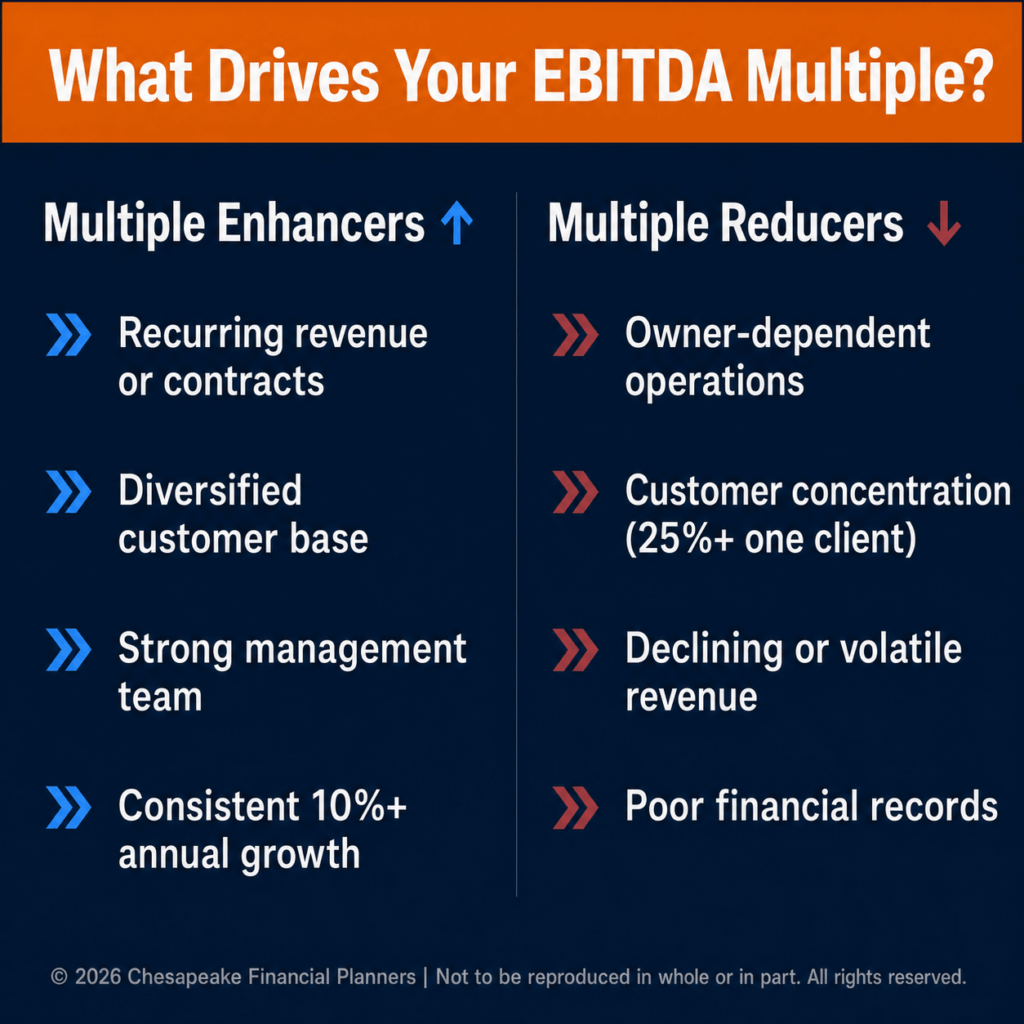
What pushes a multiple up: recurring revenue, a diversified customer base with no client over 10% of sales, a management team that stays after closing, proprietary products or processes, and consistent profit growth.
What pulls it down: owner-dependent operations, customer concentration where one client is 25% or more of revenue, and declining or volatile earnings.
Jeff has watched two clients in the same trade get offers a full point apart on the multiple. The difference was not revenue. One owner had spent four years building a team that could run the place without him, and the buyer paid for it.
What Do Business Owners Most Often Forget to Plan Before Exiting?

How Do Taxes Affect What You Actually Keep From a Sale?
Your valuation is the headline number. Your after-tax proceeds are what fund the rest of your life, and they can differ sharply.
The IRS treats the sale of a business as the sale of individual assets, not one lump transaction. According to IRS guidance, each asset class, from inventory to goodwill to equipment, can be taxed differently, which is why how the deal is structured matters as much as the price. Long-term capital gains on the sale of a business held more than a year are taxed at preferential rates, while certain recaptured depreciation is taxed as ordinary income.
The U.S. Small Business Administration recommends valuing and preparing the business well before you intend to sell, precisely so you have time to structure the transaction efficiently. A purchase-price allocation that favors capital-gains treatment over ordinary income can change your net result by six figures on a mid-sized deal.
This is where valuation stops being an accounting exercise and becomes financial planning. The R.U.D.D.E.R. Method™ is Chesapeake Financial Planners' six-step planning process: Review and Recognize, Uncover and Understand, Design and Develop, Discuss and Decide, Execute and Empower, and Reassess and Refine. We apply it to exit planning so the valuation, the tax structure, and your retirement income plan all point in the same direction.
How do I invest the proceeds from selling my business?
Can I retire after selling my business for $2-5 million?
Frequently Asked Questions
How much does a business valuation cost?
A formal business valuation from a credentialed appraiser typically ranges from a few thousand dollars for a small company to well into five figures for a complex one. A lighter "calculation of value" costs less than a full conclusion-of-value report. The right level depends on whether you need it for a sale, a divorce, estate planning, or your own planning.
When should I value my business before selling?
Value your business at least three to five years before you plan to sell. The SBA advises early preparation so you have time to fix what lowers your multiple, like owner dependence and customer concentration. An early valuation is a baseline, not a final price, and it tells you exactly where to focus.
What is the difference between EBITDA and net profit?
EBITDA adds interest, taxes, depreciation, and amortization back to net profit to show core operating performance independent of financing and accounting choices. Net profit is what remains after every expense. Buyers favor EBITDA because it strips out items tied to the current owner's tax and debt structure, making businesses easier to compare across deals.
Can I value my own business without an appraiser?
You can estimate value yourself using normalized EBITDA and an industry multiple, and that estimate is useful for early planning. But a self-estimate rarely holds up in a real negotiation, a divorce, or an IRS review. For a transaction or estate filing, a credentialed appraiser's report carries the documentation and defensibility a do-it-yourself number cannot.
Does customer concentration really lower my valuation?
Yes. When one customer represents 25% or more of revenue, buyers see real risk that losing that account guts the cash flow they're paying for. That risk shows up directly as a lower multiple or a larger portion of the price held back in an earnout. Diversifying your revenue base is one of the most reliable ways to protect value before a sale.
Get the Number Right Before It Matters
A valuation you run early is a planning tool. A valuation you run when a buyer is already at the table is a reaction. Business valuation for exit planning works best when you have years, not weeks, to improve the number. If you want a clearer picture of what your business could be worth and what would move that figure, our guide to preparing a business for sale walks through the full process. Download it at chesapeakefp.com.
Disclosures
The information provided is for educational purposes only and should not be construed as investment advice. Investment strategies should be tailored to individual circumstances, risk tolerance, and goals. Past performance doesn't guarantee future results. Consult with qualified financial professionals regarding your specific situation.
Advisors associated with Chesapeake Financial Planners may be either (1) LPL Financial Registered Representatives offering securities through LPL Financial, Member FINRA and SIPC, and investment advisor representatives offering investment advice through Great Valley Advisor Group; or (2) solely investment advisor representatives offering investment advice through Great Valley Advisor Group and not affiliated with LPL Financial. Great Valley Advisor Group, and Chesapeake Financial Planners are separate entities from LPL Financial.


