

What is the best retirement income planning strategy?
Last reviewed: July 2026
Retirement income planning is the discipline of turning your savings into reliable, tax-efficient cash flow that lasts as long as you do. The best plans start five to ten years before you stop working, not after. They coordinate Social Security timing, withdrawal sequencing across account types, healthcare cost planning, and tax bracket management into a single decision framework.
On This Page
- Key Takeaways
- What is retirement income planning?
- How much retirement income do you actually need?
- What are the main sources of retirement income?
- How should you sequence withdrawals across retirement accounts?
- When should you claim Social Security in retirement income planning?
- What withdrawal strategies actually hold up in real retirements?
- What are the biggest risks to a retirement income plan?
- Frequently Asked Questions
- Ready to put a plan around your retirement income?
- Disclosures
Key Takeaways
- The 4% rule is a useful planning baseline, but it can break under poor early-retirement returns or a longer-than-average lifespan.
- The 2026 Social Security COLA is 2.8%, lifting the average retired-worker benefit to $2,071 per month.
- Withdrawal sequencing matters as much as portfolio construction; the wrong order can cost a six-figure household more than $200,000 in lifetime taxes.
- Required minimum distributions begin at age 73 for most pre-retirees today, opening a planning window many households waste.
- Medicare IRMAA surcharges turn one high-income year into permanently higher premiums; income smoothing protects you.
About the Author: Jeff Judge, CFP®, AEP®, ChFC®, CLU® is Managing Partner of Chesapeake Financial Planners in Forest Hill, Maryland. He has been helping families and business owners in Harford County and the Baltimore metro area build durable retirement income plans since earning his CFP® certification in 2013, by using Chesapeake Financial Planners’ signature process, the R.U.D.D.E.R. method™. Jeff's view: the biggest retirement risks are not the ones the financial press writes about, and the planning window most pre-retirees waste is the five-year stretch right before they stop working.
What is retirement income planning?
Retirement income planning, sometimes called retirement cash flow planning, is the discipline of converting accumulated savings into a steady stream of after-tax cash flow that supports your spending across a retirement that may last 25 to 35 years. Where accumulation planning focuses on growing one number (the balance), income planning manages four moving targets at once: how much you draw, where you draw it from, when you turn on Social Security, and how each choice affects your tax bracket and Medicare premiums.
The 2026 numbers show the stakes. Pre-retirees nearing 65 face a standard Medicare Part B premium of $202.90 per month and a Part B deductible of $283 before any supplemental coverage. Layer on Part D, Medigap, or Medicare Advantage premiums, and a couple's healthcare baseline often runs $9,000 to $13,000 a year before a single claim. That cost isn't a footnote in a retirement income plan; it's one of the larger line items.
Why does retirement income planning differ from accumulation planning?
Accumulation is a one-equation problem: contribute, invest, repeat. Income planning is a coordination problem. Sell taxable investments and you may owe capital gains. Sell from a traditional IRA and you raise your ordinary income, which can lift your tax bracket, increase the share of Social Security that gets taxed, and push you over an IRMAA threshold for the next two years. The optimization runs across years, not within them.
What is sequence of returns risk, and why do the first years of retirement matter most?
How much retirement income do you actually need?
The honest answer is "enough to fund the life you actually plan to live, with a buffer." The standard 70-to-80-percent income replacement rule is a useful gut check for a household that plans to keep its current lifestyle, paid down debt before retiring, and built up a real cash reserve. It's not predictive for anyone with above-average healthcare expenses, a working spouse who plans to retire later, a paid-off house in a low-tax state, or a meaningful pension.
A more useful approach is bottom-up: build a month-by-month budget for the first three years of retirement, distinguish core expenses (housing, food, utilities, healthcare, taxes, insurance) from discretionary ones (travel, gifts, hobbies), and then test the budget against your projected income from Social Security, pensions, and a 3.5%-to-4% draw from your portfolio. If the math works, you have a plan. If it doesn't, you have a decision: trim, save more, work longer, or relocate.
Is the 80% replacement ratio rule still useful?
Yes as a starting point, no as an answer. Jeff Judge has seen households retire happily on 55% of their working income because they paid off their mortgage and downsized, and others struggle on 95% because their first three years included a kitchen remodel, two weddings, and a Medigap shock. The rule is a sanity check on whether your savings rate has been adequate, not a target to defend.
A second figure to anchor the conversation: the 2026 Social Security taxable wage base is $184,500. For high earners, that ceiling caps the Social Security benefit at a level that almost never covers desired retirement income alone, which is why the portfolio side of the plan does more work for them.
What are the main sources of retirement income?
A typical pre-retiree's income plan pulls from five places: Social Security, employer retirement plans, IRAs, taxable brokerage accounts, and any pension or annuity income. Each behaves differently in the tax code, and each interacts with the others in ways that matter.
Social Security is the floor. The 2026 average retired-worker benefit is $2,071 per month after the 2.8% COLA, but the gap between a benefit claimed at 62 and one delayed to 70 can exceed $1,300 per month per person. For a married couple, that timing choice often moves more money over a lifetime than any portfolio decision.
Employer plans (401(k), 403(b), 457, TSP) and traditional IRAs are tax-deferred buckets. Every dollar withdrawn is taxed as ordinary income. The 2026 401(k) employee contribution limit is $24,500, and the 2026 IRA limit is $7,500; for many pre-retirees, the last few years before retirement are the highest-saving years they'll ever have.
Roth IRAs and Roth 401(k)s are tax-free at qualified withdrawal. They don't interact with Medicare IRMAA, don't add to provisional income for Social Security taxation, and don't require distributions during the original owner's lifetime. They're the most flexible bucket in retirement, and they're usually underfunded.
Taxable brokerage accounts are the underrated middle. Long-term capital gains and qualified dividends are taxed at lower rates than ordinary income. A taxable account also gives heirs a stepped-up cost basis at death, which is a meaningful estate planning lever your IRA does not offer.
Pensions and annuities are the floor-providers when they exist. A pension fixed at a 1990s rate looks small today; a pension with a cost-of-living adjustment looks better every year. Annuities are a separate decision and deserve a separate conversation; they trade liquidity for income certainty, and that trade only sometimes wins the math.
How do pensions, annuities, and Social Security fit together?
Treat them as the layer that meets your essential expenses. If insurer-backed or government-backed income covers core costs, the portfolio can be invested for growth and used for discretionary spending. If it doesn't, the portfolio has to do more work, which means more sensitivity to market timing.
Should I do Roth conversions during the gap years before RMDs?
How should you sequence withdrawals across retirement accounts?
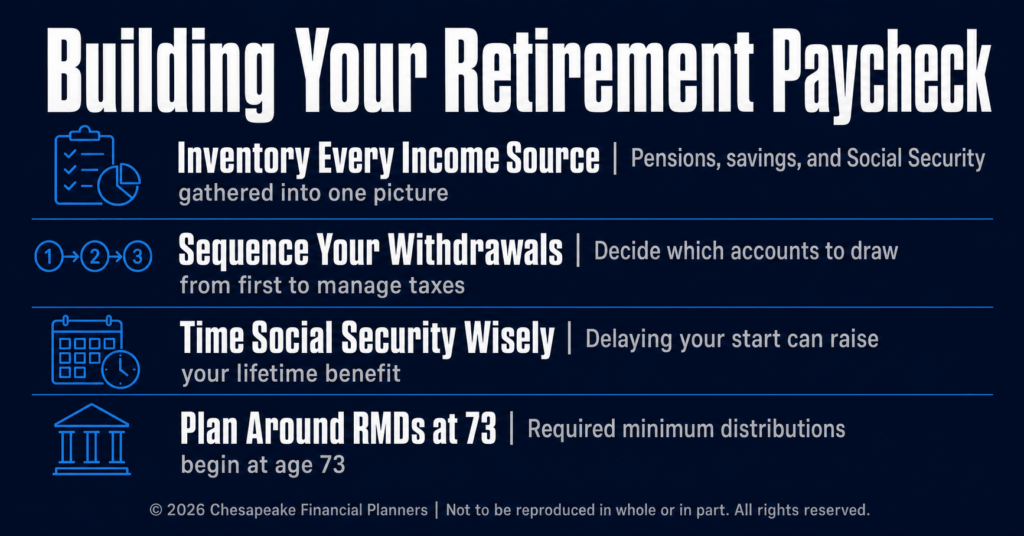
Withdrawal sequencing is the question of which account to draw from first, and it's where most retirement income strategies either earn or lose tens of thousands of dollars without anyone noticing. The conventional sequence, taxable accounts first, then tax-deferred, then Roth last, is a defensible default for many households. It defers the tax bill, lets Roth assets keep compounding tax-free for as long as possible, and avoids early withdrawal penalties.
But the default is wrong, or at least incomplete, for a meaningful share of pre-retirees. The window between retirement (often 60 to 65) and the RMD age of 73 is the lowest-tax-bracket stretch most clients will ever have. Drawing only from a taxable account during that window means leaving the 12% and 22% tax brackets unused, which sets up a much larger RMD problem at 73 and beyond, when Social Security has started and tax-deferred balances have kept growing.
The better question is: how do we fill the lower brackets every year, deliberately, until age 73 forces a different conversation?
What is the standard tax-efficient withdrawal order?
| Strategy | When it fits | Trade-off |
|---|---|---|
| Taxable first, tax-deferred next, Roth last | Households with smaller tax-deferred balances or with pensions that already use lower brackets | Largest after-tax balance early; risks bracket-creep at 73 from a swollen IRA |
| Proportional withdrawals across account types | Households balancing simplicity with tax smoothing | Less optimization in lower-bracket years; easier to administer |
| Bracket-filling Roth conversions in the gap years | Households with significant tax-deferred balances and low ordinary income between retirement and 73 | Higher tax bill today in exchange for lower lifetime tax and smaller RMDs |
| Roth-first when feasible | High-income retirees in the top brackets who expect future brackets to stay there or rise | Forfeits compounding in the most flexible bucket; rarely the right choice for most |
Most clients should think of the answer as bracket management, not a fixed order. Each year, look at projected taxable income from Social Security and forced distributions, then decide how much room remains in the 12%, 22%, and 24% brackets, and fill it with the most tax-efficient combination available, often a partial Roth conversion plus a small traditional withdrawal.
This is where coordination matters. Convert too much in one year and you pay a higher marginal rate plus a two-year IRMAA surcharge. Convert too little and you waste a $20,000 chunk of low-bracket capacity that does not come back. Jeff Judge notes: "In practice, the clients who get this right map their bracket ceiling each year, confirm whether a conversion keeps them below the IRMAA threshold, and move exactly that amount so they never waste low-bracket capacity or trigger a two-year surcharge."
When should you claim Social Security in retirement income planning?
The Social Security claiming decision is the single biggest lever in retirement income planning for most households, and it's one of the few decisions that's genuinely irreversible after the 12-month withdrawal window. The rule of thumb most clients have heard, "claim early because you might die first," misses the structure of the benefit. Social Security isn't only retirement income; it's longevity insurance and survivor income for a spouse.
Delaying from age 62 to 70 increases the monthly benefit by roughly 76% before COLAs. With the 2026 COLA of 2.8% compounding on the higher base, the delayed benefit pulls further ahead each year. For a married couple, claiming the higher earner's benefit at 70 also locks in a larger survivor benefit, which protects the spouse who lives longest.
The case to claim earlier is real but specific: poor health that meaningfully shortens life expectancy, a working spouse with a high benefit already in place, or a genuine need for the income to bridge to another resource. Most other "claim early" reasoning collapses under stress testing.
Does it ever make sense to claim Social Security before age 70?
Yes, but rarely as a default. The most defensible reasons are coordinated benefit strategies between spouses with very different earning records, a household that can build sustainable retirement income from the portfolio without straining it during the bridge years, or a known shortened life expectancy. Outside of those cases, most retirees benefit from treating the years between retirement and 70 as the prime window for Roth conversions and bracket management, while the delayed Social Security benefit grows in the background.
How should married couples coordinate Social Security claiming?

What withdrawal strategies actually hold up in real retirements?
Four named approaches dominate the academic literature and the practice. They aren't mutually exclusive; most retirees end up with a hybrid.
| Strategy | How it works | Where it shines | Where it breaks |
|---|---|---|---|
| 4% Rule (Bengen) | Withdraw 4% of starting balance in year one; adjust for inflation each year thereafter | Easy to communicate; survived historical 30-year horizons | Inflexible; can leave huge balances or run dry in bad sequences |
| Dynamic withdrawals / guardrails | Set a target spend with upper and lower guardrails; cut spending when the portfolio falls and raise it when it grows | Adjusts to real markets; supports better sustainable spending in many scenarios | Requires discipline; some years require real lifestyle cuts |
| Bucket strategy | Hold one to two years of spending in cash, three to five in bonds, the rest in growth assets; refill from the back | Psychologically durable; lowers sequence-of-returns risk | Adds complexity; requires periodic rebalancing decisions |
| Floor-and-upside | Use Social Security plus a small annuity or bond ladder to cover essentials; invest the rest for growth | Income certainty for core spending; behavioral resilience in market crashes | Requires giving up some liquidity; not the right fit for everyone |
Jeff Judge tells most pre-retirees the strategy matters less than the discipline. A 3.5% guardrails plan executed every year beats a perfect spreadsheet that gets abandoned the first time the market drops 25%. The R.U.D.D.E.R. Method™ is Chesapeake Financial Planners' six-step planning process: Review and Recognize, Uncover and Understand, Design and Develop, Discuss and Decide, Execute and Empower, and Reassess and Refine. The point of the framework is that "Reassess and Refine" is a step every year, not an emergency response.
Which strategy is best for someone with a $1-2 million portfolio?
A guardrails or bucket approach usually fits. The portfolio is large enough that small percentage cuts in a bad year cover the lifestyle adjustment, and big enough that a fixed 4% draw in a bad sequence may leave money on the table. The right blend depends on whether Social Security and any pensions cover essential expenses; if they do, you can take more equity risk in the portfolio and worry less about a fixed withdrawal floor.
What is the bucket strategy for retirement income?
What are the biggest risks to a retirement income plan?
Five risks dominate every plan we build, and four of them aren't the one most retirees are watching.
The market drop is the obvious risk and the one media spends the most time on. It matters most early in retirement, when withdrawals from a falling portfolio lock in losses; this is sequence-of-returns risk, and it can permanently reduce sustainable income even when the market eventually recovers.
Longevity risk is bigger. A 65-year-old non-smoking couple has roughly a 50% chance one spouse lives past 90. Planning to 85 is optimistic; planning to 95 is honest. Every additional year of life is an additional year of expenses and an additional decade of inflation working against you.
Inflation risk is structurally different from market risk. Even a 3% average inflation rate cuts purchasing power in half over 24 years. Fixed pensions and immediate annuities without COLAs become smaller in real terms every year of retirement. The portfolio side has to compensate.
Healthcare risk and the related Medicare IRMAA risk are the underrated ones. A single year of high income (a large Roth conversion, a business sale, an RMD plus a one-time withdrawal) raises Medicare premiums for two years. Plan badly and you can pay $2,000 to $5,000 more per couple per year in surcharges that did not need to happen.
The fifth risk is behavioral: making the wrong call in a panic. The 2008 retirees who sold equities at the bottom and never returned are mostly worse off than the ones who held. A plan that survives a real downturn is the only one that matters; the rest is theory.
How do you stress-test a retirement income plan?
Run it under four scenarios: a 30% market drop in year one, an inflation spike of 5%-plus for three years, an unexpected long-term care episode at age 80, and the death of either spouse at age 75. If the plan survives all four with the lifestyle adjustments you would actually accept, it's a real plan. If any one of them requires selling the house, working again, or relying on adult children, it's a draft.
In Jeff's practice, the most common gap is not investment selection. It's the household that hit age 60 with $1.6 million and never sat down to model what the same dollars look like spent across 25 years across five different account types under different tax laws. The accumulation work was done; the income planning work wasn't.
What are the rules and strategies for required minimum distributions?

Frequently Asked Questions
What is the 4% rule in retirement income planning?
The 4% rule is a planning baseline that says you can withdraw 4% of your starting portfolio in year one of retirement and adjust that dollar amount for inflation each subsequent year, with a reasonable chance of not running out of money across a 30-year retirement. It was developed by William Bengen in 1994 using historical market returns. The rule is a starting point, not a ceiling and not a floor; real plans use dynamic guardrails that adjust spending up or down based on actual portfolio performance.
How much money do I need to retire?
Most pre-retirees need 25 to 30 times their target first-year retirement spending in invested assets, in addition to expected Social Security and pension income. For a household planning $80,000 a year in portfolio-funded spending, that means roughly $2 million to $2.4 million in invested savings, paired with whatever Social Security and pensions will cover. The number depends on retirement age, expected spending pattern, tax location of the assets, and whether either spouse plans to keep working part-time.
Should I delay Social Security until age 70?
Yes for most healthy single retirees and for the higher earner in many married couples, because delaying from 62 to 70 raises the monthly benefit by roughly 76% before COLAs and locks in a larger survivor benefit for a married couple. The exceptions are clients with a meaningfully shortened life expectancy, those with no other income source during the bridge years, or a lower-earning spouse coordinating with a higher-earning spouse already claiming. The decision is one of the largest lifetime levers in retirement income planning.
What is the safest way to draw down retirement accounts?
There's no single safest order; the better answer is to manage by tax bracket each year, drawing from the combination of accounts that fills lower brackets without spilling into higher ones or triggering Medicare IRMAA. For many pre-retirees, this means small withdrawals from a traditional IRA plus Roth conversions during the years between retirement and age 73, while taxable accounts cover most actual spending. The aim is to flatten lifetime taxes, not minimize this year's bill.
How do I avoid the Medicare IRMAA surcharge in retirement?
Manage modified adjusted gross income across years rather than within one year. IRMAA brackets create cliffs: one dollar of MAGI over a threshold triggers a surcharge that lasts two years, so a large one-time Roth conversion or capital gain can cost a couple over $2,000 in extra premiums. Spread Roth conversions across multiple years, harvest losses to offset gains, and time big distributions around the two-year IRMAA lookback to avoid the surprise.
What if my portfolio drops 25% in the first year of retirement?
A 25% drop in year one is the worst sequence-of-returns scenario, and the response should be temporary: reduce discretionary spending using the guardrails framework, pause Roth conversions for the year, and avoid selling equities to fund lifestyle if the bond and cash buckets cover one to three years of spending. Retirees who pre-built the bucket framework before retirement handle this without behavioral damage; those who did not often sell at the bottom and lose recovery upside.
Do I need to take RMDs from my Roth IRA?
No, not from a Roth IRA you own during your lifetime; Roth IRAs are the one major retirement account that doesn't require distributions for the original owner. This is one of the reasons Roth assets are so valuable in retirement income planning: they let you control the timing of every dollar, which protects you from the IRMAA cliff, the Social Security taxation spike, and the bracket creep that forced distributions from traditional accounts cause starting at age 73.
Ready to put a plan around your retirement income?
Retirement income planning is one of the few decisions where what you do in the five years before you retire matters more than anything you do after. Jeff Judge and the Chesapeake Financial Planners team work with pre-retirees, business owners, and families across Harford County and the Baltimore metro on coordinated retirement income strategies, sequencing decisions, Social Security timing, and Medicare IRMAA management. Schedule a no-obligation fit call at chesapeakefp.com.
Want to go deeper? Our Retirement Income Blueprint Workbook walks through this step by step.
This material is for educational purposes only and should not be considered tax or legal advice. Please consult with your tax advisor or attorney regarding your specific situation.
The opinions voiced in this material are for general information only and are not intended to provide specific advice or recommendations for any individual.
All investing involves risk including loss of principal. No strategy assures success or protects against loss.
There is no guarantee that a diversified portfolio will enhance overall returns or outperform a non-diversified portfolio. Diversification does not protect against market risk.
Contributions to a traditional IRA may be tax deductible in the contribution year, with current income tax due at withdrawal. Withdrawals prior to age 59½ may result in a 10% IRS penalty tax in addition to current income tax.
Traditional IRA account owners have considerations to make before performing a Roth IRA conversion. These primarily include income tax consequences on the converted amount in the year of conversion, withdrawal limitations from a Roth IRA, and income limitations for future contributions to a Roth IRA. In addition, if you are required to take a required minimum distribution (RMD) in the year you convert, you must do so before converting to a Roth IRA.
Disclosures
The information provided is for educational purposes only and should not be construed as investment advice. Investment strategies should be tailored to individual circumstances, risk tolerance, and goals. Past performance doesn't guarantee future results. Consult with qualified financial professionals regarding your specific situation.
This information is not intended to be a substitute for specific individualized tax, investment or legal advice. We suggest that you discuss your specific situation with a qualified tax, legal or financial advisor.
Advisors associated with Chesapeake Financial Planners may be either (1) LPL Financial Registered Representatives offering securities through LPL Financial, Member FINRA and SIPC, and investment advisor representatives offering investment advice through Great Valley Advisor Group; or (2) solely investment advisor representatives offering investment advice through Great Valley Advisor Group and not affiliated with LPL Financial. Great Valley Advisor Group, and Chesapeake Financial Planners are separate entities from LPL Financial.


