

What is sequence of returns risk, and why do the first years of retirement matter most?
Last reviewed: July 2026
Sequence of returns risk is the danger that poor investment returns in the first few years of retirement permanently shrink a portfolio that has to last another 25 to 35 years. Two retirees with the same average return over 30 years can end up in very different places: one solvent at 90, the other out of money at 75, based only on when the losses arrived. The first five years matter most because withdrawing during a down market locks in losses that compounding cannot fully recover later.
On This Page
- Key Takeaways
- What Is Sequence of Returns Risk?
- Why Do the First Five Years of Retirement Matter Most?
- How Do You Reduce Sequence of Returns Risk Before You Retire?
- What Does Sequence Risk Look Like in Real Numbers?
- Related Topics Worth Reading
- Frequently Asked Questions
- Disclosures
Key Takeaways
- Sequence of returns risk strikes hardest in the first five years of retirement, when withdrawals from a down portfolio lock in permanent losses.
- Two retirees with identical average returns can finish with very different balances based only on the order in which gains and losses arrive.
- A bucket strategy or written guardrails soften sequence risk by funding spending from cash or bonds during a downturn instead of equities.
- Delaying Social Security past full retirement age raises monthly benefits by 8% per year, locking in a larger income floor for life.
- The 2026 IRS 401(k) limit of $24,500 plus an $8,000 catch-up at age 50 gives pre-retirees a final lever before sequence risk begins.
About the Author: Jeff Judge, CFP®, AEP®, ChFC®, CLU® is Managing Partner of Chesapeake Financial Planners in Forest Hill, Maryland. He has been helping families and business owners in Harford County and the Baltimore metro area work through retirement income decisions since earning his CFP® certification in 2013, by using Chesapeake Financial Planners’ signature process, the R.U.D.D.E.R. method™. Jeff often tells new retirees that the biggest mistake is treating the portfolio like a single bucket, when the math actually depends on which dollar gets withdrawn first.
What Is Sequence of Returns Risk?
Sequence of returns risk is the technical name for an old, painful truth: when you are withdrawing money from a portfolio, the order of your returns matters as much as the size of them. The same 7% average return over 30 years can produce wildly different outcomes depending on whether a minus-20% year arrives in retirement year three or retirement year twenty-eight. While you are still saving, sequence does not matter; the math is symmetric. The moment you start drawing income, the math changes shape entirely.
Here is the mechanism. If your portfolio drops 25% in year one of retirement and you sell shares to fund living expenses, you are selling more shares than you would have at a higher price. Those shares are gone. When the market rebounds the next year by 25%, the recovery happens on fewer shares, not the original number. The portfolio never fully catches up to the path it would have taken without that early withdrawal. Compounding works against you in those first years in a way it never did during accumulation.
Most retirees discover this only after the fact. They look at planning software that shows an average return assumption, and they assume that average will protect them. It will not. Two retirees with identical 5.5% average returns over 30 years can end up with completely different ending balances based on whether the bad years arrived in their 60s or their 80s. This is why retirement timing risk is sometimes more dangerous than market risk itself.
Why Do the First Five Years of Retirement Matter Most?
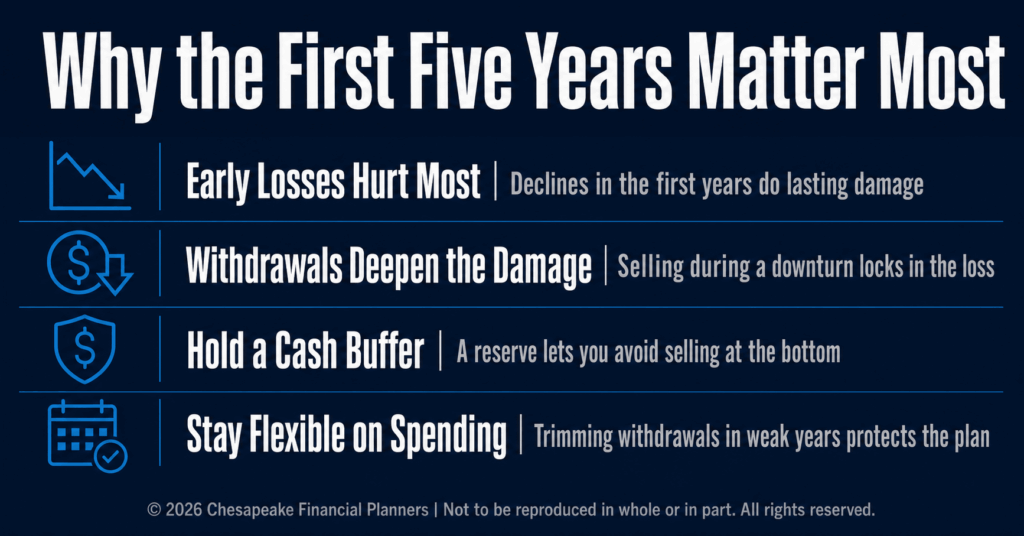
The first five years of retirement carry a disproportionate amount of weight in any plan because withdrawing from a down portfolio compounds losses in a way the rest of the timeline cannot easily fix. Researchers sometimes call this stretch the "retirement red zone," the five years on either side of your stop-working date. A poor sequence during this window can take 30% to 50% off your portfolio's terminal value even if the average return over the full retirement is normal. The same poor sequence in retirement years 25 through 30 has almost no effect, because the portfolio is much smaller by then and the withdrawal rate is a smaller fraction of remaining life expectancy.
This is why Jeff Judge often tells pre-retirees that the years right before and right after they stop working deserve more planning attention than the next twenty combined. Adjustments made in those years, things like building a cash reserve, delaying a withdrawal by twelve months, or pausing a Roth conversion during a down market, have a permanence to them that later adjustments do not. The retirees who handle this stretch well almost always handle the rest of retirement well. The retirees who panic-sell during a year-one drawdown rarely make the math back.
There is one wrinkle worth naming directly. The first-five-years effect is asymmetric. Strong early returns do not protect you in the same way that weak early returns hurt you. A 30% gain in year one of retirement is welcome, but it does not provide as much insulation against future bad years as a 30% loss in year one removes from your safety margin. The downside is steeper than the upside in retirement math, which is why planning has to treat the first stretch as a defensive period, not an opportunistic one.
How Do You Reduce Sequence of Returns Risk Before You Retire?
You reduce sequence of returns risk before retirement begins by building a written income plan, not by trying to time the market. The three highest-impact moves are establishing a cash and bond reserve large enough to cover one to three years of essential spending, deciding in advance how withdrawal sequencing will work across taxable, traditional, and Roth accounts, and locking in a Social Security claiming strategy that prioritizes a larger benefit floor over a faster start. None of these requires forecasting returns; all of them reduce how much the first five years can hurt you.
At Chesapeake Financial Planners, we walk pre-retirees through this with our six-step planning framework. The R.U.D.D.E.R. Method™ is Chesapeake Financial Planners' six-step planning process: Review and Recognize, Uncover and Understand, Design and Develop, Discuss and Decide, Execute and Empower, and Reassess and Refine. The Uncover and Understand step is where most clients first learn that their picture of retirement income has a sequence problem buried in it. By the time we reach Design and Develop, the conversation has shifted from "what is my return going to be" to "what do I want my withdrawal pattern to be if the first five years go badly." Different question, much better answers.
Should I do Roth conversions during the gap years before RMDs?
There is a tax angle that compounds the strategic one. The pre-retirement years are often the lowest-income window of an adult lifetime, especially the gap between retiring and starting Social Security at 70. Smart use of Roth conversions in those years can shift dollars out of a traditional IRA, where they would otherwise be taxed at higher brackets once Social Security and required minimum distributions begin. Done carefully, this also reduces the chance of crossing a 2026 Medicare IRMAA bracket, where exceeding $218,000 in modified adjusted gross income for a couple triggers a surcharge that lasts two years per the lookback rule. Avoiding those cliffs is part of the same defensive planning that addresses sequence risk.
Use the 2026 catch-up contributions too. The IRS raised the 401(k) limit to $24,500 in 2026, with an $8,000 catch-up at 50 and an enhanced $11,250 catch-up for workers age 60 through 63 under SECURE 2.0. The years between 60 and 63 are exactly the years when the cash reserve and Roth bucket need to be strongest, so this enhanced catch-up window matters more than it gets credit for.
Should I Take Social Security at 62 or Wait Until 70?
What Does Sequence Risk Look Like in Real Numbers?
The numbers tell the story better than any abstract framing. Below is a simplified comparison of three common approaches to handling sequence of returns risk. None of them eliminate the risk; all of them change how much damage a bad first five years can do.
| Strategy | How It Works | Best Suited For |
|---|---|---|
| 4% Rule | Withdraw 4% of starting portfolio in year one, then adjust that dollar amount for inflation each year | Retirees who want a simple rule and have flexibility to cut spending if needed |
| Bucket Strategy | Hold one to three years of spending in cash, five to seven years in bonds, the rest in equities; refill buckets during good years | Pre-retirees who want a structural defense against drawing equities during a down market |
| Income Guardrails | Set an upper and lower withdrawal band; reduce withdrawals if the portfolio falls below a trigger, raise them if it grows past another | Retirees who can flex their spending year to year and want to capture upside |
The bucket strategy was popularized by Harold Evensky in the 1980s and refined by writers including Christine Benz at Morningstar. The 4% rule comes from William Bengen's 1994 study published in the Journal of Financial Planning, which tested historical sequences from 1926 forward and found that a 4% inflation-adjusted withdrawal survived a 30-year retirement across every starting point in his data. Income guardrails, sometimes called the Guyton-Klinger framework, were proposed in 2006 and have become the dominant approach in dynamic-spending planning software.
Jeff Judge's view, after many years of running retirement plans for Maryland families, is that the bucket strategy works best as a behavioral tool, not a return-maximization tool. "The point of having three years of cash isn't that it earns more," Jeff says. "It's that a client will not panic-sell their equity sleeve during a year-one drawdown if they can see the next 36 months of spending sitting in a money market." That sentence is the entire argument against sequence risk in one breath: behavior beats forecasting, every time.

A simple example with round numbers makes the math vivid. Imagine two retirees, both starting with $1 million, both withdrawing $50,000 a year inflation-adjusted, both averaging 5.5% returns over 30 years. The first retiree has a minus-15% year in year one. The second has the minus-15% year in year 28. The first retiree, with average returns identical to the second, can run out of money before age 85. The second retiree dies wealthier than they started. Same averages. Same withdrawals. Entirely different outcomes, because of one variable: when the losses arrived.
What is the bucket strategy for retirement income?
Related Topics Worth Reading
These are the supporting topics most worth reading next if sequence of returns risk is on your mind. Each one is part of the same underlying retirement income decision and connects directly to the choices laid out above.
The 4% rule deserves its own deeper treatment. There is more nuance to Bengen's original study than the headline number suggests, and the rule has been updated in light of higher equity valuations and lower bond yields. What Is the 4% Rule and Does It Still Work in Retirement?
Social Security claiming is the single largest lever many pre-retirees have over their lifetime income floor. Delaying from 62 to 70 raises the monthly benefit by roughly 76% before cost-of-living adjustments, and for many married couples it also locks in a larger survivor benefit. The same delay also strengthens the income floor that takes pressure off the portfolio in the early-retirement red zone.
Roth conversions in the pre-retirement bridge years let you move dollars out of traditional accounts at lower brackets before required minimum distributions begin at 73. Done carefully, they reduce the chance that a future bracket spike or IRMAA cliff arrives during a year you cannot control. What are the rules and strategies for required minimum distributions?
Frequently Asked Questions
What is sequence of returns risk in plain English?
Sequence of returns risk is the risk that bad investment returns early in retirement will permanently damage a portfolio that needs to last for decades, even if the average return across the full retirement is fine. It exists because withdrawing from a down portfolio sells more shares than withdrawing from a recovered one, and those shares cannot be bought back when prices rebound. The risk is irrelevant during the saving years and severe during the spending years.
Why is the first five years of retirement more important than the last five?
The first five years of retirement carry more weight because the portfolio is largest at the start and the withdrawal rate is a smaller share of remaining life expectancy at the end. A 20% loss in retirement year two does damage that 25 more years of compounding cannot fully repair. The same loss in retirement year 28 happens against a smaller balance and a much shorter remaining horizon, so the long-term outcome barely shifts.
How can I avoid sequence of returns risk before I retire?
You cannot avoid the risk entirely because markets will do what markets do. You can reduce its bite by building a one-to-three-year cash reserve, deciding withdrawal sequencing across account types in advance, delaying Social Security to lift the income floor, and using 2026 catch-up contributions in the final working years. None of these requires market timing; all of them lower how much a bad first five years can hurt the rest of the plan.
Does dollar-cost averaging help with sequence of returns risk?
Dollar-cost averaging helps during the accumulation phase, where it smooths the purchase price of shares over time. It does not help with sequence risk in retirement, which is the inverse problem: you are selling shares, not buying them. The retirement-side equivalent is sometimes called "dollar-cost de-averaging," and the defense against it is a cash or bond bucket that can fund spending during a downturn so equities are not sold at the wrong price.
Should I delay Social Security to reduce sequence risk?
For most healthy retirees, and for the higher earner in many married couples, yes. Delaying from full retirement age to 70 adds 8% per year in delayed retirement credits and locks in a larger survivor benefit. The bigger Social Security check serves as an inflation-adjusted income floor that takes pressure off the portfolio during the first five years, which is exactly when sequence risk is the most dangerous variable in the plan.
What withdrawal rate is most likely to last 30 years?
Historical research, including Bengen's original 1994 study, points to roughly 4% of the starting portfolio as a baseline that has survived most 30-year sequences in U.S. market history. More recent work has suggested a lower starting rate of 3.3% to 3.7% may be more appropriate given current bond yields and equity valuations, with dynamic guardrails allowing higher spending in good years and lower spending in bad ones.
If you've read this far and recognized your own retirement planning concerns in here, our retirement income planning guide walks through the same sequence of returns risk decisions in more detail, including the worksheets we use with clients. Download it at chesapeakefp.com. Reading is a useful start; the math gets real when you put numbers to your specific timeline.
Want to go deeper? Our Retirement Income Blueprint Workbook walks through this step by step.
Disclosures
The information provided is for educational purposes only and should not be construed as investment advice. Investment strategies should be tailored to individual circumstances, risk tolerance, and goals. Past performance doesn't guarantee future results. Consult with qualified financial professionals regarding your specific situation.
Stock investing includes risks, including fluctuating prices and loss of principal.
Bonds are subject to credit, market, and interest rate risk if sold prior to maturity. Bond values will decline as interest rates rise and bonds are subject to availability and change in price.
There is no guarantee that a diversified portfolio will enhance overall returns or outperform a non-diversified portfolio. Diversification does not protect against market risk. Asset allocation does not ensure a profit or protect against loss.
Traditional IRA account owners have considerations to make before performing a Roth IRA conversion. These primarily include income tax consequences on the converted amount in the year of conversion, withdrawal limitations from a Roth IRA, and income limitations for future contributions to a Roth IRA. In addition, if you are required to take a required minimum distribution (RMD) in the year you convert, you must do so before converting to a Roth IRA.
Advisors associated with Chesapeake Financial Planners may be either (1) LPL Financial Registered Representatives offering securities through LPL Financial, Member FINRA and SIPC, and investment advisor representatives offering investment advice through Great Valley Advisor Group; or (2) solely investment advisor representatives offering investment advice through Great Valley Advisor Group and not affiliated with LPL Financial. Great Valley Advisor Group, and Chesapeake Financial Planners are separate entities from LPL Financial.


