

Do I Need a Living Trust or Just a Will in Maryland?
Last reviewed: July 2026
Most Maryland families need a will, and some also benefit from a revocable living trust. A will directs who gets your assets after you die and names guardians for minor children, but it must pass through probate, which becomes public record. A revocable living trust holds your assets while you are alive, lets a successor trustee manage them if you become incapacitated, and passes property to your heirs without probate. The living trust vs will decision usually comes down to privacy, probate cost, and whether you own property in more than one state.
Key Takeaways
- A will goes through Maryland probate; a revocable living trust avoids it, keeping your estate private and faster to settle.
- Maryland probate fees are capped by statute, ranging from $50 on small estates to a maximum of $2,500 on estates over $10 million.
- A trust only works if you retitle assets into it; an unfunded trust does nothing and your estate still goes through probate.
- Most families still need a will even with a trust, to cover assets left outside the trust and name guardians for minor children.
About the Author: Jeff Judge, CFP®, AEP®, ChFC®, CLU® is Managing Partner of Chesapeake Financial Planners in Forest Hill, Maryland. He has been helping families and business owners in Harford County and the Baltimore metro area navigate estate planning decisions since earning his CFP® certification in 2013, by using Chesapeake Financial Planners’ signature process, the R.U.D.D.E.R. method™. Jeff sees one mistake more than any other: people pay an attorney to draft a trust and then never move their house, accounts, or property into it, which means it does nothing at all.
What Is the Difference Between a Living Trust and a Will?
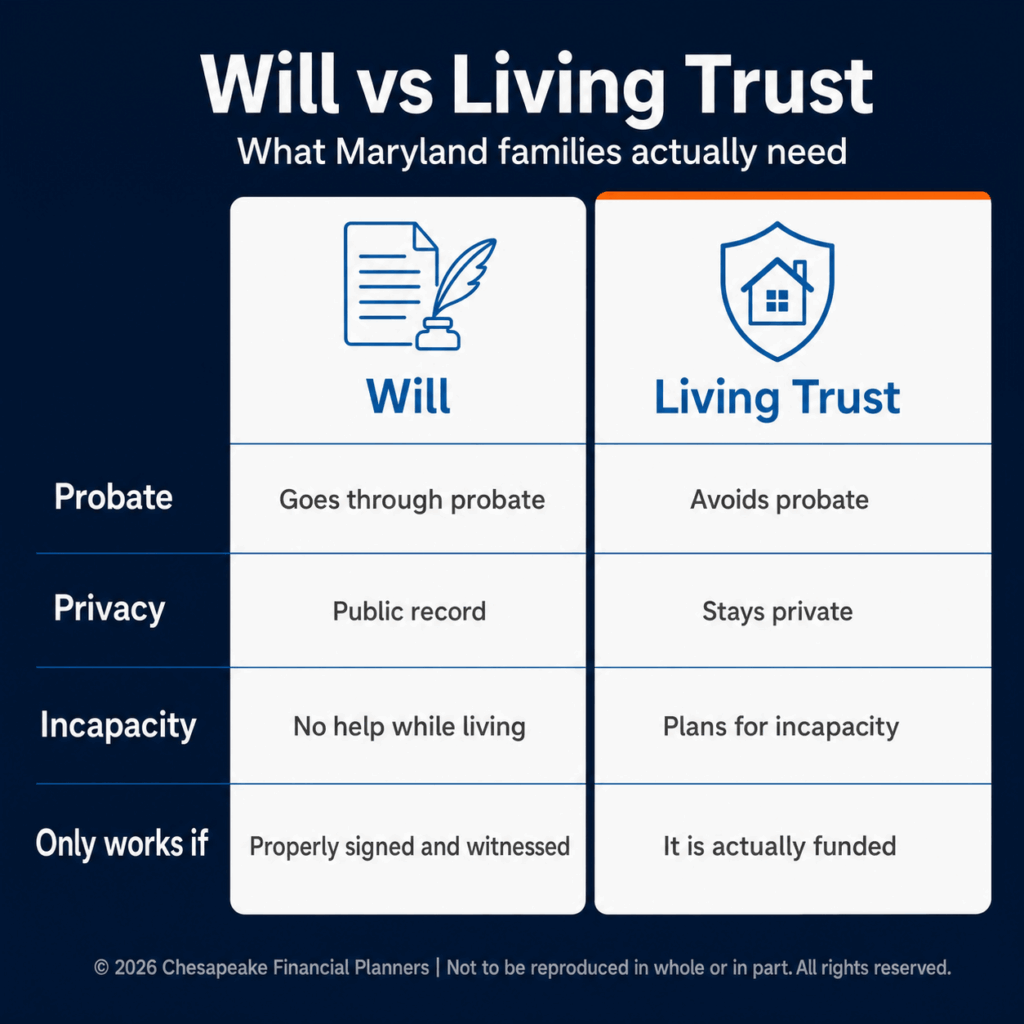
A will is a legal document that takes effect only after you die and must be validated through probate, the court-supervised process for settling an estate. A revocable living trust is a legal arrangement you create while alive, into which you transfer ownership of your assets, with yourself as trustee and a named successor to take over if you die or become incapacitated.
The practical difference shows up in three places: control during incapacity, privacy, and speed of settlement. A will does nothing if you are alive but unable to manage your finances. A living trust lets your successor trustee step in immediately, without a court guardianship proceeding. After death, a will becomes a public court record, while a trust stays private. According to the American Bar Association, probate timelines vary widely by state and estate complexity, and a funded trust generally bypasses that timeline entirely.
Jeff Judge often tells clients the trust is not magic. It only avoids probate for the assets you actually put inside it. The will is your backstop for everything else.
What is a will and do I need one for my estate?
Do I Need a Trust to Avoid Probate in Maryland?
Not necessarily. Maryland has a relatively streamlined probate system, and several common assets already skip probate without any trust at all. Retirement accounts, life insurance, and any account with a named beneficiary or a payable-on-death designation pass directly to the person you list, bypassing the will and the court.
Maryland also offers a simplified "small estate" process. As of 2026, an estate qualifies for the small estate procedure when the property subject to administration is valued at $50,000 or less, or $100,000 or less when the sole heir is the surviving spouse, under Maryland estate administration law. Many modest estates settle through this faster track without needing a trust at all.
Where a trust earns its keep is on larger estates, on real estate held in multiple states, and on situations where you want privacy or seamless management during incapacity. If you own a vacation property in another state, a will forces a second probate in that state. A trust holding both properties avoids that entirely.
Who owes Maryland's 10% inheritance tax and what planning options protect non-lineal heirs?
How Much Does Probate Cost in Maryland?
Maryland caps probate fees by statute, which keeps costs more predictable than in many states. The Register of Wills charges a probate fee tied to the gross value of the estate. As of 2026, Maryland's Register of Wills fee schedule starts at $50 for estates under $10,000 and rises in steps to a maximum of $2,500 for estates valued over $10 million.
That statutory fee is only part of the picture. Personal representative commissions and attorney fees add to the total, and both are also limited by Maryland law based on estate value. The bigger cost for most families is time. A standard Maryland estate administration commonly runs nine months to over a year, during which heirs may wait for distributions.
A revocable living trust sidesteps the Register of Wills fee on assets held in the trust and shortens the settlement timeline. For a family that values speed and privacy, that trade can be worth the upfront cost of drafting and funding the trust.
Living Trust vs Will: A Side-by-Side Comparison
The choice is easier to see laid out directly. Here is how the two documents compare on the factors that matter most to families.
| Factor | Will | Revocable Living Trust |
|---|---|---|
| Takes effect | Only at death | Immediately upon funding |
| Avoids probate | No | Yes, for funded assets |
| Public record | Yes, becomes court record | No, stays private |
| Manages incapacity | No | Yes, successor trustee steps in |
| Names guardians for minors | Yes | No (still need a will for this) |
| Upfront cost | Lower | Higher |
| Requires retitling assets | No | Yes, must be funded |
| Multi-state property | Triggers second probate | Avoids second probate |
Notice the last row of overlap: a trust does not name guardians for minor children. That function lives only in a will. This is why most families who set up a trust still need a "pour-over will" to cover guardianship and any assets left outside the trust. According to Nolo's estate planning guidance, a pour-over will directs anything you forgot to retitle into the trust at death.
What Happens If You Set Up a Trust but Don't Fund It?
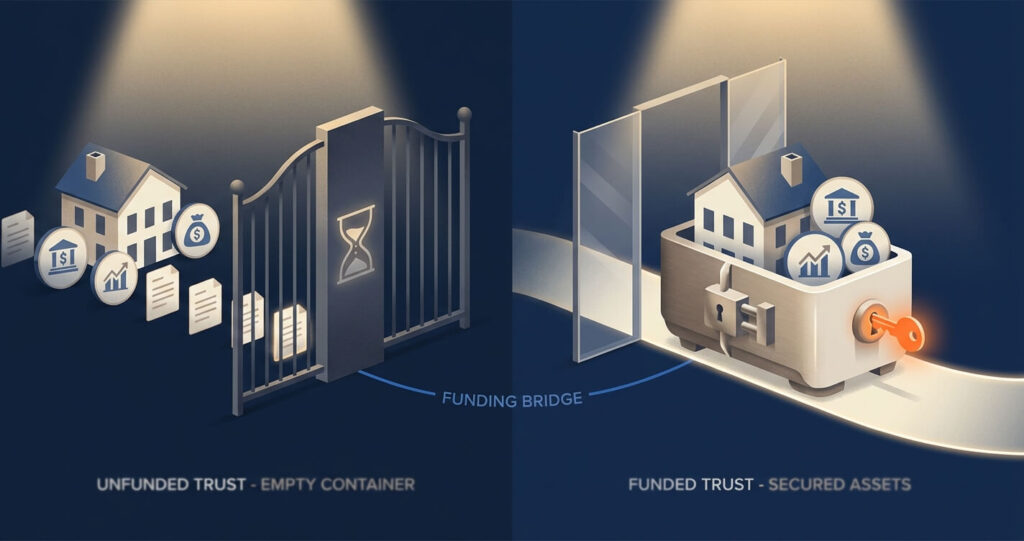
Nothing good. An unfunded trust is a stack of paper that accomplishes none of its purpose. If your home, bank accounts, and brokerage accounts are still titled in your own name when you die, they go through probate exactly as if the trust never existed.
Funding a trust means retitling assets into the trust's name. Your house deed gets re-recorded to the trust. Your taxable brokerage account gets retitled. Your bank accounts get moved. This is the step Jeff sees skipped most often, and it quietly undoes the entire plan.
This is where the R.U.D.D.E.R. Method™, Chesapeake Financial Planners' six-step planning process of Review and Recognize, Uncover and Understand, Design and Develop, Discuss and Decide, Execute and Empower, and Reassess and Refine, earns its place. The "Execute and Empower" step is where funding actually gets done, not just discussed. A plan that stops at the attorney's signature page is only half built.
What Is a Financial Power of Attorney and Why Do I Need One?
Do I need to update my beneficiary designations after a divorce or major life change?
Frequently Asked Questions
Do I need a living trust if I already have a will?
You may benefit from one, but not everyone does. A will alone is enough for many families with modest estates and assets that already pass by beneficiary designation. A living trust adds value if you want to avoid probate, keep your estate private, plan for incapacity, or own real estate in more than one state.
Can I write my own living trust in Maryland?
You can, but it is rarely wise for anything beyond the simplest situation. A trust that is drafted incorrectly or never properly funded can fail entirely, sending your estate through the probate you were trying to avoid. Maryland estate planning attorneys handle the titling and retitling steps that DIY kits routinely miss.
Does a living trust avoid Maryland estate taxes?
No. A revocable living trust does not reduce estate or inheritance taxes in Maryland because you still control the assets and they remain part of your taxable estate. A revocable trust is a probate-avoidance and management tool, not a tax-reduction tool. Reducing estate tax requires different, often irrevocable, strategies.
What is a pour-over will and do I need one with a trust?
A pour-over will is a backup document that directs any assets left outside your trust into the trust at your death. Yes, you generally need one even if you have a trust. It catches anything you forgot to retitle and is the only place to name guardians for your minor children.
How long does probate take in Maryland?
A standard Maryland estate administration typically runs from nine months to over a year, depending on the estate's complexity and whether disputes arise. Smaller estates that qualify for the simplified small estate procedure can settle considerably faster. A funded revocable living trust generally bypasses this timeline entirely for the assets it holds.
Where This Leaves You
The honest answer for most Maryland families is that you need a will, and you may also want a trust if privacy, incapacity planning, or multi-state property is in the picture. The living trust vs will question is less either-or than people expect, since the two documents do different jobs and often work together. The real failure point is a trust that never gets funded.
If you want to walk through which documents your situation actually calls for, our estate planning guide breaks down the decision in plain language. Download it at chesapeakefp.com.
Disclosures
The information provided is for educational purposes only and should not be construed as investment advice. Investment strategies should be tailored to individual circumstances, risk tolerance, and goals. Past performance doesn't guarantee future results. Consult with qualified financial professionals regarding your specific situation.
Advisors associated with Chesapeake Financial Planners may be either (1) LPL Financial Registered Representatives offering securities through LPL Financial, Member FINRA and SIPC, and investment advisor representatives offering investment advice through Great Valley Advisor Group; or (2) solely investment advisor representatives offering investment advice through Great Valley Advisor Group and not affiliated with LPL Financial. Great Valley Advisor Group, and Chesapeake Financial Planners are separate entities from LPL Financial.


