

What does the Social Security Fairness Act mean now that WEP and GPO are gone?
Last reviewed: July 2026
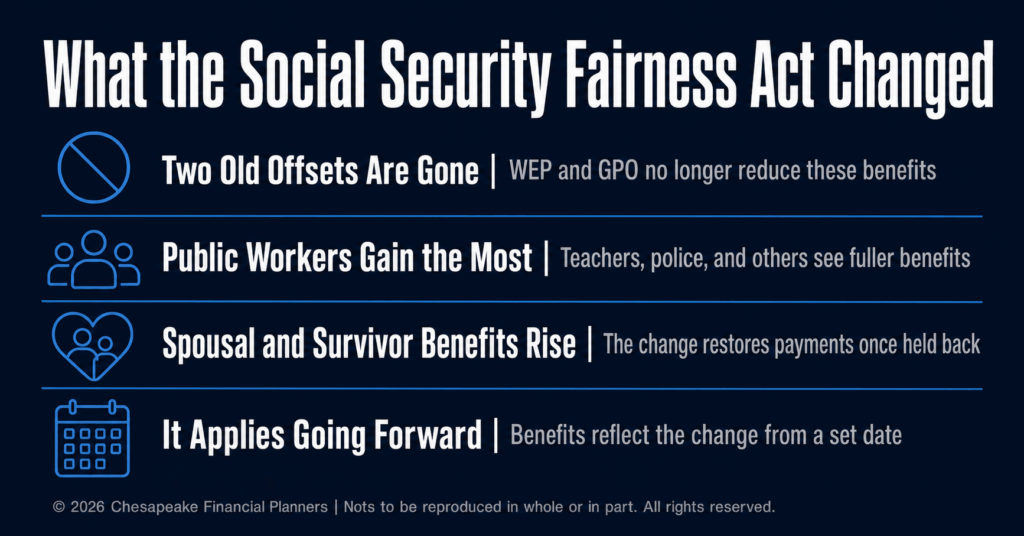
The Social Security Fairness Act ended two rules that cut Social Security checks for millions of public workers. As of January 2024, the Windfall Elimination Provision (WEP) and Government Pension Offset (GPO) no longer reduce or eliminate Social Security benefits for people with a pension from work that did not pay into Social Security. If you are a teacher, firefighter, police officer, or federal Civil Service Retirement System (CSRS) retiree who lost benefits to WEP or GPO, you are now eligible for the full Social Security benefit your work history earned.
On This Page
- Key Takeaways
- What is the Social Security Fairness Act, and what did it change?
- Who actually benefits from the WEP and GPO repeal?
- How much will benefits increase, and when do the retroactive payments arrive?
- How does the WEP and GPO repeal change Social Security planning for public retirees?
- What should public workers do right now to get the full benefit?
- Related Topics Worth Reading
- Frequently Asked Questions
- Bottom line
- Disclosures
Key Takeaways
- The Social Security Fairness Act was signed into law on January 5, 2025 and applies retroactively to benefits payable from January 2024.
- WEP and GPO previously reduced or eliminated Social Security benefits for over 2.8 million people with non-covered public pensions.
- As of July 7, 2025, SSA had paid over 3.1 million one-time retroactive payments totaling $17 billion, five months ahead of schedule.
- Most affected beneficiaries did not need to apply; SSA adjusted records automatically using direct deposit information on file.
- Public workers who never applied may need to file now; the filing date can affect when benefits begin and the back-pay window.
About the Author: Jeff Judge, CFP®, AEP®, ChFC®, CLU® is Managing Partner of Chesapeake Financial Planners in Forest Hill, Maryland. He has been helping families and business owners in Harford County and the Baltimore metro area work through Social Security claiming and retirement income decisions since earning his CFP® certification in 2013, by using Chesapeake Financial Planners’ signature process, the R.U.D.D.E.R. method™. In Jeff's experience, the workers most affected by the repeal are federal CSRS retirees from places like Aberdeen Proving Ground, Maryland teachers in MSRPS, and the surviving spouses of police and fire personnel, who often went years without a survivor check they had already earned.
What is the Social Security Fairness Act, and what did it change?
The Act, signed into law on January 5, 2025, ended two long-standing offsets that reduced Social Security benefits for people who also received a pension from work that did not pay Social Security taxes. Those two offsets were the Windfall Elimination Provision and the Government Pension Offset. Both are gone for benefits payable from January 2024 forward.
WEP applied to a person's own retirement or disability benefit. If you spent part of your career in a Social Security-covered job and part in a non-covered public sector job that paid into a separate pension, WEP used a modified benefit formula that produced a smaller check. At its 2024 maximum, the WEP reduction was about $587 per month.
GPO applied to spouse and survivor benefits. If you collected a public pension from non-covered work, GPO reduced your Social Security spouse or survivor benefit by two-thirds of that pension. In many cases the offset eliminated the survivor benefit entirely. That is the harder of the two stories Jeff has seen across his career.
Both rules dated to the early 1980s, when Congress was trying to prevent windfall benefits from a formula that assumed a full career in covered employment. The Fairness Act resolves the long argument over whether the formula was overcorrecting by removing the offsets entirely.
Who actually benefits from the WEP and GPO repeal?
The Social Security Administration reports that the repeal raises benefits for over 2.8 million people who were already receiving a reduced check. The biggest affected groups are public school teachers in the 15 states whose retirement systems opted out of Social Security, federal employees covered by the Civil Service Retirement System rather than FERS, state and local police and firefighters whose pensions are non-covered, and people who earned a pension under a foreign social security system.
Not every teacher or firefighter qualifies. Per SSA, about 72 percent of state and local public employees already work in Social Security-covered employment. Those workers paid in and were not affected by WEP or GPO, so they do not see a benefit increase from the new law.
The biggest dollar impact lands on three groups. First, federal CSRS retirees, who almost always have some Social Security-covered work history from before or alongside the federal job. Second, Maryland teachers in MSRPS who paid into Social Security here but whose spouses were hit by GPO when claiming on a CSRS, military reserve, or out-of-state public pension. Third, surviving spouses of police officers, firefighters, and CSRS workers, where GPO often eliminated the survivor benefit entirely. Jeff has watched widows of Aberdeen-based federal employees lose every dollar of a $1,400 monthly survivor check to GPO; the repeal restores that going forward.
Jeff puts it this way: "The repeal doesn't make anyone wealthy. It restores the check the original formula was designed to pay, before WEP and GPO redirected it."
How do Social Security survivor benefits work for a widow?
How much will benefits increase, and when do the retroactive payments arrive?
The totals are documented. As of July 7, 2025, SSA had completed over 3.1 million one-time retroactive payments totaling $17 billion, five months ahead of its original schedule. The average retroactive payment in the first big wave, reported on March 4, 2025, was $6,710, with about 1.1 million people receiving $7.5 billion in that first round.
Monthly increases depend on whether you were affected by WEP, GPO, or both, and on the size of your non-covered pension. Per SSA, some monthly benefits increased very little, while others now collect over $1,000 more per month. GPO survivor cases tend to see the largest increases because GPO often eliminated the survivor benefit entirely.
Past due payments cover benefits payable from January 2024 forward, since December 2023 is the last month WEP and GPO applied. SSA began the adjustment runs on February 25, 2025, and direct-deposited back payments into accounts already on file. Most affected beneficiaries began receiving their new monthly amount in April 2025, reflecting March 2025 benefits. Anyone whose benefit changed, or who received a past due payment, also got a mailed notice from SSA explaining the change.
If you were already collecting a reduced check, you did not need to apply. The Act updates your record automatically once SSA processes it. If you never applied for retirement or survivor benefits because WEP or GPO would have wiped them out, you do need to file. The filing date affects when your benefits begin; general rules limit retroactivity to six months for most retirement claims and up to 12 months for some disability-based claims.
How do I bridge my income to delay Social Security to 70?
How does the WEP and GPO repeal change Social Security planning for public retirees?
For active public workers near retirement, the repeal removes a planning variable that had been frustrating to model. WEP relied on a sliding scale based on years of "substantial earnings" in Social Security-covered work, which changed annually and made the projected benefit hard to pin down. With WEP gone, your Social Security retirement benefit is your earned primary insurance amount, based only on your covered wage history.
For retirees already collecting, a bigger Social Security check changes a few downstream decisions. Higher Social Security can push provisional income across the Social Security taxation thresholds ($32,000 of provisional income for joint filers makes up to 50 percent of benefits taxable; $44,000 makes up to 85 percent taxable), and it counts toward MAGI for Medicare IRMAA in the year you exceed a bracket. IRMAA hits the Part B and Part D premium two years later, which catches people off guard.
When evaluating these tradeoffs, we apply the R.U.D.D.E.R. Method™, Chesapeake Financial Planners' six-step planning process: Review and Recognize, Uncover and Understand, Design and Develop, Discuss and Decide, Execute and Empower, and Reassess and Refine. The Review step on a Fairness Act case includes pulling the updated SSA benefit statement, confirming the back payment hit the right account, and recalculating projected Social Security taxation and projected IRMAA brackets for the two years following the increase.
A practical observation from the practice in Forest Hill: the two most common Fairness Act profiles Jeff sees are federal CSRS retirees from Aberdeen Proving Ground and Maryland teachers retiring through MSRPS. For both, the planning question is no longer "What will my reduced check be?" It is "How do I sequence the higher Social Security check, my pension, and any IRA withdrawals so the 2026 Social Security COLA of 2.8 percent and the new full benefit don't drag me into an IRMAA bracket I did not plan for?"
How do I coordinate all my retirement income sources to minimize taxes and maximize income?

What should public workers do right now to get the full benefit?
There are four practical steps, in order.
First, check your personal my Social Security account at ssa.gov/myaccount. Confirm SSA has your current mailing address and direct deposit routing on file. If a back payment is still pending, this is the bank account it will hit.
Second, if you never applied for retirement, spouse, or survivor benefits because of WEP or GPO, apply now. Retirement and spouse applications can be filed online at ssa.gov/apply or by phone at 1-800-772-1213. Surviving spouse applications must go through the phone line; SSA does not currently take survivor applications online.
Third, if you were already collecting reduced benefits and have not seen the adjustment, wait for the SSA notice. As of July 17, 2025, SSA had taken 289,715 new applications since the Act passed and completed 92 percent of them. The agency is still processing the rest. If your case is not yet adjusted, calling does not move you up the queue; files work in date order.
Fourth, if your Medicare premium currently comes out of a CSRS annuity or a CMS direct bill, expect the deduction to switch to your Social Security check once the increase posts. Premiums prepaid to CMS are refunded, and Medicare Easy Pay users should follow SSA's instructions to stop the ACH withdrawal so the premium is not billed twice.
A note on scams. Per SSA, the agency will never charge a fee to start, increase, or expedite benefits. Anyone who calls offering to speed up your Fairness Act payment for a fee is running a scam. Hang up.
When Should Single People Claim Social Security Benefits?
Related Topics Worth Reading
If you are sorting through the bigger Social Security picture or trying to coordinate this benefit increase with other retirement income, these companion posts go deeper on the specific question.
- How Does Social Security Work for Retirement Benefits? walks through how the program works at a high level for anyone new to claiming decisions.
- How does my Social Security claiming decision affect my Medicare premiums? covers how a higher post-repeal benefit can trigger IRMAA two years after a claiming decision.
- What is the best retirement income planning strategy? sets the broader retirement income context for sequencing a new, higher Social Security check with other accounts.
Frequently Asked Questions
When did the Social Security Fairness Act take effect?
The Social Security Fairness Act was signed into law on January 5, 2025, but it applies retroactively to benefits payable from January 2024. December 2023 was the last month that WEP and GPO applied to anyone. The SSA began running automated benefit adjustments on February 25, 2025, and most affected beneficiaries saw their new monthly amount starting with the April 2025 deposit covering their March 2025 benefit.
What was the Windfall Elimination Provision?
The Windfall Elimination Provision was a Social Security rule that used a modified benefit formula for people who also received a pension from work not covered by Social Security taxes. It applied to a worker's own retirement or disability benefit and reduced the check by up to roughly $587 per month at the 2024 maximum. WEP was repealed by the Social Security Fairness Act and no longer applies to benefits payable from January 2024 forward.
What was the Government Pension Offset?
The Government Pension Offset was a rule that reduced Social Security spouse or surviving spouse benefits by two-thirds of the public pension a person received from non-covered work. For a widow with a $1,500 monthly CSRS pension, GPO subtracted $1,000 from her Social Security survivor benefit, often wiping it out entirely. GPO was repealed alongside WEP by the Social Security Fairness Act and no longer applies to benefits payable from January 2024.
Do I need to apply to get my increased Social Security benefit?
If you are already collecting a Social Security benefit reduced by WEP or GPO, you do not need to apply; SSA adjusts the record automatically using the direct deposit information on file. If you never applied because WEP or GPO would have eliminated your benefit, you do need to file an application. Per SSA, the filing date can affect when your benefits begin and how far back retroactivity applies.
Will my Social Security back payment be taxable?
Yes, the back payment is taxable as Social Security income in the year you receive it, not the year it was originally owed. The IRS does allow a lump-sum election under Publication 915, which lets you calculate the taxable portion as if the prior-year amounts had been paid in those earlier years. The election often reduces the total tax owed, especially when the back payment covers two calendar years of withheld benefits.
Does the Social Security Fairness Act affect Medicare premiums or IRMAA?
The Act does not change Medicare premium amounts directly, but a higher Social Security benefit can push more income across the IRMAA brackets two years later. The 2026 standard Medicare Part B premium is $202.90 per month, and IRMAA surcharges apply starting at $109,000 of MAGI for single filers and $218,000 for joint filers. Public workers who now collect a higher Social Security check should re-project MAGI for the year the increase first hits.
Bottom line
The biggest open question my pre-retiree clients had about Social Security has now been answered by the Social Security Fairness Act. For teachers, federal CSRS retirees, police, firefighters, and the surviving spouses of public workers, the WEP and GPO repeal restores the Social Security benefit that the original formula was designed to pay. If you found this guide useful, our resource on coordinating Social Security with the rest of your retirement income covers the tax and IRMAA sequencing in detail. Download it at chesapeakefp.com.
Disclosures
The information provided is for educational purposes only and should not be construed as investment advice. Investment strategies should be tailored to individual circumstances, risk tolerance, and goals. Past performance doesn't guarantee future results. Consult with qualified financial professionals regarding your specific situation.
Advisors associated with Chesapeake Financial Planners may be either (1) LPL Financial Registered Representatives offering securities through LPL Financial, Member FINRA and SIPC, and investment advisor representatives offering investment advice through Great Valley Advisor Group; or (2) solely investment advisor representatives offering investment advice through Great Valley Advisor Group and not affiliated with LPL Financial. Great Valley Advisor Group, and Chesapeake Financial Planners are separate entities from LPL Financial.


