

How Do Prenups and Postnups Protect My Assets?
Last reviewed: July 2026
A prenuptial agreement protects your assets by spelling out, before you marry, how property and debt get divided if the marriage ends. A postnuptial agreement does the same thing after you are already married. Good prenup financial planning turns a stack of "what ifs" into a written contract both spouses understand, which is exactly why these documents matter far more for ordinary couples than most people assume.
Key Takeaways
- A prenup is signed before marriage; a postnup is signed after, but both define how assets and debts are divided.
- Around 50% of first marriages and over 60% of second marriages end in divorce, per the American Psychological Association.
- Prenups protect business interests, inheritances, and pre-marriage assets that would otherwise become contested in a split.
- Each spouse needs separate legal counsel and full financial disclosure, or a court may toss the agreement.
- Postnups work well for blended families, business launches, or rebuilding trust after a financial crisis.
About the Author: Jeff Judge, CFP®, AEP®, ChFC®, CLU® is Managing Partner of Chesapeake Financial Planners in Forest Hill, Maryland. He has been helping families and business owners in Harford County and the Baltimore metro area navigate marriage, divorce, and asset protection since earning his CFP® certification in 2013, by using Chesapeake Financial Planners’ signature process, the R.U.D.D.E.R. method™. Jeff often tells clients that a prenup is not a bet against the marriage; it is the same kind of planning you do when you buy life insurance you hope never to use.
What Is a Prenup and What Does It Actually Cover?
A prenuptial agreement is a legal contract two people sign before marriage that defines what happens to property, income, and debt if they divorce or one spouse dies. It is not just for the wealthy. Anyone bringing assets, debt, a business, or children from a prior relationship into a marriage has something worth protecting.
A solid prenup typically covers separate property each spouse owned before the marriage, how income and assets earned during the marriage are treated, responsibility for debts (including student loans one spouse brought in), protection of a family business or professional practice, and inheritance or estate provisions. It cannot dictate child custody or child support; courts reserve those decisions based on the child's best interest at the time of divorce.
Jeff Judge has watched a single-paragraph prenup save a client's small business from being split in half during a contested divorce. The cost of drafting it years earlier was a rounding error compared to what it protected. That is the math most people miss when they assume prenups are only for celebrities.
How Do I Protect My Children's Inheritance in a Blended Family?

How Is a Postnup Different and When Does It Make Sense?
A postnuptial agreement is identical in purpose to a prenup, but it is signed after the wedding rather than before. The terms still define how assets and debts get divided, but the timing changes the legal scrutiny. Because spouses already owe each other a fiduciary duty once married, courts examine postnups more closely for fairness and full disclosure.
Postnups make sense in several real situations. A couple who skipped the prenup conversation while engaged can still document their intentions. One spouse may launch a business and want to shield the other from its liabilities. A blended family may want to lock in inheritance protections for children from prior marriages. And sometimes a postnup follows a serious financial breach, such as hidden debt or gambling, where rebuilding trust requires written terms. Jeff Judge notes: "A postnup signed after one spouse discovers hidden debt or a gambling problem has to withstand a much harder look from a judge than a prenup does, so full financial disclosure on both sides is not optional if you want the agreement to hold."
The thing the numbers do not capture is the conversation itself. In Jeff's experience, the act of sitting down to disclose every account, debt, and expectation often surfaces money problems a couple never discussed. That disclosure is half the value of the document.
Do I need to update my beneficiary designations after a divorce or major life change?
What Makes a Prenup or Postnup Hold Up in Court?
A prenup or postnup holds up in court when both spouses entered it knowingly, voluntarily, and with full financial disclosure. Courts throw out agreements that look coerced, one-sided, or built on hidden assets. Asset protection that collapses under legal challenge protects nothing.
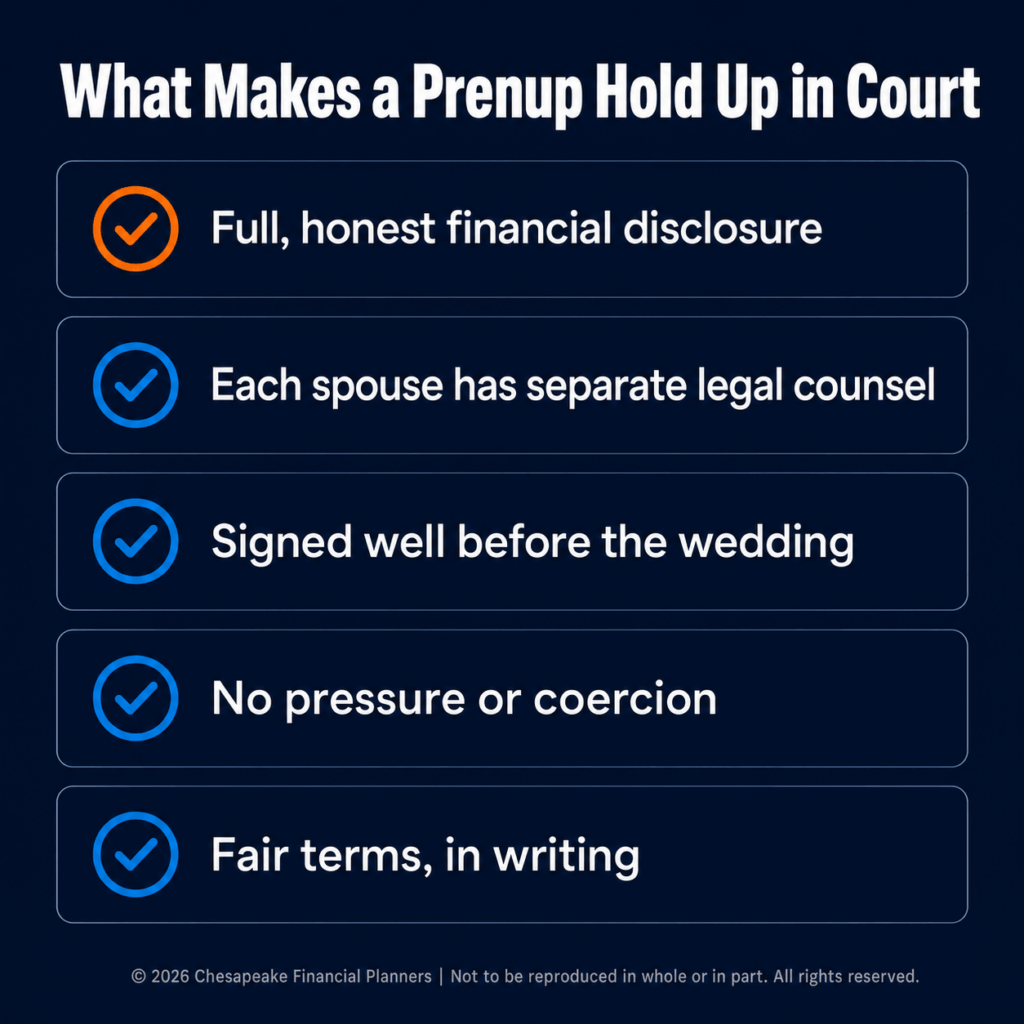
Five conditions strengthen enforceability:
- Full financial disclosure. Each spouse lists every asset, debt, and income source. Hiding an account is the fastest way to void the agreement.
- Separate legal counsel. Each party needs their own attorney. Sharing one lawyer creates a conflict of interest a court can use to invalidate the contract.
- No coercion or duress. Signing the night before the wedding looks pressured. Build in weeks, ideally months, before the ceremony.
- Fair and reasonable terms. Wildly lopsided agreements invite challenge. Courts in many states will not enforce terms that leave one spouse destitute.
- Proper execution. The document must be in writing, signed, and notarized according to state law.
State rules vary significantly. The American Bar Association notes that most states follow the Uniform Premarital Agreement Act, but enforcement standards differ. This is one reason a financial advisor and an attorney should work together rather than in isolation.
How Do Prenups Fit Into Broader Financial Planning?
A prenup is one piece of a larger asset protection plan, not a standalone fix. It works best alongside updated beneficiary designations, a will, and the right insurance. A divorce rate hovering near 40% to 50% for first marriages, according to the Centers for Disease Control and Prevention, makes this kind of planning a practical decision, not a pessimistic one.
At Chesapeake Financial Planners, this is where the R.U.D.D.E.R. Method™ comes in. The R.U.D.D.E.R. Method™ is Chesapeake Financial Planners' six-step planning process: Review and Recognize, Uncover and Understand, Design and Develop, Discuss and Decide, Execute and Empower, and Reassess and Refine. A prenup discussion lives squarely in the Uncover and Understand stage, where a couple maps out exactly what each person brings to the marriage and what they want protected.
Prenups also interact with estate planning. If you remarry and want children from a first marriage to inherit a specific account, a prenup paired with proper beneficiary designations keeps that intention intact. Without both, state default rules can override your wishes.
What is a will and do I need one for my estate?
Frequently Asked Questions
Do I need a prenup if I do not have many assets?
You may still benefit from a prenup even without significant assets, because these agreements also address debt and future earnings. If one spouse carries student loans or expects an inheritance, a prenup clarifies responsibility and ownership. It is less about current net worth and more about protecting what either spouse builds or receives during the marriage.
Can a prenup protect a business I own?
Yes, a prenup can protect a business you own by designating it as separate property and defining how any growth in its value is treated during marriage. Without this protection, a spouse may claim a share of the business or its appreciation in a divorce, which can force a sale or buyout that threatens the company's survival.
Is a postnup as enforceable as a prenup?
A postnup can be just as enforceable as a prenup, but courts often scrutinize it more closely. Because married spouses owe each other a fiduciary duty, judges examine postnups carefully for fairness, full disclosure, and voluntary consent. Meeting those standards, with separate counsel and complete financial transparency, gives a postnup strong legal standing.
What happens to a prenup if one spouse dies?
When one spouse dies, a prenup can govern how that person's separate property is distributed, often working alongside a will or trust. Many prenups include provisions waiving certain spousal inheritance rights so assets pass to children from a prior marriage instead. This makes prenups valuable estate planning tools, not just divorce protection.
Can we change or cancel a prenup after we are married?
Yes, you can change or cancel a prenup after marriage, but both spouses must agree in writing. Couples often modify agreements after major life events such as a new business, a large inheritance, or the birth of children. Any amendment should follow the same standards of disclosure and separate counsel that made the original enforceable.
If you found this helpful, our estate planning resources cover asset protection and beneficiary strategy in greater depth. Visit chesapeakefp.com to download the guide and put the right structure around your marriage and your money.
Disclosures
The information provided is for educational purposes only and should not be construed as investment advice. Investment strategies should be tailored to individual circumstances, risk tolerance, and goals. Past performance doesn't guarantee future results. Consult with qualified financial professionals regarding your specific situation.
Advisors associated with Chesapeake Financial Planners may be either (1) LPL Financial Registered Representatives offering securities through LPL Financial, Member FINRA and SIPC, and investment advisor representatives offering investment advice through Great Valley Advisor Group; or (2) solely investment advisor representatives offering investment advice through Great Valley Advisor Group and not affiliated with LPL Financial. Great Valley Advisor Group, and Chesapeake Financial Planners are separate entities from LPL Financial.


