
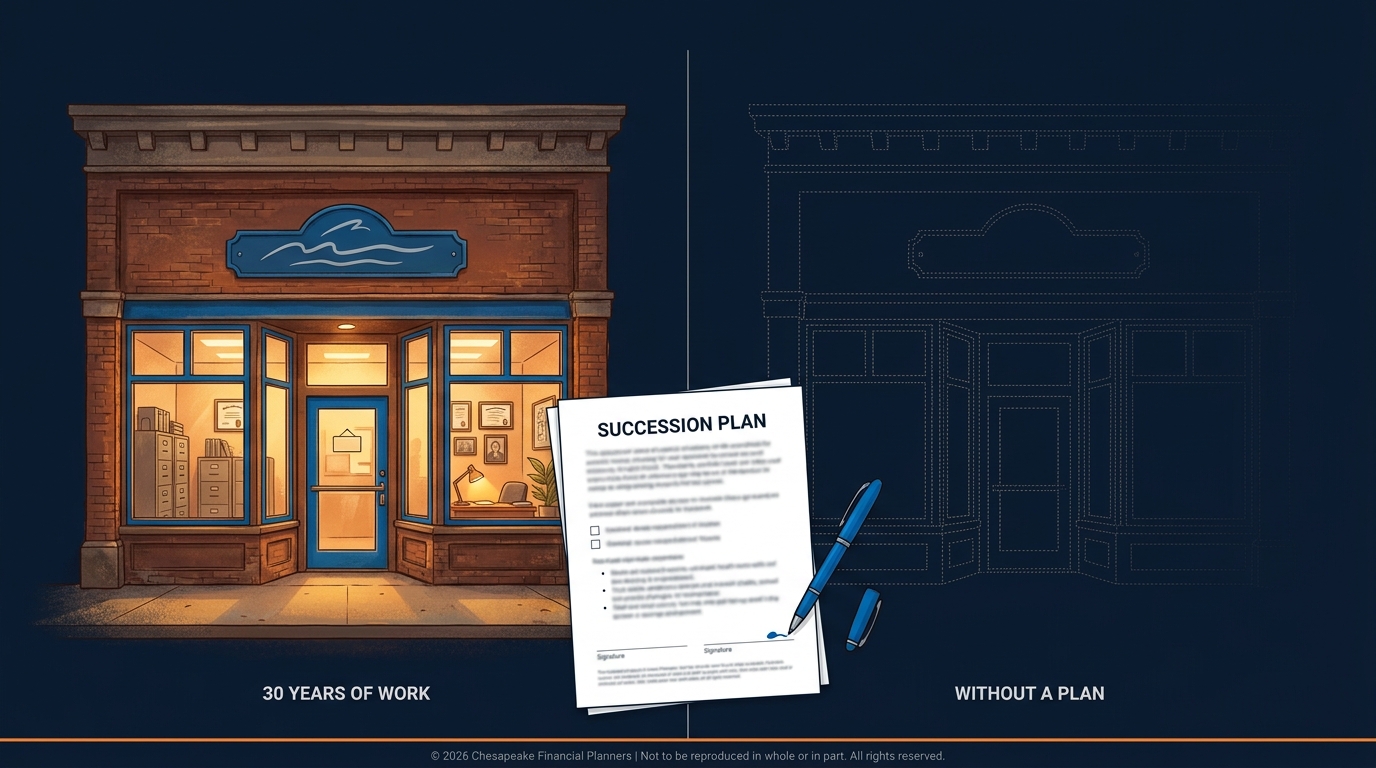
How Do I Create a Business Succession Plan?
Last reviewed: July 2026
A business succession plan is a written strategy that names who will own and operate your company after you exit, whether that exit comes from retirement, disability, or death. You create one by answering four questions in order: who will own the business, who will run it, when the transition happens, and how you or your estate gets paid. The earlier you start, the more options you keep and the more value you protect.
On This Page
- Key Takeaways
- Why Business Succession Planning Matters More Than You Think
- What Are the Core Components of a Business Succession Plan?
- How Does a Buy-Sell Agreement Protect Your Business?
- How Do You Reduce Estate Taxes on a Business Transfer?
- What Is an ESOP and How Does It Work?
- How Do You Prepare and Develop a Successor?
- What Are the Biggest Succession Planning Mistakes?
- Frequently Asked Questions
- Ready to Build Your Succession Plan?
- Disclosures
Key Takeaways
- Business succession planning names your future owner and operator and sets the terms of how you exit and get paid.
- Roughly 70% of family businesses fail to survive into the second generation, usually from poor planning rather than a weak business.
- The 2026 federal estate and gift tax exemption is $15 million per person, letting many owners transfer business interests with little or no estate tax.
- A funded buy-sell agreement turns an unexpected death or disability into a planned transaction instead of a fire sale.
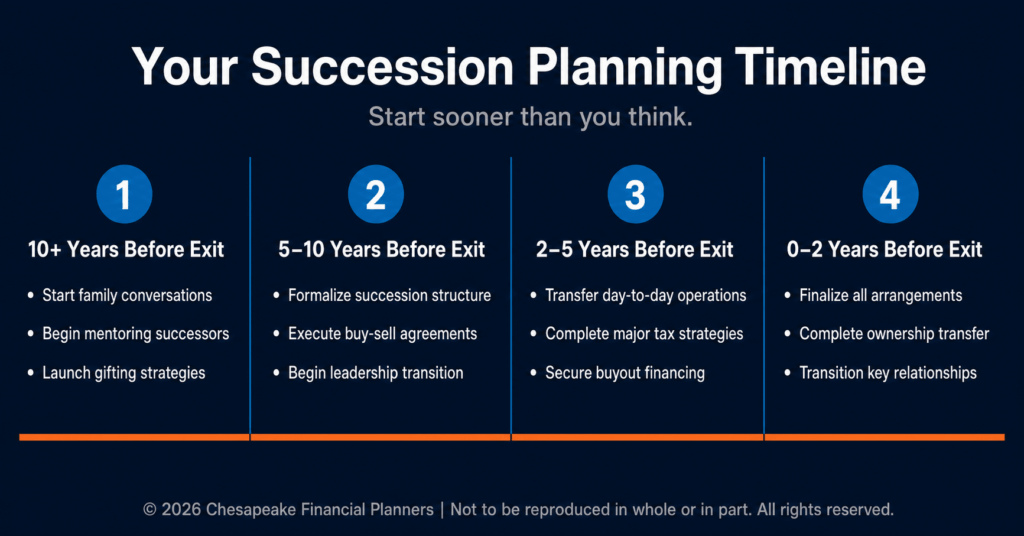
- Start five to ten years before your target exit so successors have time to prove themselves.
About the Author: Jeff Judge, CFP®, AEP®, ChFC®, CLU® is Managing Partner of Chesapeake Financial Planners in Forest Hill, Maryland. He has been helping families and business owners in Harford County and the Baltimore metro area navigate business succession and exit planning since earning his CFP® certification in 2013, by using Chesapeake Financial Planners’ signature process, the R.U.D.D.E.R. method™. Jeff has watched more businesses get destroyed by a missing buy-sell agreement than by any competitor in the market.
Why Business Succession Planning Matters More Than You Think
Most business owners hold the majority of their net worth inside one illiquid asset: the company. When that asset has no exit plan, a single bad day can erase decades of work. A succession plan converts that risk into a controlled process.
The survival numbers are blunt. Industry research consistently finds that only about 30% of family businesses make it to the second generation, and roughly 12% reach the third. The businesses that fail rarely fail because the product stopped working. They fail because nobody planned the handoff.
What Is Actually at Risk Without a Plan?
Four things are on the line. First, your family's financial security, because the business may represent 60% to 80% of your total net worth. Second, your employees' jobs, since a chaotic transition often ends in a forced sale or closure. Third, the legacy itself, which disappears the moment customers and suppliers lose confidence. Fourth, tax efficiency, because an unplanned transfer can expose the business value to a 40% top federal estate tax rate plus state-level taxes.
There is one more cost that the numbers never show. Jeff Judge has sat across the table from siblings who stopped speaking to each other after a parent died without a plan. The money was recoverable. The relationships were not. That is the real reason to start early.
How Soon Should You Begin Planning?
Begin five to ten years before your target exit. A successor needs time to develop skills, earn credibility with your team, and prove they can run the company under pressure. At Chesapeake Financial Planners, we use the R.U.D.D.E.R. Method™, our six-step planning process: Review and Recognize, Uncover and Understand, Design and Develop, Discuss and Decide, Execute and Empower, and Reassess and Refine. Succession planning lives across all six steps because it is not a single decision. It is a sequence of decisions made over years.
When Should I Start Planning My Business Exit Strategy?
[business succession planning meeting between owner and successor, alt text "business succession planning conversation between a business owner and successor"]
What Are the Core Components of a Business Succession Plan?
A complete plan answers four interconnected questions. Skip one and the plan has a hole that surfaces at the worst possible moment.
Who Will Own the Business?
You have four realistic paths. Family members keep wealth and legacy in the family but require willing, capable heirs. Key employees through a management buyout reward loyalty and preserve continuity, though financing is the constant hurdle. Outside buyers usually maximize the dollar value but end family involvement. A combination approach lets family retain partial ownership while professional management runs operations.
Each path carries a different tax and cash-flow profile. A sale to a third party often produces the cleanest exit. A transfer to children typically happens below market value, financed over years, and structured around gift and estate tax planning.
Who Will Run the Business?
Ownership and management do not have to live in the same person. Your daughter might inherit ownership while a seasoned non-family executive runs day-to-day operations. Or you might sell operations to your management team while your family keeps the real estate the business leases back.
The hardest question is also the most important: do your intended successors actually have the skill, experience, and desire to run this company? Wishful thinking kills more succession plans than financing problems do. Jeff often tells owners that the kindest thing they can do is be honest about whether a child wants the business at all, before the plan is built around an assumption that was never true.
When Will the Transition Happen?
There are three timing scenarios, and a good plan covers all three at once. A gradual transition over five to ten years allows mentoring and testing. An immediate transition triggered by death or disability requires contingency funding and clear decision authority. A planned retirement gives you maximum control over the timing and terms. The mistake is planning only for the retirement scenario and ignoring the day a heart attack changes everything.
How Will You or Your Estate Get Paid?
This is where many plans quietly fail. A sale to a third party usually means cash at closing, minus taxes. A family transfer is often below market and financed over time. A management buyout almost always requires seller financing because employees lack the capital. An ESOP, or Employee Stock Ownership Plan, offers tax benefits and employee ownership. Hybrid approaches blend partial sales, earnouts, and consulting arrangements. The funding method determines whether your exit produces real liquidity or just a promissory note that depends on the business continuing to perform.
What are the best exit strategies for business owners?
How much is my business actually worth if I want to sell?
How Does a Buy-Sell Agreement Protect Your Business?
A buy-sell agreement is a binding contract that controls what happens to an owner's interest when a triggering event occurs, such as death, disability, retirement, or divorce. It fixes the price formula and the funding source in advance, so a sudden exit becomes a planned transaction instead of an emergency.
There are two primary structures, and the difference matters for taxes and complexity.
| Feature | Cross-Purchase | Entity-Purchase (Redemption) |
|---|---|---|
| Who buys the departing owner's interest | The remaining individual owners | The business itself |
| Number of insurance policies (3 owners) | 6 policies (each owner insures the others) | 3 policies (company owns one per owner) |
| Cost basis step-up for buyers | Yes, surviving owners get a basis increase | No basis increase for surviving owners |
| Best fit | Two or three owners, simple ownership | Many owners, simpler administration |
| Common drawback | Policy count grows fast as owners increase | No basis step-up; surviving owners pay more tax on a later sale |
How Do You Fund a Buy-Sell With Insurance?
Life insurance is the most common funding tool because it creates the exact dollars needed at the exact moment they are needed. Consider three equal partners in a company worth $6 million, so each interest is worth $2 million. In a cross-purchase structure, each owner buys a $1 million policy on each of the other two. When one partner dies, the two survivors receive a combined $2 million in tax-free death benefit and use it to buy the deceased partner's interest from the estate at the agreed price.
The estate gets fair value in cash. The surviving owners keep control. The deceased partner's family is not stuck holding an illiquid minority stake in a business they cannot run. Disability buy-out insurance handles the same risk for a partner who becomes permanently disabled rather than dies. Jeff has seen a single unfunded buy-sell turn a profitable partnership into a courtroom fight within ninety days of a founder's death. Funding is what makes the agreement real.
What Is a Buy-Sell Agreement and Why Do Business Partners Need One?

[business owner reviewing a buy-sell agreement with advisor, alt text "advisor explaining a buy-sell agreement to a business owner"]
How Do You Reduce Estate Taxes on a Business Transfer?
The starting point in 2026 is favorable. The federal estate and gift tax exemption is $15 million per individual, which means a married couple can shield close to $30 million from federal estate tax with proper planning. The annual gift tax exclusion is $19,000 per recipient in 2026. As the IRS states, the exemption is the amount that "can be given away by an individual, in 2026, without being subject to estate or gift taxes." For many business owners, that exemption alone removes the federal estate tax problem entirely.
Owners with value above the exemption have several levers.
A Worked Estate-Tax Reduction Scenario
Consider an owner whose business is appraised at $20 million, sitting above the 2026 exemption. Here is one structured approach:
- Establish the value through a qualified independent appraisal so every later step rests on a defensible number.
- Gift a minority, non-controlling interest to a grantor trust for the children. Because that interest lacks control and is not easily sold, qualified valuation discounts for lack of control and lack of marketability may reduce its taxable value, commonly in the range of 20% to 40% depending on the facts.
- Use the lifetime exemption to cover the discounted gift value, removing that interest and all of its future growth from the taxable estate.
- Sell additional interest to the same grantor trust in exchange for a promissory note, freezing the value in the owner's estate while future appreciation accrues outside it.
- Carry life insurance, often inside an irrevocable life insurance trust, to provide liquidity for any remaining estate tax so the family is never forced to sell the business to pay the IRS.
This is a simplified illustration, not a recommendation, and every step requires qualified legal and tax counsel. The point is that the gap between a $20 million business and a $15 million exemption is a planning problem with known tools, not an inevitability.
Why Does Liquidity Matter So Much?
Estate tax is due in cash, generally within nine months of death. A business that is worth millions on paper can still leave a family scrambling because the value is locked inside the company. That is the trap. Funding the tax with life insurance, an installment plan, or a Section 6166 election to spread payments keeps the business intact. Without a liquidity plan, the estate tax forces the exact fire sale the succession plan was supposed to prevent.
What Do Business Owners Most Often Forget to Plan Before Exiting?
What Is an ESOP and How Does It Work?
An Employee Stock Ownership Plan, or ESOP, is a qualified retirement plan that buys company stock and holds it in trust for employees. It lets an owner sell the business to the people who helped build it while capturing significant tax advantages that a traditional third-party sale cannot match.
How Does an ESOP Transaction Work?
The mechanics follow a consistent pattern. The company establishes an ESOP trust. The trust borrows money, often from a bank plus seller financing, and uses the loan to buy shares from the departing owner at a price set by an independent appraisal. The company then makes tax-deductible contributions to the ESOP over time, which the trust uses to repay the loan. As the loan is repaid, shares are allocated to employee accounts based on a formula, usually compensation. Employees pay nothing out of pocket and receive ownership as a benefit.
What Are the Tax Advantages?
The tax treatment is the headline. Company contributions used to repay the ESOP loan are generally tax-deductible, which means both principal and interest can be paid with pre-tax dollars. For a C corporation sale, a selling owner may be able to use a Section 1042 election to defer or potentially eliminate capital gains on the sale by reinvesting the proceeds in qualified replacement property. For an S corporation, the percentage of the company owned by the ESOP can be effectively shielded from federal income tax, since the ESOP trust is a tax-exempt shareholder. These benefits come with strict compliance requirements, ongoing appraisal costs, and fiduciary obligations, so an ESOP fits some companies well and others poorly. Jeff generally points owners toward an ESOP conversation when they want continuity for employees and have steady, predictable cash flow to service the debt.
What are my options for exiting my business besides selling outright?
How Do I Exit My Business and Maximize Value?
How Do You Prepare and Develop a Successor?
Naming a successor is the easy part. Preparing one is the work that actually determines whether the plan succeeds. A capable successor is built over years, not announced in a memo.
What Does a Real Development Plan Look Like?
Start by defining the competencies the role demands: financial management, sales, operations, leadership, and the relationships that keep customers and suppliers loyal. Then map the successor's current ability against that list honestly. The gap between the two is your development plan.
From there, give the successor progressively harder responsibility with real accountability. Let them own a profit-and-loss line, manage a difficult client, or lead through a problem you would normally solve yourself. Each test builds credibility with your team, which is something no title can grant. Pair the successor with a mentor, ideally you, and create scheduled time to review decisions and reasoning, not just results.
Why Is the Handoff Itself So Hard?
The transition fails most often not because the successor lacks skill, but because the founder cannot let go. Authority that is announced but never actually transferred leaves employees confused about who is really in charge. Jeff has watched owners "retire" three separate times before the handoff finally stuck, and every false start cost the successor credibility. The cleanest transitions set a firm date, communicate it clearly to the entire organization, and then hold the founder to stepping back. Reassess and refine the plan as the successor grows. A development plan that never changes was never a real plan.
When should I start valuing my business for a future sale?

[business owner mentoring a successor in an office, alt text "business owner mentoring a successor as part of a business succession planning process"]
What Are the Biggest Succession Planning Mistakes?
Most failed transitions trace back to a short list of avoidable errors. Knowing them in advance is the cheapest insurance available.
Starting Too Late
A succession plan built in the final year before exit rarely works. Successors need time to develop, prove themselves, and earn credibility. Last-minute plans force rushed valuations, hurried financing, and decisions made under pressure. Five to ten years of runway changes everything.
Assuming Your Children Want the Business
Loving the business yourself does not mean your children share that love. Some have no interest. Others lack the temperament or the skills. Forcing an unwilling or unprepared child into ownership creates misery for the family and risk for the company. Have the honest conversation early, while you still have time to build an alternative.
Ignoring the Tax Bill
Business transfers can trigger estate tax, gift tax, capital gains tax, and income tax all at once. Without planning, taxes can consume a large share of the value you spent decades building. Gifting strategies, valuation discounts, trusts, and entity structuring can dramatically reduce that burden when they are put in place years ahead of the transfer.
Failing to Address Fairness Among Children
What happens when one child works in the business and three do not? Families fracture over perceived unfairness. The solution is rarely splitting the business equally, because giving a non-involved child a vote can paralyze the company. Instead, owners often give the business to the active child and equalize the inheritance for the others through life insurance, real estate, or other assets. Communicate the reasoning to everyone before you are gone, not after.
Skipping the Buy-Sell Agreement
Co-owned businesses without a funded buy-sell are one death or divorce away from chaos. The surviving owners can end up in business with a deceased partner's spouse or a former spouse's attorney. A funded agreement removes that risk entirely. It is the single most overlooked document among the partnerships Jeff works with.
What questions should I ask before hiring a financial advisor?
Can I retire after selling my business for $2-5 million?
Frequently Asked Questions
When should I start business succession planning?
Start five to ten years before your target exit date. Successors need time to develop the skills and credibility required to run the company, and tax strategies like gifting and valuation discounts work best when implemented years in advance. Even if your exit is far off, a contingency plan for death or disability should exist today.
What is the difference between a buy-sell agreement and a succession plan?
A succession plan is the overall strategy for who owns and runs your business after you exit. A buy-sell agreement is one document inside that plan, a binding contract that sets the price and funding for transferring an owner's interest when a triggering event like death, disability, or retirement occurs. You need both working together.
How much does business succession planning cost?
Costs vary with complexity, from a few thousand dollars for a basic buy-sell agreement to significantly more for a comprehensive plan involving trusts, valuations, and ESOP design. The real comparison is not the planning fee but the cost of having no plan, which often runs into hundreds of thousands of dollars in unnecessary taxes and lost business value.
How are estate taxes calculated on a business transfer in 2026?
In 2026, the federal estate and gift tax exemption is $15 million per person, so business value below that amount generally passes free of federal estate tax. Value above the exemption is taxed at rates climbing to 40%. Valuation discounts, gifting, and trusts can reduce or eliminate the taxable amount when planned in advance.
Can I sell my business to my employees?
Yes, employees can buy your business through a management buyout or an Employee Stock Ownership Plan. A management buyout usually requires seller financing because employees lack capital. An ESOP lets the company borrow to buy your shares while delivering significant tax advantages to both you and the business, making it attractive for owners with steady cash flow.
What happens to my business if I die without a succession plan?
Without a plan, your business interest passes through your estate according to your will or state law, often to family members who cannot run it. The company may face leadership chaos, customer flight, and a forced sale at a steep discount. A funded buy-sell agreement and a written plan prevent this by turning your death into a pre-arranged transaction.
Should I treat my children equally in my succession plan?
Equal is not always fair when one child works in the business and others do not. Giving everyone equal ownership can paralyze decision-making. Many owners instead give the business to the active child and equalize the inheritance for the rest through life insurance, real estate, or other assets, then explain the reasoning to the whole family in advance.
What is the first step in creating a business succession plan?
The first step is getting an honest, independent valuation of your business so every later decision rests on a real number. From there, you define your exit timeline, identify who will own and run the company, and choose how the transfer will be funded. A qualified financial planner and an estate attorney should guide the process together.
Ready to Build Your Succession Plan?
Your business is likely the largest asset you own, and a missing plan puts everything you built at risk. If this guide was useful, our exit and succession planning resources walk through the timeline, valuation, and tax steps in greater depth. Download them at chesapeakefp.com and start protecting the value you spent decades creating.
Want to go deeper? Our Transition Readiness Questionnaire walks through this step by step.
Disclosures
The information provided is for educational purposes only and should not be construed as investment advice. Investment strategies should be tailored to individual circumstances, risk tolerance, and goals. Past performance doesn't guarantee future results. Consult with qualified financial professionals regarding your specific situation.
This information is not intended to be a substitute for specific individualized tax, investment or legal advice. We suggest that you discuss your specific situation with a qualified tax, legal or financial advisor.
Advisors associated with Chesapeake Financial Planners may be either (1) LPL Financial Registered Representatives offering securities through LPL Financial, Member FINRA and SIPC, and investment advisor representatives offering investment advice through Great Valley Advisor Group; or (2) solely investment advisor representatives offering investment advice through Great Valley Advisor Group and not affiliated with LPL Financial. Great Valley Advisor Group, and Chesapeake Financial Planners are separate entities from LPL Financial.


