

How Does a Charitable Remainder Trust Work for High Net Worth Individuals?
Last reviewed: July 2026
A charitable remainder trust lets you donate appreciated assets to an irrevocable trust, collect income from those assets for years or for life, and send whatever remains to charity when the trust ends. You skip the capital gains tax that would normally hit when those assets are sold, claim a partial income tax deduction up front, and remove the asset from your taxable estate. It works best for people sitting on a low-basis position they want to diversify without writing a giant check to the IRS.
Key Takeaways
- A charitable remainder trust pays you income now and gives the leftover assets to charity later, avoiding capital gains tax on the sale.
- The IRS requires a payout between 5% and 50% annually, with at least 10% of the value projected to reach charity.
- You claim an immediate partial income tax deduction based on the present value of the charity's future remainder interest.
- The 2026 federal estate and gift tax exemption is $15 million per person, so removing a large asset can still matter for big estates.
- These trusts usually make sense only when funded with substantial assets, often $250,000 or more, to justify setup and administration costs.
About the Author: Jeff Judge, CFP®, AEP®, ChFC®, CLU® is Managing Partner of Chesapeake Financial Planners in Forest Hill, Maryland. He has been helping families and business owners in Harford County and the Baltimore metro area navigate charitable and estate planning since earning his CFP® certification in 2013, by using Chesapeake Financial Planners’ signature process, the R.U.D.D.E.R. method™. Jeff often tells clients that the charitable remainder trust is not a giving tool first; it is a tax-timing tool that happens to fund a cause you already care about.
What Is a Charitable Remainder Trust?
A charitable remainder trust is an irrevocable trust that pays income to you or other named beneficiaries for a set period, then passes whatever is left to one or more qualified charities. The "remainder" is exactly what it sounds like: what stays in the trust after the income payments stop.
You fund it with appreciated assets, the trust sells those assets without paying capital gains tax, reinvests the full proceeds, and pays you income along the way. Because a charity gets the remainder, the IRS rewards you with an upfront deduction and the tax-free sale inside the trust.
There are two flavors. A charitable remainder annuity trust pays a fixed dollar amount every year, set when you create it. A charitable remainder unitrust pays a fixed percentage of the trust's value, recalculated each year, so your income rises and falls with investment performance. Both are core charitable giving strategies, but they behave very differently in practice, which we cover below.
What is a will and do I need one for my estate?
How Does a Charitable Remainder Trust Work Step by Step?
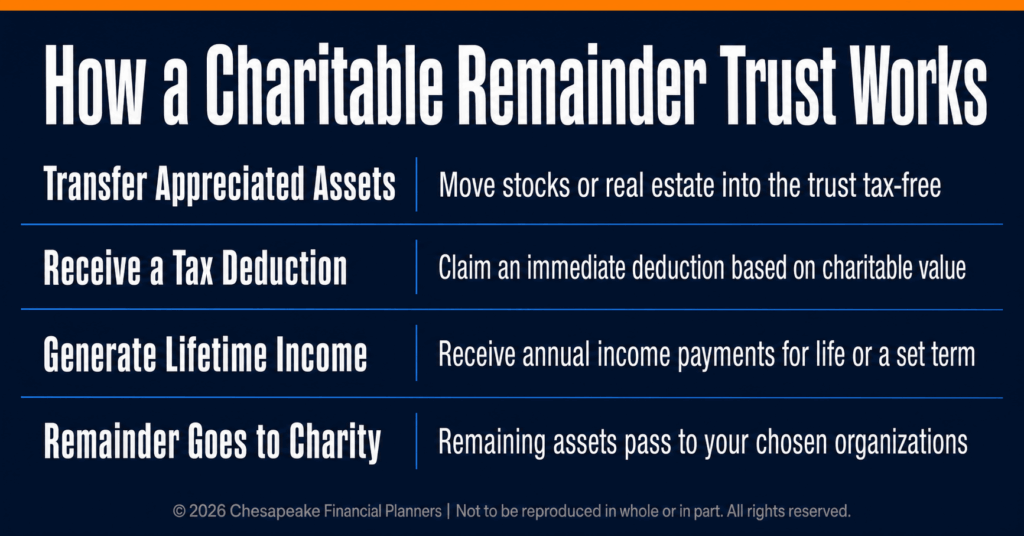
The mechanics are straightforward once you see the sequence. You transfer a low-basis asset into the trust, the trust sells it tax-free, and the proceeds go to work generating your income.
- Fund the trust. You contribute appreciated assets, usually publicly traded stock, real estate, or business interests, into the irrevocable trust.
- Claim your deduction. You receive an immediate income tax deduction equal to the present value of the charity's projected remainder interest, calculated using the payout rate, the term, and the IRS Section 7520 rate.
- Sell tax-free. The trust sells the appreciated assets and pays no capital gains tax, so the full value keeps working.
- Receive income. The trust invests the proceeds and pays you or your beneficiaries according to the trust terms, for a term of up to 20 years or for life.
- Charity gets the remainder. When the term ends or the last income beneficiary dies, the remaining assets pass to your named charities.
Here is the part most people underestimate. If you own stock with a $100,000 basis now worth $500,000, selling it outright could trigger roughly $119,000 in federal tax at the top 23.8% capital gains plus net investment income rate. Inside a charitable remainder trust, that $500,000 sells clean and stays invested. That difference is the engine behind the entire strategy.
How can I potentially optimize my taxes as my income grows?
What Are the Tax Benefits of a Charitable Remainder Trust?
A charitable remainder trust delivers three distinct tax advantages, and high-net-worth households with appreciated assets benefit from all three at once.
First, you get an immediate income tax deduction for the present value of the charitable remainder. The amount depends on your payout rate, the term, and the IRS Section 7520 rate in effect that month. A higher payout to you means a smaller deduction; a lower payout means a larger one.
Second, the trust sells appreciated assets without owing capital gains tax. You defer and spread the tax across years of income payments instead of paying it all at once, which keeps far more capital invested.
Third, the asset leaves your taxable estate. The 2026 federal estate and gift tax exemption is $15 million per person, or $30 million for a married couple, and amounts above that face a 40% federal estate tax. For families above that line, pulling a large appreciated asset out of the estate is real money.
A quick caution from the planning side: the upfront deduction is limited to a percentage of your adjusted gross income, with a five-year carryforward for anything you cannot use. Jeff Judge has watched clients assume they would deduct the full remainder value in year one, then learn the AGI limits stretch it across several returns. Model the deduction before you fund, not after.
Which Is Better, a Charitable Remainder Annuity Trust or a Unitrust?
Neither is universally better; the right choice depends on whether you value certainty or flexibility. The annuity trust pays a fixed dollar amount and never changes. The unitrust pays a percentage and moves with the trust's value.
| Feature | Charitable Remainder Annuity Trust (CRAT) | Charitable Remainder Unitrust (CRUT) |
|---|---|---|
| Payment | Fixed dollar amount, set at funding | Fixed percentage of annual trust value |
| Income predictability | High; payment never changes | Variable; rises and falls with performance |
| Inflation protection | None | Potential, if investments grow |
| Additional contributions | Not allowed after funding | Allowed over time |
| Best for | Predictable, stable income | Growth potential and flexibility |
The IRS requires every charitable remainder trust to pay out at least 5% and no more than 50% of the trust value annually, and the charity's projected remainder must be at least 10% of the initial value. Those guardrails apply to both structures. Most high-net-worth clients I work with land on a unitrust because it allows future contributions and offers some inflation defense, but a retiree who simply wants a steady, unchanging check often prefers the annuity trust.
How Can I Donate From My IRA Tax-Free?
When Does a Charitable Remainder Trust Make Sense?
A charitable remainder trust earns its complexity in a few specific situations, and it is a poor fit outside them.
It shines when you hold a highly appreciated, low-basis asset you want to diversify. Decades-old stock, a long-held rental property, or pre-sale business interests all qualify. Business owners approaching a liquidity event get particular value: moving interests into the trust before a sale closes lets the trust sell without capital gains tax, preserving far more for both income and charity.
It also fits when you want income but do not need to preserve that specific asset for heirs, and when you have genuine charitable intent you would act on anyway. The trust simply makes the gift more efficient.
It does not fit when you need the principal back, when your heirs are the priority, or when the asset throws off ordinary income rather than capital gains. Retirement accounts and annuities make weak candidates because the capital gains advantage barely applies. And the costs are real: legal setup typically runs $3,000 to $10,000 or more, plus annual tax filing and trustee administration, which is why most advisors suggest funding with at least $250,000 to justify the expense. Jeff Judge notes: "When clients ask about charitable remainder trusts, I have to be direct: if you need the principal back, or if leaving money to heirs is the priority, this structure works against you, and the legal and administrative costs alone make a poorly matched CRT an expensive mistake."
The planning process matters as much as the structure. At Chesapeake Financial Planners we run charitable remainder trust decisions through the R.U.D.D.E.R. Method™, Chesapeake Financial Planners' six-step planning process: Review and Recognize, Uncover and Understand, Design and Develop, Discuss and Decide, Execute and Empower, and Reassess and Refine. That keeps the trust tied to your actual income needs and charitable goals rather than a tax theory in a vacuum.
How Can Bunching Charitable Deductions Save Me on Taxes?
Frequently Asked Questions
What is a charitable remainder trust in simple terms?
A charitable remainder trust is an irrevocable trust you fund with appreciated assets that pays you income for a term of years or for life, then gives the remaining assets to charity. The trust sells your assets without capital gains tax, and you get an upfront income tax deduction for the charity's future share.
How much income does a charitable remainder trust pay?
A charitable remainder trust must pay out between 5% and 50% of the trust value each year, per IRS rules. An annuity trust pays a fixed dollar amount set at funding, while a unitrust pays a fixed percentage recalculated annually. Your chosen rate directly affects both your income and the size of your charitable deduction.
Do you avoid capital gains tax with a charitable remainder trust?
Yes. When the trust sells appreciated assets, it pays no immediate capital gains tax, so the full value stays invested and working. You do pay tax over time as income is distributed to you, following IRS tiered rules, but you avoid the large one-time capital gains hit you would face by selling the asset directly.
How much money do you need to fund a charitable remainder trust?
Most advisors recommend funding a charitable remainder trust with at least $250,000, and often $500,000 or more, because setup costs of $3,000 to $10,000 plus ongoing administration and trustee fees make smaller amounts inefficient. The greater the appreciation and value of the asset, the more the capital gains and estate tax benefits justify the cost.
Can you change a charitable remainder trust after it is created?
A charitable remainder trust is irrevocable, so you cannot dissolve it or reclaim the principal once funded. You can sometimes change the named charitable beneficiaries depending on how the trust is drafted, and a unitrust allows additional contributions over time. These limits are why careful planning before funding matters so much.
Who should consider a charitable remainder trust?
People holding highly appreciated, low-basis assets who want income, have genuine charitable intent, and do not need that asset for heirs are the best candidates. Business owners facing a liquidity event and retirees seeking tax-efficient income often benefit most. It is rarely a fit if preserving principal for family is your top priority.
If you are weighing whether a charitable remainder trust fits your situation, our guide to advanced charitable giving strategies walks through the trade-offs in detail. Download it at chesapeakefp.com to see how a charitable remainder trust compares with donor-advised funds and other approaches before you commit.
Want to go deeper? Our Tax-Smart Charitable Giving Playbook walks through this step by step.
Disclosures
The information provided is for educational purposes only and should not be construed as investment advice. Investment strategies should be tailored to individual circumstances, risk tolerance, and goals. Past performance doesn't guarantee future results. Consult with qualified financial professionals regarding your specific situation.
This information is not intended to be a substitute for specific individualized tax, investment or legal advice. We suggest that you discuss your specific situation with a qualified tax, legal or financial advisor.
Advisors associated with Chesapeake Financial Planners may be either (1) LPL Financial Registered Representatives offering securities through LPL Financial, Member FINRA and SIPC, and investment advisor representatives offering investment advice through Great Valley Advisor Group; or (2) solely investment advisor representatives offering investment advice through Great Valley Advisor Group and not affiliated with LPL Financial. Great Valley Advisor Group, and Chesapeake Financial Planners are separate entities from LPL Financial.


