

What Financial Planning Challenges Do American Expats Face?
Last reviewed: July 2026
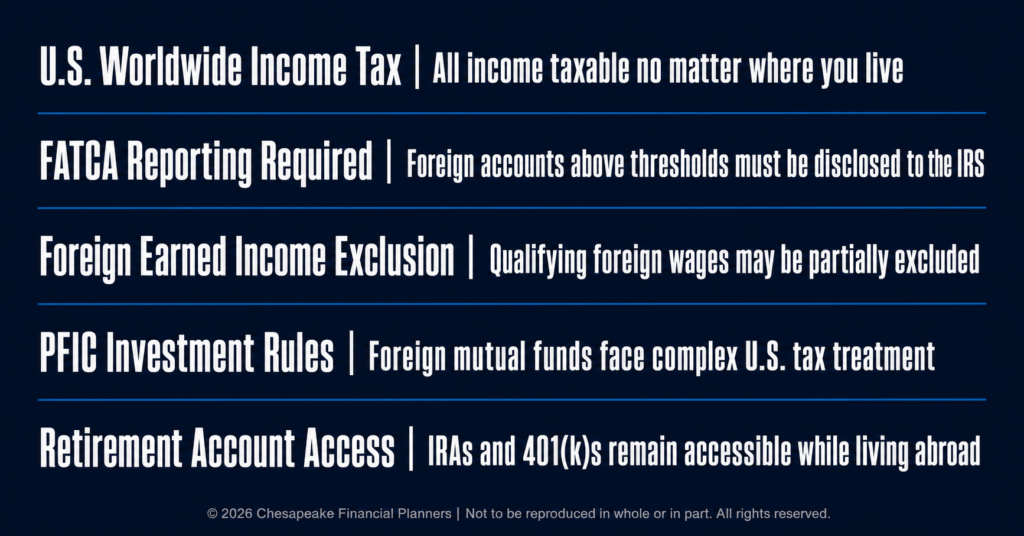
American expats face a stack of financial challenges no domestic taxpayer deals with: the United States taxes your worldwide income regardless of where you live, you must report foreign accounts under FATCA and FBAR rules, and common foreign investments can trigger punishing tax treatment. Expat financial planning means coordinating two tax systems at once, avoiding reporting penalties that start at $10,000, and keeping your investments, retirement accounts, and estate plan working in both countries. Get one piece wrong and the cost can run into the tens of thousands.
Key Takeaways
- The U.S. taxes citizens on worldwide income no matter where they live, so expats file U.S. returns on top of any host-country filings.
- The 2026 foreign earned income exclusion lets qualifying expats exclude up to $132,900 of earned income from U.S. tax.
- FBAR filing is required once foreign accounts exceed $10,000 combined at any point in the year, with non-willful penalties starting at $10,000.
- Foreign mutual funds are usually classified as PFICs, which can push effective tax rates above 50% for U.S. investors.
About the Author: Jeff Judge, CFP®, AEP®, ChFC®, CLU® is Managing Partner of Chesapeake Financial Planners in Forest Hill, Maryland. He has been helping families and business owners in Harford County and the Baltimore metro area navigate cross-border tax and investment questions since earning his CFP® certification in 2013, by using Chesapeake Financial Planners’ signature process, the R.U.D.D.E.R. method™. Jeff sees the same pattern with expat clients again and again: the move abroad happens first, and the financial cleanup happens later, usually after a costly surprise.
Why Does the U.S. Tax System Follow Americans Abroad?
The United States is one of the only countries that taxes its citizens on worldwide income regardless of where they live. That single rule sits underneath every other expat financial challenge. You can move to Lisbon, Singapore, or Mexico City, pay full local taxes, and still owe a U.S. tax return reporting your global income every April.
This creates the risk of double taxation, where both your host country and the U.S. tax the same dollars. Two main tools soften that blow. The foreign earned income exclusion lets qualifying expats exclude up to $132,900 of foreign earned income from U.S. taxation in 2026. The foreign tax credit gives dollar-for-dollar credit for foreign income taxes you already paid.
Here's the catch most people miss. The exclusion only covers earned income, like wages and salary. Investment income, dividends, capital gains, and rental income do not qualify. High earners can also blow right past the $132,900 cap, pulling substantial income back into the U.S. system. Jeff Judge often tells clients that the exclusion is a useful floor, not a force field, and planning has to account for everything it leaves exposed.
What Are FATCA and FBAR Reporting Requirements?
FATCA and FBAR are two separate foreign-account reporting rules that catch almost every American living abroad. You must file an FBAR (FinCEN Form 114) if your foreign financial accounts exceed $10,000 combined at any point during the year. Separately, FATCA requires Form 8938 when your foreign financial assets exceed thresholds that run from $50,000 up to $600,000, depending on your filing status and whether you live abroad.
The penalties are what make these rules matter. According to the IRS, non-willful FBAR violations can run $10,000 per violation, and willful failures can reach the greater of $100,000 or 50% of the account balance. Form 8938 failures start at $10,000, with more piling on for continued non-compliance.
A high-net-worth expat with several foreign accounts, a local brokerage, and a foreign pension can easily trip multiple filing obligations in a single year. Systematic recordkeeping is not optional here. This is one area where professional help usually pays for itself many times over.

Why Are Foreign Investments a Tax Trap for Expats?
Foreign mutual funds and ETFs are usually classified as Passive Foreign Investment Companies, or PFICs, and the U.S. tax treatment is brutal. Under the PFIC rules, gains and certain distributions can face punitive taxation that pushes effective rates above 50%, plus interest charges that compound over the holding period. For practical purposes, that local index fund your host-country bank recommends is often the worst possible choice for an American.
The problem runs the other direction too. Some U.S. brokerage firms refuse to keep accounts open for non-resident Americans, citing compliance burdens, while others restrict trading. So expats can get squeezed: punished for holding foreign funds, and shut out of some U.S. accounts at the same time.
U.S.-domiciled funds generally work better from a U.S. tax standpoint, but a few host countries impose their own withholding on U.S. dividends or refuse to recognize the tax-advantaged structure of U.S. retirement accounts. This is where expat financial planning earns its keep, because the right answer depends on the specific treaty between the U.S. and your country of residence, not a generic rule of thumb.
How Do Retirement Accounts and Social Security Work Abroad?
U.S. retirement accounts mostly keep their tax-deferred status abroad, but your host country may not honor that deferral and could tax the growth annually. Traditional IRAs and 401(k)s usually stay deferred for U.S. purposes. Roth IRAs can be attractive because qualified distributions are tax-free under U.S. rules, though host-country treatment varies widely and some nations tax Roth withdrawals as ordinary income.
Social Security adds another layer. Most countries allow you to receive U.S. benefits while living there, but a handful do not, and your benefits may be taxed by both the U.S. and your country of residence depending on the tax treaty. Healthcare is the bigger gap: Medicare generally does not cover care outside the United States. That leaves most long-term expat retirees relying on international health insurance or a local system instead.
If you split time between countries, healthcare planning gets harder still. Understanding how Medicare interacts with your retirement timeline matters even more when you're crossing borders. For a deeper look at coverage costs, see our guides on How Much Should I Budget for Healthcare Costs in Retirement? and What Are the Different Parts of Medicare and What Do They Cover?.

What About Estate Taxes, State Taxes, and Currency Risk?
U.S. estate and gift tax rules follow citizens abroad, and the 2026 federal estate and gift tax exemption is $15 million per individual. Your worldwide assets count toward that exemption. Special rules apply if you're married to a non-U.S. citizen: the unlimited marital deduction does not apply to a non-citizen spouse, though a qualified domestic trust can provide partial relief, and the annual gift exclusion to a non-citizen spouse is higher than the standard exclusion but still capped.
State taxes are stickier than most people expect. Leaving the country does not automatically end state tax residency. States like California, New York, and Virginia are aggressive about asserting jurisdiction over former residents who keep a driver's license, property, or voter registration. Documenting a clean break from your old state can save high-income expats real money, but only if you actually change the domicile markers.
Then there's currency risk. Your expenses are in local currency while much of your wealth may sit in dollars, so exchange-rate swings hit your purchasing power directly. Some expats hold assets in multiple currencies to match spending, while others hedge actively. The R.U.D.D.E.R. Method™ is Chesapeake Financial Planners' six-step planning process: Review and Recognize, Uncover and Understand, Design and Develop, Discuss and Decide, Execute and Empower, and Reassess and Refine. For cross-border clients, the Uncover and Understand step is where the hidden currency, treaty, and reporting exposures usually surface. Related decisions like How Does Working in Retirement Affect My Taxes and Social Security? and How Much Money Do I Actually Need to Retire Comfortably? interact with all of this.
Frequently Asked Questions
Do American expats still have to file U.S. taxes?
Yes. American citizens must file a U.S. tax return reporting worldwide income no matter where they live, because the U.S. uses citizenship-based taxation. You file even if you owe nothing after the foreign earned income exclusion or foreign tax credit. Filing requirements apply regardless of how long you have lived abroad.
What is the foreign earned income exclusion for 2026?
The 2026 foreign earned income exclusion lets qualifying expats exclude up to $132,900 of foreign earned income from U.S. taxation, according to the IRS. It covers wages and self-employment income only, not investment income, dividends, or capital gains. You must meet either the bona fide residence test or the physical presence test to claim it.
What happens if I don't file an FBAR?
Failing to file an FBAR can trigger steep penalties. Non-willful violations start at $10,000 per violation, while willful failures can reach the greater of $100,000 or 50% of the account balance. You must file once your combined foreign financial accounts exceed $10,000 at any point during the calendar year, even briefly.
Why are foreign mutual funds bad for U.S. expats?
Foreign mutual funds are usually classified as PFICs, which subjects gains and distributions to punitive U.S. tax treatment that can push effective rates above 50%, plus interest charges. Most non-U.S. investment funds fall into this category. U.S.-domiciled funds and ETFs are generally far more tax-efficient for American expats.
Does Medicare cover expats living abroad?
Medicare generally does not cover healthcare services received outside the United States. Most long-term expat retirees rely on international health insurance or their host country's healthcare system instead. Some expats maintain U.S. residency to retain Medicare access, but that choice creates its own tax and reporting complications worth weighing carefully.
Do I still owe state taxes after moving abroad?
Possibly. Leaving the country does not automatically end state tax residency, especially in aggressive states like California, New York, and Virginia. Keeping a driver's license, property, voter registration, or bank accounts can keep you on the hook. Documenting a domicile change is essential to cleanly terminate state tax obligations.
If you're weighing a move abroad or already managing money across borders, these decisions compound fast. Map your expat financial plan before the next tax surprise finds you.
Disclosures
The information provided is for educational purposes only and should not be construed as investment advice. Investment strategies should be tailored to individual circumstances, risk tolerance, and goals. Past performance doesn't guarantee future results. Consult with qualified financial professionals regarding your specific situation.
Advisors associated with Chesapeake Financial Planners may be either (1) LPL Financial Registered Representatives offering securities through LPL Financial, Member FINRA and SIPC, and investment advisor representatives offering investment advice through Great Valley Advisor Group; or (2) solely investment advisor representatives offering investment advice through Great Valley Advisor Group and not affiliated with LPL Financial. Great Valley Advisor Group, and Chesapeake Financial Planners are separate entities from LPL Financial.


