

How Do I Start Investing as a Beginner?
Last reviewed: July 2026
To start investing as a beginner, open a tax-advantaged account like a 401(k) or Roth IRA, choose a low-cost diversified fund such as an index fund or ETF, and contribute regularly. Investing basics come down to one idea: give your money time to grow faster than inflation erodes it. You do not need a large sum or expert knowledge to begin. You need a plan and consistency.
Key Takeaways
- Start with a tax-advantaged account, then add a low-cost diversified fund and contribute on a regular schedule.
- The 2026 employee 401(k) contribution limit is $24,500, according to the IRS, giving you a powerful starting point.
- Diversification across stocks and bonds reduces risk because different assets move differently over time.
- Keeping fees under 0.20% can save you hundreds of thousands of dollars over a lifetime of compound growth.
About the Author: Jeff Judge, CFP®, AEP®, ChFC®, CLU® is Managing Partner of Chesapeake Financial Planners in Forest Hill, Maryland. He has been helping families and business owners in Harford County and the Baltimore metro area navigate investing basics since earning his CFP® certification in 2013, by using Chesapeake Financial Planners’ signature process, the R.U.D.D.E.R. method™. Jeff has watched far more beginners hurt themselves by waiting for the "perfect" moment than by picking the "wrong" fund.
Why Do the Investing Basics Matter So Much?
Money in a savings account feels safe. You see it, track it, and know what you have. But inflation quietly chips away at its value every year.
Here is the math. Say you keep $10,000 in a savings account earning a fraction of a percent. After 20 years you might have a slightly larger number on the statement. But the Bureau of Labor Statistics tracks consumer prices, and history shows inflation averages around 3% annually over long stretches. At that rate, prices roughly double every 24 years. Your "safe" money loses purchasing power while it sits.
Now invest that same $10,000 in a diversified portfolio. The SEC's Investor.gov compound interest calculator shows how a 7% average annual return turns $10,000 into roughly $38,700 over 20 years. That is real growth, not just a bigger number eaten by inflation.
This is how wealth builds. The earlier you start, the more time compound growth has to work. Jeff often tells new clients the goal is not to beat the market this quarter. It is to stay invested long enough that the market does the heavy lifting for you.

What Are the Main Types of Investments?
Most beginners only need to understand three building blocks. Each plays a different role in a portfolio, and most people use a mix.
Stocks (equities). When you buy a stock, you own a small slice of a company. If the company grows, your share typically gains value, and some companies pay dividends. Stocks offer the highest long-term growth potential, but they swing in value day to day. They suit goals that are 10 or more years away.
Bonds (fixed income). A bond is a loan to a government or corporation that pays you interest and returns your principal at maturity. Bonds move less dramatically than stocks, which makes them useful for shorter-term goals and for steadying a portfolio.
Mutual funds and ETFs. These pool money from many investors to buy a diversified basket of stocks or bonds. One purchase gives you exposure to dozens or hundreds of holdings. For most beginners, a low-cost index fund or ETF is the simplest way to own a diversified portfolio without picking individual stocks.
| Investment type | Typical role | Volatility | Best for |
|---|---|---|---|
| Stocks | Long-term growth | High | Goals 10+ years out |
| Bonds | Stability and income | Lower | Shorter-term goals, balance |
| Index funds / ETFs | Instant diversification | Varies by holdings | Most beginners |
The Financial Industry Regulatory Authority maintains plain-language guides on each of these products if you want to go deeper before you buy. Understanding how stocks and bonds behave together is the foundation of nearly every sound investment strategy.
Which Account Should a Beginner Open First?
For most people, the order is simple. Start with your workplace 401(k) if your employer offers a match, because that match is an immediate return on your money. The 2026 employee contribution limit is $24,500, according to the IRS, with additional catch-up room for those 50 and older.
After capturing the full match, a Roth IRA is often the next stop. You contribute after-tax dollars, and qualified withdrawals in retirement come out tax-free. The IRS sets the 2026 IRA contribution limit at $7,500, with extra catch-up room for savers 50 and up.
The account is the container. The investments inside it are what actually grow. Pick the account, then choose a diversified fund to hold within it. This is exactly the kind of sequencing question a good plan answers, which is why retirement investing is more about consistent contributions than clever fund selection.
What Principles Should Guide My Investing Strategy?
A few principles carry more weight than any single fund choice. These are the rules Jeff comes back to with nearly every beginner.
Start early. Time is your most powerful tool. A dollar invested at 25 has 40 years to compound before retirement at 65. The same dollar invested at 45 has only 20. Do not wait until you feel like an expert. Start with what you have.
Diversify to manage risk. Spreading money across different assets reduces risk, because they rarely move in lockstep. When stocks decline, bonds may hold steady. When U.S. markets struggle, international markets may do better. Diversification does not guarantee profits, but it smooths the ride.
Think long-term. Markets move constantly, and headlines feed anxiety. The biggest risk for most beginners is not a market crash. It is selling during one and missing the recovery. Discipline beats prediction.
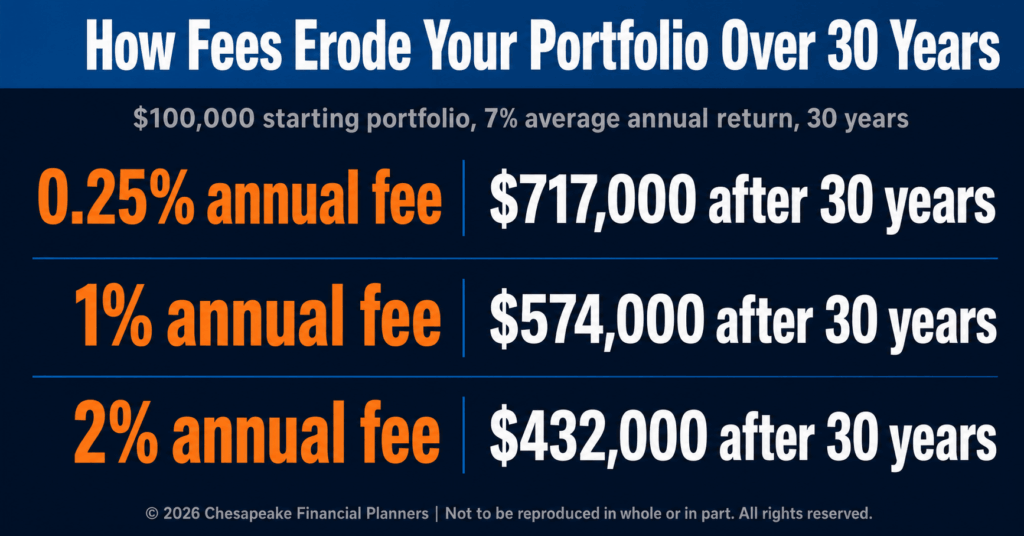
Keep costs low. Fees compound against you the same way returns compound for you. On a $100,000 portfolio earning 7% over 30 years, the difference between a 0.25% fund and a 2% fund can be several hundred thousand dollars. Look for index funds and ETFs with expense ratios under 0.20%.
This disciplined, step-by-step approach mirrors the R.U.D.D.E.R. Method™, Chesapeake Financial Planners' six-step planning process: Review and Recognize, Uncover and Understand, Design and Develop, Discuss and Decide, Execute and Empower, and Reassess and Refine. The same emotional discipline that protects your portfolio also explains why your money values drive better outcomes than your fund picks.
Frequently Asked Questions
How much money do I need to start investing?
You can start investing with very little money today. Many brokerages and 401(k) plans have no minimum, and index funds and ETFs let you buy in with small amounts. The more important number is your contribution rate, not your starting balance, because consistent monthly investing matters far more than the size of your first deposit.
What is compound growth and why does it matter?
Compound growth is earning returns on your previous returns, so your money grows faster over time. A $10,000 investment earning 7% annually becomes roughly $38,700 in 20 years, according to the SEC's compound interest calculator. The longer your money stays invested, the more dramatic the effect, which is why starting early beats trying to invest a large sum later.
Should a beginner invest in individual stocks or funds?
Most beginners should start with low-cost index funds or ETFs rather than individual stocks. A single fund gives you instant diversification across dozens or hundreds of companies, which spreads your risk. Picking individual stocks requires research, time, and a tolerance for concentration risk that most new investors are better off avoiding until they have a solid foundation.
Is it safe to invest when the market is volatile?
Short-term volatility is normal and expected, and it should not stop a long-term investor from starting. Over long holding periods, broad markets have historically recovered from downturns and trended upward. The real danger is selling during a drop and missing the rebound. Staying invested and continuing to contribute through ups and downs is the proven approach.
How do I balance investing with paying off debt?
Generally, capture any 401(k) employer match first, then attack high-interest debt before investing more aggressively. Debt above roughly 6% to 8% interest often costs you more than investments are likely to return, so paying it down is effectively a guaranteed return. Building a cash cushion alongside this keeps you from selling investments in an emergency.
Ready to Build Your Investing Foundation?
Investing basics are simple to understand but easy to delay. The hardest part is starting, and the second hardest is staying the course. If you found this helpful, our Financial Planning Foundations guide walks through accounts, allocation, and first steps in greater depth. Download it at chesapeakefp.com and put your plan in motion this year.
What are the fundamentals of personal financial planning?
How Much Should I Have in My Emergency Fund?
What is the best way to pay off debt quickly?
Why Do Your Money Values Matter More Than Your Investment Choices?
Want to go deeper? Our Why Financial Advice Isn’t Just for Retirees walks through this step by step.
Disclosures
The information provided is for educational purposes only and should not be construed as investment advice. Investment strategies should be tailored to individual circumstances, risk tolerance, and goals. Past performance doesn't guarantee future results. Consult with qualified financial professionals regarding your specific situation.
Contributions to a traditional IRA may be tax deductible in the contribution year, with current income tax due at withdrawal. Withdrawals prior to age 59 ½ may result in a 10% IRS penalty tax in addition to current income tax.
A Roth IRA offers tax deferral on any earnings in the account. Qualified withdrawals of earnings from the account are tax-free. Withdrawals of earnings prior to age 59 ½ or prior to the account being opened for 5 years, whichever is later, may result in a 10% IRS penalty tax. Limitations and restrictions may apply.
Stock investing includes risks, including fluctuating prices and loss of principal.
Bonds are subject to credit, market, and interest rate risk if sold prior to maturity. Bond values will decline as interest rates rise and bonds are subject to availability and change in price.
Bonds are subject to market and interest rate risk if sold prior to maturity. Bond values will decline as interest rates rise. Bonds are subject to availability, change in price, call features and credit risk. The opinions expressed in this material do not necessarily reflect the views of LPL Financial.
Advisors associated with Chesapeake Financial Planners may be either (1) LPL Financial Registered Representatives offering securities through LPL Financial, Member FINRA and SIPC, and investment advisor representatives offering investment advice through Great Valley Advisor Group; or (2) solely investment advisor representatives offering investment advice through Great Valley Advisor Group and not affiliated with LPL Financial. Great Valley Advisor Group, and Chesapeake Financial Planners are separate entities from LPL Financial.


